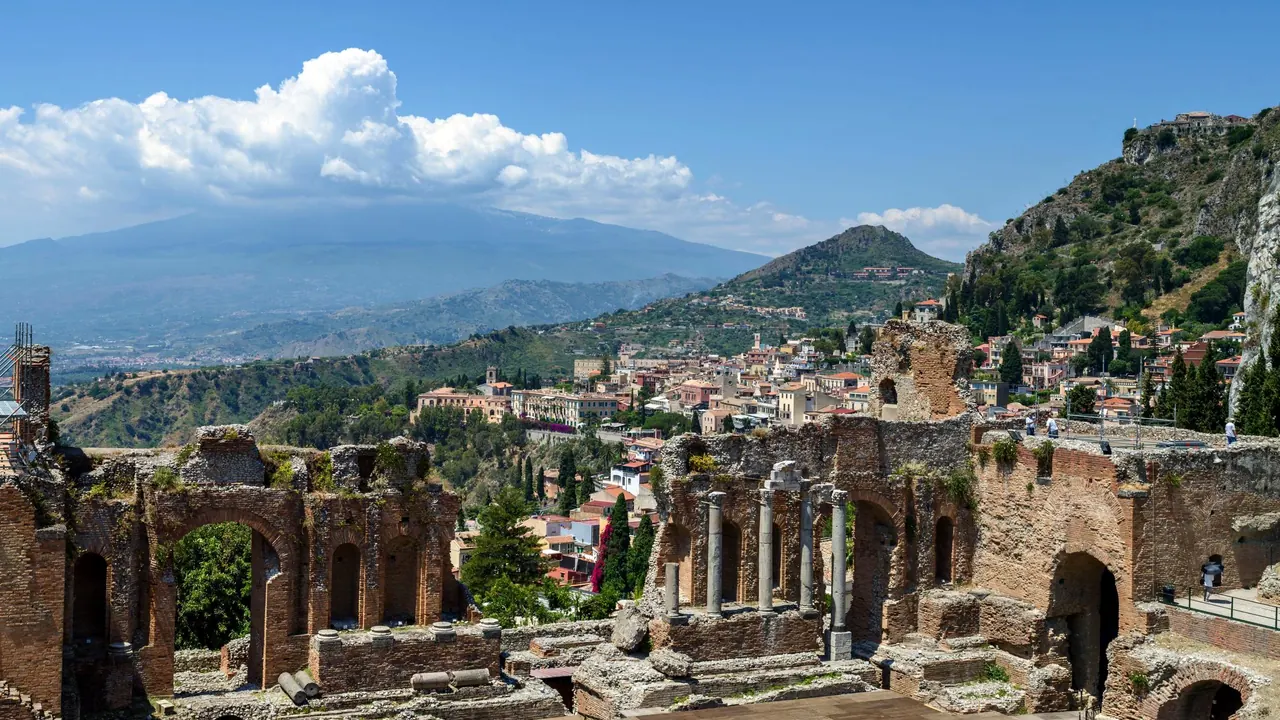
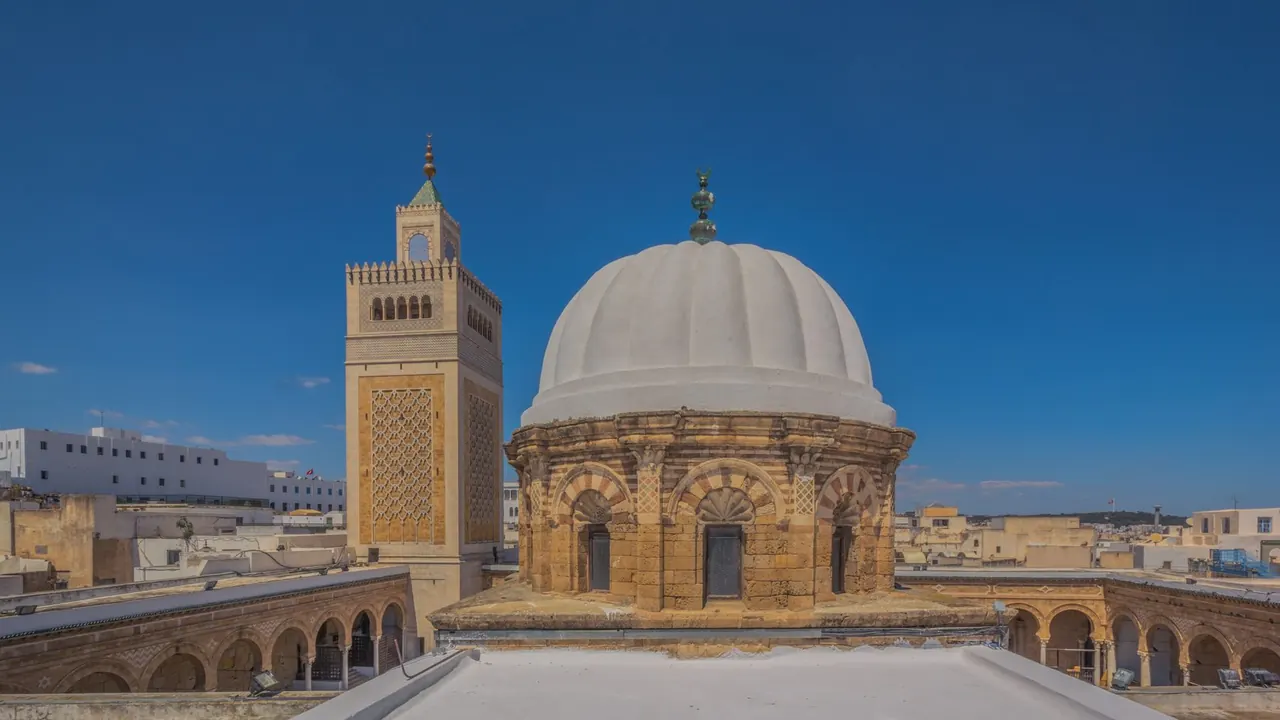
Photos: Taormina by Reinhard Bruckner, Pexels License; Tunis by IssamBarhoumi, CC BY-SA 4.0, cropped.
Taormina or Tunis?
Our verdict in twelve categories, each scored against the same fixed benchmark cities, and the climate month by month, so you can choose for your trip.
Choose Taormina for
- nature and the outdoors
- beaches
- getting around
Taormina suits travellers who want a beautiful setting more than a long list of sights. Etna fills the skyline, the clear coves below town are made for snorkelling, and evenings pass slowly over an aperitivo on a terrace. It works best for couples and walkers who are happy to pay resort prices for the view and the calm.
Choose Tunis for
- prices
- culture and sights
- wellness
Tunis is the better pick for the curious traveller who wants a real capital with layers of history. The medina, the Bardo's mosaics and the ruins of Carthage fill several days, Dougga and Kairouan are within reach, and money goes much further. In return you get a loud, congested city where the beaches are a train ride out to the suburbs.
Scoreboard
Twelve categories on one fixed scale from 0 to 100. The shaded stretch is the gap between the two.
Your match
Pick a travel style or drag the sliders, and both match scores follow your weighting.
Wins on nature and the outdoors and beaches with your weighting.
Wins on prices and culture and sights with your weighting.
What matters to you?
Category by category
What the scores mean for a trip.
Beaches & swimming
The sea is the same temperature at both, so the difference is the beaches themselves, and Taormina comes out ahead. The water at Mazzarò and around Isola Bella is clear and glassy, and the cable car gets you down from town. The catch is that the beaches are narrow pebble strips, full of loungers in summer. For sand you take a short bus ride to Giardini Naxos.
Tunis does have sand, in long stretches at La Marsa and quieter ones at Gammarth, but they are a suburban train ride from the centre, and the water near the port is best avoided. A proper beach day there means the hour's drive to Hammamet.
Food & drink
The two are about equal for food, but they feed you in different ways. In Taormina you sit down. You get pasta alla Norma, raw red prawns and swordfish, there are Etna reds and whites on every list, and there is a serious tier of refined cooking with sea views. Avoid the tourist menus on Corso Umberto.
In Tunis the best eating is on the street and costs little: brik, lablabi for breakfast, fricassé sandwiches and Friday couscous, with the Marché Central and the medina's sweet shops close by. Wine is a side note there, and the seafood in La Goulette is as close as Tunis gets to Taormina's long lunches.
Culture & sights
Tunis gives you far more to see. Its medina is a large, intact old city of souks, madrasas and carved doorways around the Zitouna Mosque. The Bardo holds one of the world's great collections of Roman mosaics, and Carthage and Sidi Bou Said are a short train ride away, enough for several full days.
Taormina has one great sight: the Greek theatre framing Etna and the coast. Add the Duomo, Palazzo Corvaja and the gardens along the Corso and you have seen the town in a day of slow walking.
Nightlife
Neither is a place for a night out, and they are quiet in different ways. In Taormina the evening is an aperitivo in Piazza IX Aprile, a stroll along the Corso and a piano bar over the sea, mostly among couples and older visitors.
Evenings in Tunis centre on cafés, with mint tea and shisha, and they come alive on Ramadan nights. The younger, mixed crowd goes out late on summer weekends in the lounges and beach clubs of La Marsa and Gammarth, a long way from the rough beer bars downtown.
Nature & outdoors
Taormina is far ahead here, because it has Etna. Within about an hour you can walk the Silvestri craters, go up towards the summit with a guide, ski in winter, or follow the Alcantara gorges through basalt columns. Paths climb from town to Castelmola, and the reserve at Isola Bella is good for snorkelling and diving.
Tunis is pleasant rather than dramatic. It has flamingos on the lagoon, short hikes on Bou Kornine and clifftop walks at Sidi Bou Said. The birdlife at Ichkeul is the main reason to go further, but trails and outfitters are scarce.
Day trips
Both make excellent bases for day trips, and the difference is in what you go to see. From Taormina it is Greek and baroque Sicily: Ortigia and the Neapolis quarries at Syracuse, the black lava-stone streets of Catania and, with an early start, the honey-coloured towns of the Val di Noto. Catania and Syracuse are on the coastal railway. The wine villages of Linguaglossa and Randazzo on Etna's northern slopes are easier with a tour or a hired car.
From Tunis it is Roman Africa and the Islamic Maghreb: the theatre and capitol of Dougga on their hillside, the Great Mosque of Kairouan, Punic Kerkouane at the tip of Cap Bon and the walled medinas of Hammamet and Sousse. The furthest of these take about as long to reach as Syracuse does from Taormina. Apart from the train to Sousse, a hired driver or a shared louage is the practical way to get there.
Good for families
Both welcome children warmly, and both are awkward with small ones, for different reasons. In Taormina the trouble is the slope. There are steps everywhere, the beaches are pebbly and many hotels are aimed at couples, though granita, the cable car and a trip up Etna go down well. Families often stay down in Giardini Naxos instead.
In Tunis the trouble is the street. Traffic is heavy and pavements are broken. Belvedere Park, the beaches at La Marsa and the open ruins of Carthage are the easy outings, and many families do better at a beach hotel on the coast with day trips into the city.
Getting around
Taormina is a little easier to get around. Its centre is small and largely pedestrian, with a cable car down to the sea, but the stairs and steep lanes make every outing a climb. Etna and the inland villages realistically need a tour or a hired car.
Tunis is flat in the centre, and its medina and boulevards sit close together. The TGM railway is a simple way out to Carthage, Sidi Bou Said and La Marsa, and taxis are cheap if you insist on the meter. Away from those routes, the chaotic traffic and the summer heat wear you down.
Shopping & style
Tunis is the more rewarding place to shop. The covered souks are still partly arranged by trade, so you can watch chechia caps being made, visit the perfumers by the Zitouna Mosque, and bargain for kilims, brass and leather in the deeper lanes. Nabeul ceramics and Sidi Bou Said birdcages make classic souvenirs.
Shopping in Taormina means one street. Corso Umberto has coral and cameos, lace, Caltagirone majolica and pistachio cream from Bronte. It is good for browsing, but the stock is pitched at visitors, and anything larger means a trip to Catania.
Affordability
This is the widest gap between the two. Taormina is the most expensive place to stay in eastern Sicily. Grand hotels set the tone, rooms in the centre are scarce in summer, and the Corso charges resort prices. Granita and bakery snacks are the cheap pleasures, and staying in Letojanni or Giardini Naxos helps.
In Tunis your money goes a long way. Street food, taxis, train rides and medina guesthouses all cost very little. Only the smart hotels and seafood restaurants of Gammarth and La Marsa come near European prices.
Live music & performing arts
Both have their best performances in summer, in ancient theatres. Taormina's Greek theatre hosts opera, ballet and pop concerts with Etna behind the stage. Out of season there is little beyond piano bars, and serious opera means going to Catania.
Tunis has a little more spread through the year. The Carthage International Festival fills the Roman theatre in summer, and the Carthage theatre and film festivals take over in the cooler months. The Municipal Theatre and the malouf concerts at Ennejma Ezzahra in Sidi Bou Said add a local classical tradition that Taormina has no equivalent of.
Wellness & relaxation
Tunis has the deeper bathing tradition. There is full seawater thalassotherapy at the Gammarth resorts, there are plain, steamy neighbourhood hammams in the medina, and the Roman-era hot springs at Korbous are about an hour away. The city itself is loud, so most of the calm is found at the edges.
In Taormina, wellness means hotel spas with terrace pools and volcanic mud treatments. Most of the rest comes from the pace: shade in the Villa Comunale and Etna changing colour at dusk. It is gentle in May and June, but not when the August crowds fill the Corso.
When should you go?
Pick your month. The climate figures are measured averages, not a forecast.
Taormina in July
Tunis in July
Daytime high, °C
Rainfall in the month, mm
Where the figures come from
Taormina's temperatures are measured 45 km from the centre, at Messina.
Taormina has no rain gauge within 25 km of the centre, so its rainfall comes from a gridded climate dataset read at the city rather than from a gauge further away.
Temperature and rainfall are climate normals, averaged over the years shown. Taormina: 1991-2020 normals, Messina (45.1 km from centre). Tunis: 1991-2020 normals, Tunis-Carthage (6 km from centre).
Taormina is at its best for walking from April to early June, when the days are warm but not hot and the rain has mostly stopped. The sea is warm enough to swim in from June to October and reaches about 26°C in August, when the town peaks at around 31°C. The rain comes back in late September. October is the wettest month, at about 102mm, and November and December are not far behind, so autumn walking there is a gamble.
Tunis has the same sea and the same swimming season, but its summer is hotter. It reaches about 35°C in August, which makes the medina and the open ruins of Carthage hard going at midday. Spring there is as pleasant as in Taormina, and autumn is kinder: October stays warm and is much drier, so it suits Tunis better than Taormina. Tunis is also sunnier in every month, and its winter is a little milder and drier.
Which traveller are you?
On an outdoors trip, Taormina is the clear choice. Etna's lava flows, craters and vineyards are about an hour away, the Alcantara gorges are even closer, and the marine reserve at Isola Bella offers kayaking and diving. Around Tunis the trails are few and fairly tame.
For a culture and arts trip, go to Tunis. Its UNESCO-listed medina, the Roman mosaics in the Bardo and the sites of Carthage give you several days of sightseeing. Taormina has one superb Greek theatre and a short street of palazzi, and it has no major museums.
On a tight budget, Tunis wins easily. Street food, cafés, taxis and medina guesthouses cost very little. Taormina is the most expensive base in eastern Sicily, and even if you stay down in Giardini Naxos it costs much more.
Before you go
| Measure | Taormina | Tunis |
|---|---|---|
| Official language | Italian | Arabic |
| Currency | Euro (EUR) | Tunisian Dinar (TND) |
| Sockets | CFL230 V, 50 Hz | CE230 V, 50 Hz |
| Driving side | Right | Right |
| Time zone | UTC+1, UTC+2 in summer | UTC+1 |
| Emergency number | 112 | Police 197, ambulance 190, fire 198 |
| Elevation | 204 m | 4 m |
| Main airport | Catania-Fontanarossa Airport (CTA)47 km from centre96 non-stop destinations | Tunis Carthage International Airport (TUN)7 km from centre56 non-stop destinations |
| Public holidays this year | 13 days | 8 days |
By the numbers
| Measure | Taormina | Tunis |
|---|---|---|
| City population | 10,471 | 602,560 |
| People per km² | 799 | 2,834 |
| Museums within 10 km | 5 | 16 |
| UNESCO World Heritage sites within 50 km | 2 | 3 |
| Swim season, months above 21 °C | 5 months | 5 months |
Where else could you go?
Every comparison below shares a destination with this one, so you can follow Taormina or Tunis somewhere new.
- Cataniavs Taormina
- Syracuse, Sicilyvs Taormina
- Palermovs Taormina
- Vallettavs Taormina
- Amalfivs Taormina
- Positanovs Taormina