Türkiye
Ankara
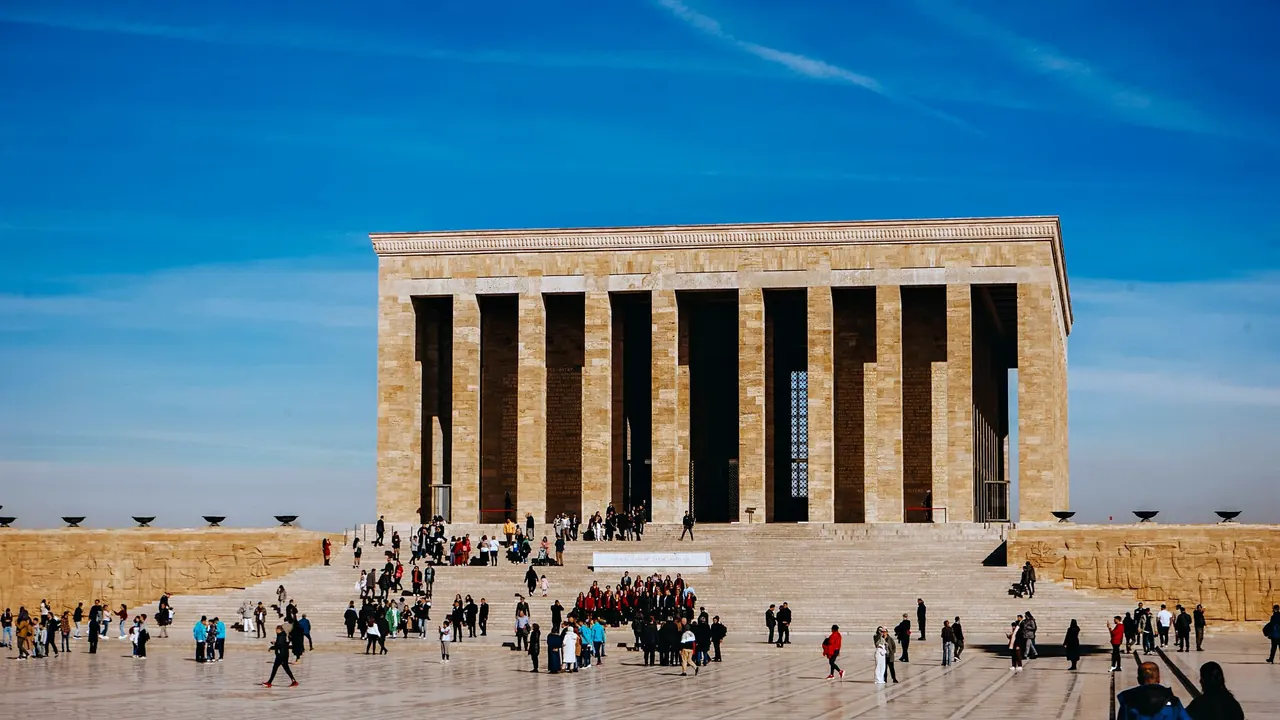
Visitors on the square before Anıtkabir
- Affordable cities73
- Culture & sights60
- Day trips58
Photo: Batuhan Kocabaş, Pexels License
Match
49
Every category weighted equally
- Beach & sun44
- Culture & arts54
- Food & nightlife51
- Family trip48
- Outdoors47
- Relax & unwind46
- Shopping & style51
- On a budget51
Ankara in twelve categories
Our verdict on each, scored 0 to 100 against the same fixed benchmark cities, so a score means the same thing on every page.
Beaches & swimming. Scores 5 out of 100.
Food & drink. Scores 55 out of 100.
Culture & sights. Scores 60 out of 100.
Nightlife. Scores 42 out of 100.
Nature & outdoors. Scores 36 out of 100.
Day trips. Scores 58 out of 100.
Good for families. Scores 48 out of 100.
Getting around. Scores 54 out of 100.
Shopping & style. Scores 46 out of 100.
Affordability. Scores 73 out of 100.
Live music & performing arts. Scores 57 out of 100.
Wellness & relaxation. Scores 48 out of 100.
Ankara category by category
Beaches & swimming
5Ankara is an inland capital on the Anatolian plateau, several hours by road from the nearest coast. Lake Eymir and Lake Mogan on the southern edge are for walking and rowing, not swimming. In summer, swimming means a hotel or municipal pool, and anyone who wants the sea flies or drives to the Aegean or Mediterranean coast as a separate trip.
Food & drink
55Eating in Ankara is honest Turkish cooking without much local signature. The strengths are kebab and pide houses, esnaf lokantası canteens serving stews and vegetable dishes from steam trays, and long, unhurried breakfasts. Ankara tava, a baked dish of lamb and rice, is the city's own contribution. The old streets around Ulus and the castle keep the traditional places, and the restored Ottoman houses of Hamamönü suit tea and simple meals.
The modern side is in Kızılay, Tunalı Hilmi and Çankaya, where diplomats and students support cafés, meyhanes and some upmarket restaurants. It is reliable and good value, but the range is narrow: seafood is limited, street food is modest, and a visitor who travels to eat will find the same handful of dishes done well rather than a scene worth exploring for days.
Culture & sights
60Ankara's sights fit in two or three days, and two of them are excellent. The Museum of Anatolian Civilizations, housed in an Ottoman bedesten below the citadel, follows the peninsula from Neolithic Çatalhöyük through the Hittites and Phrygians, and is one of the finest archaeological collections in the region. Anıtkabir, Atatürk's monumental mausoleum on a hill above the city, is the country's national shrine and shows the Republic's austere architecture at its most deliberate.
Around these are the walled citadel with its old houses, the Temple of Augustus inscribed with the emperor's own account of his reign, the Roman baths, the Hacı Bayram Mosque, the Ethnography Museum and the Rahmi M. Koç Museum in an old caravanserai. Away from Ulus the city is mostly modern and planned.
Nightlife
42Going out in Ankara is driven by students from the city's many universities. The densest scene is in the side streets off Kızılay, where crowded multi-storey buildings hold beer bars, rock bars and meyhanes, and it continues in Tunalı Hilmi and Çankaya, which are more polished and draw an older crowd. Evenings are long and sociable, often built around rakı at dinner. The club scene is small, and the city is not a late or famous party destination. Weekdays in term time are livelier than you might expect, while the summer break and the religious festivals, when many residents leave town, are noticeably quieter.
Nature & outdoors
36Ankara sits on open, treeless steppe, golden in summer and often snowy in winter, and the landscape is more austere than inviting. Within the city, the Atatürk Forest Farm, the lakes of Eymir and Mogan and the ridge parks give space to walk, cycle and row. About an hour north, Soğuksu National Park near Kızılcahamam has pine forest, trails and birds of prey. Elmadağ, just south-east, has a small ski slope in snowy winters, and the vast white flats of Tuz Gölü, with flamingos in spring, are within reach to the south. Serious hiking means travelling much further.
Day trips
58High-speed trains make Ankara a better base than its position suggests. Konya, with the Mevlana Museum and its Seljuk mosques and madrasas, is under two hours by train. Eskişehir, with its painted Ottoman quarter of Odunpazarı and a riverside university-town feel, is about an hour and a half away. By road, the Phrygian capital of Gordion, with King Midas's great burial mound, is a little over an hour west. Beypazarı, a town of whitewashed Ottoman timber houses, is about an hour and a half away.
The Hittite capital of Hattusa makes a long day of it. Safranbolu and Cappadocia are better done with a night away.
Good for families
48Children are welcomed everywhere in Ankara, and families are a normal part of restaurant and park life. Gençlik Parkı and the big green spaces around the lakes give room to run. The MTA Natural History Museum has dinosaur skeletons, and the Rahmi M. Koç Museum fills an old caravanserai with vintage cars, trains and boats that children can climb into. The large malls double as indoor play areas in cold winters and hot summers. On the other hand, there is no major attraction built for children, the central streets are hilly and heavy with traffic, and the main sights suit older children better.
Getting around
54Ankara's core is a north-south axis: the old town and citadel at Ulus, the hub of Kızılay, then Kavaklıdere and Çankaya up the hill. Several metro lines and the Ankaray light rail meet at Kızılay and cover this spine well, and one rechargeable card works on metro and city buses. Beyond that, the city is laid out for cars, with broad boulevards, pedestrian underpasses and steep climbs, and taxis are the practical way to fill the gaps. Walking is pleasant around Ulus and Tunalı Hilmi but not between districts. Esenboğa airport lies well north of the centre and is reached by airport bus or taxi.
Shopping & style
46Shopping in Ankara is mostly modern and practical. The city has many large malls carrying Turkish and international chains, and Tunalı Hilmi and the streets of Kızılay add mid-range boutiques and bookshops. The more characterful shopping is in the old quarter below the citadel, around Samanpazarı and Ulus, where coppersmiths, carpet sellers, spice shops and stalls sell dried fruit, honey and goods made of angora wool, which takes its name from Angora, the city's old name. It is a pleasant afternoon, not a reason to visit.
Affordability
73Ankara is a business and government city rather than a tourist one, and its prices reflect that. Comfortable hotels, canteen meals, kebab houses, metro rides and taxis all cost well below Western European levels, and the city has none of the inflated pricing found where Turkey caters mainly to tourists. The main extra costs are alcohol, which is heavily taxed, international hotel chains in Çankaya and the entrance fees at the major museums. A visitor who eats locally and uses public transport travels cheaply here.
Live music & performing arts
57As the capital, Ankara is home to Türkiye's state performing institutions, and that gives it a fuller formal season than its profile suggests. The State Opera and Ballet performs from the historic opera house near Ulus, the Presidential Symphony Orchestra plays in a large concert hall complex, and the Bilkent Symphony Orchestra adds a strong university programme. The State Theatres stage a broad repertoire, though in Turkish. Tickets are usually easy to get and inexpensive. Live music in the bar streets of Kızılay leans towards Turkish rock and folk, which suits the student crowd. There is little jazz of note.
Wellness & relaxation
48Ankara has an everyday bathing culture rather than a showcase one. A few old neighbourhood hammams still work in the Ulus and Hamamönü quarters, offering the full scrub and foam routine to locals more than tourists, and many hotels add their own Turkish bath. For hot springs, Turks head to Kızılcahamam in the forested hills to the north or to Haymana to the south-west, both about an hour away, where thermal hotels and public pools are built around mineral water. In the city itself the pace is that of a working capital. Tea gardens and the parks around the lakes are the main places to slow down.
When should you go?
Pick a month to see what it is like. The climate figures are measured averages, not a forecast.
Ankara in July
Daytime high, °C
Rainfall in the month, mm
The whole year
Shaded against this city’s own year: the deepest cell is its best month for that figure and the palest its weakest.
Temperature and rainfall are climate normals, averaged over the years shown. Ankara: 1991-2020 normals, Ankara / Central (4.1 km from centre).
Before you go
| Measure | Ankara |
|---|---|
| Official language | Turkish |
| Currency | Turkish Lira (TRY) |
| Sockets | CF230 V, 50 Hz |
| Driving side | Right |
| Time zone | UTC+3 |
| Emergency number | 112 |
| Elevation | 938 m |
| Main airport | Esenboğa International Airport (ESB)25 km from centre92 non-stop destinations |
| Public holidays this year | 14 days |
By the numbers
| Measure | Ankara |
|---|---|
| City population | 5,803,482 |
| Museums within 10 km | 51 |
| UNESCO World Heritage sites within 50 km | 0 |
Compare Ankara with
Every comparison with a written verdict behind it.