Uzbekistan
Tashkent
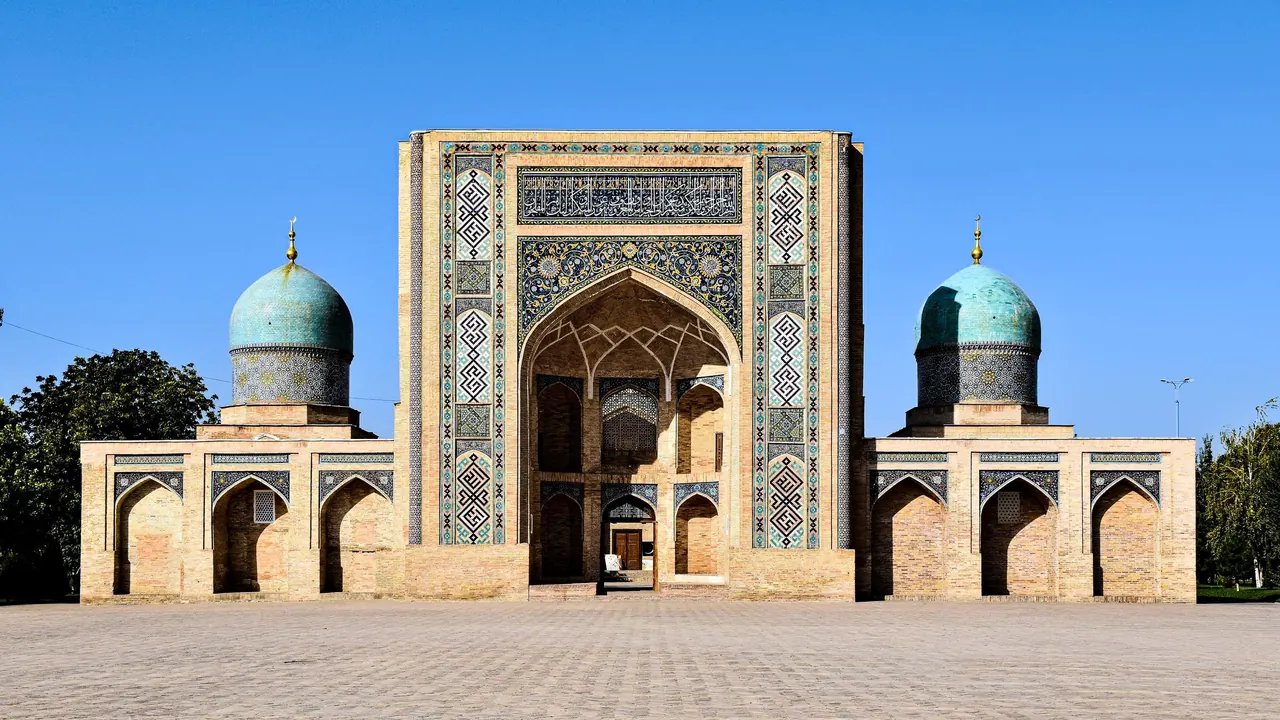
The Barak Khan madrasa at the Hazrati Imam complex
- Affordable cities80
- Food & drink58
- Nature & outdoors58
Photo: AXP Photography, Pexels License
Match
48
Every category weighted equally
- Beach & sun45
- Culture & arts52
- Food & nightlife49
- Family trip50
- Outdoors50
- Relax & unwind46
- Shopping & style49
- On a budget52
Tashkent in twelve categories
Our verdict on each, scored 0 to 100 against the same fixed benchmark cities, so a score means the same thing on every page.
Beaches & swimming. Scores 13 out of 100.
Food & drink. Scores 58 out of 100.
Culture & sights. Scores 52 out of 100.
Nightlife. Scores 30 out of 100.
Nature & outdoors. Scores 58 out of 100.
Day trips. Scores 52 out of 100.
Good for families. Scores 47 out of 100.
Getting around. Scores 57 out of 100.
Shopping & style. Scores 43 out of 100.
Affordability. Scores 80 out of 100.
Live music & performing arts. Scores 55 out of 100.
Wellness & relaxation. Scores 33 out of 100.
Tashkent category by category
Beaches & swimming
13Tashkent lies in one of the only two doubly landlocked countries in the world, so there is no sea anywhere near it. In the city, swimming means hotel pools and the big outdoor water parks that fill up during the long, hot summer.
The nearest real bathing is at the Charvak reservoir, about 80km north-east in the foothills. It takes roughly an hour and a half by car. Locals head there in July and August for pebbly shores, lakeside resorts and cool, clear mountain water. It makes a good escape from the heat, but it is a day out and not the reason for coming.
Food & drink
58Eating in Tashkent revolves around plov, the rice, carrot and mutton dish cooked in huge cauldrons over open fires. It is a midday meal, served from great communal kitchens that are often sold out by early afternoon. Around it you find tandir-baked samsa, hand-pulled lagman noodles, shashlik smoked over charcoal and round, stamped non bread, which is treated almost as sacred. Chorsu Bazaar, under its green dome, is the place to see it all: dried fruit, nuts, spices, kurt cheese balls and halls of bread and meat.
Tea houses with raised platforms under the trees are where meals stretch out. The range is narrow, though. The cooking is heavy on meat and fat, vegetarians struggle, and the wine and fine-dining scene is small.
Culture & sights
52Much of old Tashkent was lost in the earthquake of 1966, and the city was rebuilt as a Soviet capital of broad avenues, monumental squares and bold modernist buildings. Heritage survives in pockets. The Hazrat Imam complex in the old town holds mosques, a madrasa and a library that keeps one of the oldest surviving Qurans. Nearby stands the brick Kukeldash Madrasa above Chorsu.
The Museum of Applied Arts, set in a merchant's house with carved and painted rooms, is the most charming of the museums. The State Museum of History and the Amir Timur Museum fill in the background. The metro is a sight in its own right, with chandeliers, mosaics and themed stations. It is a rewarding two or three days, but not a city of great monuments.
Nightlife
30Going out in Tashkent is low-key. There are pubs, beer gardens, a few lounge and cocktail bars and some clubs, mostly near the centre and around Amir Timur Square. Karaoke and long restaurant dinners with friends matter more than dancing. Summer evenings are the best time, when people stay out in parks and on terraces after the heat breaks.
The atmosphere is relaxed and secular, but most places wind down around midnight. Visitors who want a real night out will find a handful of options rather than a scene.
Nature & outdoors
58The city itself sits on a hot, flat oasis plain, and its green space is limited to tree-lined avenues, the Botanical Garden and a few large parks. The landscape opens up to the north-east. Within about an hour and a half by road, the western Tian Shan rises into the Chimgan range and the Ugam-Chatkal National Park, where Big Chimgan reaches 3,309 m above the turquoise Charvak reservoir.
In summer there is ridge hiking, walnut and juniper valleys, horse riding and paragliding. In winter there is skiing at the mountain resorts of Chimgan and Amirsoy. Spring, when the foothills turn green and are covered in tulips, is the loveliest season. Midsummer in the city is too hot for much outdoor activity.
Day trips
52One trip dominates everything else: Samarkand, with the Registan, the Gur-e-Amir and the Shah-i-Zinda necropolis. It is just over two hours away by high-speed train. Many visitors do it as a long day, though it rewards an overnight stay.
Beyond Samarkand the choice is thin. Bukhara, Khiva and the Fergana Valley craft towns are too far for a day and are better treated as stops on a wider route. Closer to the city, the outings are to the mountains and the reservoir, not to other towns.
Good for families
47Uzbek culture is warm towards children, and families with small children are fussed over in restaurants and on the metro. The city has a large zoo, the Botanical Garden, fairy-tale amusement parks, water parks for the summer and big landscaped parks where local families gather in the evening.
The drawbacks are physical. Summer days often pass 35°C, sights are spread out along wide avenues that are slow to cross, and the main cultural sights hold little for children. Spring and autumn are much easier, and cheap taxis take a lot of the strain out of getting around.
Getting around
57Tashkent is a city of very wide avenues and long blocks, built on a Soviet scale, so walking between sights takes time and is hard work in summer heat. The metro helps. Its lines are clear, trains are frequent and stations are easy to navigate once you know the Cyrillic and Latin names. Several sights, including the old town and the main squares, lie close to stations.
App-based taxis are cheap and widely used by visitors to fill the gaps, and a car is never needed. Pavements are generally good in the centre but patchier in the outer districts.
Shopping & style
43The bazaars are the shopping worth doing here. Chorsu sells spices, dried fruit and everyday goods, and its surrounding stalls offer embroidered suzani, ikat silk and cotton, Rishtan blue ceramics, skullcaps and knives. The craft workshops in the old madrasas sell similar pieces, though much of the finest work is made in the Fergana Valley, Bukhara and Samarkand and costs less at the source.
Modern shopping is mostly malls with international chain stores. There are few independent designers and almost no luxury retail.
Affordability
80Tashkent is a very inexpensive city for a visitor. Plov and bazaar meals, bread and tea cost very little, metro rides and app taxis are cheap, and museum entry and opera tickets are modest.
Accommodation is the main exception. International business hotels in the capital are priced well above everything else, but simple guesthouses and mid-range hotels keep a stay cheap by any international standard.
Live music & performing arts
55The cultural centrepiece is the Alisher Navoi Theatre. This grand opera and ballet house was built after the Second World War with halls decorated in the styles of different Uzbek regions, and it stages a repertory of classic ballets and operas through most of the season. Tickets are easy to get, and an evening there is one of the city's pleasures.
The conservatory and philharmonic halls offer classical concerts. The city also has a long-standing independent theatre tradition and a drama scene performed mainly in Russian and Uzbek. Traditional music and dance, from maqom singing to folk ensembles, turn up at concerts and festivals. Jazz and live rock are limited to a few small venues.
Wellness & relaxation
33Tashkent has old neighbourhood bathhouses in the hammam tradition and a few spa complexes, but bathing is not part of a visit the way it is elsewhere in the Islamic world. Most visitors who want a spa use hotel facilities.
The gentler side of the city is its pace in the shade. Long afternoons on a tea-house platform, quiet walks in the Botanical Garden and leafy parks all slow things down. For a real retreat, locals head to the mountain sanatoria and resorts around Chimgan.
When should you go?
Pick a month to see what it is like. The climate figures are measured averages, not a forecast.
Tashkent in July
Daytime high, °C
Rainfall in the month, mm
The whole year
Shaded against this city’s own year: the deepest cell is its best month for that figure and the palest its weakest.
Temperature and rainfall are climate normals, averaged over the years shown. Tashkent: 1991-2020 normals, Tashkent (5.1 km from centre).
Before you go
| Measure | Tashkent |
|---|---|
| Official language | Uzbek |
| Currency | Uzbekistan Sum (UZS) |
| Sockets | CFI220 V, 50 Hz |
| Driving side | Right |
| Time zone | UTC+5 |
| Emergency number | 112 |
| Elevation | 455 m |
| Main airport | Tashkent International Airport (TAS)6 km from centre112 non-stop destinations |
By the numbers
| Measure | Tashkent |
|---|---|
| City population | 2,956,384 |
| People per km² | 8,830 |
| Museums within 10 km | 27 |
| UNESCO World Heritage sites within 50 km | 1 |
Compare Tashkent with
Every comparison with a written verdict behind it.