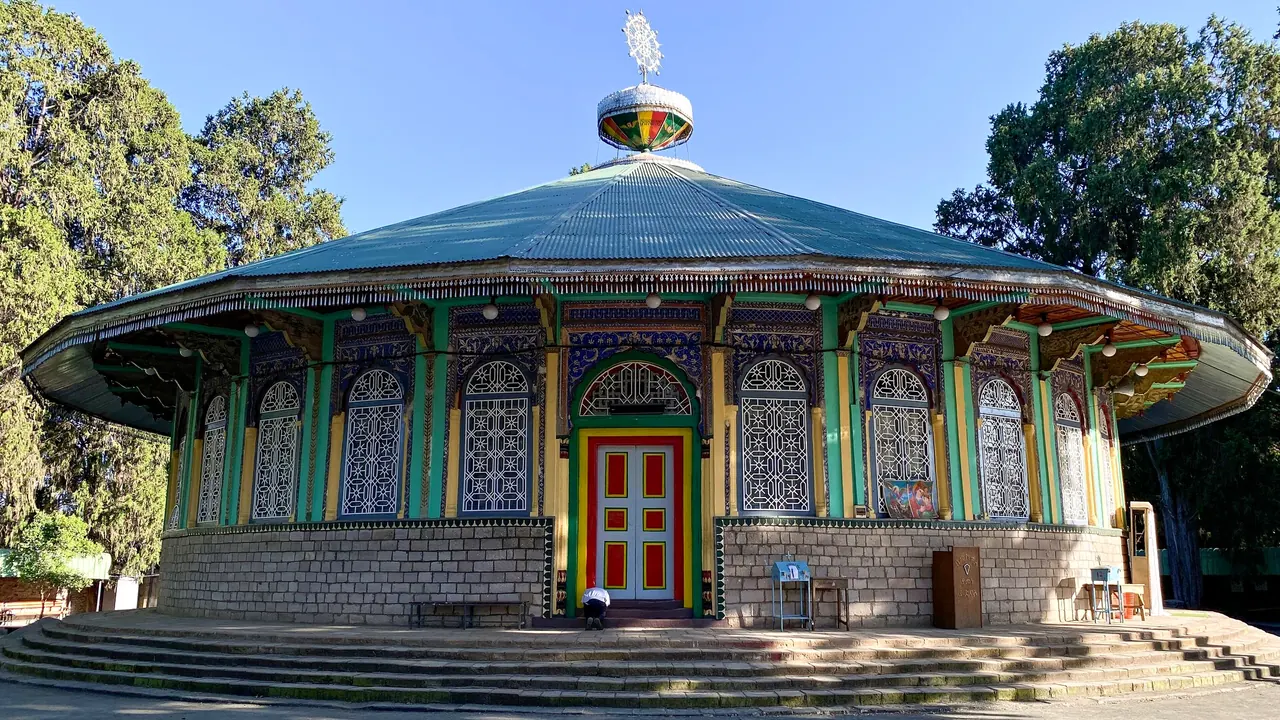

Photos: Addis Ababa by ProtoplasmaKid, CC BY 4.0, cropped; Nairobi by Lmwangi, CC BY-SA 3.0, cropped.
Addis Ababa or Nairobi?
Our verdict in twelve categories, each scored against the same fixed benchmark cities, and the climate month by month, so you can choose for your trip.
Choose Addis Ababa for
- live music and the arts
- prices
- food and drink
Addis Ababa suits the traveller who wants to eat, listen and learn. Injera platters and the coffee ceremony, evenings with azmari singers and Ethio-jazz, and museums running from Lucy to the Derg years give it more to do in town than Nairobi. Local life also costs very little. It works best for adults happy with a few days in the city before flying north to Lalibela or Gondar.
Choose Nairobi for
- nature and the outdoors
- families
- nightlife
Wildlife is the reason to pick Nairobi. A real safari starts at the city's southern edge, the Rift Valley is a couple of hours away, and the giraffe and elephant orphanages make it far easier to visit with children. Its nights out in Westlands are livelier too. The trade-off is that its sights and kitchens are thinner, and sightseeing costs more.
Scoreboard
Twelve categories on one fixed scale from 0 to 100. The shaded stretch is the gap between the two.
Your match
Pick a travel style or drag the sliders, and both match scores follow your weighting.
Too close to call, 2 points apart
Wins on live music and the arts and prices with your weighting.
Wins on nature and the outdoors and families with your weighting.
What matters to you?
Category by category
What the scores mean for a trip.
Beaches & swimming
Neither city has a beach, and in both swimming means a hotel pool. The difference is how far the nearest water is. From Addis Ababa, the crater lakes at Bishoftu are about an hour away for a lakeside resort weekend. From Nairobi, beach time means a flight or a long train ride to the Kenyan coast, so it has to be a separate leg of the trip.
Food & drink
Addis Ababa has the more distinctive food. Shared platters of injera with doro wat, tibs and kitfo, vegan dishes on fasting days, tej served in flasks and the coffee ceremony, in the country where coffee comes from, make eating a reason to come.
Nairobi's food is heartier and more social than special: nyama choma around the grill on long weekend afternoons, and chapati and pilau from roadside kiosks. Its advantage is range, with strong Indian cooking and a big café scene in Westlands and Karen. Addis rarely goes beyond Ethiopian and Italian cooking.
Culture & sights
Both are young capitals with no old quarter, but Addis Ababa has more to fill the days. Lucy in the National Museum, the Ethnological Museum in Haile Selassie's former palace, the emperor's tomb at Holy Trinity, Menelik's palace compound and the Entoto churches together tell the story of an empire.
Nairobi, which began as a railway depot in 1899, has its own fossil galleries in the National Museum and the Karen Blixen farmhouse. After that come a few colonial buildings and the view from the convention centre roof, and most visitors are soon off to see the animals.
Nightlife
Nairobi has the bigger night out. From Thursday on, the rooftop bars and clubs of Westlands play amapiano and gengetone until dawn, and Kilimani adds quieter cocktail bars. Plan on ride-hailing door to door, as walking between areas after dark is not safe.
In Addis Ababa, the lounges of Bole and the rougher local bars of Kazanchis and Piazza fill up mainly on Friday and Saturday, and weeknights are quiet.
Nature & outdoors
Nairobi wins this clearly. Lions, rhinos and giraffes graze in Nairobi National Park at the city's southern edge, with Karura Forest and the Ngong Hills close by. Within two hours you can cycle through Hell's Gate, take a boat among the hippos on Lake Naivasha or hike the rim of Mount Longonot.
The outdoors around Addis Ababa is gentler: eucalyptus trails on Entoto, colobus monkeys in the Menagesha Suba forest, birdwatching at Bishoftu and geladas along the Blue Nile gorge near Debre Libanos. Its truly wild places, the Simien and Bale mountains, are far beyond a day out.
Day trips
Addis Ababa has the better spread of outings, most of them historic. To the north are the monastery of Debre Libanos and the Portuguese Bridge. To the south are the Tiya stelae, the rock-hewn church of Adadi Mariam and Melka Kunture. All are reached on slow roads, usually with a hired driver.
Outside the national parks, Nairobi has fewer places to visit: the Limuru tea estates for a half-day and the stone hand axes at Olorgesailie. Kenya's heritage towns, Mombasa and Lamu, are on the coast and too far for a day trip.
Good for families
Nairobi is much the stronger choice for children. Feeding giraffes at the Giraffe Centre, watching baby elephants being bottle-fed at the Sheldrick orphanage and a morning game drive make for days Addis Ababa can't match, especially if you stay in Karen or Langata.
Addis Ababa welcomes children warmly but has little for them beyond the palace park with its lions, the Entoto hills and hotel pools, and the altitude tires small children for the first few days. It suits a stopover with older children better than a whole family vacation.
Getting around
Neither city is easy, and in both visitors mostly use ride-hailing or a hired driver, but Addis Ababa is a little less tiring. Its light rail at least crosses the city, even though it misses most sights, and the traffic is slow mainly at rush hour.
Nairobi's congestion is among the worst in Africa. With the giraffes and orphanage in Karen and Langata and the nightlife in Westlands, a short trip can take an hour. The matatus are fun to look at but hard to use, and few areas have pavements.
Shopping & style
Both are craft and market cities with no luxury streets, but shopping feels different in each. In Addis Ababa it means Merkato, a vast, disorienting open-air market best explored with someone who knows it, plus handwoven cotton shawls from Shiro Meda and Orthodox crosses around Piazza.
Nairobi is easier going. The Maasai Market, which moves around the city, sells beadwork and soapstone, workshops in Karen let you watch glass and ceramics being made, and Westlands and Gigiri have secure malls. In either city, coffee is the natural gift to bring home.
Affordability
Addis Ababa is the cheaper of the two. Injera, macchiatos, minibus rides and museum entries cost little, and only international-standard hotels and the restaurants of Bole push the bill up.
Nairobi has the same gap between cheap local life and expensive secure hotels. It also adds higher park fees for foreigners and the cost of a vehicle for game drives, so a stay built around wildlife costs noticeably more.
Live music & performing arts
Addis Ababa's music is the bigger draw. Azmari singers in Kazanchis and Piazza improvise verses about their audience, Ethio-jazz, born here in the 1960s and 70s, is played live in a handful of clubs, and cultural restaurants put on eskista dancing over dinner.
Nairobi has good bands playing benga, rumba and jazz on weekend evenings and traditional dance shows at Bomas of Kenya. Its plays in English and Swahili are easier for a visitor to follow than the mostly Amharic programme at Hager Fikir. Neither city has opera.
Wellness & relaxation
Addis Ababa comes out slightly ahead, because it has a bathing habit of its own. The city was founded beside the Filwoha hot springs, and their mineral water still feeds plain private bath cubicles near the centre, where residents go for their health. It is a simple soak rather than a pampering spa day, but Nairobi has nothing like it. Beyond that, winding down in Addis means a hotel spa, an unhurried coffee ceremony or a walk up into Entoto, away from the noise.
Nairobi has no springs, so its wellness is limited to hotel spas and a few day spas, and its centre is just as noisy and jammed. Where it makes up ground is in the leafy suburbs of Karen and Langata. A garden hotel or an old cottage there, with cool, fresh mornings at this altitude, keeps the city at a distance. Many people treat Nairobi as a staging post and leave the real rest for later, out in the bush or on the coast.
When should you go?
Pick your month. The climate figures are measured averages, not a forecast.
Addis Ababa in July
Nairobi in July
Daytime high, °C
Rainfall in the month, mm
Temperature and rainfall are climate normals, averaged over the years shown. Addis Ababa: 1991-2020 normals, Addis Ababa (7.8 km from centre). Nairobi: 1991-2020 normals, Nairobi ACC/FIC/RCC/MET/COM/ (13.3 km from centre).
Addis Ababa has one long wet season. Rain builds from June and peaks in July and August at close to 300mm, with grey skies, so the time to go is the dry, bright stretch from October to February. December is the sunniest month of all. Daytime highs stay in the low to mid twenties all year, so it is never too hot for walking the streets.
Nairobi gets its rain in two seasons: the long rains of April and May, and the short rains, which peak in November at around 128mm. June to September is its driest spell, the reverse of Addis Ababa, though these months are often overcast. January and February are fairly dry and sunny, with highs near 28°C. Neither city is a beach destination in any month.
Which traveller are you?
On an outdoors trip, Nairobi is the obvious pick. Game drives in the national park start at the city's edge, Karura Forest and the Ngong Hills are close by, and Hell's Gate, Lake Naivasha and Mount Longonot each make a day out.
For a culture and arts trip, Addis Ababa gives you more. Lucy, the imperial palaces and the cathedrals fill two or three days, and the evenings go to azmari singers and live Ethio-jazz. Nairobi's smaller museum and dance shows can't match that.
On a family trip with children, Nairobi is far better prepared. Feeding giraffes, watching orphaned elephants at bottle time and a short safari will keep children busy, while Addis Ababa has little for them beyond the palace park and hotel pools.
Before you go
| Measure | Addis Ababa | Nairobi |
|---|---|---|
| Official language | Amharic | English, Swahili |
| Currency | Ethiopian Birr (ETB) | Kenyan Shilling (KES) |
| Sockets | CEFJL220 V, 50 Hz | G240 V, 50 Hz |
| Driving side | Right | Left |
| Time zone | UTC+3 | UTC+3 |
| Emergency number | 911 | Police 112/999, ambulance 112/999, fire 112/999 |
| Elevation | 2,355 m | 1,661 m |
| Main airport | Addis Ababa Bole International Airport (ADD)8 km from centre137 non-stop destinations | Jomo Kenyatta International Airport (NBO)13 km from centre60 non-stop destinations |
| Public holidays this year | 10 days | 10 days |
By the numbers
| Measure | Addis Ababa | Nairobi |
|---|---|---|
| City population | 5,704,000 | 5,545,000 |
| People per km² | 10,824 | 7,967 |
| Museums within 10 km | 7 | 4 |
| UNESCO World Heritage sites within 50 km | 1 | 0 |
Where else could you go?
Every comparison below shares a destination with this one, so you can follow Addis Ababa or Nairobi somewhere new.
- Arushavs Nairobi
- Mombasavs Nairobi
- Stone Townvs Nairobi
- Kigalivs Nairobi
- Arushavs Addis Ababa
- Kigalivs Addis Ababa