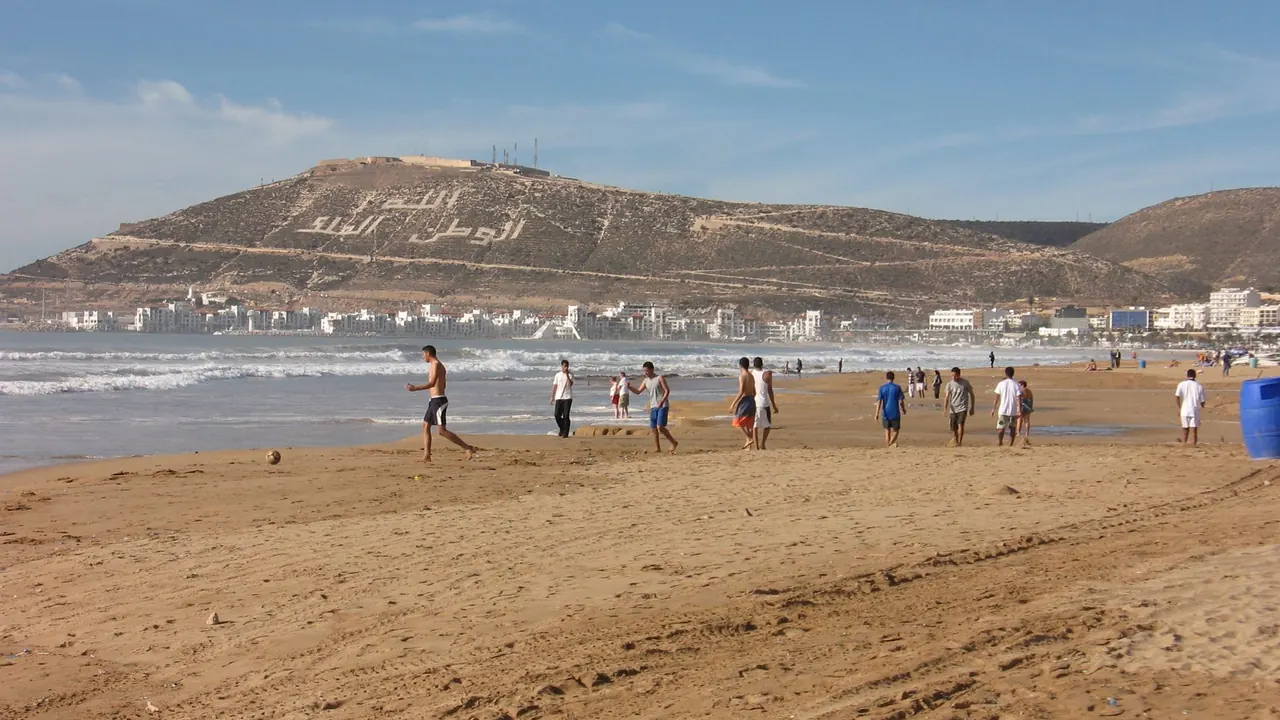
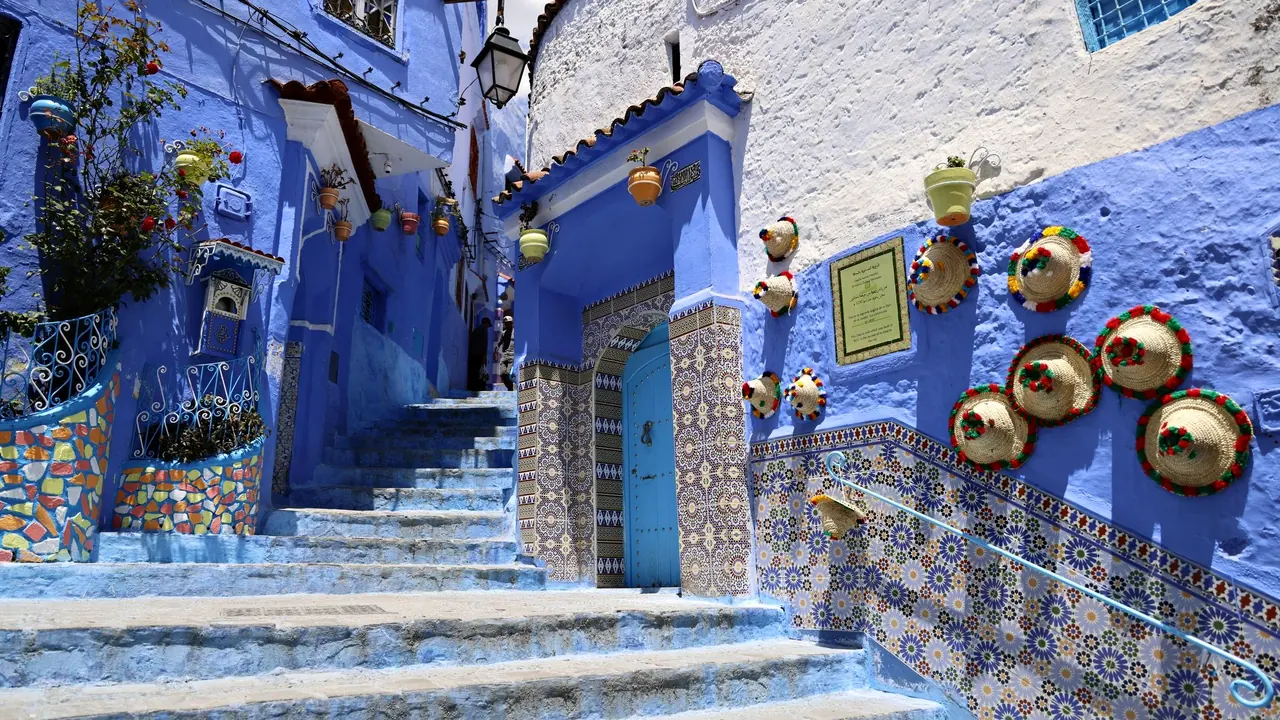
Photos: Agadir by michiel1972, CC BY-SA 3.0, cropped; Chefchaouen by Christophe RASCLE, Pexels License.
Agadir or Chefchaouen?
Our verdict in twelve categories, each scored against the same fixed benchmark cities, and the climate month by month, so you can choose for your trip.
Choose Agadir for
- beaches
- nightlife
- families
Agadir is the pick for a week of sun and sand, especially in winter when much of Europe is grey. A long sheltered bay, resort hotels with pools and spas, a flat promenade for buggies and enough bars for a couple of late nights make it the easier choice for families. It also suits anyone whose idea of rest involves a sunlounger.
Choose Chefchaouen for
- culture and sights
- prices
- getting around
Travellers who would rather walk than swim will be happier in Chefchaouen. Its blue medina, founded by refugees from Andalusia, holds more history in a few lanes than the whole of rebuilt Agadir. The Rif mountains begin at the town walls, and rooms and meals cost less. Evenings are silent and alcohol is scarce, so it rewards a quiet two or three days, ideally as one stop on a route through northern Morocco.
Scoreboard
Twelve categories on one fixed scale from 0 to 100. The shaded stretch is the gap between the two.
Your match
Pick a travel style or drag the sliders, and both match scores follow your weighting.
Wins on beaches and nightlife with your weighting.
Wins on culture and sights and prices with your weighting.
What matters to you?
Category by category
What the scores mean for a trip.
Beaches & swimming
Agadir is a beach destination first. Its crescent of sand runs for nearly 10km around a sheltered bay that is calm enough for easy swimming, and the surf beaches of Taghazout and Tamraght are half an hour to the north. The Atlantic stays cool, but the steady sun makes the beach work even in winter.
Chefchaouen has no beach of its own. The grey-sand Mediterranean shore at Oued Laou lies over an hour away down a winding gorge road. The river pools at Akchour are a cold dip rather than a swim, so the sea is a day out at best.
Food & drink
Neither town is a reason to travel for food, but Agadir gives you more to work with. Sardines grilled at the fishing port, Souss flavours such as argan oil and amlou, and the piled-up produce of Souk El Had beat anything on Chefchaouen's menus. A beer or a glass of wine is also easier to find in its hotels and licensed restaurants.
Around Outa el-Hammam, Chefchaouen's restaurants serve much the same tagines and kefta one after another. The rewards are small and local: Rif goat cheese wrapped in palm leaf, bissara for breakfast and bread from the communal ovens.
Culture & sights
Here Chefchaouen comes out ahead. The whole medina is the attraction. It was founded in 1471 and settled by refugees from Andalusia, and you get blue-washed stairways, the red kasbah on Outa el-Hammam and the sunset view from the Spanish Mosque. It is small and seen in a day or two, but it is genuinely old.
Agadir lost its old town in the 1960 earthquake and was rebuilt as a modern, planned city. The kasbah walls on Agadir Oufella, the Medina Polizzi craft village and a small Amazigh museum fill a day, and the view from the hill is the main reward.
Nightlife
Agadir at least offers a night out. It has hotel bars, a few clubs, lounges by the marina and beach clubs with music at sunset, all running late in summer, though it is resort nightlife with no local bar scene. Chefchaouen has almost nothing. Only a couple of hotel bars serve alcohol, and evenings end with mint tea in the square and a walk through silent lanes.
Nature & outdoors
Both are strong for the outdoors, in very different landscapes. Agadir's are coast and dry plain: the point breaks of Taghazout and Imsouane, the palm gorge of Paradise Valley, argan trees with climbing goats, and the birdlife of Souss-Massa National Park, including the rare northern bald ibis.
Chefchaouen means mountain walking. Trails leave straight from the Ras el-Maa spring into the Rif, and Talassemtane National Park has the gorge walk to God's Bridge, cedar forests and Barbary macaques. Paths are poorly marked, so a guide helps. Surfers should pick Agadir and hikers Chefchaouen.
Day trips
Agadir's best outing is Taroudant, about an hour and a half inland, where long ochre ramparts enclose souks far calmer than those of the big cities. Tiznit, the walled silver town to the south, makes a second full day, and the surf villages of Taghazout and Imsouane are easy half days. That gives Agadir a slightly wider choice.
From Chefchaouen the obvious trip is Tetouan, about an hour and a quarter away. Its UNESCO-listed medina is larger than Chefchaouen's and far less visited, and the coast at Martil lies just beyond. After that both lists run thin. Marrakech from Agadir, and Fes or Tangier from Chefchaouen, are about three hours away or more, so they work better as the next stop on a route than as a return trip in a day.
Good for families
With children, Agadir is much easier. It has a gentle sandy bay, a flat promenade for buggies, and all-inclusive hotels with pools and kids' clubs. The crocodile park and the Vallée des Oiseaux make a change from the beach.
Chefchaouen is welcoming, but it is built for adults on foot. Steep, stepped lanes rule out pushchairs, there is little for children to do beyond the pools at Akchour, and the hashish offers in the lanes are awkward with a family in tow. It works best as a short stop with older children.
Getting around
Agadir's flat promenade is easy to walk from the hotels to the marina, but the city behind it is spread out. You need a petit taxi to reach the souk, the port or the kasbah hill, so agree the fare or ask for the meter first. For Paradise Valley or the surf coast you need a grand taxi, a tour or a hire car.
Chefchaouen is simpler once you are there, because you can cross the medina on foot in about fifteen minutes. Nearly every route involves steep stairs and polished steps, though, which is hard work with luggage. There is no railway. Tetouan is the nearby link by bus or taxi, while getting there from Tangier or Fes is a long road journey.
Shopping & style
Shopping is modest in both, and the difference is mainly in kind. Agadir has one huge working market, Souk El Had, where locals buy their produce among the carpets and leather. The best things to take home are argan oil and cosmetics from the Souss cooperatives, and Amazigh silver.
Chefchaouen sells crafts made close by: Rif blankets and striped weavings, often woven on looms in the shopfront, as well as djellabas, baskets and bottles of blue pigment. Sellers push less than in the big souks, but the range repeats after a few lanes.
Affordability
Both are cheap by European standards, and Chefchaouen is cheaper. Simple riads and guesthouses cost little, the medina is free to wander, and even the restaurants on the main square stay modest. Agadir is good value away from the seafront, where fish at the port and petit taxis cost little and off-season packages can be a bargain. The promenade strip, alcohol and room rates in the school breaks push the cost of a stay up.
Live music & performing arts
Neither is a place to plan evenings around live performance. Agadir has the edge thanks to Timitar, the long-running summer festival of Amazigh music with large free stages. The rest of the year it offers hotel entertainment and folk shows. In Chefchaouen there is only occasional Andalusian music around festivals, and the call to prayer over the rooftops is most of what visitors hear.
Wellness & relaxation
Agadir is better equipped for pampering. Its resort hotels have hammams with black-soap scrubs and argan-oil massages, thalassotherapy centres line the bay, and there are yoga and surf retreats up the coast.
In Chefchaouen, rest is simpler. Cool mountain air, roof terraces and the sound of water at the spring slow the days down, and the neighbourhood hammams give a cheap, authentic scrub. Spa treatments, though, are limited to a handful of riads.
When should you go?
Pick your month. The climate figures are measured averages, not a forecast.
Agadir in July
Chefchaouen in July
Daytime high, °C
Rainfall in the month, mm
Where the figures come from
Chefchaouen has no weather station within reach, so its figures come from a gridded climate model rather than a measured record, and read a broad area rather than the city itself.
Temperature and rainfall are climate normals, averaged over the years shown. Agadir: 1945-2025, 15 years observed (sunshine 1981-2010, rainfall 1981-2010) normals, Agadir (4.5 km from centre). Chefchaouen: 2001-2020 normals, NASA POWER reanalysis grid, no weather station within 90 km.
Agadir barely changes through the year. Daytime highs run from about 21°C in January to 28°C in August, it is almost completely dry from May to September, and the light winter rain rarely spoils a day. The sun shines generously in every month, so the beach works year-round. The one limit is the Atlantic, which stays cool and peaks at around 20°C in late summer.
Chefchaouen swings between extremes. Winter is cold and very wet, and November is the wettest month with around 141mm of rain. In July and August highs reach 35°C, which makes the steep lanes hard going, although the sea at Oued Laou is at its warmest then. For walking the medina and the hills, April, May and September are the best months. For a winter escape Agadir wins easily. In late spring and early autumn both are pleasant, for very different trips.
Which traveller are you?
For a beach and sun trip, Agadir is the only real choice. Its long, sheltered bay of fine sand, dependable sunshine even in winter and resort hotels with pools put swimming at the centre of each day. Chefchaouen's nearest beach is over an hour away.
On a culture and arts trip, Chefchaouen gives you more to see in a short stay. Its fifteenth-century blue medina, red kasbah and Andalusian roots reward slow wandering. Rebuilt Agadir offers a view from its hilltop kasbah and a small museum. Neither has much live performance.
On a tight budget, Chefchaouen makes money go further. Guesthouses are cheap, the medina costs nothing to explore and shared taxis reach the valleys for little. Agadir can be good value too, but seafront prices and the cost of alcohol add up faster.
Before you go
| Measure | Agadir | Chefchaouen |
|---|---|---|
| Official language | Arabic, Standard Moroccan Tamazight | Arabic, Standard Moroccan Tamazight |
| Currency | Moroccan Dirham (MAD) | Moroccan Dirham (MAD) |
| Sockets | CE50 Hz | CE50 Hz |
| Driving side | Right | Right |
| Time zone | UTC+1 | UTC+1 |
| Emergency number | Police 19/112, ambulance 15, fire 15 | Police 19/112, ambulance 15, fire 15 |
| Elevation | 74 m | 564 m |
| Main airport | Al Massira Airport (AGA)20 km from centre75 non-stop destinations | Tangier Ibn Battuta Airport (TNG)86 km from centre50 non-stop destinations |
| Public holidays this year | 11 days | 11 days |
By the numbers
| Measure | Agadir | Chefchaouen |
|---|---|---|
| City population | 538,000 | 46,168 |
| People per km² | - | 2,998 |
| Museums within 10 km | 1 | 1 |
| UNESCO World Heritage sites within 50 km | 0 | 1 |
| Swim season, months above 21 °C | None | 3 months |
Where else could you go?
Every comparison below shares a destination with this one, so you can follow Agadir or Chefchaouen somewhere new.
- Tangiervs Chefchaouen
- Essaouiravs Agadir
- Fesvs Chefchaouen
- Rabatvs Chefchaouen
- Marrakechvs Agadir
- Casablancavs Chefchaouen