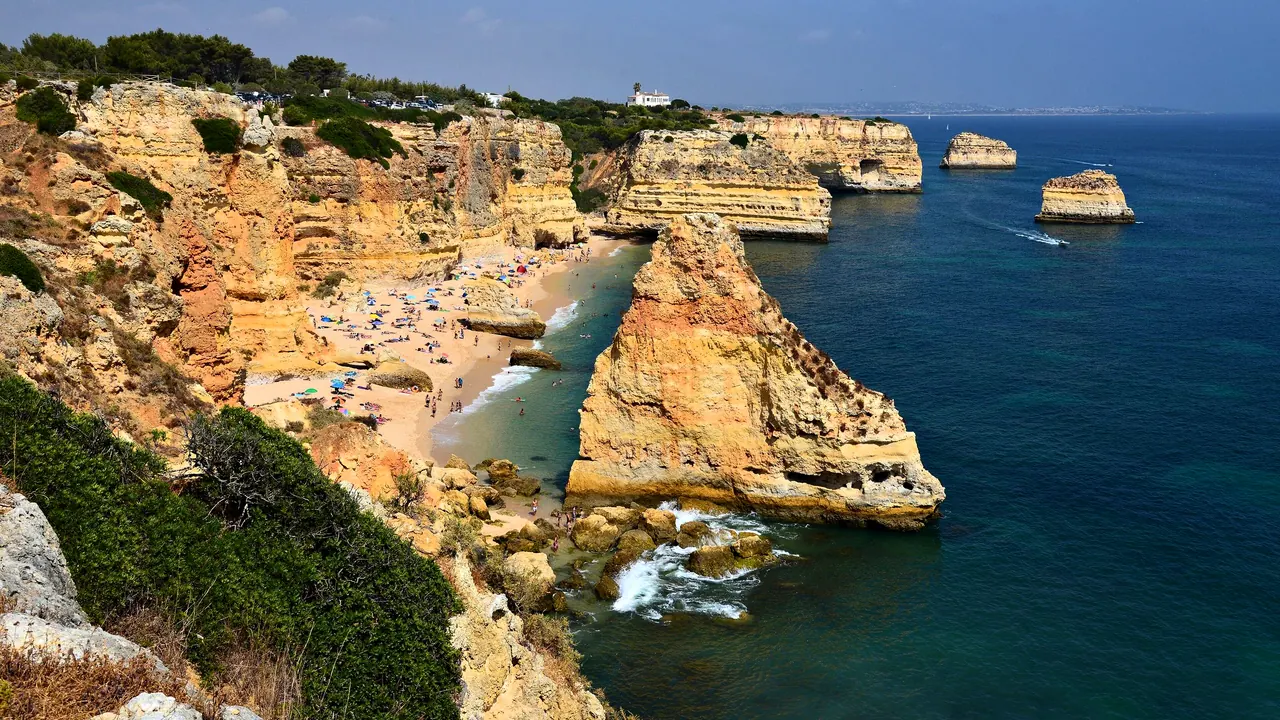
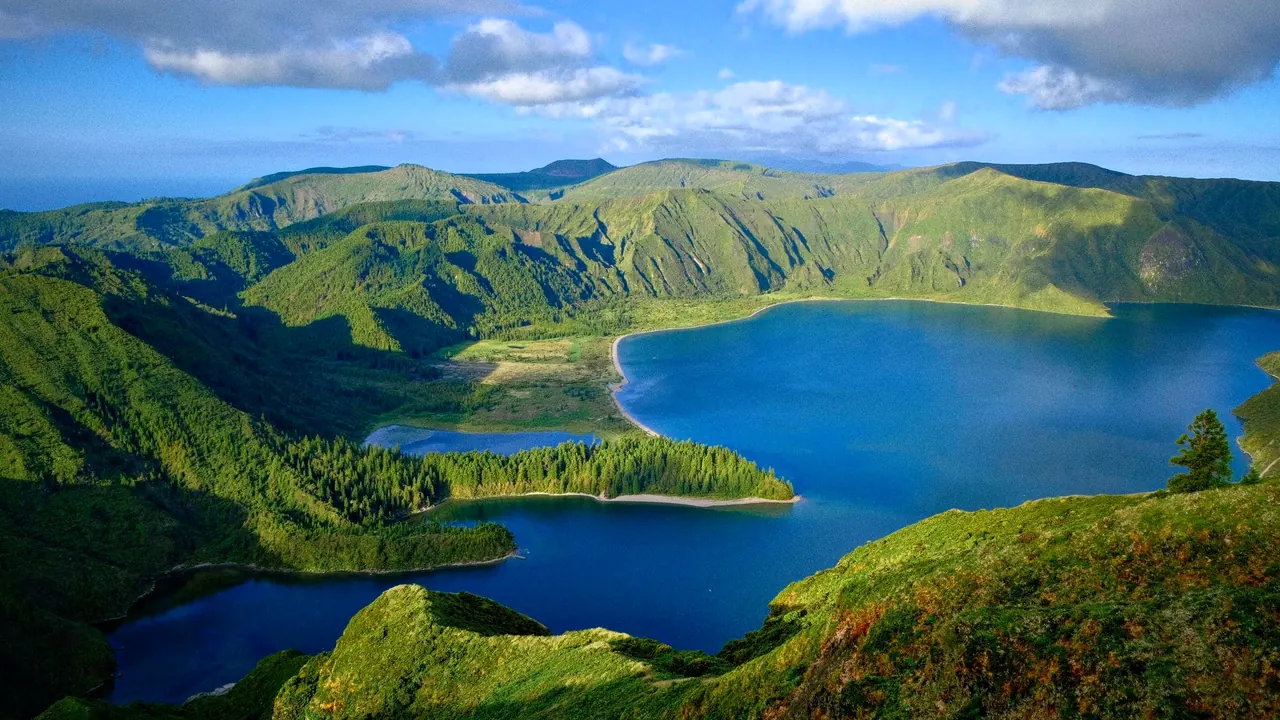
Photos: Algarve by Tobi 87, CC BY-SA 3.0, cropped; Azores by Leonardo Barucci, Pexels License.
Algarve or Azores?
Our verdict in twelve categories, each scored against the same fixed benchmark cities, and the climate month by month, so you can choose for your trip.
Choose Algarve for
- beaches
- nightlife
- families
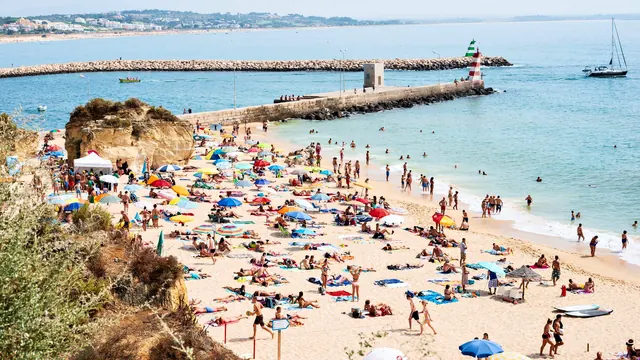
The Algarve suits a trip where the beach is the plan. Its coast offers sandy coves under ochre cliffs between Lagos and Albufeira and long, quiet strands on the Ria Formosa islands, with a dry, reliably sunny summer. Water parks, resort nightlife and an easy drive to Seville give it more to fill the days, which makes it the safer pick for families and groups.
Choose Azores for
- wellness
- nature and the outdoors
- prices
Choose the Azores if you care more about the landscape than the sand. Crater lakes, the steaming Furnas valley, the climb up Pico and sperm whales offshore all year make this an outdoors trip first, and soaking in warm springs in the forest makes it a deeply restful one. In return you accept changeable weather, very quiet evenings and flights between islands.
Scoreboard
Twelve categories on one fixed scale from 0 to 100. The shaded stretch is the gap between the two.
Your match
Pick a travel style or drag the sliders, and both match scores follow your weighting.
Wins on beaches and nightlife with your weighting.
Wins on wellness and nature and the outdoors with your weighting.
What matters to you?
Category by category
What the scores mean for a trip.
Beaches & swimming
The Algarve wins this clearly. You can choose between the photogenic coves under ochre cliffs and sea stacks around Praia da Marinha and Lagos, or the long, empty sand of Ilha de Tavira and Culatra behind the Ria Formosa, where the water is gentler. The only downside is the crowds in the famous coves in high summer.
The Azores give you black volcanic sand, concrete-edged sea pools at Caloura and Biscoitos, and surf beaches on São Miguel's north coast. Santa Maria is the exception, with pale sand, but swell and cloud mean beach time fits around other plans.
Food & drink
Both are good, and both are built on fish and simple cooking, but the flavours differ. The Algarve is about the sea: sardines grilled over charcoal, clams in a copper cataplana and the market halls of Olhão, plus a few ambitious resort kitchens near Almancil. Avoid the English-menu grills on the resort strips.
The Azores lean more on the land. There is cozido cooked in the hot ground at Furnas, alcatra braised in clay on Terceira, sharp São Jorge cheese, mineral Pico wine and tea from the north coast of São Miguel. Outside Ponta Delgada and Angra the choice is narrower.
Culture & sights
Neither is a culture trip, and they come out about level. The difference is in how the sights are spread. The Algarve's are a string of pleasant old towns along one coast, Silves with its red castle, Tavira, walled Faro and Lagos, and the Sagres headland, all easy to fit around beach days.
The Azores have one standout, the World Heritage grid of Angra do Heroísmo, as well as Pico's walled vineyards and Terceira's painted impérios. To see them all you have to take flights between islands.
Nightlife
The Algarve has a real summer scene. Albufeira's Strip has bars and clubs that stay open until dawn, Lagos has a younger crowd in the lanes of its old town, and Praia da Rocha has clubs on the beach. Vilamoura's marina is dressier. Outside June to September it all quietens down.
In the Azores most nights end after dinner, apart from a few bars in Ponta Delgada and the sailors' harbour bars in Horta. The exception is the summer festas on Terceira, which fill the streets.
Nature & outdoors
Both are outdoor places, but the Azores are wilder and more varied. There are the crater lakes of Sete Cidades and Lagoa do Fogo, the fumaroles at Furnas, the 2,351m climb up Pico and the lava tube of Algar do Carvão. At sea there are resident sperm whales and manta rays off Santa Maria, though mist often hides the views.
The Algarve's nature is mostly its coast: the Seven Hanging Valleys path, kayaking into the Benagil grottoes, surf and cliffs in the Costa Vicentina, and flamingos in the Ria Formosa. It is easier going and drier, but it has less drama.
Day trips
The Algarve has more good outings. Seville is about two hours away by car, walled Mértola is an hour north, you can take a boat out to Culatra, and towns such as Silves and Loulé are close by, although the choice runs out after about a week.
In the Azores, a day out on one island usually means landscape and small towns such as Ribeira Grande and Furnas. Real day trips by ferry only work in the central group, from Faial over to Pico or São Jorge.
Good for families
The Algarve is far easier with children. It has shallow water and wide sand on the lagoon islands and at Alvor, water parks inland from Albufeira, Zoomarine near Guia, and villas and resorts with pools and kids' clubs. Avoid the stair-access coves and the midday heat of August.
The Azores offer memorable outdoor moments, such as whale trips, warm pools at Furnas and lunch lifted out of the ground. Beyond a science centre and a small aquarium, though, little is made for children, and winding roads and sudden rain make the days harder work.
Getting around
You will want a hire car in both, but the Algarve is simpler. It is one coastline joined by the A22, so Lagos to Tavira takes about an hour, and a slow railway and compact old towns make a car-free stay possible if you accept fewer beaches.
The Azores work well on any single island with a car, as São Miguel is only about 65km long. Combining islands means flights or seasonal ferries, and Atlantic weather can cancel either.
Shopping & style
The Algarve has more to offer here, though it is still no shopping trip. There is Loulé's market hall with cork, copper and almonds, ceramics near Porches and sea salt from Castro Marim, plus malls, an outlet centre and marina boutiques.
The Azores mostly sell food and crafts to take home, such as São Jorge cheese, tea, pineapple liqueur and scrimshaw. Ponta Delgada is the only place with much choice.
Affordability
The Azores come out a little cheaper. Village meals are generous, local wine and cheese cost little, and the crater lakes and trails are free. The extras add up fast, though: a hire car you cannot do without, whale trips and flights between islands.
In the Algarve eating out is good value too, but rooms and villas are expensive in July and August, especially in the golf areas around Almancil. Basing yourself in Tavira or Olhão keeps costs moderate.
Live music & performing arts
Both are thin on live performance. What there is follows the summer calendar rather than a theatre season. The Algarve has open-air events such as the world music festival in Loulé's old town and medieval fairs in Silves and Castro Marim, and its fado nights are staged mainly for tourists.
The Azores have more living tradition: parish brass bands at processions, folk dances at village festas and Angra's autumn jazz festival.
Wellness & relaxation
The Azores offer something the Algarve cannot. Volcanic springs feed the warm pool at Terra Nostra in Furnas, the forest waterfall at Caldeira Velha and the hot ocean inlet at Ponta da Ferraria, and quiet roads and early nights do the rest.
Relaxation in the Algarve means resort spas between Albufeira and Quinta do Lago, the old spring village of Caldas de Monchique and yoga retreats near Aljezur. Tavira and the west coast are calm, but the central resorts in August are not.
When should you go?
Pick your month. The climate figures are measured averages, not a forecast.
Algarve in July
Azores in July
Daytime high, °C
Rainfall in the month, mm
Where the figures come from
Algarve's temperatures are measured 26 km from the centre, at Faro / Aeroporto.
Algarve has no rain gauge within 25 km of the centre, so its rainfall comes from a gridded climate dataset read at the destination rather than from a gauge further away.
Temperature and rainfall are climate normals, averaged over the years shown. Algarve: 1991-2020 normals, Faro / Aeroporto (26.4 km from centre). Azores: 1991-2020 normals, Ponta Delgada / Nordela Acores (2.3 km from centre).
Along the Algarve coast summer is long, hot and almost rainless. From June to August there is barely any rain, highs reach 29°C in July and August, and it is one of the sunniest places in Europe. The sea at the point where the climate is measured only reaches about 20°C, so swimming is cool but comfortable from June to October, and warmer in the east. Midsummer is too hot for long walks, so May and late September to October are the better months for the cliff paths and towns. The rain comes in from October, and December is the wettest month, though winters stay mild.
On São Miguel, where most visitors stay, the climate is gentler and wetter. It is never cold and rarely hot, with highs that only reach 26°C in August. The sea is actually warmer than the Algarve's in late summer, at about 23°C in August and September. July is the driest month, but showers can fall in any month, and from October to March the islands are properly wet, with about 170mm in December. June to September is the season for both walking and swimming. The Algarve has the more reliable sun, but in high summer the Azores are more comfortable for hiking.
Which traveller are you?
For a beach and sun trip, the Algarve is the clear choice. The summer is long and dry, the sand is soft, and there is a different beach for every day. In the Azores, a swim is something you fit in between walks and showers.
On a relaxing and wellness trip, the Azores pull ahead. Bathing outdoors in naturally warm water is part of island life, and the quiet green days slow you down. In the Algarve you only get that calm away from the resorts in summer.
On a family trip with young children, the Algarve is much less work. Easy beaches, attractions built for children and family-sized places to stay are all close together on one coast. The Azores suit older children who enjoy boats and walks, but expect wet days and winding drives.
Before you go
| Measure | Algarve | Azores |
|---|---|---|
| Official language | Portuguese | Portuguese |
| Currency | Euro (EUR) | Euro (EUR) |
| Sockets | CF230 V, 50 Hz | CF230 V, 50 Hz |
| Driving side | Right | Right |
| Time zone | UTC, UTC+1 in summer | UTC-1, UTC in summer |
| Emergency number | 112 | 112 |
| Main airport | Faro - Gago Coutinho International Airport (FAO)91 non-stop destinations | João Paulo II Airport (PDL)25 non-stop destinations |
| Public holidays this year | 14 days | 15 days |
By the numbers
| Measure | Algarve | Azores |
|---|---|---|
| Population | 438,864 | 236,440 |
| People per km² | 88 | 102 |
| Swim season, months above 21 °C | None | 4 months |
Where else could you go?
Every comparison below shares a destination with this one, so you can follow Algarve or Azores somewhere new.
- Alentejovs Algarve
- Lisbonvs Algarve
- Andalusiavs Algarve
- Cascaisvs Algarve
- Costa del Solvs Algarve
- Douro Valleyvs Algarve