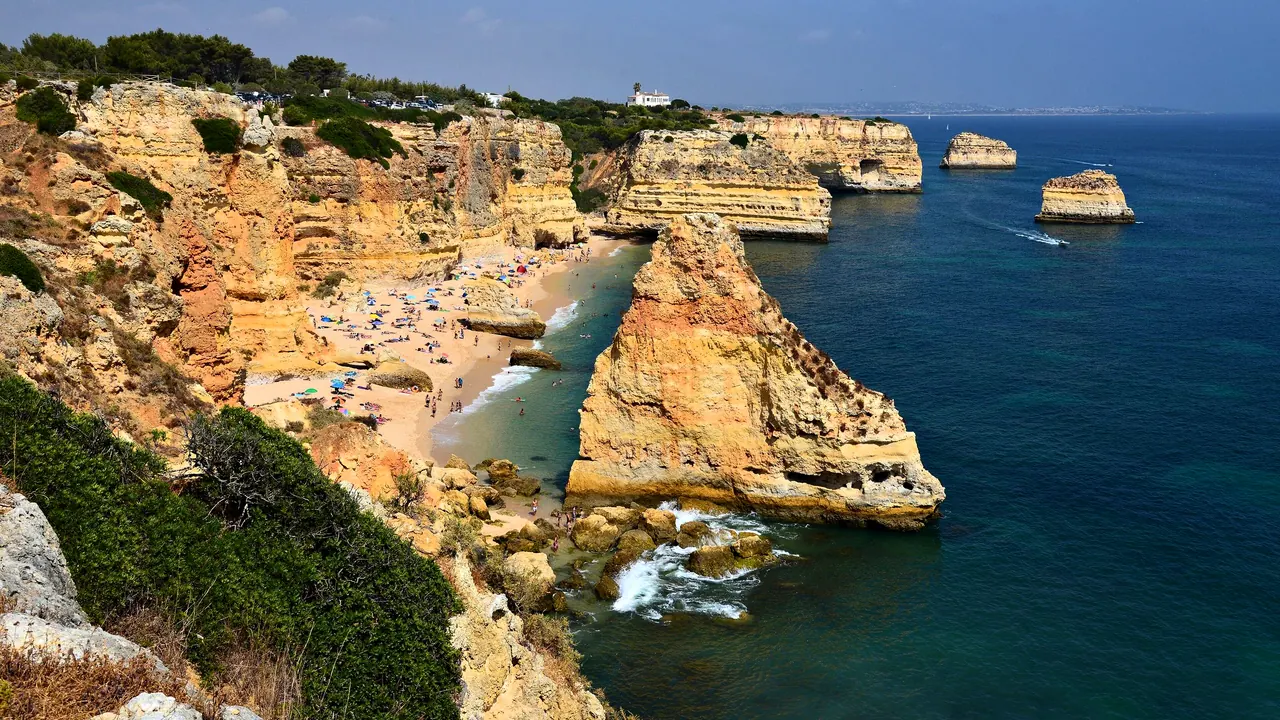
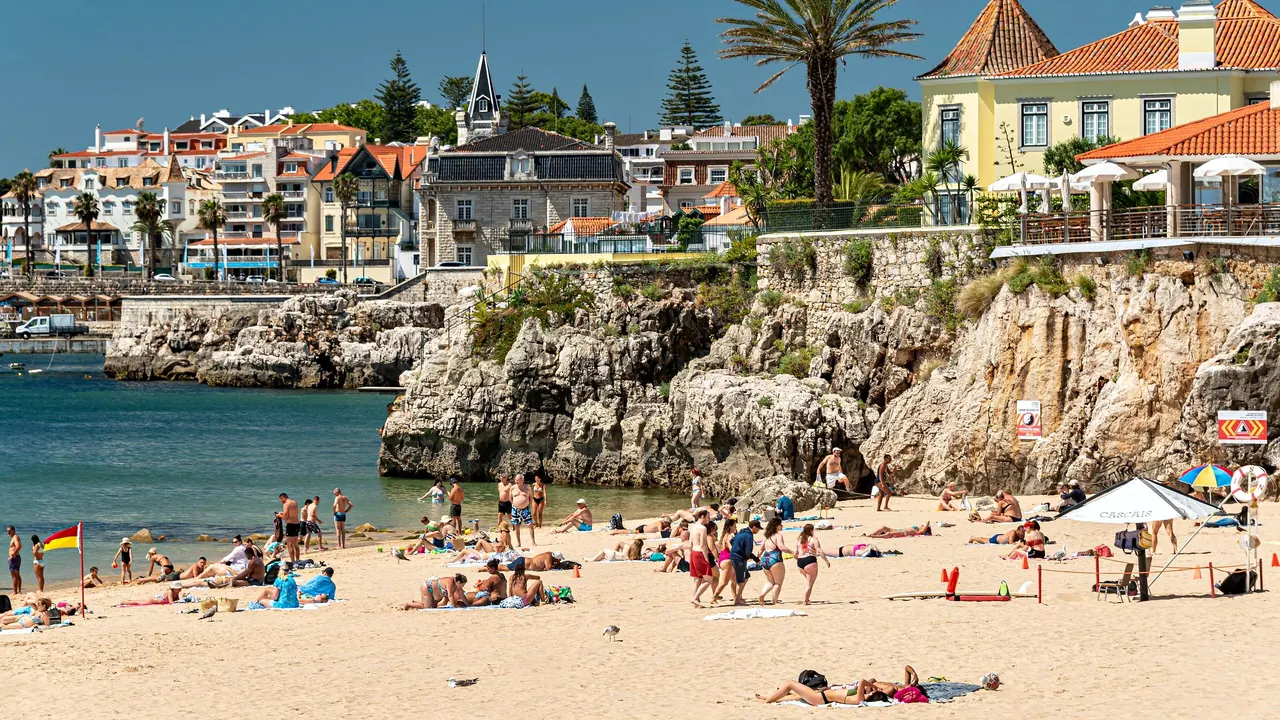
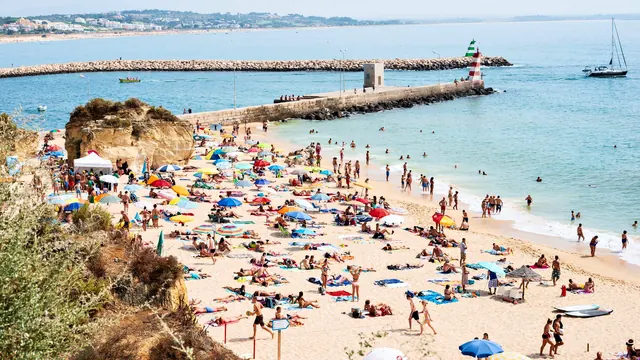
Photos: Algarve by Tobi 87, CC BY-SA 3.0, cropped; Cascais by Jorge Franganillo, CC BY 2.0, cropped.
Algarve or Cascais?
Our verdict in twelve categories, each scored against the same fixed benchmark cities, and the climate month by month, so you can choose for your trip.
Choose Algarve for
- beaches
- nightlife
- families
The Algarve is for a sun-and-sea week with the beach at its centre. It has the warmer water and the wider choice of sand, from the cliff coves around Lagos to the empty lagoon islands off Tavira, and more to keep children busy. Its fish grills are better and its summer nights are livelier. You will want a car, and you give up easy access to any great city. Families, couples after long beach days and groups who want to go out late will get more from it.
Choose Cascais for
- day trips
- getting around
- live music and the arts
Cascais makes more sense when the coast is the backdrop rather than the whole trip. It is a compact, walkable resort town with a train straight into Lisbon and Sintra's palaces over the hill, so the beach becomes a swim between outings. It costs more to stay in and the sea is cooler, but you can see a lot without hiring a car. Travellers who want a coastal base for exploring Portugal's capital region will prefer it.
Scoreboard
Twelve categories on one fixed scale from 0 to 100. The shaded stretch is the gap between the two.
Your match
Pick a travel style or drag the sliders, and both match scores follow your weighting.
Wins on beaches and nightlife with your weighting.
Wins on day trips and getting around with your weighting.
What matters to you?
Category by category
What the scores mean for a trip.
Beaches & swimming
The Algarve is the stronger beach destination by some way. It has the ochre cliff coves between Lagos and Albufeira, such as Marinha and Dona Ana, and long, quiet sand on the Ria Formosa islands of Culatra and Barril. In late summer the east coast's water is a few degrees warmer than anything Cascais offers.
Cascais has its convenience. The coves of Conceição and Rainha sit right under the town and the bay is calm, but the sea stays cool and the season is short. Guincho is for watching the surf, not for swimming.
Food & drink
Both cook mainly fish, but the Algarve has more depth. Olhão's market halls, the fishing quarters of Tavira and Portimão, goose barnacles from the west coast and medronho from the hills give it variety, and a handful of high-end kitchens sit near Almancil.
Cascais does the grilled fish and seafood platter well, especially at the long lunch places along the Guincho road. Beyond that the choice is narrow, and the best eating is a train ride away in Lisbon.
Culture & sights
Neither is a place for great monuments, though the Algarve has a bit more of its own. It has Silves's red Moorish castle, Faro's walled old town, the Roman ruins at Milreu and the headland at Sagres, spread along the coast.
Cascais is more compact and more modern in character. Its sights are royal-era seaside villas, the Citadel and Paula Rego's red-towered museum, and you can see them all in a day's stroll. The real draw is Lisbon and Sintra nearby.
Nightlife
The Algarve has a proper summer night scene. It runs from Albufeira's neon Strip to backpacker bars in Lagos and the beach clubs of Praia da Rocha, with the smarter crowd at Vilamoura's marina. Outside June to September it goes quiet.
Cascais keeps to wine bars, pubs and cocktail terraces in a few old-town lanes, with the Estoril casino if you want to dress up. Anyone after a late night takes the train to Lisbon and has to plan the ride back.
Nature & outdoors
Both are strong outdoors, and the difference is in the kind of landscape. The Algarve has the more varied coast. You can walk the Seven Hanging Valleys trail above sea caves, kayak into the Benagil grottoes, follow the Rota Vicentina along the wild west and watch flamingos on the Ria Formosa saltpans.
Cascais packs its wild country closer together. Boca do Inferno, the Guincho cycle path and the cliffs at Cabo da Roca are all near town, and the misty forests of the Serra de Sintra are just inland. Guincho's steady wind also makes it a centre for kitesurfing and windsurfing.
Day trips
Cascais is the far better base for days out. Lisbon and Belém are a short train ride away, Sintra's palaces are about half an hour over the ridge, and Mafra, Ericeira, Óbidos and Setúbal's wine country are all within easy driving.
The Algarve has fewer outings. Seville is the big one, about two hours from the east, and there are also Mértola, the border villages on the Guadiana and the car-free islands off Olhão. After a week the choice starts to run out.
Good for families
The Algarve is better set up for children. It has shallow lagoon beaches, water parks near Albufeira and Lagoa, Zoomarine's dolphin shows and villas with pools all along the coast. Avoid the cove beaches with steep stairs, and plan around the midday heat in high summer.
Cascais is calm, safe and easy with small children. The flat promenade suits pushchairs and the park has peacocks and a playground. It has no attractions built for children, though, and the cold sea may put young swimmers off.
Getting around
In Cascais a car is optional. The harbour, coves and promenade are all close together, and the coastal train runs straight to central Lisbon. A car only helps if you want to explore the hills and the wilder coast.
On the Algarve most visitors hire one. The A22 links Lagos and Tavira in about an hour, but the train is slow and the buses rarely reach the beaches. Staying car-free works only if you settle in Lagos, Tavira or Faro and accept fewer beaches.
Shopping & style
Neither is a shopping destination, so the difference is in what you browse. On the Algarve it is produce and crafts: Loulé's Moorish-style market, the painted ceramics around Porches and sea salt from Castro Marim, with malls and an outlet centre for practical buying. Cascais has a single compact old town of surf brands, small boutiques, tiles and tinned fish, and Lisbon is close by when you want more.
Affordability
The Algarve is the cheaper of the two. Simple fish meals and car hire are good value, and a base in Tavira or Olhão keeps rooms reasonable, though the villas and the golf enclaves near Almancil can be expensive.
Cascais is an upmarket town with a wealthy local population, and its seafront hotels and promenade restaurants charge accordingly. Back-street cafés and set lunches help, and the train needs no rental car. Coming outside July and August saves more here than anywhere else in the budget.
Live music & performing arts
Both are thin on live arts, and Cascais has slightly more going on, mostly because of Lisbon. It has a long-running theatre company in Estoril, casino shows and a summer jazz tradition, and the capital's opera and fado are close. The Algarve has modest municipal theatres in Faro and Loulé, summer festivals and staged fado in restaurants.
Wellness & relaxation
The two are much alike here, and both rely mainly on hotel spas. The Algarve has the older healing tradition at Caldas de Monchique's Roman-era springs, plus surf and yoga retreats near Aljezur. In Cascais the slow seafront routine is the restorative part, with Estoril's spa heritage carried on through thalassotherapy, though Lisbon's crowds arrive at weekends.
When should you go?
Pick your month. The climate figures are measured averages, not a forecast.
Algarve in July
Cascais in July
Daytime high, °C
Rainfall in the month, mm
Where the figures come from
Algarve's temperatures are measured 26 km from the centre, at Faro / Aeroporto.
Algarve has no rain gauge within 25 km of the centre, so its rainfall comes from a gridded climate dataset read at the destination rather than from a gauge further away.
Temperature and rainfall are climate normals, averaged over the years shown. Algarve: 1991-2020 normals, Faro / Aeroporto (26.4 km from centre). Cascais: 1991-2020 normals, Lisboa / Geof (23.6 km from centre).
The two share the same Atlantic pattern of dry, sunny summers and wet winters, but the Algarve is a little drier, sunnier and warmer in the water. Around its main resort coast the sea reaches 20°C from July to October, while at Cascais it barely gets past 18°C to 19°C. That makes the Algarve the better choice for swimming, and it keeps its beach season going later into the autumn. Daytime highs in July and August are close, about 29°C on the Algarve and a touch lower at Cascais, and both feel hot rather than unbearable.
Spring and autumn suit walking and sightseeing at both. The rains begin in October, and from then until spring Cascais is much the wetter of the two, with about 121mm in November. The Algarve stays brighter through the winter months, so it is the better pick for a mild off-season escape. Cascais is at its most pleasant from May to September.
Which traveller are you?
For a beach and sun trip, choose the Algarve. It has the warmer sea and a long swimming season, and the beaches run from sandstone coves to lagoon islands. Cascais has cooler, shorter swimming and smaller coves that fill with day visitors from Lisbon.
On a food and nightlife trip, the Algarve gives you more. Olhão, Tavira and Portimão serve proper fish grills and cataplana, and Albufeira, Lagos and Praia da Rocha keep summer nights going until late. Cascais is in bed by midnight and sends serious diners to Lisbon.
For a short city break, Cascais is the obvious choice. You arrive, walk everywhere, and take the coastal train into Lisbon or the bus up to Sintra. On the Algarve you would need a car and time to cover the spread-out region.
Before you go
| Measure | Algarve | Cascais |
|---|---|---|
| Official language | Portuguese | Portuguese |
| Currency | Euro (EUR) | Euro (EUR) |
| Sockets | CF230 V, 50 Hz | CF230 V, 50 Hz |
| Driving side | Right | Right |
| Time zone | UTC, UTC+1 in summer | UTC, UTC+1 in summer |
| Emergency number | 112 | 112 |
| Elevation | - | 0 m |
| Main airport | Faro - Gago Coutinho International Airport (FAO)91 non-stop destinations | Lisbon Humberto Delgado Airport (LIS)26 km from centre157 non-stop destinations |
| Public holidays this year | 14 days | 14 days |
By the numbers
| Measure | Algarve | Cascais |
|---|---|---|
| Population | 438,864 | 214,124 |
| People per km² | 88 | 2,198 |
| Museums within 10 km | - | 6 |
| UNESCO World Heritage sites within 50 km | - | 3 |
| Swim season, months above 21 °C | None | None |
Where else could you go?
Every comparison below shares a destination with this one, so you can follow Algarve or Cascais somewhere new.
- Sintravs Cascais
- Lisbonvs Cascais
- Alentejovs Algarve
- Coimbravs Cascais
- Lagos, Portugalvs Cascais
- Lisbonvs Algarve