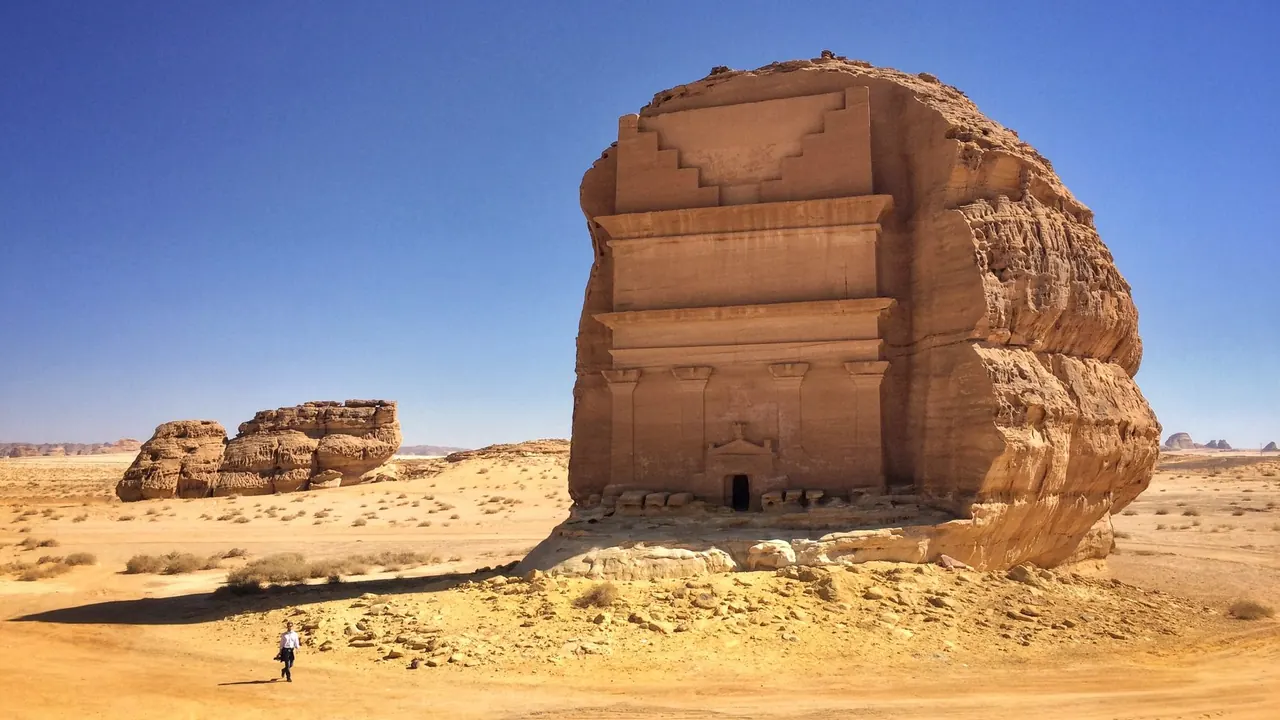
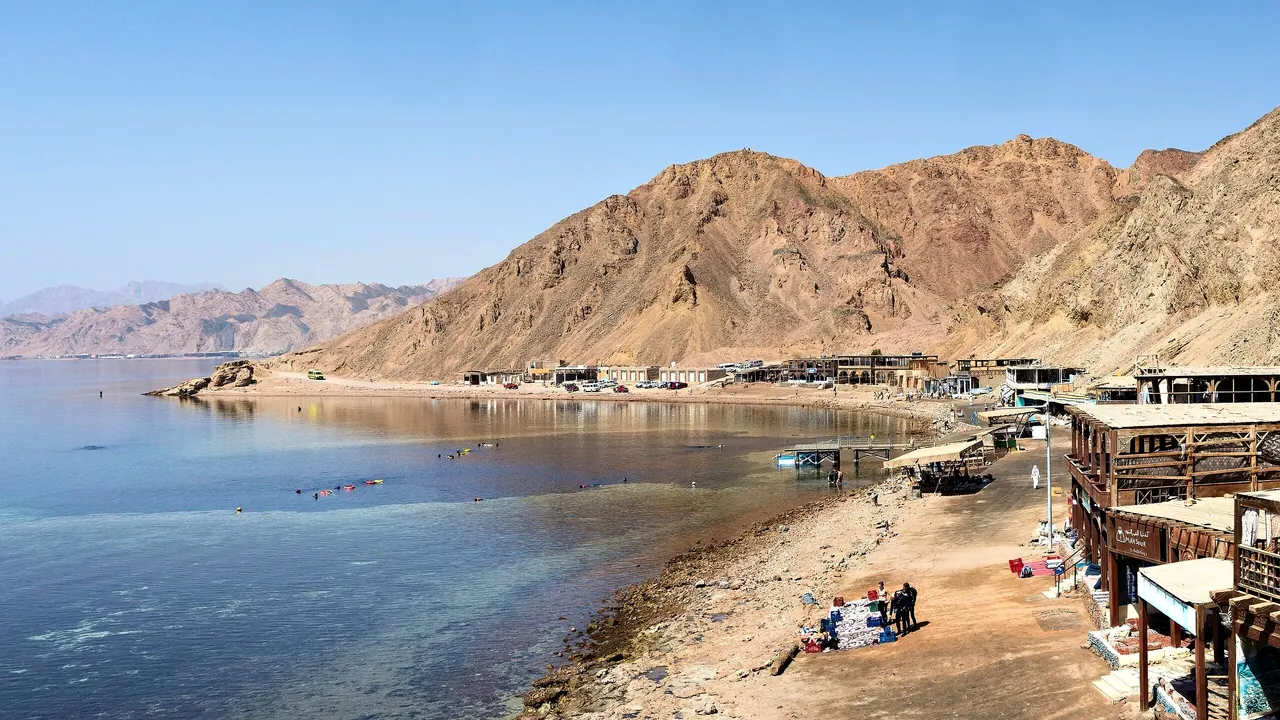
Photos: AlUla by Richard.hargas, CC BY-SA 4.0, cropped; Dahab by Petar Milošević, CC BY-SA 4.0, cropped.
AlUla or Dahab?
Our verdict in twelve categories, each scored against the same fixed benchmark cities, and the climate month by month, so you can choose for your trip.
Choose AlUla for
- culture and sights
- live music and the arts
- shopping
AlUla is the choice if you want ancient history in a dramatic landscape. The Nabataean tombs of Hegra, the inscribed canyon walls of Jabal Ikmah and the mud-brick Old Town make it a trip built around a handful of major sights. It is best seen in winter, and the money goes on resort comfort, guided tours and a hire car or driver.
Choose Dahab for
- beaches
- prices
- nature and the outdoors
Anyone drawn to the water should pick Dahab. Reefs start a few steps off the promenade, the diving and freediving are known worldwide, and the granite mountains of South Sinai rise behind the town. It costs a fraction of what AlUla does, you can swim in the sea all year, and the slow pace suits a long stay much better than a packed sightseeing plan.
Scoreboard
Twelve categories on one fixed scale from 0 to 100. The shaded stretch is the gap between the two.
Your match
Pick a travel style or drag the sliders, and both match scores follow your weighting.
Wins on culture and sights and live music and the arts with your weighting.
Wins on beaches and prices with your weighting.
What matters to you?
Category by category
What the scores mean for a trip.
Beaches & swimming
This is the biggest gap between the two. AlUla lies deep inland with no sea or lake within reach, and the Red Sea coast is too far away across the mountains for a beach day. Swimming means the pool at your resort or desert camp.
Dahab is built around the water, though it is not a sandy beach town. Along the promenade and at Eel Garden and the Blue Hole you step from rocks or a jetty straight onto coral, so a swim here is really a snorkel. For sand and calm shallows, the Lagoon is at the southern edge of town.
Food & drink
Neither is a place to travel to for the food, and both offer about as little. AlUla's best meals come from the resorts' chef-led kitchens and the Old Town terraces, and its local signature is oasis dates with cardamom-scented coffee.
Dahab is more casual and cheaper. You pick grilled fish from the ice at low tables on the bay, or eat foul, falafel and koshary in Assala. You can also get a beer in the tourist bars, while AlUla has no bars at all.
Culture & sights
AlUla is far ahead for sights. The monumental Nabataean tombs of Hegra stand alone in open desert, and there are the lion tombs of Dadan, the inscribed walls of Jabal Ikmah and the mud-brick Old Town below its fort. It adds up to a few weighty visits, mostly guided.
Dahab has no monuments, museums or historic buildings of its own. The Bedouin roots that still show in Assala give the town its character, but there is nothing to tour, and the region's great heritage lies hours away inland.
Nightlife
Neither suits a big night out, but Dahab at least has bars. You can have a beer or a shisha on cushions by the water, and a few promenade spots play music and host the odd late party. AlUla has no bars or clubs, so evenings mean a late dinner, a walk through the lit Old Town and stargazing in the desert, with winter events adding a little life.
Nature & outdoors
Both are excellent for the outdoors, but Dahab has the edge because it has the sea as well as the desert. You can dive the reef straight from the shore at the Canyon and the Blue Hole, freedive at one of the sport's main centres or kitesurf on the steady wind at the Lagoon. On land there are camel and jeep trips into the wadis, the walk to Ras Abu Galum and the night climb up Mount Sinai.
AlUla's appeal is all on land, and on a grand scale. Elephant Rock and other wind-carved formations, palm groves under sandstone cliffs, the lava plateau of Harrat Uwayrid and the Sharaan reserve are explored by hiking, via ferrata, balloon flights and stargazing. Its season is shorter, though, because summer heat limits time outside to dawn and dusk.
Day trips
Neither offers many day trips, since you spend most of your time exploring each place itself. Dahab has the stronger single outing: St Catherine's Monastery, about two hours inland and easily paired with the overnight climb up Mount Sinai. Sharm el-Sheikh, an hour south, gives you a change of scene.
From AlUla the choice is the oasis town of Tayma, with its great stone well and old walls, or Khaybar, with its fortress on a basalt outcrop. Each is about two hours across the desert and best done as a full guided day.
Good for families
Both suit older, outdoorsy children better than toddlers, and neither has a zoo, aquarium or play attractions. What they offer is different. AlUla has climbing among the rocks, ziplines, camel rides and the sheer size of Hegra, with resort pools for the afternoons, but every site means a car or bus and walking in the sun.
Dahab revolves around the water. The sheltered Lagoon suits younger swimmers and reef snorkelling suits confident ones, though reef shoes are a must and serious medical care is in Sharm el-Sheikh.
Getting around
Getting around AlUla takes planning. Hotels, the Old Town and the archaeological sites are strung along a long valley, and Hegra lies more than 20km north of the Old Town. There is no ordinary public transport, so you rely on ticketed shuttles, a hire car, a driver or a tour, and each day is arranged around them.
Dahab has no public transport either, but it is far easier day to day. Its seafront promenade is about 2km long, mostly free of cars and lined with restaurants, dive centres and guesthouses, so many visitors go for days without a vehicle. You only need a taxi or pickup for the Lagoon, the Blue Hole or trips into the mountains.
Shopping & style
What you can buy differs more than how much, since each has only a handful of small shops. In AlUla these are the craft and design shops of the Old Town, selling weaving, pottery, perfume and work from the local arts and crafts school, and oasis dates make the best souvenir. Dahab's promenade stalls sell Bedouin embroidery, scarves and spices, with some haggling expected, and the one thing really worth buying there is diving and freediving gear.
Affordability
On cost the two sit at opposite ends. Dahab is one of the cheapest places for a sea and diving trip, with simple guesthouses, low-cost Egyptian meals in Assala, cheap taxis and dive courses that cost little by international standards. Only alcohol and the few smarter hotels push the bill up.
AlUla is expensive. Most of the rooms are in luxury resorts and tented camps, the archaeological sites are reached on costly guided tours, and you almost always need a hire car or driver. Moderate meals in the Old Town and cheap petrol barely dent the total.
Live music & performing arts
AlUla has a real draw, though only in winter. Maraya, the mirror-clad concert hall in a desert canyon, hosts international singers and orchestras in the winter festival season, along with outdoor music and traditional Saudi dance among the rocks. Come outside that season and there is little to see.
Dahab has no theatre or concert hall. The most you will find is a band or DJ in a promenade bar, or Bedouin music around a fire at a desert camp.
Wellness & relaxation
For rest, Dahab has the edge, because its calm comes from the whole town rather than from a booking. AlUla is peaceful too, but only as peaceful as the resort you choose: the camps and lodges have spas, sunrise yoga and pools among the rocks, and nights are spent by a fire in the silent desert. Beyond the resorts there is little to seek out.
Dahab slows you down wherever you stay. A long-stay community has grown up around yoga, breathwork and freediving, classes and massage are cheap and easy to find, and evenings mean watching the sun set over the Sinai mountains from a cushioned café. Neither place has public baths or a hammam tradition.
When should you go?
Pick your month. The climate figures are measured averages, not a forecast.
AlUla in July
Dahab in July
Daytime high, °C
Rainfall in the month, mm
Where the figures come from
AlUla has no rain gauge within 25 km of the centre, so its rainfall comes from a gridded climate dataset read at the city rather than from a gauge further away.
Dahab has no weather station within reach, so its figures come from a gridded climate model rather than a measured record, and read a broad area rather than the city itself.
Temperature and rainfall are climate normals, averaged over the years shown. AlUla: 2010-2025 (rainfall 1991-2020) normals, Alula / Al ‘Ulá (23.7 km from centre). Dahab: 1991-2020 normals, TerraClimate 4 km grid at the town, no weather station within 90 km.
Rain hardly matters in either place, so the real question is heat. AlUla is at its best from November to March, when days run from about 23°C to the high twenties and the valley is comfortable for hiking and touring the sites. By May it is too hot for easy sightseeing, and from June to September afternoons pass 40°C, which leaves only the early mornings and evenings for anything outdoors.
Dahab stays a few degrees cooler in summer and a little cooler in winter. Winter days near 21°C are good for walking and mountain trips but cool for lying on the shore, and the sea is at its coolest in February and March, though still fine for snorkelling. October and November combine a warm sea with weather that still suits the desert. April is pleasant on land while the water is only starting to warm. High summer, with the sea reaching 28°C in August, suits people who plan to spend their days in the water.
Which traveller are you?
On a beach and sun trip, Dahab is the only real option. AlUla is far inland with nothing but resort pools. Dahab has warm, clear water all year, reef snorkelling straight off the promenade and soft sand at the Lagoon.
For a culture and arts trip, AlUla clearly wins. Hegra's tombs, Dadan and the inscriptions of Jabal Ikmah are ancient sites of real stature, and Maraya stages concerts in winter. Dahab has no monuments, no museums and nowhere to see a performance.
On a trip on a tight budget, Dahab is far easier. Guesthouses, Egyptian meals in Assala, taxis and dive courses all cost little. AlUla relies on luxury resorts, ticketed guided tours and a hire car, and costs well above what the region suggests.
Before you go
| Measure | AlUla | Dahab |
|---|---|---|
| Official language | Arabic | Arabic |
| Currency | Saudi Riyal (SAR) | Egyptian Pound (EGP) |
| Sockets | G60 Hz | CF220 V, 50 Hz |
| Driving side | Right | Right |
| Time zone | UTC+3 | UTC+2, UTC+3 in summer |
| Emergency number | 112 or 911 | Police 122, ambulance 123, fire 180 |
| Elevation | 692 m | 21 m |
| Main airport | Al-Ula International Airport (ULH)24 km from centre8 non-stop destinations | Sharm El Sheikh International Airport (SSH)58 km from centre116 non-stop destinations |
| Public holidays this year | - | 15 days |
By the numbers
| Measure | AlUla | Dahab |
|---|---|---|
| City population | 32,413 | 4,479 |
| Museums within 10 km | 2 | 0 |
| UNESCO World Heritage sites within 50 km | 1 | 0 |
| Swim season, months above 21 °C | - | 12 months |
Where else could you go?
Every comparison below shares a destination with this one, so you can follow AlUla or Dahab somewhere new.