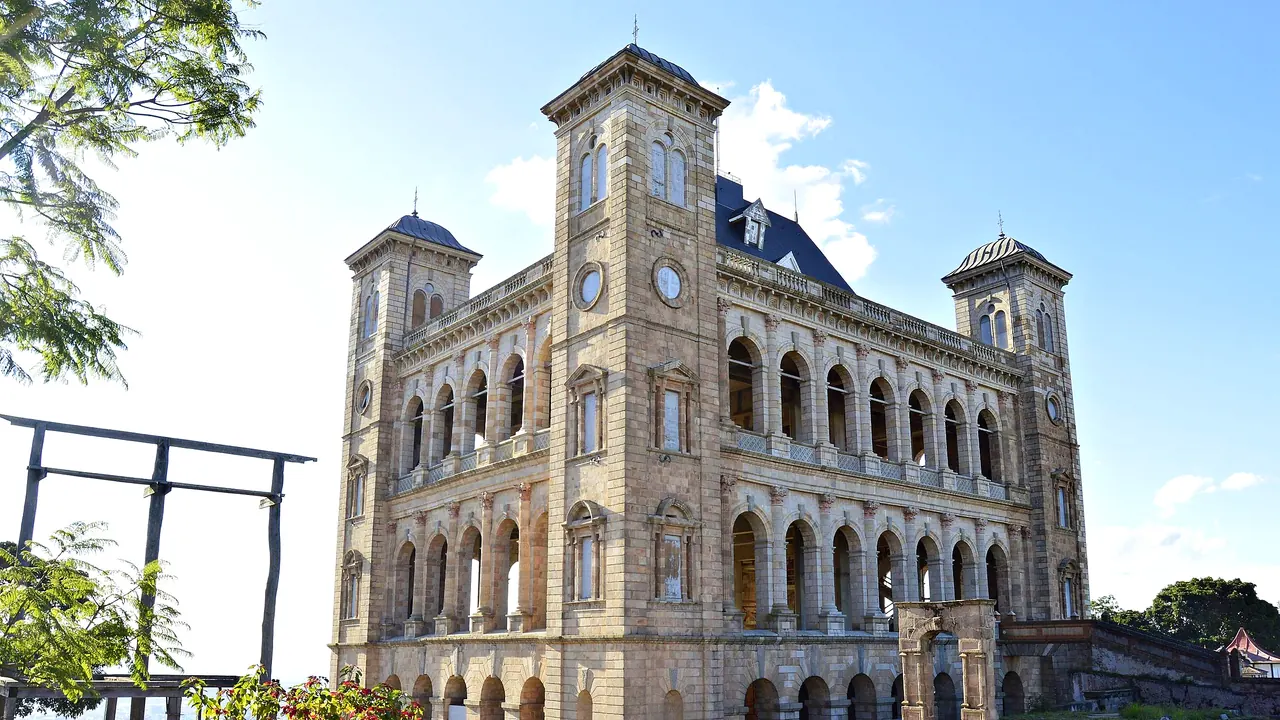

Photos: Antananarivo by ApexDynamo, CC BY-SA 4.0, cropped; Nairobi by Lmwangi, CC BY-SA 3.0, cropped.
Antananarivo or Nairobi?
Our verdict in twelve categories, each scored against the same fixed benchmark cities, and the climate month by month, so you can choose for your trip.
Choose Antananarivo for
- prices
- day trips
- culture and sights
Antananarivo suits a traveller who is crossing Madagascar anyway and wants a couple of days of history and highland scenery before heading for the parks or the coast. The royal ridge of the Rova, the balconied lanes of the Haute-Ville and the sacred hill of Ambohimanga give it more of a past to walk through than Nairobi has. Everyday costs are also lower here, so it is a cheap and interesting stopover, though not a place to base a whole trip.
Choose Nairobi for
- nature and the outdoors
- families
- nightlife
Nairobi works as a destination in its own right, above all for wildlife. Lions and rhinos graze in the national park on the city's southern edge, children can feed giraffes and watch orphaned elephants, and the Rift Valley is close enough for a day of hiking or boating among hippos. Add a confident late-night scene in Westlands and it is the stronger choice for families, outdoor travellers and anyone who wants evenings out, if you can accept higher hotel and park bills.
Scoreboard
Twelve categories on one fixed scale from 0 to 100. The shaded stretch is the gap between the two.
Your match
Pick a travel style or drag the sliders, and both match scores follow your weighting.
Wins on prices and day trips with your weighting.
Wins on nature and the outdoors and families with your weighting.
What matters to you?
Category by category
What the scores mean for a trip.
Beaches & swimming
Neither city is anywhere near the sea, and both are high on an inland plateau where swimming means a hotel pool. The difference is in how you reach the coast. From Antananarivo it is a long, slow road east through the mountains, while from Nairobi a short flight or a train gets you to the Kenyan shore, so a beach extension is easier to arrange from Nairobi.
Food & drink
The two are broadly level, and each is pleasant rather than a reason to travel. Antananarivo's table is built on rice with zebu and greens, mofo gasy rice cakes at dawn and a French streak in its bakeries and the bistros of Isoraka, with rhum arrangé to drink.
Nairobi's food centres on nyama choma, meat grilled over charcoal and eaten in long weekend sessions. Its real strengths come from elsewhere: Indian cooking from the South Asian community, Ethiopian restaurants and a large café scene serving Kenyan coffee in Westlands and Karen.
Culture & sights
Neither city takes more than a day or two of sightseeing, but the sights are of different kinds. Antananarivo's appeal lies in its townscape: the Merina royal compound on the highest ridge, the prime ministers' palace below it and the brick houses and memorial churches of the Haute-Ville, though its museums are small.
Nairobi was founded as a railway depot in 1899, so it has no old quarter. It makes up for that with a proper museum, the National Museum and its early human fossils, along with the Karen Blixen farmhouse and some contemporary African art galleries.
Nightlife
Nairobi has much the better night out. Westlands has rooftop bars and clubs playing Afrobeats and amapiano until dawn from Thursday to Saturday, Kilimani has quieter cocktail bars, and local pubs fill up for football and grilled meat.
In Antananarivo, evenings are mostly hotel bars, cabarets and a few clubs playing salegy at weekends, and many visitors simply eat at their hotel. In both cities you go door to door by car after dark.
Nature & outdoors
Nairobi is far stronger here. It is a capital with a real savanna park, with lions, rhinos and giraffes, on its southern edge. Karura Forest and the Ngong Hills are inside or next to the city, and Hell's Gate, Lake Naivasha and Mount Longonot are all within a day out.
Antananarivo's surroundings are a farmed landscape of red hills, rice paddies and eucalyptus. Apart from a small lemur reserve within an hour, the island's famous rainforests are overnight trips away.
Day trips
Antananarivo has slightly more to offer for an excursion with a sense of place. Ambohimanga, the World Heritage royal hill with its stone gateways and wooden royal houses, is a genuinely fine outing, and the foundry town of Ambatolampy and Lake Mantasoa add variety.
Nairobi's best excursions are into wildlife and landscape, which belong under nature. As towns and heritage go, it has the Limuru tea estates and the prehistoric hand axes of Olorgesailie, and little beyond them.
Good for families
Nairobi is much easier to sell to children. Giraffe feeding in Langata, the elephant orphanage, a safari morning and Karura's trails make several full days, especially if you stay in the leafy suburbs of Karen and Langata.
Antananarivo has lemurs close up and the animals of Tsimbazaza, but little else for children, and its stairways, broken pavements and fumes make it tiring with small ones. Families tend to stay a night or two on the way elsewhere.
Getting around
Both are hard work, with traffic that can turn a short distance into an hour, and in both cities visitors rely on taxis or a hired driver. The differences are in the details: Antananarivo's cream taxis need a fare agreed first, and its walkable upper town means steep climbs. Nairobi has ride-hailing apps, a walkable central business district and an expressway to the airport, but its sights are scattered across distant suburbs.
Shopping & style
Both are craft cities rather than places to shop for fashion, but Nairobi offers a little more. The roving Maasai Market sells beadwork, soapstone and kiondo baskets, the Karen workshops let you watch glass and ceramics being made, and the malls are comfortable if you need anything practical.
Antananarivo's artisan market on the airport road is excellent for raffia, embroidered linen, Antemoro paper, gemstones and vanilla. Beyond that and Analakely market there is very little.
Affordability
Antananarivo is clearly the cheaper of the two. Food, beer, taxis and crafts cost very little, and the main expenses are comfortable hotels and a car with a driver for travelling onward.
In Nairobi, local food and transport are cheap too, but visitors usually stay in secure international hotels in Westlands or Karen. Foreigners also pay far more than Kenyans to enter the park and other attractions, so a wildlife-focused stay costs noticeably more.
Live music & performing arts
Local music is the main reason to go out in both capitals, and neither has an opera house or a symphony orchestra. In Antananarivo the thing to look for is hiragasy, costumed troupes mixing song, oratory and dance at open-air events on the edge of the city. Weekend concerts bring salegy singers and players of the valiha, the bamboo zither, and there is a long-established annual jazz festival.
Nairobi offers more bands and more theatre. Benga, rumba and Afro-fusion groups play in clubs and garden venues, Bomas of Kenya stages the traditional dances of the country's many communities, and the Kenya National Theatre puts on plays in English and Swahili, with spoken word and comedy as well. In Antananarivo you have to ask around to find what is on, while in Nairobi you can check local listings, so it is a little easier for a visitor to plan a night.
Wellness & relaxation
Neither city will restore you, but Nairobi gives you more chances to slow down. The garden hotels and colonial-style cottages of Karen and Langata have lawns, birdsong and cool mornings on the veranda, and day spas are easy to find.
Antananarivo offers a few hotel spas and the quiet of the upper-town lanes. Its historic thermal baths are hours away in Antsirabe.
When should you go?
Pick your month. The climate figures are measured averages, not a forecast.
Antananarivo in July
Nairobi in July
Daytime high, °C
Rainfall in the month, mm
Temperature and rainfall are climate normals, averaged over the years shown. Antananarivo: 1991-2020 (rainfall 1961-1990) normals, Antananarivo / Ivato (13 km from centre). Nairobi: 1991-2020 normals, Nairobi ACC/FIC/RCC/MET/COM/ (13.3 km from centre).
Antananarivo has one long dry season and one heavy wet one. From May to October the rain almost stops and the days are mild, dropping to around 21°C in July, which is ideal for walking the hills and the upper town. From November to March the rains are heavy, peaking at about 358mm in December, and the sunniest stretch comes just before the storms, in September and October.
Nairobi stays at a similar mild warmth all year but has two rainy seasons: the long rains in April and May, with about 126mm in April, and the short rains in November. June to September is dry but often grey, with the least sunshine of the year in July. January and February are the most reliable months, with dry, sunny days. That is the opposite of Antananarivo, where those months fall in the wettest part of the year.
Which traveller are you?
For an outdoors trip, Nairobi is the clear pick. Game drives in the national park, forest trails in Karura, ridge walks in the Ngong Hills and the Rift Valley within two hours all beat Antananarivo's farmed hills and its distant rainforest parks.
On a family trip with children, Nairobi again comes out ahead. Feeding giraffes at the Giraffe Centre, watching orphaned baby elephants and a short safari morning will keep children busy for days, while Antananarivo offers one lemur reserve and the Tsimbazaza gardens.
On a trip on a tight budget, Antananarivo stretches the money further. Street food, beer, taxis and the craft markets cost very little, and there are no high wildlife entry fees for foreigners like those that push up the cost of a stay in Nairobi.
Before you go
| Measure | Antananarivo | Nairobi |
|---|---|---|
| Official language | French, Malagasy | English, Swahili |
| Currency | Malagasy Ariary (MGA) | Kenyan Shilling (KES) |
| Sockets | CEJK50 Hz | G240 V, 50 Hz |
| Driving side | Right | Left |
| Time zone | UTC+3 | UTC+3 |
| Emergency number | Police 117, ambulance 124, fire 118 | Police 112/999, ambulance 112/999, fire 112/999 |
| Elevation | 1,276 m | 1,661 m |
| Main airport | Ivato International Airport (TNR)13 km from centre18 non-stop destinations | Jomo Kenyatta International Airport (NBO)13 km from centre60 non-stop destinations |
| Public holidays this year | 10 days | 10 days |
By the numbers
| Measure | Antananarivo | Nairobi |
|---|---|---|
| Population | 1,275,207 | 5,545,000 |
| People per km² | 14,491 | 7,967 |
| Museums within 10 km | 2 | 4 |
| UNESCO World Heritage sites within 50 km | 1 | 0 |
Where else could you go?
Every comparison below shares a destination with this one, so you can follow Antananarivo or Nairobi somewhere new.
- Arushavs Nairobi
- Mombasavs Nairobi
- Kampalavs Nairobi
- Stone Townvs Nairobi
- Nosy Bevs Antananarivo
- Dar es Salaamvs Nairobi