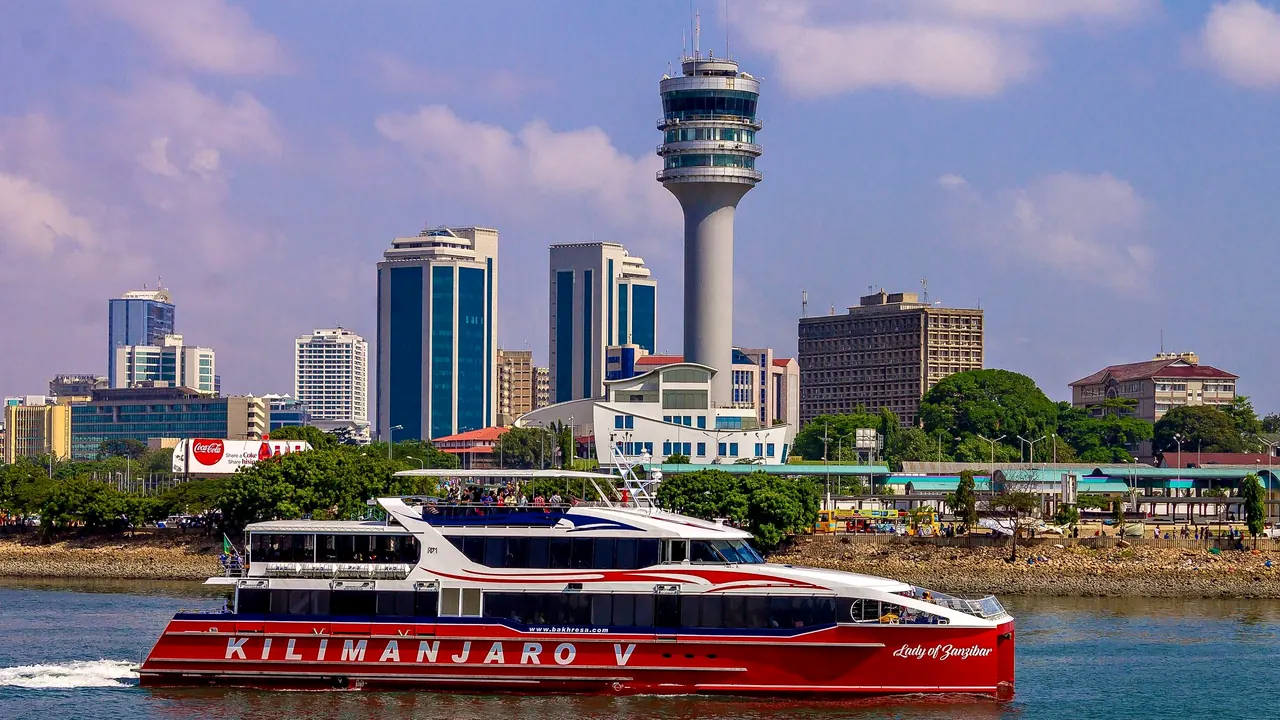

Photos: Dar es Salaam by Dicksonpicha, CC BY-SA 4.0, cropped; Nairobi by Lmwangi, CC BY-SA 3.0, cropped.
Dar es Salaam or Nairobi?
Our verdict in twelve categories, each scored against the same fixed benchmark cities, and the climate month by month, so you can choose for your trip.
Choose Dar es Salaam for
- beaches
- day trips
- getting around
Dar es Salaam is the choice for a trip built around warm sea. The city's own shore is no place to swim, but boats reach the white sand of Bongoyo and Mbudya in half an hour, the Kigamboni coast offers slow resort days, and Zanzibar's Stone Town and old Bagamoyo are both within reach for a day out. It also suits snorkellers, and travellers who eat locally will find it a little easier on the budget.
Choose Nairobi for
- nature and the outdoors
- families
- nightlife
Wildlife is the reason to pick Nairobi. Lions and rhinos roam a national park at the city's edge, the Rift Valley's gorges and lakes are a couple of hours away, and children can feed giraffes and watch orphaned elephants being bottle-fed. The highland air makes long days outdoors comfortable, and nights out in Westlands go later and harder than anything in Dar, though there is no beach at all.
Scoreboard
Twelve categories on one fixed scale from 0 to 100. The shaded stretch is the gap between the two.
Your match
Pick a travel style or drag the sliders, and both match scores follow your weighting.
Too close to call, level with your weighting
Wins on beaches and day trips with your weighting.
Wins on nature and the outdoors and families with your weighting.
What matters to you?
Category by category
What the scores mean for a trip.
Beaches & swimming
Dar es Salaam has warm sea all year, but the swimming is away from the city itself. Coco Beach is for strolling, and the good sand is on the island reserve of Bongoyo and Mbudya or along the quieter Kigamboni and Kunduchi shores. The tide goes out a long way, so swims need to be timed around it.
Nairobi sits on a high plateau with no coast nearby, and swimming there means a hotel or club pool. Anyone who wants sand on a Kenyan trip has to fly to the coast for a few extra days.
Food & drink
The two cities eat in similar ways. Both gather around nyama choma and cold beer, and both owe a lot to long-settled Indian communities. The difference is coast against highland. Dar has a sea and spice flavour, with octopus and coconut curries, the morning catch fried at the Kivukoni fish market, and dusk street snacks such as mishkaki and chipsi mayai.
Nairobi's everyday food is plainer: ugali, sukuma wiki and githeri from roadside kiosks. It adds Ethiopian restaurants and a large café scene in Westlands, Kilimani and Karen, serving coffee grown just outside the city.
Culture & sights
Neither city is a place for grand sights, and a day or two covers either one. Dar es Salaam's appeal is the working port: German-era churches and colonial offices by the harbour, the Village Museum's traditional houses, and the commercial crush of Kariakoo. The coast's deeper history lies outside the city, in Bagamoyo and on Zanzibar.
Nairobi was founded as a railway depot in 1899 and has no old quarter, so its interest is in a few strong institutions. The National Museum's early human fossils and the Karen Blixen farmhouse lead the list, and contemporary African art galleries add to it.
Nightlife
Nairobi has the bigger night out. Westlands has a cluster of rooftop bars and clubs playing Afrobeats, amapiano and gengetone until dawn from Thursday onwards, and the crowd is mostly local. Kilimani has calmer cocktail bars for slower evenings.
Dar es Salaam comes alive mainly at weekends, and its scene is split. Expatriates go to the beach lounges of Masaki and Oyster Bay, while bongo flava plays in the beer gardens and clubs of Sinza and Mwenge. Midweek is quiet. In both cities you travel between venues by car, not on foot.
Nature & outdoors
In nature, Nairobi is in another league. Its national park, with lions, rhinos and giraffes, starts at the southern edge of the city. Karura Forest and the Ngong Hills offer walks without leaving town, and within two hours you can cycle among zebras in Hell's Gate or take a boat past hippos on Lake Naivasha. The mild highland climate makes all of this comfortable.
Dar es Salaam's outdoors is on the water: snorkelling and diving on the reefs of the marine reserve, dhow trips through the mangroves and kitesurfing on the trade winds. On land it has little beyond the Pugu Hills, and a safari means a separate trip.
Day trips
Dar es Salaam has the stronger outings, because both of them are historic Swahili places. A fast ferry reaches Stone Town on Zanzibar, with its coral-stone lanes and old slave market, in about two hours. Bagamoyo, at the end of the old caravan route, has its fort, its mission buildings and the medieval Kaole ruins nearby.
Nairobi's closer outings are gentler: lunch among the Limuru tea estates or the stone hand axes at Olorgesailie. Kenya's own Swahili heritage at Mombasa and Lamu is too far away for a day trip.
Good for families
Nairobi is much easier to plan around children. They can feed Rothschild's giraffes in Langata, watch orphaned elephants play in the mud at the Sheldrick orphanage, and see a real safari after a short drive. Staying in Karen or Langata keeps all of this close.
In Dar es Salaam families are usually passing through. Island boat trips, resort pools and a water park are the highlights, while the heat, malaria precautions and care with food and water add to the effort. Both cities lack pavements and have heavy traffic, and in both places people are warm towards children.
Getting around
Both cities are sprawling and choked with traffic, and in both visitors end up relying on ride-hailing. Dar es Salaam is a little easier. Its rapid buses run in their own lanes along the main roads, and the old harbour centre is pleasant to walk, though Masaki, the beaches and the museums are far apart.
Nairobi's matatu routes are hard for an outsider to work out, its roads are among Africa's most congested, and its sights sit in Karen and Langata, a long way from the nightlife in Westlands. The airport expressway does save time on arrival.
Shopping & style
The two differ mainly in the kind of market they offer. Dar es Salaam has Kariakoo, East Africa's great trading market, a dense grid of wholesalers that is better to watch than to shop in. For things to take home, the Mwenge carvers make Makonde ebony pieces, Tingatinga paintings are the city's own art style, and kanga cloth is quick to have tailored.
Nairobi's Maasai Market is a craft market that moves between sites through the week, with beadwork, kiondo baskets and soapstone to bargain over. In Karen you can watch glass and ceramic beads being made, and Westlands and Gigiri have larger malls with international chains. Fashion and luxury shopping are thin in both cities.
Affordability
In both cities local life is cheap and the visitor's version is not, but Dar es Salaam is a little kinder to the budget. Street food, bajaji rides and simple guesthouses cost very little there, and the costs rise only with resort stays, Masaki restaurants and island boats.
Nairobi adds wildlife to the bill. Non-residents pay much higher park and attraction fees, and a game drive also means hiring a vehicle and driver. Most visitors also choose secure international hotels, which lifts the baseline.
Live music & performing arts
Nairobi has more for a visitor to see. Troupes at Bomas of Kenya perform traditional dances from across the country, the Kenya National Theatre stages plays in English and Swahili, and jazz nights, benga bands and spoken word fill the weekends.
Dar es Salaam has the richer musical roots, as the birthplace of bongo flava and a home of taarab. Its programme is irregular, though, and anyone who wants traditional performance does better at the Bagamoyo arts college or at Zanzibar's festivals.
Wellness & relaxation
Neither city is restful, and wellness in both means hotel spas rather than any local tradition. The difference is where you go to slow down. In Dar es Salaam it is a resort on the Kigamboni coast, where the day follows the tides and the shade, though the city's humid heat follows you.
Nairobi's calm is green and cool instead: the garden hotels and old cottages of Karen and Langata, with birdsong, lawns and fresh highland mornings over a long breakfast.
When should you go?
Pick your month. The climate figures are measured averages, not a forecast.
Dar es Salaam in July
Nairobi in July
Daytime high, °C
Rainfall in the month, mm
Temperature and rainfall are climate normals, averaged over the years shown. Dar es Salaam: 1991-2020 normals, Dar Es Salaam Airport (10.5 km from centre). Nairobi: 1991-2020 normals, Nairobi ACC/FIC/RCC/MET/COM/ (13.3 km from centre).
Dar es Salaam is hot all year, and the main question is rain. The long rains peak in April with about 266mm, and the short rains return in November and December. June to September is the best stretch. It is dry and sunny, highs ease to about 30°C, and the sea stays warm enough for swimming at around 26°C. January and February are mostly dry as well, but they are the hottest months and make walking the streets tiring.
Nairobi's altitude keeps it mild, and daytime highs rarely pass 28°C, so walking is pleasant in every month. Its rains fall at roughly the same times as Dar's, in April and May and again in November, but they are lighter. June to September is dry but often grey and cool, with July the least sunny month. January and February bring the clearest skies. For sun, Dar is best in the middle of the year and Nairobi at its start.
Which traveller are you?
On a beach and sun trip, Dar es Salaam is the only real choice, since Nairobi has no coast. Stay out of town. The resort beaches north towards Bagamoyo put sand at your door, while seaweedy Coco Beach is only for an evening stroll.
For an outdoors trip, Dar es Salaam's best is offshore, with reefs for snorkellers and little on foot. Nairobi is far stronger. There are dawn game drives in the national park at the city's edge and crater-rim hikes on Mount Longonot.
On a family trip with children, Dar es Salaam has island boat trips and resort pools, but its heat soon tires small children. Nairobi gives them more to remember, with the park's animal orphanage and Karura's cycling trails, though car journeys are long.
Before you go
| Measure | Dar es Salaam | Nairobi |
|---|---|---|
| Official language | English, Swahili | English, Swahili |
| Currency | Tanzanian Shilling (TZS) | Kenyan Shilling (KES) |
| Sockets | G230 V, 50 Hz | G240 V, 50 Hz |
| Driving side | Left | Left |
| Time zone | UTC+3 | UTC+3 |
| Emergency number | Police 112, ambulance 115, fire 114 | Police 112/999, ambulance 112/999, fire 112/999 |
| Elevation | 12 m | 1,661 m |
| Main airport | Julius Nyerere International Airport (DAR)10 km from centre39 non-stop destinations | Jomo Kenyatta International Airport (NBO)13 km from centre60 non-stop destinations |
| Public holidays this year | 13 days | 10 days |
By the numbers
| Measure | Dar es Salaam | Nairobi |
|---|---|---|
| City population | 4,715,000 | 5,545,000 |
| People per km² | 3,385 | 7,967 |
| Museums within 10 km | 3 | 4 |
| UNESCO World Heritage sites within 50 km | 0 | 0 |
| Swim season, months above 21 °C | 12 months | - |
Where else could you go?
Every comparison below shares a destination with this one, so you can follow Dar es Salaam or Nairobi somewhere new.
- Stone Townvs Dar es Salaam
- Arushavs Nairobi
- Mombasavs Dar es Salaam
- Mombasavs Nairobi
- Arushavs Dar es Salaam
- Stone Townvs Nairobi