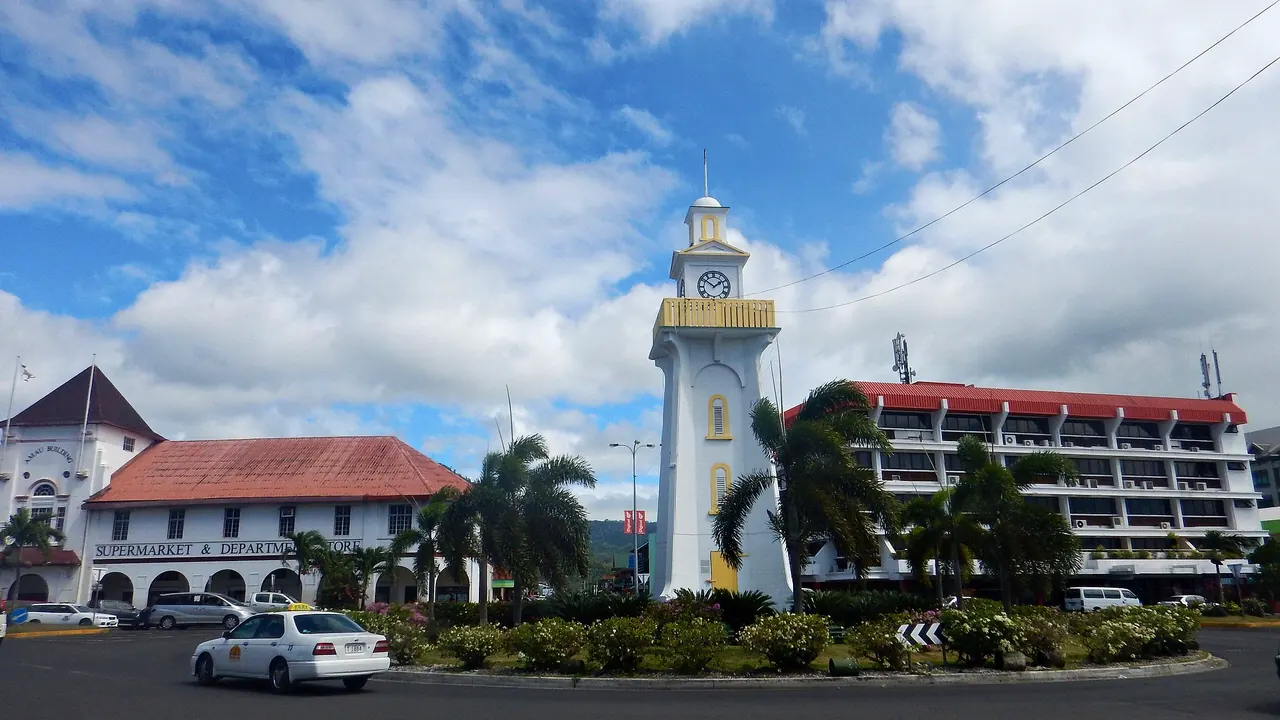
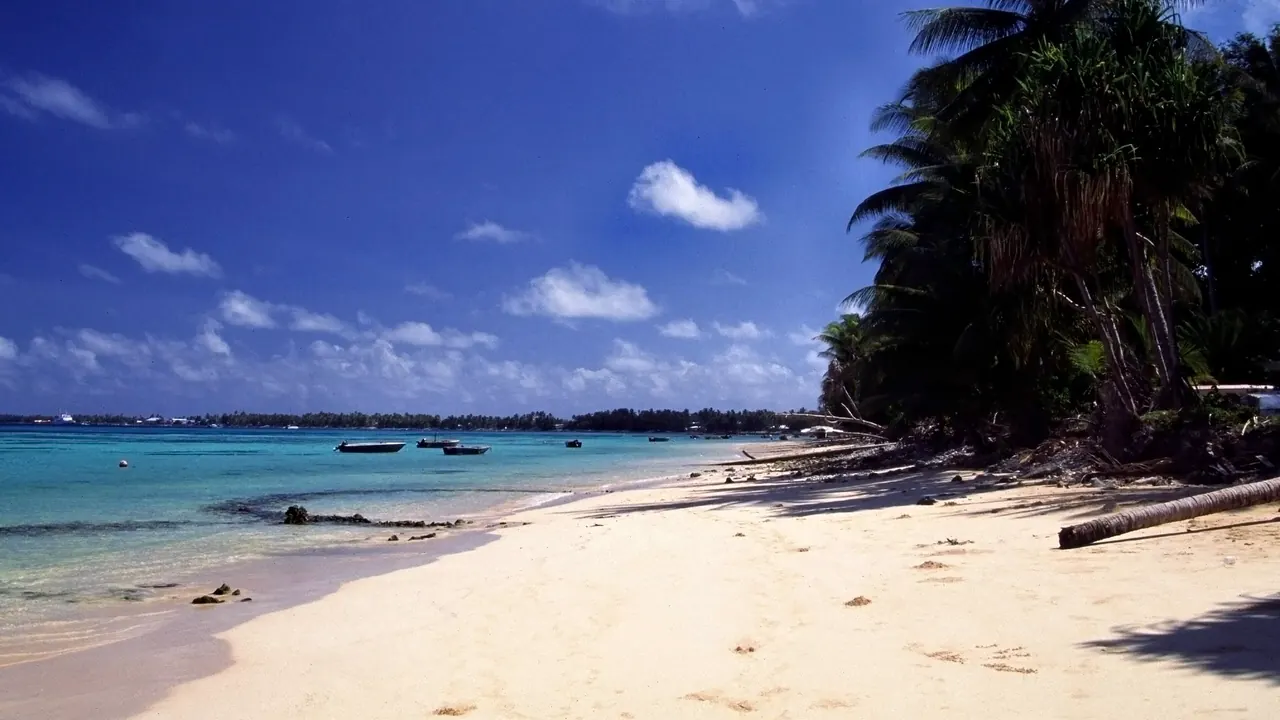
Photos: Apia by Rickard Törnblad, CC BY-SA 4.0, cropped; Funafuti by mrlins, CC BY 2.0, cropped.
Apia or Funafuti?
Our verdict in twelve categories, each scored against the same fixed benchmark cities, and the climate month by month, so you can choose for your trip.
Choose Apia for
- nature and the outdoors
- culture and sights
- families
Apia suits travellers who want a South Pacific island with plenty to do. Upolu gives you rainforest ridges, crater lakes, waterfalls and reef pools, the town has a proper produce market and fiafia nights, and Samoan village life is all around you. It works best as a base for a night or two before you move to a beach fale on the south or east coast, and it costs less to do well.
Choose Funafuti for
- beaches
Funafuti is for people who want to reach a very remote place and are happy to do very little once they get there. Its strength is the lagoon: warm, calm water beside the settlement, with empty coral islets a boat ride away. Food, sights, shopping and evenings out are about as thin as anywhere, so it rewards curiosity and patience rather than a full itinerary.
Scoreboard
Twelve categories on one fixed scale from 0 to 100. The shaded stretch is the gap between the two.
Your match
Pick a travel style or drag the sliders, and both match scores follow your weighting.
Wins on nature and the outdoors and culture and sights with your weighting.
Wins on beaches with your weighting.
What matters to you?
Category by category
What the scores mean for a trip.
Beaches & swimming
Funafuti makes swimming easier. The calm lagoon lies right along Fongafale, so you can swim near Vaiaku or join the children jumping off the wharf at dusk, and a boat takes you to deserted islets of white coral sand. Expect no facilities, and the water near the settlement is not always clean.
Apia's own waterfront is reef flat and working harbour, so the only swim in town is snorkelling at Palolo Deep. The beaches people picture, Lalomanu, Matareva and Return to Paradise, are on the far coasts of Upolu and take a full day by winding road, which is why beach lovers usually move out there.
Food & drink
Apia gives you far more to eat. The produce market sells cooked plates next to taro and breadfruit, the fish market sits by the harbour, and dishes such as oka, palusami and koko Samoa are easy to find. On a Sunday you may even share an umu meal at your guesthouse.
In Funafuti most of the food in the stores is imported tinned and frozen goods, and the restaurants are a few simple counters. Pulaka and the best reef fish turn up at community feasts rather than on menus, so the fresh tuna and a glass of kaleve toddy are about as good as it gets.
Culture & sights
Apia has real sights. You can visit Villa Vailima, Robert Louis Stevenson's last home, climb to his tomb on Mount Vaea, and see the Museum of Samoa, the waterfront cathedral and the chiefs' tombs at Mulinu'u. Beyond those, fa'a Samoa is part of daily life all around, in the fales, the village councils and the traditional tattooing.
Funafuti's interest is more particular. It has the maneapa meeting houses, the runway American forces laid in 1943 with its wartime pits, and a marker for the 1890s coral drilling that tested Darwin's theory of atolls. All of it fits into a single morning.
Nightlife
Neither place suits a big night out, but Apia at least has a waterfront to wander. There are bars along Beach Road, hotel terraces over the harbour and a couple of nightclubs where locals dance at weekends. Funafuti's evenings mostly happen outdoors on the runway and the lagoon front, with a weekend dance now and then and a drink at the guesthouse otherwise. Sundays go quiet in both.
Nature & outdoors
Apia sits on a high volcanic island, and that makes all the difference. Rainforest trails start just above town, the Cross Island Road runs past the crater lake of Lanoto'o and Papapapaitai Falls, and O Le Pupu-Pu'e National Park reaches down to black lava cliffs. Add the To Sua trench, the Piula cave pools, reef surfing and passing humpbacks.
Funafuti's beauty is all lagoon and sky: a ring of islets only a few metres high, where on Fongafale you can sometimes see ocean and lagoon at once. The Conservation Area has nesting seabirds and feeding turtles, but there are no trails, and you have to arrange any snorkelling or fishing through locals.
Day trips
From Apia you can get out and about. A loop round Upolu passes fale villages and churches, a short boat crosses to car-free Manono, and the ferry to Savai'i makes a long day or, better, an overnight trip. Funafuti has nowhere to go beyond its own lagoon, because the other Tuvaluan atolls are many hours away by an irregular ship. A boat out to the uninhabited islets is the only outing.
Good for families
Children are made welcome in both, but Apia gives them more to do. There is sheltered snorkelling at Palolo Deep, swimming at Piula and under waterfalls, and lazy days at south-coast beach fales. Long drives, dengue mosquitoes and basic clinics are the trade-offs.
Funafuti's best family moment is joining local children playing on the runway in the evening, along with calm lagoon swims. Strong sun with little shade, limited food and a long journey through Fiji make it better for adventurous families with older children.
Getting around
Both centres are small enough to walk in the heat, but Apia has more ways to go further. Cheap taxis run out to Vailima, and the painted wooden buses leave the market for villages all over the island, though they thin out on Sundays. Most visitors hire a car with a temporary licence and drive on the left.
Funafuti is one road along a strip of land about 12km long, with no buses and few taxis, so a rented motorbike or bicycle does the job. Anywhere beyond Fongafale means a boat.
Shopping & style
Apia has a proper craft market. The waterfront flea market sells siapo bark cloth, kava bowls, carvings and lavalava wraps, and the produce market has coconut oil and cocoa to take home. In Funafuti the only real souvenirs are pandanus mats, fans and shell necklaces from the women's groups near the airport, plus the postage stamps that collectors seek out.
Affordability
Apia is easier on the budget. Buses, taxis and market meals cost little, and the beach fales on the coast, with meals included, are some of the cheapest seaside beds in the Pacific. Resorts, imported goods and car hire are what push the costs up.
In Funafuti you pay more for less. The few guesthouses and the government hotel are expensive for what they offer, imported food raises the price of meals, and you charter any lagoon boat yourself. Getting there at all is most of the cost.
Live music & performing arts
Apia makes Samoan performance easy to see. Hotels stage weekly fiafia nights with the slap dance and the fire knife dance, and in September the Teuila Festival fills the waterfront with choirs and fautasi longboat races. In Funafuti the fatele dance belongs to weddings and national days in the maneapa, so you see it only by luck or invitation. In both places, Sunday church singing is the performance anyone can hear.
Wellness & relaxation
Apia has something you can actually book. Fofō massage with coconut oil is offered by local practitioners and in day spas and resort spas, and a quiet coastal resort or beach fale makes the rest easy. Funafuti offers nothing of the kind. Unwinding there means a breadfruit tree, the lagoon at sunset and an unhurried day set by the tide, in constant heat with basic comforts.
When should you go?
Pick your month. The climate figures are measured averages, not a forecast.
Apia in July
Funafuti in July
Daytime high, °C
Rainfall in the month, mm
Temperature and rainfall are climate normals, averaged over the years shown. Apia: 1998-2025 (sunshine 1981-2010, rainfall 1991-2020) normals, Faleolo Intl / Apia (18.1 km from centre). Funafuti: 1991-2020 normals, Funafuti (2.1 km from centre).
Neither place has a cool season. Daytime highs stay at 31 to 32°C in both all year, so the sea is warm enough for swimming in every month, a little warmer around Funafuti at 30°C. Walking the streets is a job for early morning or late afternoon in both. The real difference is rain. Apia has a clear wet season from November to April, peaking in February at 427mm, then a much drier and sunnier stretch from June to September, with August the driest month at 124mm.
Funafuti never really dries out. Its wettest months are December to March, but even its driest, September, gets 209mm, so showers are likely whenever you go. Its sunniest months, May and August to October, overlap with Apia's best spell, which makes June to September the most comfortable time for either.
Which traveller are you?
On a beach and sun trip, Apia means moving out to the far coast of Upolu before you swim, so Funafuti has the edge. Its warm, calm lagoon is the whole point of the place, and it starts minutes from your guesthouse.
For an outdoors trip, Apia is the clear choice, because a high volcanic island gives you a week of hiking, wild swimming and reef days. Choose Funafuti only if one boat day on the lagoon is enough, since the flat coral offers nowhere to walk.
On a family trip with children, Apia suits younger ones better, with enough simple outdoor days to fill a week without needing organised attractions. Funafuti is for older, adventurous children who will happily spend the whole stay in the lagoon or playing with local kids.
Before you go
| Measure | Apia | Funafuti |
|---|---|---|
| Official language | English, Samoan | English, Tuvaluan |
| Currency | Tala (WST) | Australian Dollar (AUD) |
| Sockets | I230 V, 50 Hz | I220 V, 50 Hz |
| Driving side | Left | Left |
| Time zone | UTC+13 | UTC+12 |
| Emergency number | 999 | 911 |
| Elevation | 2 m | 7 m |
| Main airport | Faleolo International Airport (APW)19 km from centre6 non-stop destinations | Funafuti International Airport (FUN)0 km from centre2 non-stop destinations |
| Public holidays this year | 11 days | 11 days |
By the numbers
| Measure | Apia | Funafuti |
|---|---|---|
| Population | 37,708 | 6,025 |
| People per km² | 305 | 2,510 |
| Museums within 10 km | 4 | 0 |
| UNESCO World Heritage sites within 50 km | 0 | 0 |
| Swim season, months above 21 °C | 12 months | 12 months |
Where else could you go?
Every comparison below shares a destination with this one, so you can follow Apia or Funafuti somewhere new.