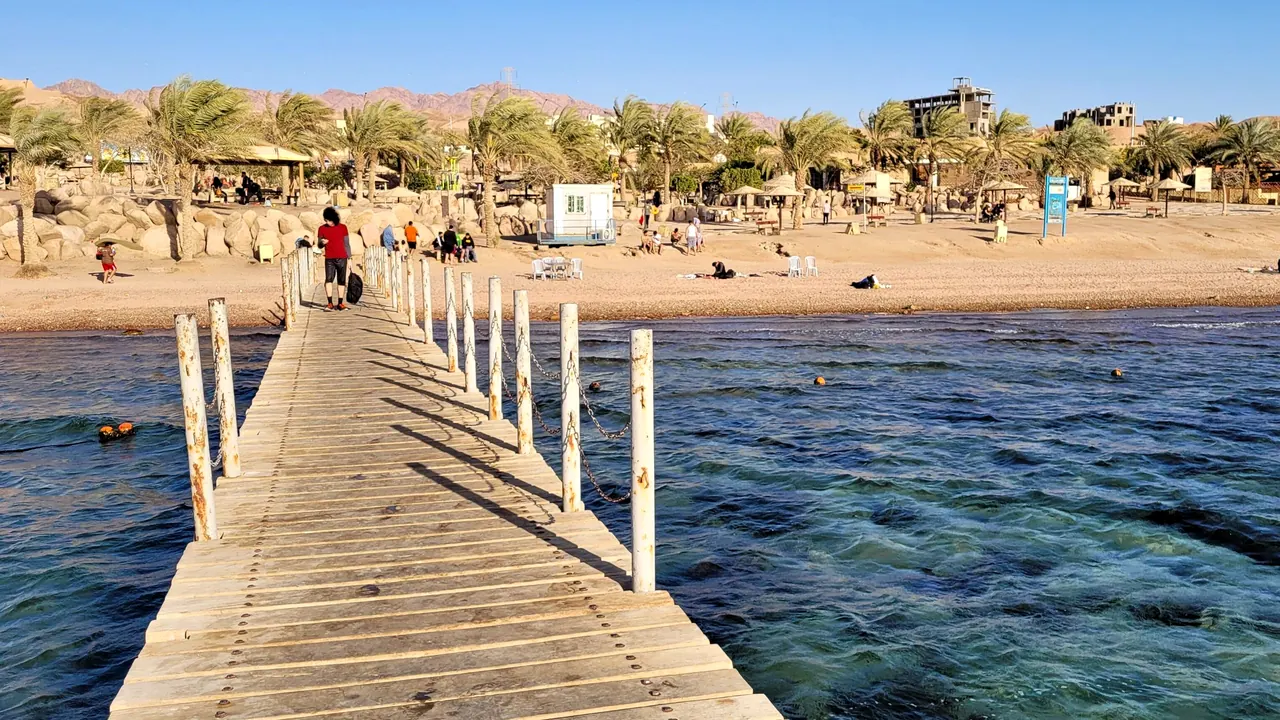
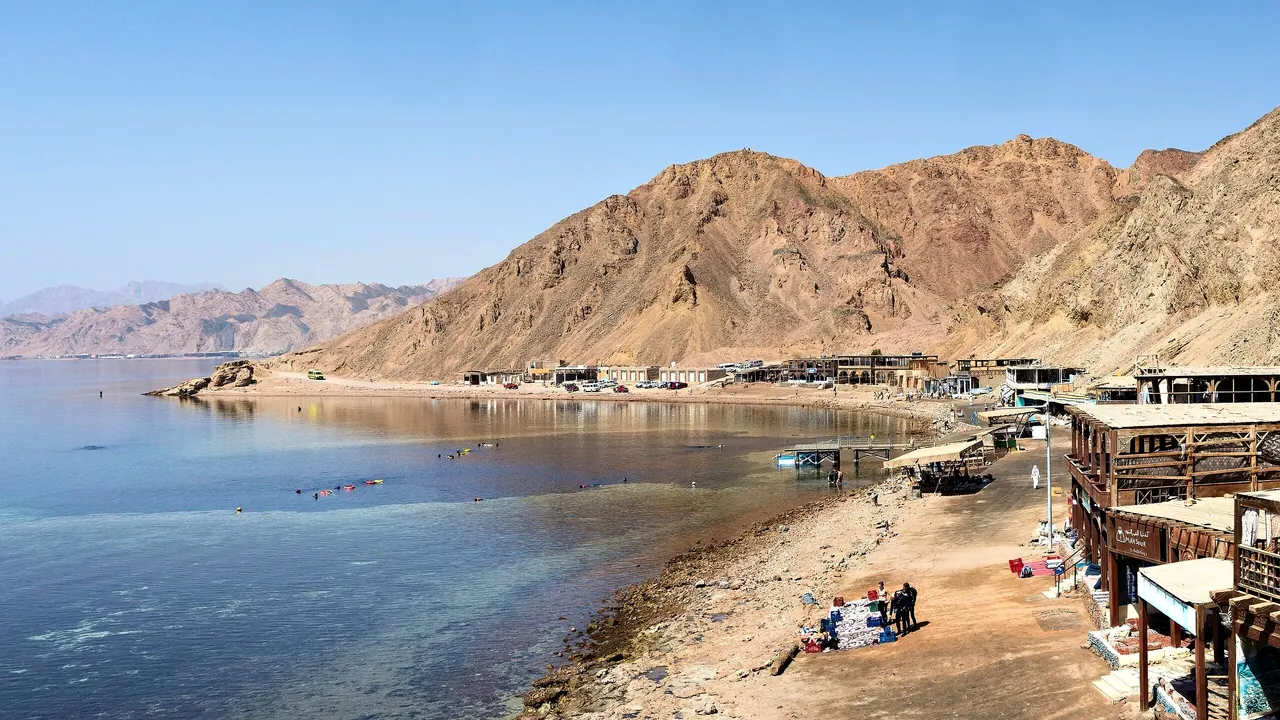
Photos: Aqaba by عباد ديرانية, CC BY-SA 4.0, cropped; Dahab by Petar Milošević, CC BY-SA 4.0, cropped.
Aqaba or Dahab?
Our verdict in twelve categories, each scored against the same fixed benchmark cities, and the climate month by month, so you can choose for your trip.
Choose Aqaba for
- day trips
- culture and sights
- shopping
Aqaba suits travellers who want the Red Sea reefs as one part of a wider Jordan trip, with Petra and Wadi Rum within easy reach by road. It has the more conventional resort stretch at Tala Bay, beach clubs with loungers, hotels with pools and kids' clubs, and a little more to eat and see in town. That makes it the better choice for a shorter, more comfortable stay, a family resort vacation or a first look at the region.
Choose Dahab for
- prices
- wellness
- nature and the outdoors
Divers, freedivers and anyone happy to slow right down for weeks on very little money will be happier in Dahab. The reef starts at the jetty, the granite mountains of South Sinai rise behind the town, and yoga, cheap guesthouses and cushioned seafront cafés set the pace. What it gives up is nearly everything else: sights, shopping and day trips are all thin.
Scoreboard
Twelve categories on one fixed scale from 0 to 100. The shaded stretch is the gap between the two.
Your match
Pick a travel style or drag the sliders, and both match scores follow your weighting.
Too close to call, 2 points apart
Wins on day trips and culture and sights with your weighting.
Wins on prices and wellness with your weighting.
What matters to you?
Category by category
What the scores mean for a trip.
Beaches & swimming
Both towns swim in the same warm, clear gulf, and in both the reef begins almost at the shoreline, so the sea itself is close to a draw. The difference is what sits on land. Aqaba has the conventional resort set-up, with beach clubs and hotel stretches south of town and at Tala Bay offering loungers and shade. The free town beaches are narrow, busy and conservative in dress.
Dahab has hardly any beach in the usual sense. You get into the water from jetties and rocks at the Lighthouse, Eel Garden or the Blue Hole and dry off on cushions in a seafront café, then head to the Lagoon when you want sand and shallow water. Pick Aqaba for a sunbed and Dahab for snorkelling straight off the promenade.
Food & drink
Neither town is a food destination, but Aqaba gives you a little more to work with. Sayadieh, the port's spiced fish with rice and onions, Jordanian breakfasts of falafel and hummus, and the resort hotels' restaurants add some range, and tax-free drinks are easy to find.
In Dahab, the most rewarding meals are the cheap Egyptian plates of koshary and foul in Assala. The waterfront grills are worth visiting for the setting more than the cooking, and much of the rest is pizza and smoothie bowls for travellers. Alcohol is confined to tourist bars.
Culture & sights
Aqaba has at least a morning's worth of history: the Mamluk fort on the waterfront, the low walls of Ayla, the site of a very early church and a small archaeological museum. Dahab has nothing comparable to visit. Its Bedouin roots show in Assala and in the tea stops around town, but as atmosphere rather than sights, so in both towns the serious heritage lies inland.
Nightlife
Nights end early in both towns, and neither has clubs. The feel is different, though. In Aqaba the evenings belong to local families strolling the corniche and sitting in shisha cafés, and drinking happens in resort bars, divers' pubs and the occasional beach-club DJ night. Dahab's promenade bars draw a mixed crowd of divers, instructors and backpackers for a beer on cushions by the water, and now and then a party night runs late.
Nature & outdoors
Both towns have fine reefs and desert on the doorstep, but Dahab comes out ahead. At the Canyon and the Blue Hole the reef drops into deep blue straight from the shore, the town is one of the world's main centres for freediving, and the wind at the Lagoon adds windsurfing and kitesurfing. Inland, the Coloured Canyon, Ras Abu Galum and the night climb of Mount Sinai give it a second half.
Aqaba's reefs are gentler and very easy to reach, with the Japanese Garden and the sunken wrecks suiting snorkellers and newer divers. Its strongest card is Wadi Rum, about an hour away, with its red sandstone mountains, natural arches and nights in Bedouin camps.
Day trips
Each town has one great excursion, but Aqaba's is the bigger prize. Petra, about two hours away by road, is one of the great ancient sites of the Middle East, and Little Petra fits into the same day. Eilat and the Sinai coast look close on the map, but the border crossings make them awkward outings.
From Dahab, St Catherine's Monastery and the climb up Mount Sinai make a memorable day or night. After that the choice comes down to the resorts and malls of Sharm el-Sheikh or quiet Nuweiba.
Good for families
Aqaba is the easier choice with younger children. Resorts with pools, kids' clubs and shaded beaches, plus glass-bottomed boats over the reef, make a straightforward package as long as you avoid the summer heat.
Dahab works best for families whose children already swim confidently. The Lagoon is sheltered and sandy, but elsewhere coral and sea urchins mean reef shoes, there is little laid on for children, and serious medical care is an hour away in Sharm el-Sheikh.
Getting around
Aqaba lets you travel further on your own terms. Its roads are good and easy to drive, so a hire car is a realistic way to reach Petra and Wadi Rum without a tour, and taxis and hotel shuttles cover the coast road south to the resorts and Tala Bay. The small centre around the corniche, fort and markets can be walked, though only outside the hottest hours.
In Dahab, most of a stay happens on the seafront promenade, about 2km from the Lighthouse to Mashraba and largely free of cars, and many visitors walk it for days without needing anything else. Beyond it there is no public transport, so the Blue Hole, the Lagoon and every desert trip mean a taxi or an arranged transfer. Getting there usually means about an hour by road from Sharm el-Sheikh airport.
Shopping & style
Shopping is a minor part of either trip, but Aqaba offers slightly more. Its old market streets sell spices, dates and Dead Sea mud and salts, and its tax-free status makes perfume, electronics and alcohol cheaper than elsewhere in Jordan. Dahab's promenade stalls stick to scarves, Bedouin embroidery and souvenirs, with haggling expected. The one purchase that really pays off there is dive or freediving gear.
Affordability
Dahab is by far the cheaper of the two. Guesthouses and camps, Egyptian meals in Assala and taxis cost very little, and dive and freediving courses are inexpensive enough that many people stay for weeks.
Aqaba is cheap only at street level. Once you add a resort on the south coast, beach-club passes, dive courses, desert tours and the entrance to Petra, a comfortable stay costs about what a Mediterranean resort would. Drinks are the exception: tax-free Aqaba is the cheaper place for a beer, while in Dahab alcohol is relatively expensive.
Live music & performing arts
Neither town has a performing arts scene, so don't plan either trip around one. In both, the most memorable music is Bedouin song around a desert campfire, in Wadi Rum or the Sinai. Beyond that, Aqaba offers singers in hotel lounges and Dahab the odd live band or DJ in a promenade bar.
Wellness & relaxation
Dahab is the better place to switch off. Its long-stay community is built around yoga, breathwork and cheap massage, and the slow rhythm of cushioned cafés and sunsets over the Sinai mountains does the rest.
Aqaba is more about treatments than a way of life. The traditional Turkish baths in town offer steam, scrub and massage, and the resort spas use Dead Sea mud and salt, something Dahab, with no hammam tradition, cannot match. The pace is unhurried here too, but it is less centred on rest.
When should you go?
Pick your month. The climate figures are measured averages, not a forecast.
Aqaba in July
Dahab in July
Daytime high, °C
Rainfall in the month, mm
Where the figures come from
Dahab has no weather station within reach, so its figures come from a gridded climate model rather than a measured record, and read a broad area rather than the city itself.
Temperature and rainfall are climate normals, averaged over the years shown. Aqaba: 1991-2020 normals, Eilat (5.8 km from centre). Dahab: 1991-2020 normals, TerraClimate 4 km grid at the town, no weather station within 90 km.
The two towns follow almost the same calendar. Rain is practically unknown in either, and winter days of about 21°C are pleasant for walking but a little cool for long hours in the water, although the sea stays warm enough to swim all year. Spring, from March to April, and autumn, from October to November, give the best balance of warm water and bearable air in both, and they are also the seasons for desert trips to Wadi Rum or Mount Sinai.
Summer is where they part. Aqaba is the hotter of the two, reaching 40°C in July and August under more than 350 hours of sunshine a month, which makes daytime walking or hiking impractical. Dahab peaks at around 37°C, still very hot but slightly less punishing. Both seas warm to about 28°C by August, so high summer suits people who plan to spend the day in the water.
Which traveller are you?
For a culture and arts trip, Aqaba is the clear choice. Its waterfront fort and the excavated walls of early Islamic Ayla fill a morning, and Petra, about two hours away by road, is one of the great sights of the region. Dahab has no sights of its own.
On a trip on a tight budget, Dahab goes much further. Simple guesthouses, Egyptian meals in Assala and cheap taxis keep daily costs low, and dive courses are inexpensive. In Aqaba, the resorts, desert tours and the Petra entrance soon add up.
For a relaxing and wellness trip, Dahab suits people who want to slow down, with yoga, breathwork, cheap massage and long evenings on seafront cushions. Choose Aqaba instead if pampering matters more, for its Turkish baths and the Dead Sea mud treatments in its resort spas.
Before you go
| Measure | Aqaba | Dahab |
|---|---|---|
| Official language | Arabic | Arabic |
| Currency | Jordanian Dinar (JOD) | Egyptian Pound (EGP) |
| Sockets | BCFGJ230 V, 50 Hz | CF220 V, 50 Hz |
| Driving side | Right | Right |
| Time zone | UTC+3 | UTC+2, UTC+3 in summer |
| Emergency number | 911 | Police 122, ambulance 123, fire 180 |
| Elevation | 6 m | 21 m |
| Main airport | King Hussein International Airport (AQJ)9 km from centre5 non-stop destinations | Sharm El Sheikh International Airport (SSH)58 km from centre116 non-stop destinations |
| Public holidays this year | - | 15 days |
By the numbers
| Measure | Aqaba | Dahab |
|---|---|---|
| City population | 140,000 | 4,479 |
| People per km² | 3,733 | - |
| Museums within 10 km | 5 | 0 |
| UNESCO World Heritage sites within 50 km | 2 | 0 |
| Swim season, months above 21 °C | 12 months | 12 months |
Where else could you go?
Every comparison below shares a destination with this one, so you can follow Aqaba or Dahab somewhere new.
- Eilatvs Aqaba
- Sharm el-Sheikhvs Dahab
- Petravs Aqaba
- Eilatvs Dahab
- Hurghadavs Dahab
- Sharm el-Sheikhvs Aqaba