Australia
Darwin
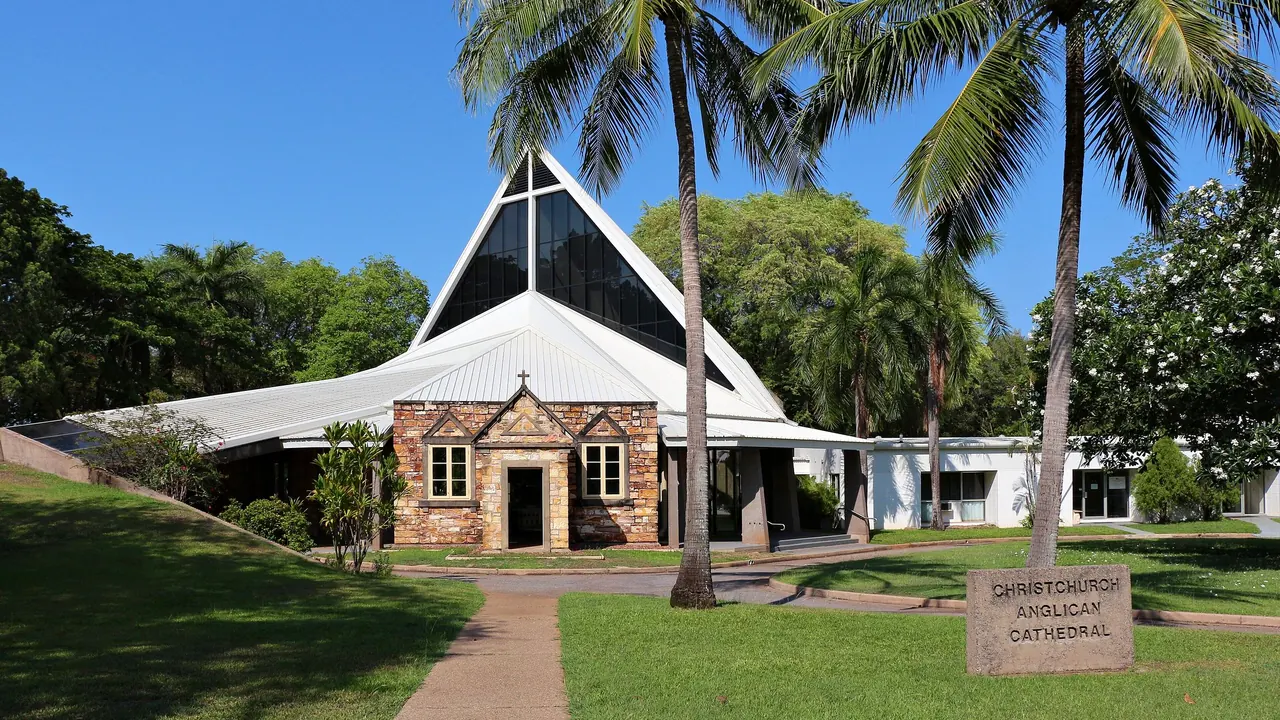
Christ Church Cathedral among the palms
- Nature & outdoors72
- Families55
- Food & drink44
Photo: Bernard Gagnon, CC BY-SA 4.0, cropped
Match
36
Every category weighted equally
- Beach & sun35
- Culture & arts34
- Food & nightlife34
- Family trip38
- Outdoors39
- Relax & unwind36
- Shopping & style35
- On a budget35
Darwin in twelve categories
Our verdict on each, scored 0 to 100 against the same fixed benchmark cities, so a score means the same thing on every page.
Beaches & swimming. Scores 22 out of 100.
Food & drink. Scores 44 out of 100.
Culture & sights. Scores 34 out of 100.
Nightlife. Scores 38 out of 100.
Nature & outdoors. Scores 72 out of 100.
Day trips. Scores 17 out of 100.
Good for families. Scores 55 out of 100.
Getting around. Scores 36 out of 100.
Shopping & style. Scores 30 out of 100.
Affordability. Scores 30 out of 100.
Live music & performing arts. Scores 27 out of 100.
Wellness & relaxation. Scores 29 out of 100.
Darwin category by category
Beaches & swimming
22Darwin sits on a warm tropical sea with long sandy beaches at Mindil, Casuarina and East Point, but swimming in that sea is not part of a normal stay. Box jellyfish drift in from roughly October to May, saltwater crocodiles live in the harbour and creeks all year, and locals generally stay out of the water. The beaches are for sunset walks, picnics and the dry-season market crowds rather than swimming.
Where people do swim is the Waterfront precinct, with a netted, patrolled recreation lagoon and a wave pool, plus the hotel and public pools. The spring-fed waterholes of Litchfield, about an hour and a half away, are the region's real swimming, and some close in the wet season.
Food & drink
44Eating in Darwin is shaped by its position closer to Southeast Asia than to most Australian cities. The markets are the heart of it: the dry-season sunset market at Mindil Beach, with stalls of Thai, Indonesian, Sri Lankan and Greek food eaten on the sand, and the Saturday market at Parap, where a bowl of laksa is something of a local ritual. Barramundi, mud crab and other tropical seafood appear on most menus, and crocodile and buffalo turn up for the curious.
Beyond that the scene is small. The waterfront and Mitchell Street have pubs, casual Asian places and a few more polished restaurants, but there is little fine dining and not much depth for a visitor staying a week.
Culture & sights
34Darwin's sights are few but specific to the place. The Museum and Art Gallery of the Northern Territory at Fannie Bay holds a fine collection of Aboriginal art and a sobering gallery on Cyclone Tracy, which flattened the city on Christmas Day 1974. The Second World War is the other thread: Darwin was bombed in 1942, and the oil storage tunnels under the city, the gun emplacements and military museum at East Point and the memorials along the Esplanade tell that story.
Little older architecture survived the cyclone and the bombing, so the centre is largely modern. A few stone survivors, such as Government House, the Old Court House and Brown's Mart, can be seen in an afternoon's walk.
Nightlife
38Going out in Darwin centres on Mitchell Street, a short strip of big open-air pubs, backpacker bars and a couple of late venues that fill up on Friday and Saturday nights and through the dry season. The mood is casual and boisterous, with a young traveller and local crowd, and it can stay loud past midnight.
Away from that strip the options thin quickly: waterfront bars for a sunset drink, the sailing club and a few quieter wine and cocktail bars. There is little in the way of a club scene, and outside the busy months many evenings end early.
Nature & outdoors
72Darwin is the gateway to the Top End, and the landscape around it is the main reason most visitors come. Litchfield National Park, about an hour and a half south, has waterfalls dropping into monsoon forest pools, giant magnetic termite mounds and short walking tracks. Closer in, the Territory Wildlife Park at Berry Springs shows the region's animals in natural settings, and boat cruises on the Adelaide River and the Mary River wetlands bring visitors face to face with large saltwater crocodiles and rich birdlife.
The coast is for watching rather than walking far: wallabies graze at East Point, the harbour sunsets are famous, and barramundi fishing draws anglers from across the country. The dry season, roughly May to September, is the time for all of this. The wet brings storms, heat and flooded roads, though also the most dramatic waterfalls. Kakadu, the great prize, is a long drive and best done overnight.
Day trips
17Within two hours of Darwin there are few towns or heritage sites to visit as such; the outings are almost all into national parks and wetlands. The main exception is the Tiwi Islands, reached by a short flight or a longer ferry, where guided visits take in Aboriginal art centres and the community of Wurrumiyanga.
On the road south, the small town of Adelaide River has a war cemetery for those killed in the 1942 raids, and Batchelor is a stop on the way to Litchfield. Katherine and its gorge are a long day away. Visitors who want towns and history should not expect them here.
Good for families
55Darwin works reasonably well with children if the trip is planned around its heat. The Waterfront precinct is the easiest base, with a netted swimming lagoon, a wave pool and grassy space by the harbour, and there is a free outdoor water park in the northern suburbs. Crocodiles are the star attraction: a central venue lets visitors see huge saltwater crocodiles up close, a crocodile park on the city's edge adds other animals, and jumping-crocodile cruises on the Adelaide River delight most children.
The Territory Wildlife Park and the fish feeding at Doctors Gully are other good outings, and the evening markets suit families. The drawbacks are real: the sea is not for swimming, the heat and humidity tire small children, and most outings need a car.
Getting around
36The centre of Darwin is small: the CBD, Mitchell Street, the Esplanade and the Waterfront are all a short walk apart, though the heat makes even short walks hard work in the middle of the day. Mindil Beach, Fannie Bay and East Point are a bus ride or a long, sunny walk along the coast, and the city's buses run across the suburbs but not often enough to rely on for a tight schedule.
There is no rail service for visitors and nothing reaches the national parks. Most people hire a car, often a four-wheel drive in the wet, or join tours for Litchfield, the wetlands and anything further out.
Shopping & style
30The one real reason to shop in Darwin is Aboriginal art. Galleries in the centre and around the city sell paintings, bark art, weavings and carvings from Arnhem Land, the Tiwi Islands and the desert communities, and buying from galleries linked to community art centres is the way to be sure the artists benefit.
Otherwise the offer is modest: the Smith Street Mall for everyday shopping, a large suburban mall at Casuarina, and the Mindil and Parap markets for crafts, jewellery and souvenirs. There is no luxury or fashion shopping to speak of.
Affordability
30Darwin is an expensive place to visit. Hotel rooms are pricey in the dry season, when most visitors come, and eating out costs what it does elsewhere in Australia, with drinks particularly dear. The real expense is getting out of the city: a hire car or guided tours are almost essential for the national parks and wetlands, and flights in and out are long.
There are ways to soften it. The markets are an inexpensive way to eat well, many outdoor sights and the main museum are free, and rooms are noticeably cheaper in the wet season, when fewer travellers come.
Live music & performing arts
27Darwin's performing arts calendar has one clear highlight: the Darwin Festival each August, a long-running event of theatre, music, dance, comedy and Aboriginal performance spread across outdoor stages around the city. For the rest of the year the offer is small. The Darwin Entertainment Centre hosts touring shows and concerts, the heritage Brown's Mart building stages local theatre, and pubs on Mitchell Street have cover bands and occasional gigs.
A visitor outside festival time will find something to see on a given week, but not a scene to plan a trip around.
Wellness & relaxation
29Darwin has no bathing or spa tradition of its own; wellness means a few hotel day spas and massage studios. What it does have is an unhurried, informal pace, with locals gathering on the foreshore at sunset and life slowing down in the heat of the afternoon.
The closest thing to a soak is the spring-fed pools at Berry Springs, about 45 minutes south, set in shady monsoon forest and best in the dry season. The heat and humidity of the build-up and wet season, from about October to April, make the city more tiring than restorative.
When should you go?
Pick a month to see what it is like. The climate figures are measured averages, not a forecast.
Darwin in July
Daytime high, °C
Rainfall in the month, mm
The whole year
Shaded against this city’s own year: the deepest cell is its best month for that figure and the palest its weakest.
Temperature and rainfall are climate normals, averaged over the years shown. Darwin: 1991-2020 normals, Darwin Airport (7.7 km from centre).
Before you go
| Measure | Darwin |
|---|---|
| Official language | English |
| Currency | Australian Dollar (AUD) |
| Sockets | I230 V, 50 Hz |
| Driving side | Left |
| Time zone | UTC+9:30 |
| Emergency number | 000 |
| Elevation | 0 m |
| Main airport | Darwin International Airport / RAAF Darwin (DRW)5 km from centre20 non-stop destinations |
| Public holidays this year | 12 days |
By the numbers
| Measure | Darwin |
|---|---|
| City population | 139,902 |
| People per km² | 3,446 |
| Museums within 10 km | 6 |
| UNESCO World Heritage sites within 50 km | 0 |
| Swim season, months above 21 °C | 12 months |
Compare Darwin with
Every comparison with a written verdict behind it.