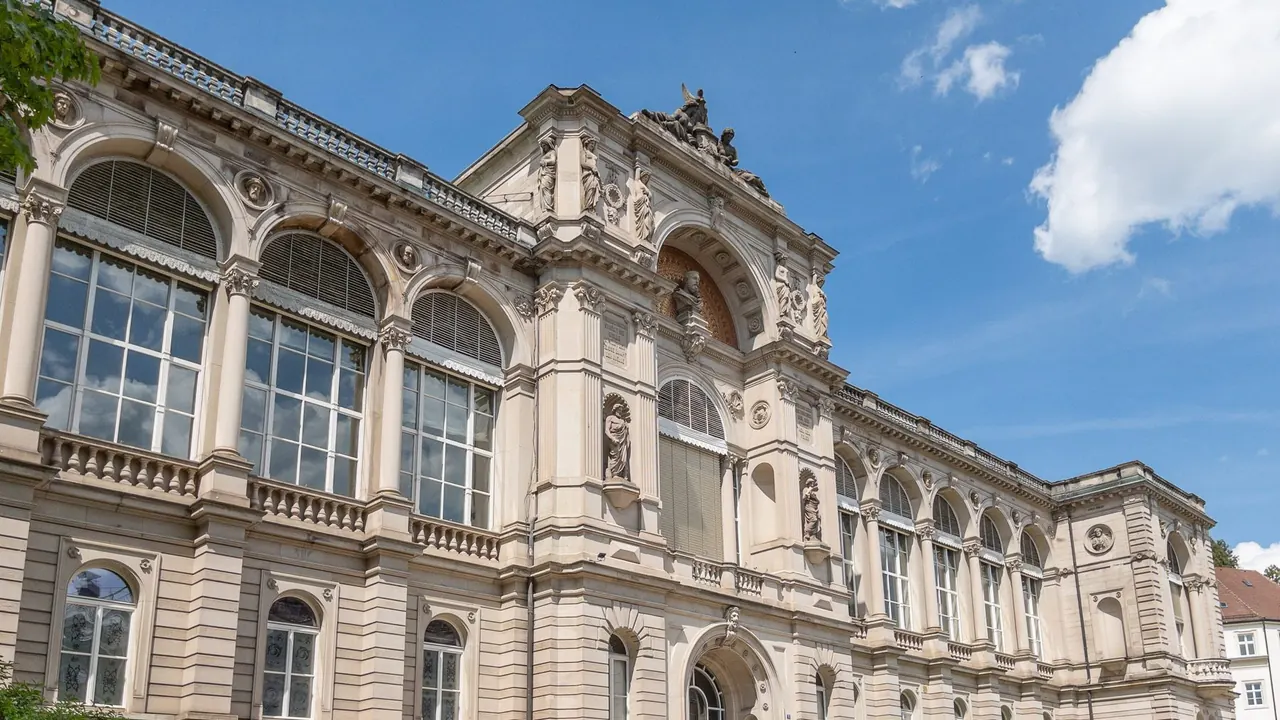
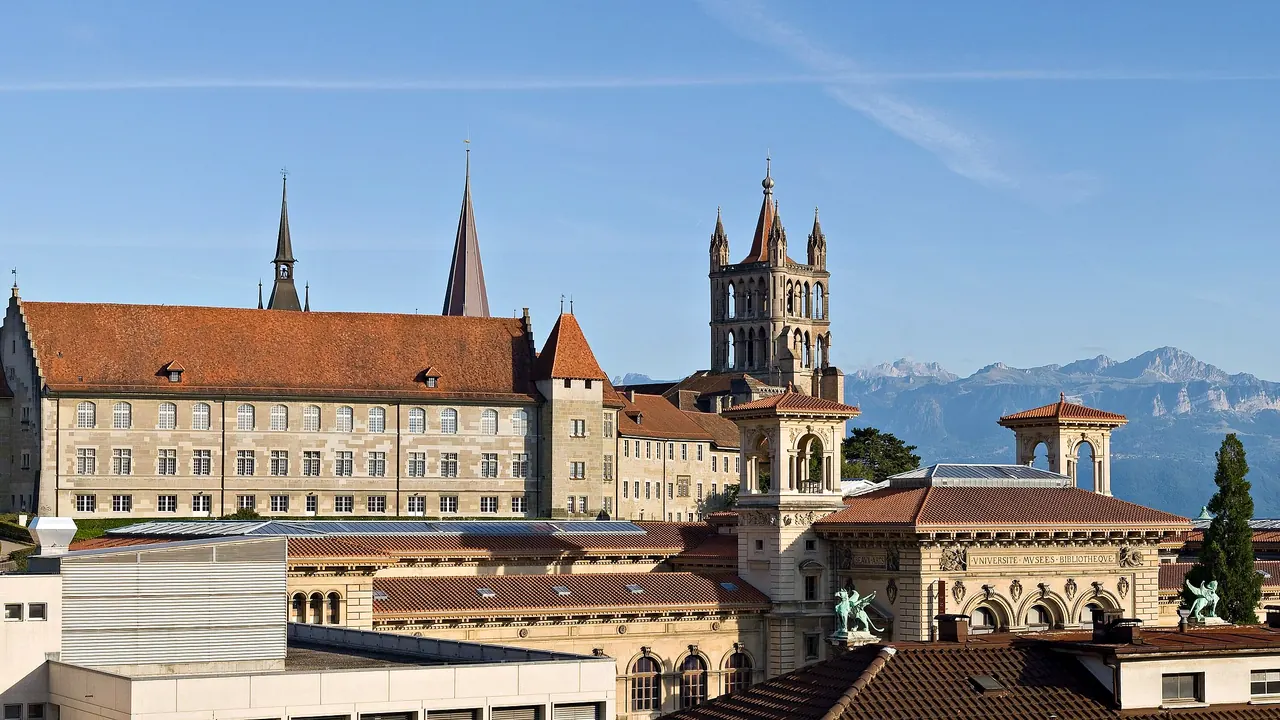
Photos: Baden-Baden by Kent Wang, CC BY-SA 2.0, cropped; Lausanne by Christian Mehlführer, CC BY-SA 3.0, cropped.
Baden-Baden or Lausanne?
Our verdict in twelve categories, each scored against the same fixed benchmark cities, and the climate month by month, so you can choose for your trip.
Choose Baden-Baden for
- wellness
- prices
Baden-Baden suits travellers who want to rest properly. The whole town is built around its hot springs, from the silent, domed Friedrichsbad to the big modern pools at Caracalla. Evenings are quiet and smart, with the Kurhaus casino or a classical concert at the Festspielhaus. It costs less than Lausanne, though it is still not cheap, and with a car Alsace and the Black Forest are close by.
Choose Lausanne for
- beaches
- nightlife
- families
Lausanne is the better pick for a more active, varied trip. Lake Geneva sits below the town with the Alps across the water, the Lavaux vineyard terraces run east along the shore, and you can be in the mountains in about an hour. It also has a real night out in the Flon, more for children to do and an excellent train network, so you don't need a car. The catch is cost, which is among the highest anywhere in Europe.
Scoreboard
Twelve categories on one fixed scale from 0 to 100. The shaded stretch is the gap between the two.
Your match
Pick a travel style or drag the sliders, and both match scores follow your weighting.
Wins on wellness and prices with your weighting.
Wins on beaches and nightlife with your weighting.
What matters to you?
Category by category
What the scores mean for a trip.
Beaches & swimming
Neither town is anywhere near the sea, but Lausanne at least has proper summer swimming. From late June to early September locals swim in Lake Geneva from the lawns, piers and pebbly shores at Vidy, Bellerive, Pully and Lutry, and the old lido at Bellerive makes a classic afternoon out.
Baden-Baden has only outdoor pools and the flooded gravel pits on the Rhine plain. Here the water to look forward to is hot spring water, not anywhere to swim outside.
Food & drink
Both sit in good wine country, and both have celebrated top-end restaurants within reach. Lausanne has the broader choice in town. Lake perch, papet vaudois and fondue are easy to find, the Saturday market around the Riponne brings in cheese and charcuterie, and you can taste wine straight from the growers in the Lavaux caveaux.
Baden-Baden's cooking leans on the Black Forest and Alsace: Flammkuchen, venison, ham and cherry gateau. In the small centre, though, much of the eating is in hotel dining rooms and cafés. The best of it is in the wine taverns of Varnhalt and Neuweier, or at the destination restaurants a drive away in the hills.
Culture & sights
There is about as much to see in each, but the sightseeing is of a different kind. In Baden-Baden the town itself is the sight: a Belle Époque spa resort among the Great Spa Towns of Europe, with the gilded Kurhaus, the colonnaded Trinkhalle and hillside villas above the Lichtentaler Allee. Add the two art museums side by side, the Fabergé museum and Brahms's summer house, and a day or two is enough.
Lausanne has a medieval core instead, with the Gothic cathedral on the hill, where a night watchman has called out the hours for centuries, and steep covered stairways below it. Its museums carry more weight: the Olympic Museum at Ouchy, the cluster at Plateforme 10 and the unusual Collection de l'Art Brut. Allow two or three days.
Nightlife
Lausanne is far livelier after dark, mostly thanks to its large student population. The Flon packs clubs and late bars into old warehouses, and on summer evenings people gather by the lake at Ouchy. Weeknights are quiet, though, and drinks are expensive.
In Baden-Baden the night out means dressing up for the casino in the Kurhaus, then a hotel bar or wine bar, and the streets are calm well before midnight. For clubs you have to go to Karlsruhe or Strasbourg.
Nature & outdoors
Lausanne has the more dramatic setting. The French Alps rise straight out of the lake opposite, the Lavaux terraces make a fine walk from Lutry to Saint-Saphorin, and there is sailing and paddleboarding in the warmer months. Proper mountains are about an hour away, with skiing at Villars and Les Diablerets and a glacier at Glacier 3000.
Baden-Baden's outdoors is gentler wooded upland. The Merkur funicular, the Battert cliffs and the Panoramaweg are all on the edge of town, and the Black Forest High Road climbs past the Mummelsee to the Hornisgrinde moorland. It is lovely for forest walks and autumn colour, but it is not high mountain country.
Day trips
Both are excellent bases, and Lausanne edges ahead mainly because you rarely need a car. Trains run along the lake to Montreux and Chillon, to Geneva in under an hour, and on to Bern, Fribourg and Gruyères. Boats cross the lake to Évian.
Baden-Baden puts you on a border. Strasbourg, the Alsace wine route and Colmar lie on one side, and Heidelberg, Freiburg and the UNESCO sites at Speyer and Maulbronn on the other. Many of the best outings are much easier by car.
Good for families
Lausanne is the easier place to bring children. The hands-on Olympic Museum, the freshwater aquarium-vivarium, the animal park and pedal boats at Sauvabelin, and the paddle steamers on the lake give you several days of outings in town. The drawbacks are steep streets for pushchairs and expensive family meals.
Baden-Baden is calm and safe, but it is made for adults, and young children are not allowed into the Friedrichsbad. Families tend to spend their days at Europa-Park, about an hour south, or at the zoo in Karlsruhe.
Getting around
Lausanne is better connected, despite its hills. The m2 metro climbs more than 300m from the lakeshore to the upper town, buses and lake boats cover the rest, and fast Swiss trains reach most places you would want to go.
Baden-Baden's centre is compact and easy on foot, but the station is a few kilometres out in Oos, so you need a bus to get there. Once you leave the main rail lines, the Black Forest and Alsace really call for a car.
Shopping & style
Neither is a shopping destination, and the two are similar in scale. Baden-Baden's Sophienstraße and Lange Straße are aimed at well-off spa guests, with jewellers, watchmakers and delicatessens. The souvenirs are cuckoo clocks and wine.
Lausanne has a slightly wider spread. You'll find Swiss watches and chocolatiers on Rue de Bourg, the familiar international chains around Saint-François and in the Flon, and market stalls in the old town squares.
Affordability
Both are expensive, but Baden-Baden is the more manageable of the two. It has simple guesthouses, bakeries and wine taverns at ordinary German prices and cheap buses, so the costs pile up mainly if you spend most of your time in the spas and grand hotels.
In Lausanne, everyday things like hotel rooms, simple lunches, wine and taxis all cost far more than in most of Europe. Visitors keeping costs down live on supermarket picnics, the free lakeside promenades and the odd glass of Chasselas in a village caveau.
Live music & performing arts
Both have a far richer stage life than towns their size usually do, but they excel at different things. Baden-Baden is about classical music. The Festspielhaus, one of Germany's largest opera and concert houses, brings in leading international orchestras, and the town's musical history goes back to Brahms and Clara Schumann.
Lausanne's strength is dance and new theatre. It is home to the Béjart Ballet and the Prix de Lausanne, and the Théâtre de Vidy stages contemporary work that tours Europe. In July the Montreux Jazz Festival is a short train ride along the lake.
Wellness & relaxation
This is Baden-Baden's whole reason for being, and nowhere else comes close. You can follow the old ritual of warm and hot rooms, scrubs and pools at the Friedrichsbad, then switch to the big modern pools and saunas at Caracalla. Around the baths, the town sets you up for slow afternoons along the Lichtentaler Allee and early nights.
Lausanne offers calm rather than bathing. It has lakeside promenades, walks through the Lavaux vines and spas in the grand hotels. For hot springs you take the train to Yverdon-les-Bains or Lavey-les-Bains.
When should you go?
Pick your month. The climate figures are measured averages, not a forecast.
Baden-Baden in July
Lausanne in July
Daytime high, °C
Rainfall in the month, mm
Where the figures come from
Lausanne's temperatures are measured 40 km from the centre, at Payerne.
Lausanne has no rain gauge within 25 km of the centre, so its rainfall comes from a gridded climate dataset read at the city rather than from a gauge further away.
Temperature and rainfall are climate normals, averaged over the years shown. Baden-Baden: 1991-2020 normals, Baden-Baden-Geroldsau (3.9 km from centre). Lausanne: 1991-2020 (sunshine 1961-1990) normals, Payerne (39.7 km from centre).
The two follow much the same pattern through the year. Both are cold and grey in winter, pleasant in spring and autumn, and warm but rarely hot in summer, with highs of about 25°C in July and August in each. Summer is warm enough for long walks, though too short a season for anything like a sun vacation. From November to February both towns are cold and dull, but Lausanne is a little colder and gets a little more sun. Its nearby mountains are also often sunny above the winter fog.
The rain is where they differ. In Baden-Baden it is spread evenly through the year, with no dry season, and December is the wettest month at about 122mm. Lausanne is drier from late winter into spring and wetter from May to September. It also has noticeably more sunshine in high summer. That summer is also when the lake is warm enough for a swim, roughly from late June to early September. For Baden-Baden, May, June and September are the easiest months to enjoy the forest and the wine villages. For Lausanne, June to September suits the lake and the mountains best.
Which traveller are you?
On a relaxing and wellness trip, Baden-Baden is the clear choice. Roman-era hot springs feed the Friedrichsbad and Caracalla, the grand hotels have their own spas, and the whole town keeps a slow pace. Lausanne has no bathing tradition of its own, and for thermal water you have to take a train out of town.
For a food and nightlife trip, Lausanne is the better pick. You get lake perch and Lavaux Chasselas by day. At weekends there are clubs and late bars in the Flon's old warehouses. Baden-Baden has good regional cooking and wine taverns, but its evenings are quiet, older and over early.
On a tight budget, Baden-Baden is easier on the wallet, though neither town is cheap. Simple guesthouses, bakeries and the taverns of the Rebland wine villages are fairly priced by German standards. In Lausanne, Swiss prices make even a simple lunch out expensive, so picnics are the norm.
Before you go
| Measure | Baden-Baden | Lausanne |
|---|---|---|
| Official language | German | French, German, Italian, Romansh |
| Currency | Euro (EUR) | Swiss Franc (CHF) |
| Sockets | CF230 V, 50 Hz | CJ230 V, 50 Hz |
| Driving side | Right | Right |
| Time zone | UTC+1, UTC+2 in summer | UTC+1, UTC+2 in summer |
| Emergency number | 112 | 112 |
| Elevation | 181 m | 495 m |
| Main airport | Karlsruhe Baden-Baden Airport (FKB)12 km from centre43 non-stop destinations | Geneva International Airport (GVA)52 km from centre150 non-stop destinations |
| Public holidays this year | 12 days | 9 days |
By the numbers
| Measure | Baden-Baden | Lausanne |
|---|---|---|
| City population | 56,952 | 144,873 |
| People per km² | 406 | 3,499 |
| Museums within 10 km | 11 | 31 |
| UNESCO World Heritage sites within 50 km | 3 | 3 |
Where else could you go?
Every comparison below shares a destination with this one, so you can follow Baden-Baden or Lausanne somewhere new.
- Strasbourgvs Baden-Baden
- Genevavs Lausanne
- Stuttgartvs Baden-Baden
- Chamonixvs Lausanne
- Bernvs Lausanne
- Heidelbergvs Baden-Baden