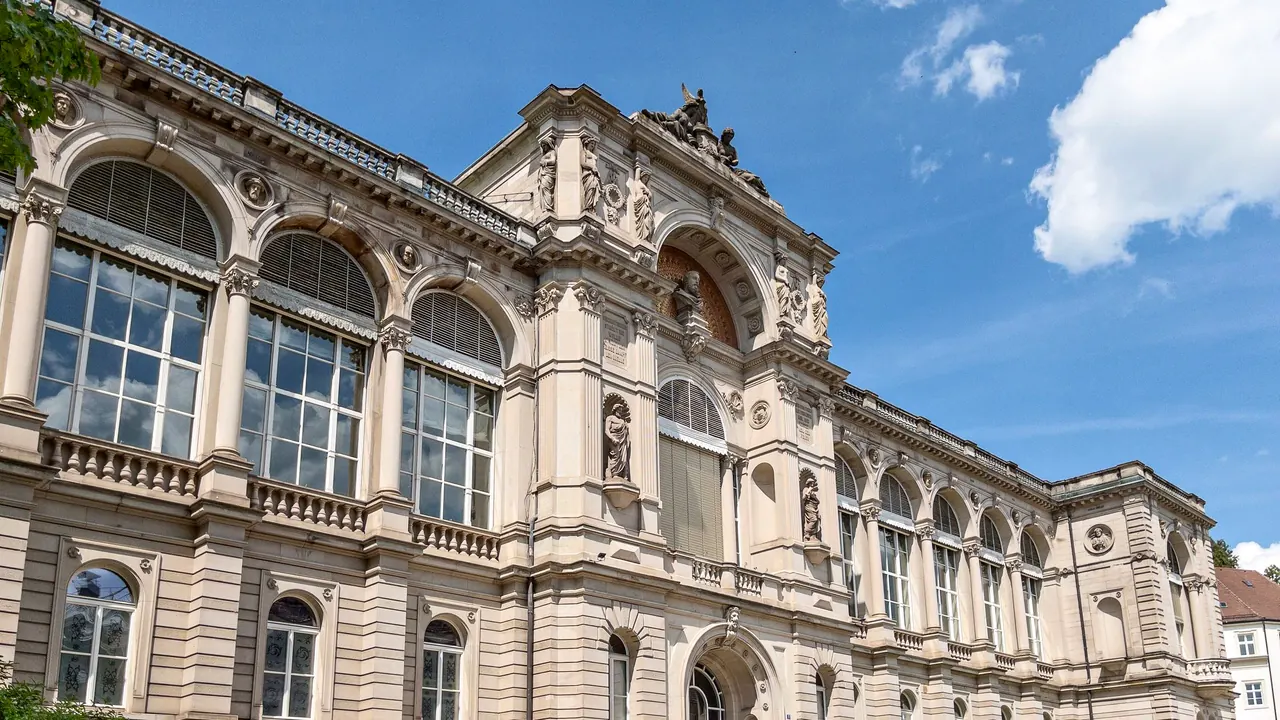
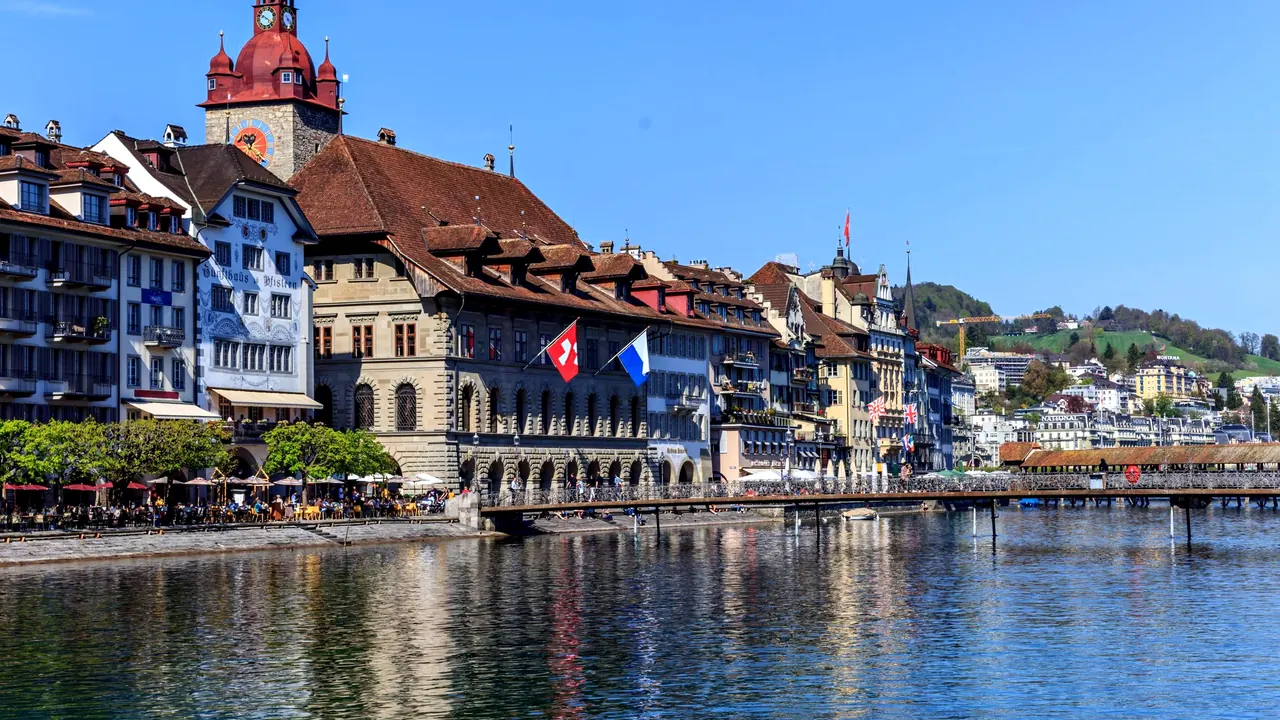
Photos: Baden-Baden by Kent Wang, CC BY-SA 2.0, cropped; Lucerne by ILOVESwitzerland, Pexels License.
Baden-Baden or Lucerne?
Our verdict in twelve categories, each scored against the same fixed benchmark cities, and the climate month by month, so you can choose for your trip.
Choose Baden-Baden for
- wellness
- prices
- food and drink
Baden-Baden is for a slow, restorative stay built around the thermal baths. The Friedrichsbad ritual and Caracalla's pools set the pace, the evenings belong to the Rebland wine taverns, and the regional cooking is better than anything Lucerne serves. It is also the cheaper of the two by a clear margin, and Strasbourg, Alsace and Heidelberg are all within reach for days out.
Choose Lucerne for
- beaches
- getting around
- nature and the outdoors
Travellers who want mountains should pick Lucerne. Pilatus, Rigi and the Stanserhorn rise straight from the lake, and steamers and cogwheel railways take you there without a car. The Transport Museum and summer swimming in the lake also make it the easier choice for families. It costs more, but the scenery is far grander.
Scoreboard
Twelve categories on one fixed scale from 0 to 100. The shaded stretch is the gap between the two.
Your match
Pick a travel style or drag the sliders, and both match scores follow your weighting.
Wins on wellness and prices with your weighting.
Wins on beaches and getting around with your weighting.
What matters to you?
Category by category
What the scores mean for a trip.
Beaches & swimming
Neither is a beach destination, but Lucerne at least has a summer swimming culture. In July and August locals swim from the Lido, the old wooden lake baths and the lawns at Ufschötti, with mountains behind the water. Steamers also reach small bathing spots in the lakeside villages.
Baden-Baden has nothing like this in town. A swim means an outdoor pool or a flooded gravel pit out on the Rhine plain, and the water people come for is the hot spring kind.
Food & drink
Baden-Baden eats better. It lies in Baden, one of Germany's strongest food regions, with Flammkuchen, venison and Black Forest ham on the menus and French influence from across the Rhine. The Rebland wine taverns just outside town pour Riesling and Pinot Noir, and some of Germany's most celebrated restaurants are a drive away in the northern Black Forest.
Lucerne's cooking is hearty and reliable: Chügelipastete, rösti, fondue and lake perch in wood-panelled guild houses. But the range is narrow, and many tables near the Chapel Bridge cater to tour groups.
Culture & sights
Each town makes for a day or two of sightseeing, and Lucerne edges ahead thanks to a few famous sights. The Chapel Bridge and Water Tower, the towers of the Musegg Wall that you can climb, the Lion Monument, and the Picasso and Klee works at the Rosengart Collection are all within a short walk of each other.
Baden-Baden's appeal lies in the whole townscape rather than single landmarks. The Belle Époque spa resort, with the Kurhaus, the Trinkhalle and the hillside villas, is one of the Great Spa Towns of Europe. The Museum Frieder Burda and the Kunsthalle next door make a good pair for modern art.
Nightlife
Neither suits a big night out, but Lucerne has a little more going on. There are riverside pubs and wine bars, and around the Neustadt a few cocktail bars and a small club scene that students keep going at weekends. At Fasnacht the Old Town becomes an all-night carnival.
Baden-Baden's evenings are dressier and quieter still. They centre on the gilded casino rooms of the Kurhaus and on hotel bars with an older crowd, and anyone after clubs goes to Karlsruhe or Strasbourg.
Nature & outdoors
This is Lucerne's strongest suit. Real Alpine peaks rise from the lakeshore: a cogwheel railway climbs Pilatus, Rigi has ridge walks, the Stanserhorn has an open-top cable car and Titlis has snow all year. Steamers make it easy to combine a boat, a train and a hike in one day.
Baden-Baden's outdoors is gentler. There is the Merkur funicular, climbing on the Battert cliffs, fir forest and vineyard paths, and the High Road up to the moorland of the Hornisgrinde. It is good walking country, but it is wooded hills rather than mountains, and the skiing is modest.
Day trips
Both make excellent bases. The difference is which direction you travel. Baden-Baden is close to the French border, with Strasbourg and the Alsace wine villages, Heidelberg, Freiburg, the palaces of Karlsruhe and Rastatt and Speyer's UNESCO cathedral all in range, though many of these are easier with a car.
Lucerne's outings stay in Switzerland and almost all go by train or boat. Zurich, Bern and Basel are each under an hour away. The lake leads to the Rütli meadow and Altdorf in William Tell country, and a scenic line runs over the Brünig Pass to Interlaken.
Good for families
Lucerne is the easier base for families. The Swiss Museum of Transport can fill a whole day, and the Glacier Garden and the Goldau wildlife park add more. Paddle steamers, cogwheel trains and the toboggan run on Pilatus make the journeys part of the fun when the weather holds.
Baden-Baden is calm and safe but made for adults, and young children are not allowed into the Friedrichsbad. Families tend to spend their days at Europa-Park, about an hour south, or at Karlsruhe's zoo.
Getting around
Lucerne is the simpler place to be without a car. The station, the boat piers and the Old Town are all together on the lakefront. Steamers, trains, cogwheel railways and cable cars all run on the same integrated Swiss tickets, and the network reaches deep into the mountains.
Baden-Baden's centre is compact but has some steep streets, and the station is a bus ride away in Oos. Trains serve the bigger cities well, but the High Road, the wine villages and Alsace are much easier with a car.
Shopping & style
Both offer small-town shopping aimed at well-off visitors. Lucerne has a slight edge thanks to its watch trade, with large watch houses on Schwanenplatz, along with chocolate, army knives and a Saturday riverside market for produce and crafts.
Baden-Baden's Sophienstraße and Lange Straße have jewellers, boutiques and delicatessens for a wealthy spa crowd. They are pleasant to browse, but there is no real market, and keen shoppers go over to Strasbourg.
Affordability
Baden-Baden is clearly the cheaper of the two, and it is easy to see where the money goes. The spending comes from the baths, since the Friedrichsbad and Caracalla charge for every visit, and from the grand hotels that set the tone of the town. Local buses are cheap, so a stay that rations its spa sessions costs noticeably less than one built around them.
In Lucerne the main costs are getting around and finding a bed. The cogwheel railways, cable cars and lake steamers that make the trip worthwhile each cost a lot, and central hotel rooms get dearer still in summer and during the music festival. A Swiss travel pass covers the boats and some excursions, which helps, but it does not make Lucerne a cheap stay.
Live music & performing arts
Both are small towns with unusually strong classical music. Lucerne goes further because of the Lucerne Festival, which brings the world's leading orchestras to Jean Nouvel's lakefront hall, famous for its acoustics. Fasnacht's Guggenmusik brass bands and some blues and jazz add a little variety.
Baden-Baden's Festspielhaus, built into the old railway station, is one of Germany's largest opera and concert houses, and the town's links to Brahms and Clara Schumann run deep. Beyond classical music, though, there is little on offer.
Wellness & relaxation
Here Baden-Baden has no real rival. The town exists because of its hot springs. The domed Friedrichsbad, with its silent sequence of rooms, and Caracalla's modern pools and saunas shape a stay, along with grand hotel spas and slow walks on the Lichtentaler Allee.
Lucerne has no bathing tradition of its own. Its calm comes from steamer rides and lakeside promenades, and for a proper soak there are hotel spas or the Botta-designed mineral bath high on the Rigi.
When should you go?
Pick your month. The climate figures are measured averages, not a forecast.
Baden-Baden in July
Lucerne in July
Daytime high, °C
Rainfall in the month, mm
Where the figures come from
Lucerne has no rain gauge within 25 km of the centre, so its rainfall comes from a gridded climate dataset read at the destination rather than from a gauge further away.
Lucerne's sunshine is measured 42 km from the centre, at Zurich Town / Ville..
Temperature and rainfall are climate normals, averaged over the years shown. Baden-Baden: 1991-2020 normals, Baden-Baden-Geroldsau (3.9 km from centre). Lucerne: 2005-2025 (sunshine 1991-2020, rainfall 1991-2020) normals, Emmen (4.2 km from centre).
Both towns are at their best from June to September, when daytime highs reach the mid-20s. Baden-Baden is a little warmer and sunnier in high summer, with about 243 hours of sun in July, and its rain is spread fairly evenly through the year. In Lucerne summer is the wettest season, with around 141mm in July and August, so plan mountain days with some flexibility. July and August are also the only months when the lake is warm enough for most swimmers.
Spring and autumn suit walking in both towns. April is noticeably sunnier in Baden-Baden, and October brings autumn colour to the Black Forest. Winters are grey and cold in each, around 4°C in Lucerne in December and January. In winter Baden-Baden's hot baths come into their own, while Lucerne turns to skiing and sledging in the mountains above.
Which traveller are you?
For a relaxing and wellness trip, Baden-Baden is the clear choice. The whole town runs around its Roman-era springs, the silent Friedrichsbad and Caracalla's saunas. Lucerne offers hotel spas, and the Botta mineral bath up on the Rigi is a day out in itself.
On an outdoors trip, Lucerne wins easily. Boats, rack railways and cable cars reach Pilatus, Rigi, the Stanserhorn and the glacier snow of Titlis, and winter brings skiing. Baden-Baden's Black Forest trails are lovely but gentler, wooded upland rather than Alps.
On a tight budget, Baden-Baden is the easier of two expensive places. Its guesthouses, bakeries and wine taverns are fairly priced by German standards. In Lucerne, even simple meals and the mountain railways that make the trip worthwhile push costs up steeply.
Before you go
| Measure | Baden-Baden | Lucerne |
|---|---|---|
| Official language | German | French, German, Italian, Romansh |
| Currency | Euro (EUR) | Swiss Franc (CHF) |
| Sockets | CF230 V, 50 Hz | CJ230 V, 50 Hz |
| Driving side | Right | Right |
| Time zone | UTC+1, UTC+2 in summer | UTC+1, UTC+2 in summer |
| Emergency number | 112 | 112 |
| Elevation | 181 m | 436 m |
| Main airport | Karlsruhe Baden-Baden Airport (FKB)12 km from centre44 non-stop destinations | Zürich Airport (ZRH)49 km from centre226 non-stop destinations |
| Public holidays this year | 12 days | 12 days |
By the numbers
| Measure | Baden-Baden | Lucerne |
|---|---|---|
| Population | 56,952 | 86,234 |
| People per km² | 406 | 2,963 |
| Museums within 10 km | 11 | 14 |
| UNESCO World Heritage sites within 50 km | 3 | 1 |
Where else could you go?
Every comparison below shares a destination with this one, so you can follow Baden-Baden or Lucerne somewhere new.
- Zurichvs Lucerne
- Strasbourgvs Baden-Baden
- Interlakenvs Lucerne
- Bernvs Lucerne
- Stuttgartvs Baden-Baden
- Baselvs Lucerne