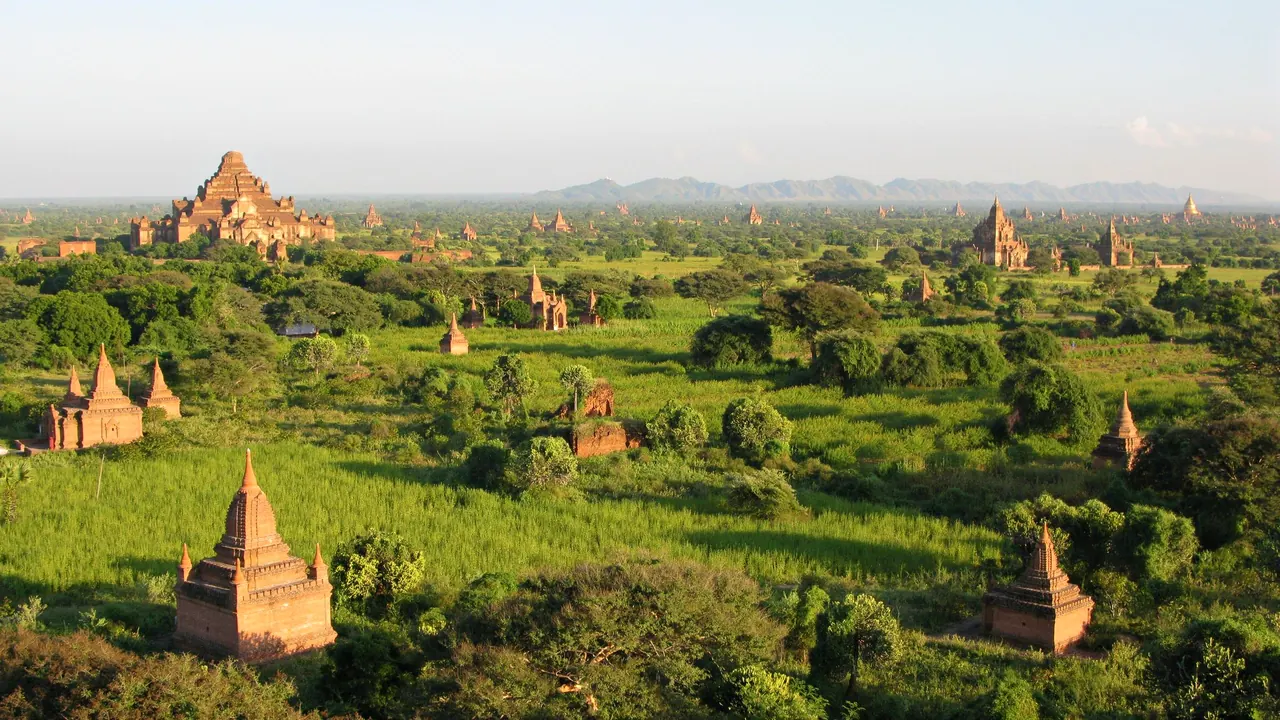
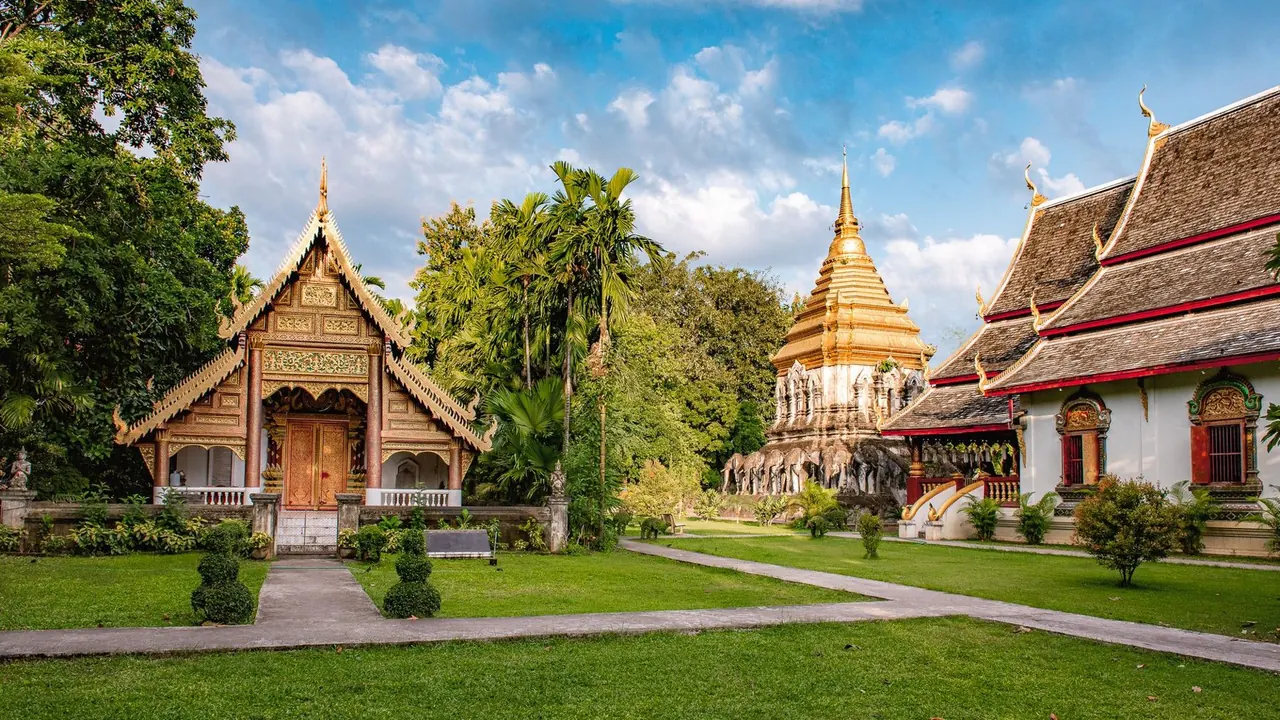
Photos: Bagan by Vyacheslav Argenberg, CC BY 4.0, cropped; Chiang Mai by Gije Cho, Pexels License.
Bagan or Chiang Mai?
Our verdict in twelve categories, each scored against the same fixed benchmark cities, and the climate month by month, so you can choose for your trip.
Choose Bagan for
- culture and sights
Bagan is for the traveller who wants one extraordinary sight and is happy to build the whole trip around it. The plain of more than two thousand temples, stupas and monasteries by the Irrawaddy outclasses anything in Chiang Mai for sheer historic scale. In return you accept simple food, quiet evenings and long dusty rides between monuments. Two or three days of dawn starts, e-bike rides and sunset boats suit a history lover best.
Choose Chiang Mai for
- food and drink
- wellness
- nightlife
If you want a place to settle into for a week or more, Chiang Mai is the better choice. Its temples are fewer and smaller, but northern Thai cooking, a deep café culture, Thai massage on every street, mountain forest at the edge of town and relaxed bars all give it far more range. It works better for families, for people who want time in the outdoors and for anyone who wants their evenings to be as good as their days.
Scoreboard
Twelve categories on one fixed scale from 0 to 100. The shaded stretch is the gap between the two.
Your match
Pick a travel style or drag the sliders, and both match scores follow your weighting.
Wins on culture and sights with your weighting.
Wins on food and drink and wellness with your weighting.
What matters to you?
Category by category
What the scores mean for a trip.
Beaches & swimming
You won't find a beach in either city, since both lie far inland. Bagan's broad, silty Irrawaddy is for boat trips rather than swimming, so a hotel pool is the only way to cool off there.
Chiang Mai gives you a bit more. There is the reservoir at Huay Tung Tao, quarry lakes and pools below waterfalls. If you want the sea, plan a separate leg to the southern islands.
Food & drink
Chiang Mai is much the better place to eat. Northern Thai cooking is a draw in its own right: khao soi, herb-heavy sai ua sausage, nam prik noom and sticky rice, served at Warorot market, at the Chang Phueak Gate stalls and along the weekend walking streets. Locally grown coffee adds a café culture Bagan has nothing to match.
Bagan's good meals are Burmese curry spreads with their many side dishes, tea-leaf salad and mohinga in the tea shops. Beyond that, many restaurants serve the same tourist menu, and you eat to fuel the temple days.
Culture & sights
Here Bagan is clearly ahead. Nearly a thousand years ago the Pagan kings covered a wide bend of the Irrawaddy with temples, stupas and monasteries, and so many still stand that you can ride from one to the next for days. The gilded Shwezigon, the white Ananda and the brick mass of Dhammayangyi are the landmarks, but the small shrines with faded murals along the dirt tracks are often more memorable. The drawback is sameness.
Almost everything comes from one era, and damage from the 2016 earthquake and some heavy-handed restoration are easy to see.\n\nChiang Mai's culture is gentler and fits inside the moat. Wat Chedi Luang's ruined chedi, the Lanna wooden halls of Wat Phra Singh and the silver Wat Sri Suphan make good slow walks, with Doi Suthep looking down from its mountain. The Lanna Folklife Museum gives some background. You get a few days of temple lanes rather than a heritage site on Bagan's scale.
Nightlife
Bagan has no nightlife. The pre-dawn sunrise outings mean a beer with dinner on Nyaung U's restaurant strip is as late as it gets.
Chiang Mai has real evenings, though not wild ones. You can drink craft beer and cocktails among students in Nimmanhaemin, try the backpacker bars and rooftops around Tha Phae Gate, or go to the brasher Loi Kroh Road. Most places close around midnight.
Nature & outdoors
Chiang Mai sits among green mountains, and Doi Suthep-Pui National Park begins at the western edge of town with trails and waterfalls. Doi Inthanon's cloud forest is within reach, and the Mae Taeng valley offers rafting, ziplines and treks to hill villages.
Bagan's landscape is a dry, flat plain of palms and peanut fields. Its beauty comes from the temples on it, seen from a balloon or a river boat. Mount Popa is the only real high ground nearby.
Day trips
Both cities have a classic outing that takes about an hour and a half: the steps up to Taung Kalat on Mount Popa from Bagan, and Lampang with its horse carriages and Wat Phra That Lampang Luang from Chiang Mai. Bagan adds teak-monastery Salay and market town Pakokku, and then you run out of options.
Chiang Mai has more close by. Lamphun's golden chedi is half an hour away, and the craft villages of Bo Sang and San Kamphaeng and hill village Mae Kampong make easy half days. Chiang Rai and Pai are better as overnight stays.
Good for families
Chiang Mai is the easier choice with children. Elephant sanctuaries where you feed and walk the animals, the zoo and Night Safari, the quarry swimming parks and gentle waterfall walks give you a week of outings. Broken pavements and the hazy burning season are the drawbacks.
Bagan suits older children who enjoy history, balloons and cycling between temples. Younger ones will find little made for them, the plain is hot and dusty, and medical care is basic.
Getting around
Neither city has public transport in the usual sense, but Chiang Mai is easier to get around. Its moated old city can be walked, red songthaews and tuk-tuks are flagged down in the street, and ride-hailing makes trips to Nimmanhaemin or the airport easy.
In Bagan, Nyaung U, Old Bagan and New Bagan lie kilometres apart with temples scattered between them. That makes an e-bike on sandy tracks, a horse cart or a driver hired for the day the normal way to get about.
Shopping & style
Bagan's shopping comes down to lacquerware, and it does that one thing well. In the Myinkaba and New Bagan workshops you can watch bowls and boxes built up from bamboo and horsehair under coat after coat of lacquer, then buy straight from the maker. Outside that, there are sand paintings sold hard at the temples and longyi cloth and thanaka at Nyaung U market.
Chiang Mai gives you far more to browse. The Sunday Walking Street on Ratchadamnoen, the Saturday market on Wualai Road, where the silversmiths used to work, and the Night Bazaar every evening are full of textiles, ceramics, carved wood and hill-tribe embroidery. Bo Sang umbrellas, San Kamphaeng silk and Nimmanhaemin's design studios add to that. You still come away with handmade things rather than fashion labels.
Affordability
Both cities are very cheap, so the difference lies in where the money goes. In Bagan the costs are the archaeological zone fee, the better hotels in Old Bagan and an expensive balloon flight, while days of temple hopping cost almost nothing.
In Chiang Mai daily life is cheap, from street food to temples to massages, but organised extras add up. Sanctuary visits, treks, cooking classes and the hill resorts are the costs to plan for.
Live music & performing arts
In Bagan an evening show usually means marionettes or traditional dance put on for diners in a restaurant, and that is pleasant enough. If you happen to be there for a pagoda festival such as Ananda's, an all-night zat pwe of music, dance and comedy is the real local thing.
Chiang Mai has live music every night. There are jazz and blues jam sessions near the north gate and rock and acoustic bands in Nimmanhaemin, as well as khantoke dinners with Lanna dance, Muay Thai fight nights and Yi Peng processions. Neither city has opera, concert halls or regular theatre.
Wellness & relaxation
Chiang Mai is one of Thailand's main places for slowing down. It is the best-known city to learn Thai massage, has yoga studios and herbal steam rooms, and offers meditation at Wat Umong and Wat Suan Dok. The springs at San Kamphaeng are less than an hour away.
Bagan's calm is simpler: a pool and a Burmese massage at a riverside resort through the hot midday, then the light fading over the plain. Heat, dust and touts get in the way more often.
When should you go?
Pick your month. The climate figures are measured averages, not a forecast.
Bagan in July
Chiang Mai in July
Daytime high, °C
Rainfall in the month, mm
Where the figures come from
Bagan has no weather station within reach, so its figures come from a gridded climate model rather than a measured record, and read a broad area rather than the city itself.
Temperature and rainfall are climate normals, averaged over the years shown. Bagan: 2001-2020 normals, NASA POWER reanalysis grid, no weather station within 90 km. Chiang Mai: 1991-2020 normals, Chiang Mai (0.6 km from centre).
Both cities are at their best from November to February, when afternoons reach about 30°C, the air is dry and walking or cycling is comfortable. Both heat up hard after that. Bagan is the fiercer of the two, with highs near 39°C in April that make midday on the open temple plain punishing. Chiang Mai stays a little cooler, but from about February to April smoke from field burning hangs in its valley.
The rains are where the two really differ. Bagan lies in Myanmar's dry zone and even its wettest month, July, brings only about 71mm, so temple touring is possible all year if you can take the heat. Chiang Mai has a true monsoon. Rain builds from May to a peak of about 234mm in August, sunshine hours roughly halve, and the hills turn green but muddy until October.
Which traveller are you?
On a culture and arts trip, choose Bagan. Its plain of Pagan-era temples is one of Asia's great monuments, from the Ananda Temple to small brick shrines with faded murals. Chiang Mai's old-city temples are lovely but much smaller in scale.
For a food and nightlife trip, Chiang Mai wins easily. You get khao soi and sai ua at the markets, coffee from the surrounding hills, and then cocktails in Nimmanhaemin or jazz near the north gate. In Bagan dinner is usually the last event of the day.
On a relaxing and wellness trip, Chiang Mai is the place. Massage schools, garden spas in teak houses, yoga, temple meditation retreats and the San Kamphaeng hot springs suit a slow stay. Bagan offers resort pools and a quiet plain, broken up by heat and touts.
Before you go
| Measure | Bagan | Chiang Mai |
|---|---|---|
| Official language | Burmese | Thai |
| Currency | Kyat (MMK) | Baht (THB) |
| Sockets | CFG230 V, 50 Hz | ABCF220 V, 50 Hz |
| Driving side | Right | Left |
| Time zone | UTC+6:30 | UTC+7 |
| Emergency number | Police 199, ambulance 192, fire 191 | Police 191, ambulance 1669, fire 199 |
| Elevation | 75 m | 310 m |
| Main airport | Bagan Airport (NYU)7 km from centre | Chiang Mai International Airport (CNX)3 km from centre28 non-stop destinations |
By the numbers
| Measure | Bagan | Chiang Mai |
|---|---|---|
| City population | 22,000 | 1,198,000 |
| People per km² | - | 2,958 |
| Museums within 10 km | 1 | 6 |
| UNESCO World Heritage sites within 50 km | 1 | 0 |
Where else could you go?
Every comparison below shares a destination with this one, so you can follow Bagan or Chiang Mai somewhere new.
- Paivs Chiang Mai
- Chiang Raivs Chiang Mai
- Luang Prabangvs Chiang Mai
- Yangonvs Chiang Mai
- Vientianevs Chiang Mai
- Paivs Bagan