Photos: Bagan by Vyacheslav Argenberg, CC BY 4.0, cropped; Siem Reap by allPhoto Bangkok, Pexels License.
Bagan or Siem Reap?
Our verdict in twelve categories, each scored against the same fixed benchmark cities, and the climate month by month, so you can choose for your trip.
Choose Bagan for
Bagan does not lead in any category we score.
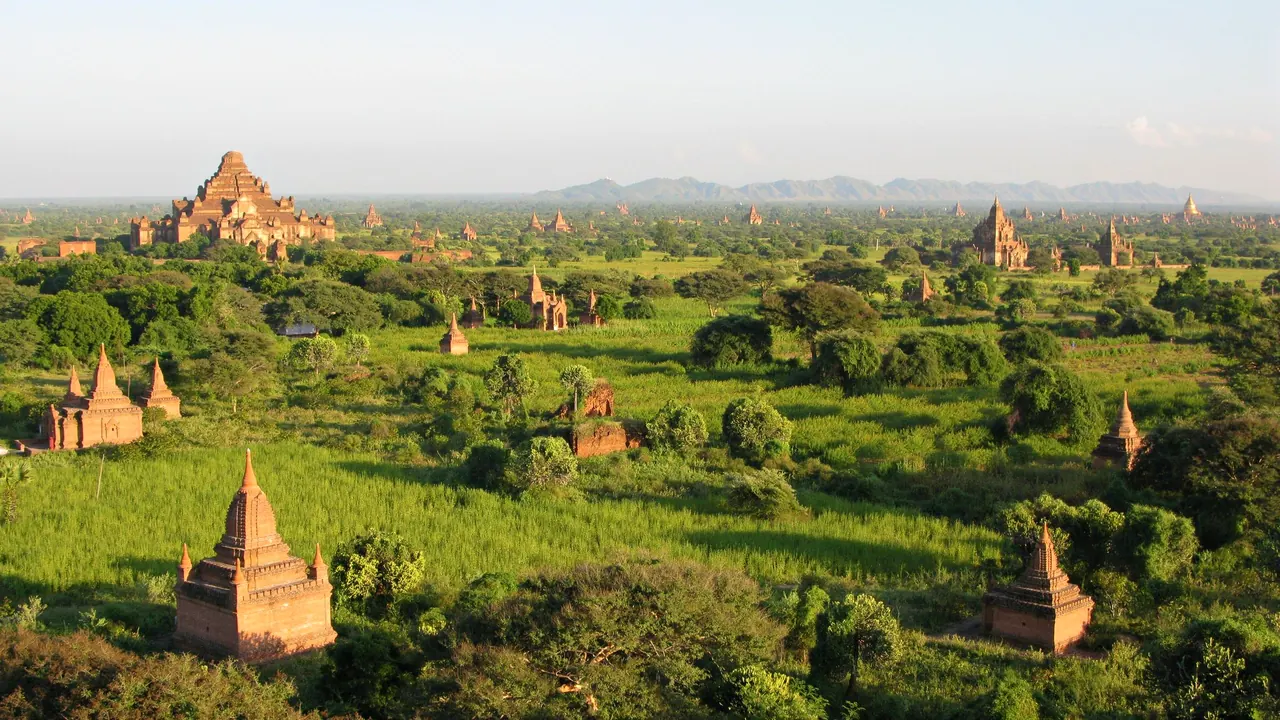
Bagan is for the traveller who wants the temples and very little else. Its brick shrines stand across an open plain, you can reach them by e-bike along sandy tracks, and the evenings end early and quietly. Choose it if a dawn balloon flight, sunset from a mound and nights with nothing to do sound like the whole point.
Choose Siem Reap for
- nightlife
- wellness
- day trips
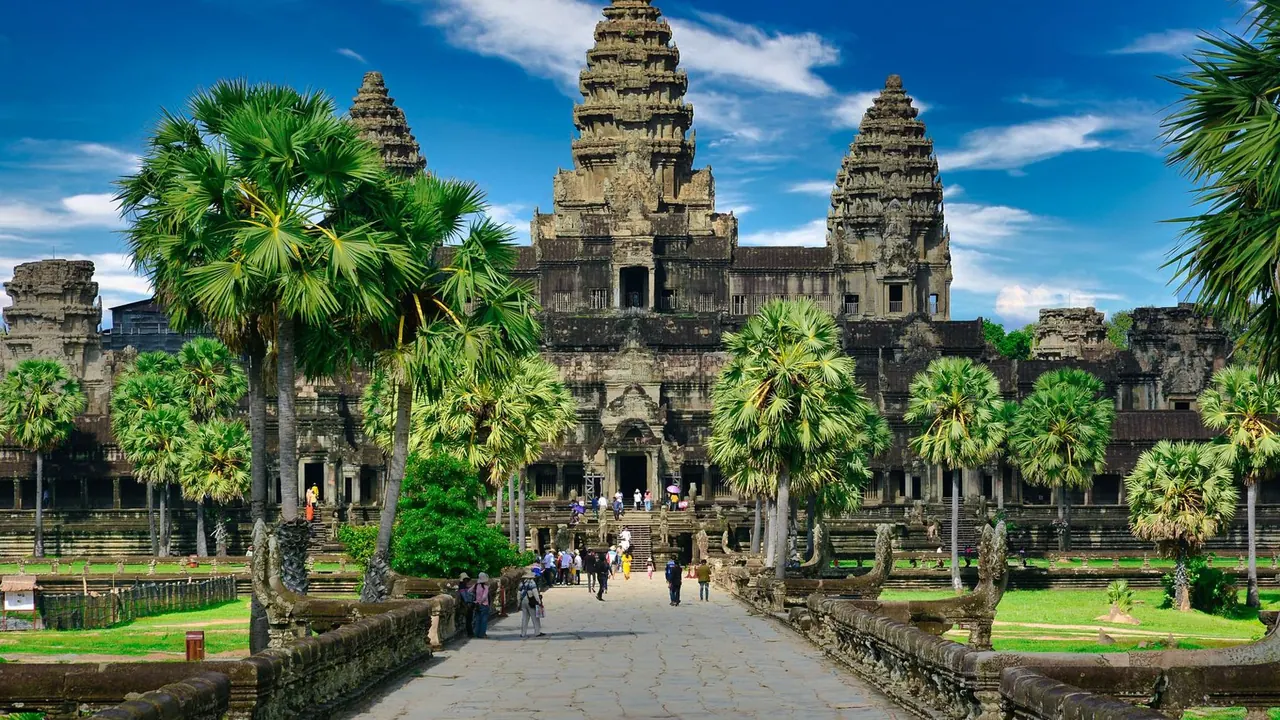
Siem Reap gives a fuller trip around equally great ruins. The forest temples of Angkor come with Khmer cooking worth seeking out, a lively bar street, massage on every corner, apsara dance and a celebrated circus in the evenings, and better outings beyond the main park. It is the safer choice for families, first-timers to the region and anyone who wants their afternoons and nights to have something in them.
Scoreboard
Twelve categories on one fixed scale from 0 to 100. The shaded stretch is the gap between the two.
Your match
Pick a travel style or drag the sliders, and both match scores follow your weighting.
Has no clear advantage with the weighting you have chosen.
Wins on nightlife and wellness with your weighting.
What matters to you?
Category by category
What the scores mean for a trip.
Beaches & swimming
Neither has a beach, so for both, swimming means the hotel pool. In Bagan the Irrawaddy is for sunset boat trips rather than bathing, and you need to choose a place to stay with a pool, because not all of them have one.
Siem Reap's Tonle Sap is a vast, muddy lake. Pools are standard at most guesthouses and resorts, and the afternoon swim after a dawn at the temples is built into the rhythm of a stay here. The Gulf of Thailand coast is most of a day's drive away.
Food & drink
Siem Reap eats noticeably better. Khmer cooking has real depth, from fish amok in banana leaf to morning stalls ladling green fish curry over rice noodles, and a small group of serious kitchens builds tasting menus on local produce. The best meals are a tuk-tuk ride away from the pizza and backpacker menus of Pub Street.
Bagan's highlight is the Burmese curry spread, with its many small side dishes, alongside tea-leaf salad, mohinga at breakfast and tea shops serving sweet milky tea. Beyond that, restaurants across Nyaung U and New Bagan tend to serve the same mixed tourist menu, and there is nothing at the top end.
Culture & sights
These are two of Asia's greatest temple sites, and either one is worth the journey. What separates them is setting and scale. Bagan is an open plain with more than two thousand brick temples and stupas, nearly all from the same era of the Pagan kings, including the gilded Shwezigon and the white Ananda. Much of the pleasure is in finding small shrines with faded murals along dirt tracks. Climbing is restricted, though, and some of the repairs after the 2016 earthquake are heavy-handed.
Angkor is monumental stone set in forest. Angkor Wat, the carved faces of the Bayon and the tree-gripped galleries of Ta Prohm are bigger and more dramatic. Siem Reap also has a little more to see in town, with its colonial quarter and the Angkor National Museum.
Nightlife
There is a real difference here. In Bagan, evenings are dinner and a cold beer on Nyaung U's restaurant strip, and the town goes dark by ten.
Siem Reap has Pub Street, a few blocks of neon bars, cheap draught beer and loud music that run late every night, with quieter cocktail and wine bars along the river. It is a sociable backpacker scene rather than a club town, but it gives you somewhere to go.
Nature & outdoors
Both sit on flat, hot plains, but Siem Reap's surroundings have a little more variety. Boats cross the Tonle Sap to the flooded forest and the bird colonies of Prek Toal, and Phnom Kulen and Kbal Spean add waterfalls and short jungle trails.
Bagan's dry scrub and peanut fields are beautiful mainly for the temples rising from them, seen from a balloon or a river boat. Mount Popa's forested volcanic slopes are the only real walking nearby.
Day trips
Siem Reap has the stronger list of outings. Beyond the main Angkor park are Banteay Srei's fine pink sandstone carving, the overgrown ruins of Beng Mealea, the early Roluos temples and Koh Ker's pyramid, plus the stilt villages on the lake, so a week fills easily.
Bagan has fewer options. The barefoot climb to the nat shrines at Taung Kalat on Mount Popa is memorable, and Salay's carved teak monastery and the market town of Pakokku make quieter half days. After that the choices run out.
Good for families
Neither suits young children, but Siem Reap is the easier of the two with older ones. Scrambling through root-wrapped ruins, riding tuk-tuks and taking boats to the stilt villages feel like adventures, and a family room with a pool costs little.
Bagan offers horse carts, cycling and the balloon flight. However, its temples look much alike to children, distances across the dusty plain are long, and medical care is basic, so it needs more careful planning.
Getting around
In both places you will mostly be driven or riding something, but Siem Reap is a little easier. Its centre around the Old Market and the river can be walked, tuk-tuks can be booked through ride-hailing apps, and a driver for the day is the standard way to see Angkor.
In Bagan, Nyaung U, Old Bagan and New Bagan are several kilometres apart, so the e-bike is the default. It is fun on the open tracks but tricky in deep sand, and walking only works within a single cluster of temples.
Shopping & style
Shopping is about crafts in both places, and neither has fashion or malls. Bagan is the home of Burmese lacquerware, and watching bowls built up layer by layer in the Myinkaba workshops is the reason to shop. You will also find sand paintings at the temples and longyi cloth in Nyaung U market.
Siem Reap has a wider range: silk, kramas and silver at the Old Market, night markets by the river, and social-enterprise workshops for weaving and carving, along with a few boutiques selling Cambodian-made homewares.
Affordability
Both are very cheap, and in each the biggest single cost is the foreigners' entry fee for the temple zone. In Bagan the other big treat is the dawn balloon flight, and staying in Nyaung U keeps everything else low.
In Siem Reap, a pool, a tuk-tuk driver for the day and a nightly massage all fit a modest budget. Places aimed at visitors cost noticeably more than the stalls locals use.
Live music & performing arts
Siem Reap has more worth staying up for. Apsara dance brings the figures carved on the temple walls to life, best at the smaller, more serious performances, and the contemporary Cambodian circus under its big top, staged by young performers from a training school, is widely admired.
Bagan offers marionette shows and dance at dinner restaurants. With luck, a pagoda festival at a temple such as Ananda brings an all-night zat pwe of music, dance and comedy.
Wellness & relaxation
Siem Reap is much better for unwinding. Khmer massage is available on almost every street, hotel spas use herbal compresses, and yoga and small retreats are easy to arrange. The quiet lanes across the river are the place to stay, away from the noise of Pub Street.
Bagan has its own calm, with long resting afternoons and evening light fading over the plain. Treatments are mostly found at the riverside resorts in Old and New Bagan or at simple places in Nyaung U, and dust and touts at the busiest temples can break the peace.
When should you go?
Pick your month. The climate figures are measured averages, not a forecast.
Bagan in July
Siem Reap in July
Daytime high, °C
Rainfall in the month, mm
Where the figures come from
Bagan has no weather station within reach, so its figures come from a gridded climate model rather than a measured record, and read a broad area rather than the city itself.
Siem Reap has no weather station within reach, so its figures come from a gridded climate model rather than a measured record, and read a broad area rather than the city itself.
Temperature and rainfall are climate normals, averaged over the years shown. Bagan: 2001-2020 normals, NASA POWER reanalysis grid, no weather station within 90 km. Siem Reap: 2001-2020 normals, NASA POWER reanalysis grid, no weather station within 90 km.
Both are hot all year, so the best time for each is the dry, slightly cooler stretch at the end of the year. Bagan is easiest from November to February, with highs around 30°C in December and January and almost no rain. From March to May it gets fiercely hot, peaking near 39°C in April, and midday on the plain becomes punishing. Its rainy season is mild: even the wettest months bring only modest showers, so the summer is hot and humid but rarely washed out.
Siem Reap has a much stronger monsoon. November to January is the comfortable window, with December nearly dry, and February to April is the hottest stretch for clambering through ruins. From May to October heavy rain sets in, peaking at about 231mm in September. The temples turn green and the Tonle Sap floods out to the stilt villages, but expect downpours most afternoons and muddy lanes.
Which traveller are you?
On a food and nightlife trip, choose Siem Reap. Bagan is built around the dawn start, so dinner is the last event of the day. In Siem Reap a temple morning can still end in a long Khmer meal across the river and drinks late into the night.
On a family trip with children, Siem Reap is easier to manage. Bagan's temples are spread across a wide, dusty plain, so days run long. Angkor begins a short ride from town, so a morning in the ruins still leaves the hot afternoon for the pool.
If a dawn balloon flight is the reason for going, choose Bagan. Rising over a plain dotted with brick stupas in the dry season is the view that brings people here. Angkor's temples are half hidden by forest and cannot be seen that way.
Before you go
| Measure | Bagan | Siem Reap |
|---|---|---|
| Official language | Burmese | Khmer |
| Currency | Kyat (MMK) | Riel (KHR) |
| Sockets | CFG230 V, 50 Hz | ACG230 V, 50 Hz |
| Driving side | Right | Right |
| Time zone | UTC+6:30 | UTC+7 |
| Emergency number | Police 199, ambulance 192, fire 191 | Police 117, ambulance 119, fire 118 |
| Elevation | 75 m | 18 m |
| Main airport | Bagan Airport (NYU)7 km from centre | Siem Reap-Angkor International Airport (SAI)39 km from centre16 non-stop destinations |
| Public holidays this year | - | 21 days |
By the numbers
| Measure | Bagan | Siem Reap |
|---|---|---|
| City population | 22,000 | 147,866 |
| Museums within 10 km | 1 | 6 |
| UNESCO World Heritage sites within 50 km | 1 | 1 |
Where else could you go?
Every comparison below shares a destination with this one, so you can follow Bagan or Siem Reap somewhere new.
- Phnom Penhvs Siem Reap
- Pattayavs Siem Reap
- Bangkokvs Siem Reap
- Ayutthayavs Siem Reap
- Ho Chi Minh Cityvs Siem Reap
- Paivs Bagan