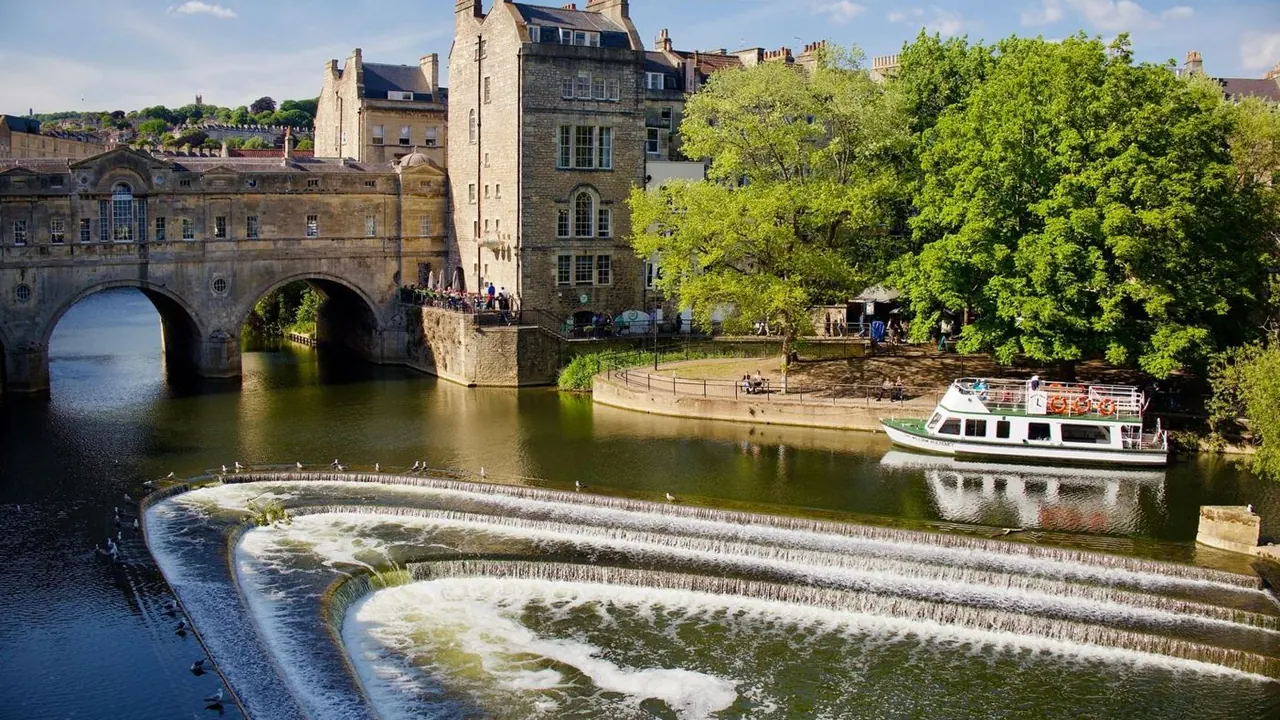
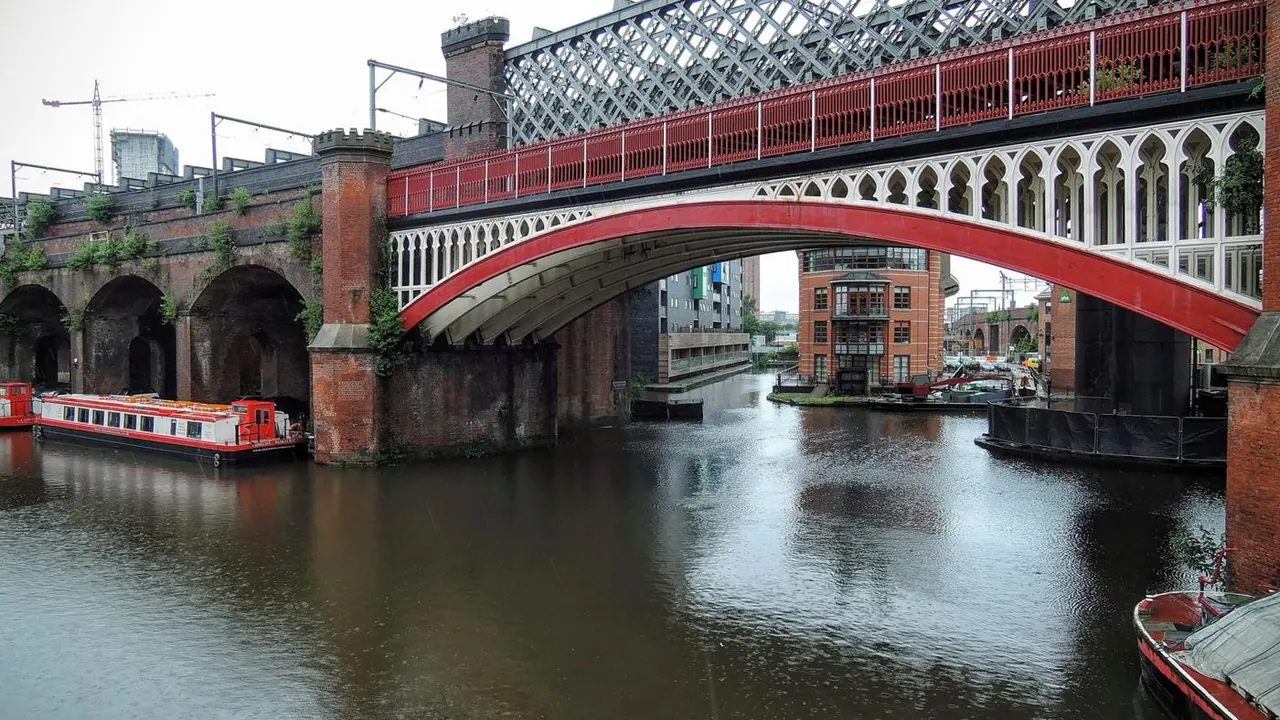
Photos: Bath by Lucas Carlini, Pexels License; Manchester by IIya Kuzhekin, CC BY 3.0, cropped.
Bath or Manchester?
Our verdict in twelve categories, each scored against the same fixed benchmark cities, and the climate month by month, so you can choose for your trip.
Choose Bath for
- wellness
- culture and sights
- getting around
Bath suits a slower, gentler trip: a long weekend among Georgian crescents and Roman remains, with evenings spent soaking in Britain's only natural thermal water rather than out late. It rewards travellers who love fine architecture, tearooms and soft countryside on the doorstep, and who don't mind steep room prices or a town that goes quiet soon after dinner.
Choose Manchester for
- nightlife
- live music and the arts
- prices
Pick Manchester if your evenings matter as much as your days. Its gig circuit, two orchestras and the warehouse bars of the Northern Quarter give it a night-time life Bath cannot match, and its free museums of the industrial age cost little to see. It is also the cheaper base, with the moors of the Peak District and fast trains to Liverpool, Chester and York close at hand.
Scoreboard
Twelve categories on one fixed scale from 0 to 100. The shaded stretch is the gap between the two.
Your match
Pick a travel style or drag the sliders, and both match scores follow your weighting.
Wins on wellness and culture and sights with your weighting.
Wins on nightlife and live music and the arts with your weighting.
What matters to you?
Category by category
What the scores mean for a trip.
Beaches & swimming
Neither city has a beach. In both, the seaside is about an hour away and better for a walk than a swim. Bath's nearest shore, Weston-super-Mare, is shallow, brown and tidal, but in hot weather locals swim in the Avon at the weir east of town, and the clear water of Dorset and Devon is a long day out.
Manchester has no river swimming to offer, and its coast is about scenery: the dunes and pinewoods at Formby and Blackpool's promenade on the Irish Sea, with fish and chips rather than a dip.
Food & drink
Manchester has the wider table. Chinatown, the curry houses of Rusholme and the food halls in converted Ancoats mills give you plenty of range, and the Victorian pubs and craft-beer scene make drinking a highlight in its own right.
Bath's food is narrower but more tied to its region: West Country cheese, Somerset cider, the Sally Lunn and Bath buns, a farmers' market in the old Green Park station and afternoon tea in Georgian rooms. You'll find little foreign cooking and almost no street food, and the town empties early in the evening.
Culture & sights
Bath is the stronger city for sightseeing. Its whole centre is a World Heritage Site, and the Royal Crescent, the Circus, Pulteney Bridge, the Abbey and the steaming great bath of the Roman Baths are known far beyond Britain, all within a short walk of each other.
Manchester's appeal is more specialised. It tells the story of the first industrial city through the neo-Gothic Town Hall, the John Rylands Library, the Ancoats mills and the Science and Industry Museum, backed by free galleries such as the Whitworth. It rewards an interest in cotton, railways and politics, but it has no landmark with Bath's fame.
Nightlife
After dark the two cities are far apart. Manchester's nights grow out of its dance-music past: warehouse bars and basement DJ rooms in the Northern Quarter, the long-established Gay Village on Canal Street, dressed-up Spinningfields, and big warehouse raves in autumn and winter. Weekends run late.
A night out in Bath means a pint in a coaching inn or a real-ale house on Walcot Street, a few student clubs in term time and an early night. Visitors who want more usually take the short train ride to Bristol.
Nature & outdoors
Manchester has the wilder outdoors. Trains reach Edale in under an hour for the climb onto Kinder Scout and the ridge walk from Mam Tor. The West Pennine Moors lie to the north and the Lake District is within reach, though the moors often come with low cloud and mud.
Bath's countryside is gentler and starts at the edge of town: the Skyline loop over the ridges, the Kennet and Avon towpath, and the Two Tunnels Greenway for cyclists, with the Cotswolds and Cheddar Gorge close by. It suits an easy country walk better than a hard day on the hills.
Day trips
Both make excellent bases, but the outings are of different kinds. From Bath the highlights are ancient sites and old villages: Stonehenge and Avebury, Wells and Glastonbury, Lacock and Castle Combe. Many of these are far easier by car or on a tour, and Bristol and Cardiff are the simple rail trips.
Manchester's strength is the train. Liverpool, Chester and York are each about an hour or a little more away, and Buxton, Saltaire and Windermere are in reach too, so a visitor without a car can see more.
Good for families
Manchester gives children more to do, and much of it is indoors and free. There are working engines at the Science and Industry Museum and dinosaurs at the Manchester Museum, an aquarium and a real-snow slope at the Trafford Centre, and football stadium tours, with Chester Zoo about an hour away.
Bath is safe and small, and most children love the Roman Baths and the playground in Royal Victoria Park. Beyond those it is a city for adults, its steep streets are hard work with a pushchair, and families often head out to Bristol or Longleat.
Getting around
Both centres are easy on foot, in different ways. Bath is smaller, about twenty minutes from end to end and largely pedestrianised, though its streets climb steeply out of the centre and buses handle the hills.
Manchester's centre is flat, and the Metrolink trams run out to Salford Quays, Old Trafford and the airport, so the wider city is simpler to cover. Rain is the main nuisance there. In Bath the weak point is getting to the villages beyond the city without a car.
Shopping & style
Manchester is the bigger shopping destination. It has the high-street names and department stores around Exchange Square, designer labels on King Street and in Spinningfields, vintage clothes and records in the Northern Quarter with Afflecks at its heart, and the vast Trafford Centre on the city's edge.
Bath has no luxury tier and no big department stores, but its browsing is quieter and more personal: antiques on Bartlett Street, galleries and salvage dealers on Walcot Street, the centuries-old Guildhall Market and the little shops built into Pulteney Bridge.
Affordability
Manchester is easier on the wallet. Rooms are fair on ordinary weeknights, though they jump when there is a home match or a big arena show, and the free museums and cheap curry houses keep daily spending down.
Bath is a small city with many visitors and prices to match, especially on summer weekends and at Christmas, and both the Roman Baths and the spa are expensive. Staying midweek helps, and some visitors sleep in Bristol and come in by train.
Live music & performing arts
Manchester has far more on stage. The Hallé and the BBC Philharmonic both play at the Bridgewater Hall, and the gig circuit runs from tiny back rooms to a huge arena. The Royal Exchange stages theatre-in-the-round inside the old cotton hall, and the Palace and Opera House bring touring musicals.
Bath's stage life centres on the gilded Georgian Theatre Royal, with concerts in the Abbey and the Assembly Rooms and long-running festivals of literature, music and Mozart. It makes a lovely evening out, but on most nights the choice is small.
Wellness & relaxation
Here Bath is in a different league. It is the one place in Britain where you can bathe in natural thermal water, either in the rooftop pool at Thermae Bath Spa above the Abbey or in the small Georgian Cross Bath. The whole town suits tea in the Pump Room and unhurried walks.
Manchester has hotel spas and Victoria Baths, an Edwardian pool you tour rather than swim in, and a loud pace. For real rest, the advice there is to leave for Buxton or the Peak District.
When should you go?
Pick your month. The climate figures are measured averages, not a forecast.
Bath in July
Manchester in July
Daytime high, °C
Rainfall in the month, mm
Where the figures come from
Bath's temperatures are measured 29 km from the centre, at Lyneham.
Bath has no rain gauge within 25 km of the centre, so its rainfall comes from a gridded climate dataset read at the city rather than from a gauge further away.
Temperature and rainfall are climate normals, averaged over the years shown. Bath: 1991-2020 normals, Lyneham (29.2 km from centre). Manchester: 1991-2020 normals, Manchester Airport (14.8 km from centre).
The two cities have almost the same temperatures all year, from about 7°C on winter days to 21°C in July and August. Neither ever gets too hot for walking the streets, and neither is warm enough for a beach vacation. The sea off the nearest coasts peaks at around 17-18°C in late summer, so most visitors only paddle. Late May to September is the best stretch in both, with long, mild days.
Where they differ is sun and rain. Bath is the brighter of the two, with noticeably more sunshine from spring through summer, and it stays fairly dry into September. Manchester turns wet earlier, with the rain building through August and September. October is the wettest month in Manchester, close to 95mm, while Bath is wettest in December. From November to February both are grey and short of daylight, which suits Bath's rooftop thermal pool far better than Manchester's moorland walks.
Which traveller are you?
On a relaxing and wellness trip, Bath is the clear choice. The rooftop thermal pool above the Abbey, the intimate Cross Bath and slow afternoons in the Pump Room and riverside gardens have no equal in loud, fast-paced Manchester.
For a food and nightlife trip, Manchester wins easily. Northern Quarter cocktail bars and DJ rooms, Canal Street, craft breweries under the railway arches and cheap curry in Rusholme keep evenings going late, while Bath winds down in the pub after dinner.
On a trip on a tight budget, Manchester makes the money go further. Its main museums and galleries are free, Chinatown and the food halls make cheap meals easy, and weeknight rooms are reasonable. Bath's central hotels and its spa are dear.
Before you go
| Measure | Bath | Manchester |
|---|---|---|
| Official language | English | English |
| Currency | Pound Sterling (GBP) | Pound Sterling (GBP) |
| Sockets | G230 V, 50 Hz | G230 V, 50 Hz |
| Driving side | Left | Left |
| Time zone | UTC, UTC+1 in summer | UTC, UTC+1 in summer |
| Emergency number | 112 or 999 | 112 or 999 |
| Elevation | 132 m | 38 m |
| Main airport | Bristol Airport (BRS)25 km from centre117 non-stop destinations | Manchester Airport (MAN)15 km from centre211 non-stop destinations |
| Public holidays this year | 8 days | 8 days |
By the numbers
| Measure | Bath | Manchester |
|---|---|---|
| City population | 94,092 | 547,627 |
| People per km² | 3,245 | 4,737 |
| Museums within 10 km | 17 | 28 |
| UNESCO World Heritage sites within 50 km | 2 | 2 |
| Swim season, months above 21 °C | None | None |
Where else could you go?
Every comparison below shares a destination with this one, so you can follow Bath or Manchester somewhere new.