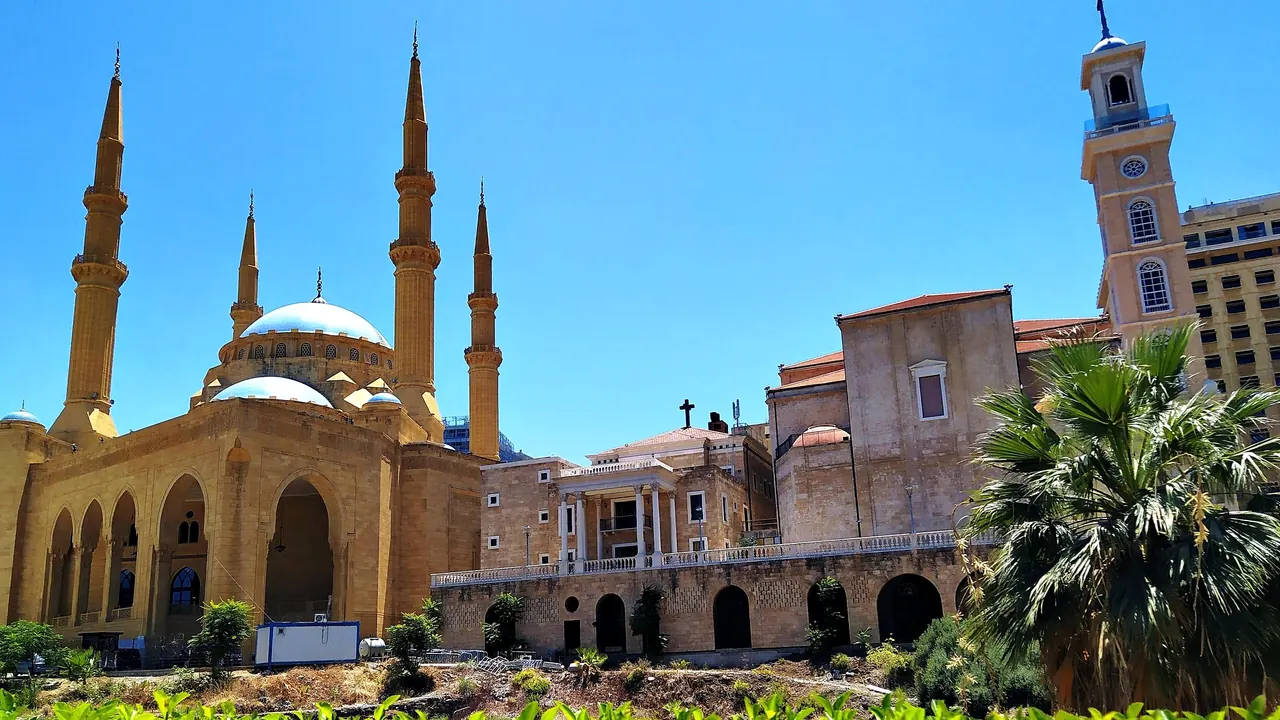
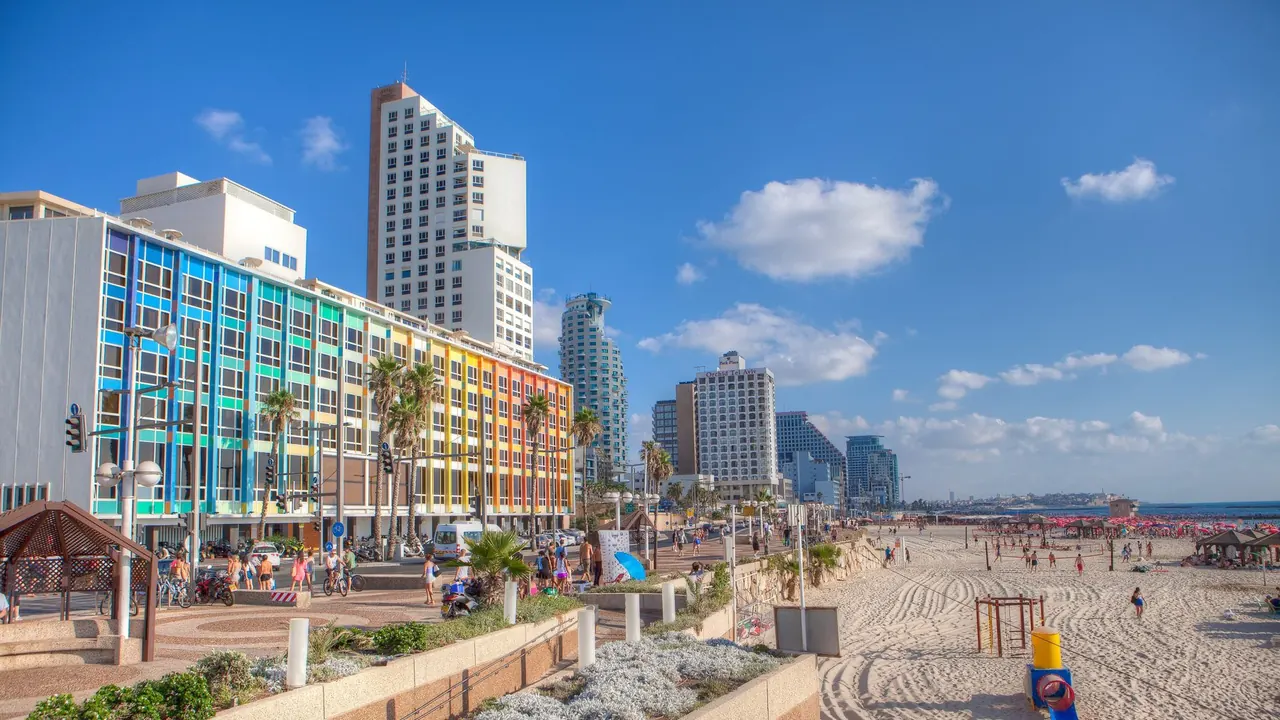
Photos: Beirut by Radosław Botev, CC BY 3.0 PL, cropped; Tel Aviv by israeltourism, CC BY-SA 2.0, cropped.
Beirut or Tel Aviv?
Our verdict in twelve categories, each scored against the same fixed benchmark cities, and the climate month by month, so you can choose for your trip.
Choose Beirut for
- prices
- nature and the outdoors
- food and drink
Beirut suits travellers who want a base for exploring a small, dense country and don't mind relying on taxis. Pine-covered mountains, ski slopes and Roman temples are all within a drive. Food and nights out are a big part of the trip here, with long mezze lunches and dressed-up evenings that run until dawn. It also costs noticeably less than its neighbour. In exchange you get a rocky shoreline and very little help from public transport.
Choose Tel Aviv for
- getting around
- families
- beaches
Pick Tel Aviv if you want the sea on your doorstep and an easy city to live in day to day. Sand starts at the end of most central streets, the flat centre is easy to walk or cycle, and the city is much easier with children. It is also stronger for evening concerts, opera and dance. The cost is high: for a long stay you pay prices like those of Western Europe's dearest capitals.
Scoreboard
Twelve categories on one fixed scale from 0 to 100. The shaded stretch is the gap between the two.
Your match
Pick a travel style or drag the sliders, and both match scores follow your weighting.
Wins on prices and nature and the outdoors with your weighting.
Wins on getting around and families with your weighting.
What matters to you?
Category by category
What the scores mean for a trip.
Beaches & swimming
Beirut's own shore is mostly rock. Along the Corniche, locals swim off concrete platforms, and the one long sandy beach, Ramlet al-Baida, has unreliable water. A proper beach day usually means paying to enter a private club with pools, or driving up to Byblos and Batroun or south to Jiyeh.
Tel Aviv's whole western edge is fine pale sand, running from the old port down to Jaffa, and you can walk to it from almost any central hotel. Breakwaters calm the water and lifeguards cover the main stretches. The sea is equally warm off both cities in late summer. The difference is that Tel Aviv lets you swim before breakfast or at sunset without planning anything.
Food & drink
Both are excellent places to eat, and the difference is in style. Beirut's strength is the classic Lebanese table: long meals of mezze with arak or Bekaa wine, Armenian grills in Bourj Hammoud, and weekend lunches on mountain terraces.
Tel Aviv cooks from many immigrant traditions, including Yemenite soups, Bukharan pastries and Iraqi kubbeh. It also has a loud, chef-led restaurant scene built on very good produce. You eat there by grazing through Carmel Market or over a long café breakfast. Many places close for Shabbat.
Culture & sights
Neither city has a long list of sights, and two or three days cover the essentials in either. What you go to see differs. Beirut's interest is ancient history: the National Museum's Phoenician sarcophagi and Roman mosaics, plus the Roman baths beside the restored Downtown streets. The war-marked buildings of Gemmayzeh tell a more recent story.
In Tel Aviv the main sight is the city itself. The UNESCO-listed Bauhaus buildings of the White City are best seen on a walk along Rothschild Boulevard. Add Jaffa's old stone quarter, the modern collection at the Tel Aviv Museum of Art, and ANU's story of the Jewish diaspora.
Nightlife
Both cities stay out until dawn, but the mood is quite different. In Beirut people dress up for the night. You move between wine and cocktail bars in Mar Mikhael and Gemmayzeh, and the bigger clubs and rooftops are about tables and bottle service. Underground electronic venues by the port and day parties at the beach clubs complete the scene, and summer weekends are the high point.
Tel Aviv is casual, with hardly any dress codes. Thursday is the big night, the clubs are mostly house and techno in basements and warehouses, and the gay scene is among the most open in the region.
Nature & outdoors
Beirut has the stronger landscape around it, though very little green inside the city. Within an hour you can be in pine forests and stone villages above 1,000m, or skiing at Mzaar in winter. The Jeita Grotto, paragliding above Jounieh Bay and the cliffs of the Qadisha Valley are all close enough for a day.
Tel Aviv is flat, and its outdoor life is on the water: surfing, paddleboarding and kitesurfing off the beaches, plus cycling and rowing in Yarkon Park. For hills or desert you drive about an hour to the Carmel ridge, or further to Ein Gedi.
Day trips
From Beirut almost every outing is a drive, while from Tel Aviv the best ones start at a railway station. Beirut packs a lot into a small country. Across the mountains are the Roman temples of Baalbek and the Umayyad ruins of Anjar. Along the coast are the Crusader castle at Byblos, Sidon's sea castle and Tyre's ruins by the water, and in the Shouf hills is the Beiteddine palace. To reach them you need a driver or a tour and an early start to beat the traffic. Check local conditions before heading south or into the Bekaa.
Tel Aviv's big outing is Jerusalem, about half an hour away by fast train, and many visitors give it several separate days. Haifa and the Baha'i Gardens are about an hour up the line. Caesarea, Acre, and Masada with a float in the Dead Sea are also within reach. The catch is Shabbat: trains and buses stop, so Saturday trips need a car or a tour.
Good for families
Tel Aviv is far easier with children. The calm, lifeguarded beaches, Yarkon Park with Luna Park, the Ramat Gan Safari and the children's museum in Holon fill the days, and the flat promenade is good with a pushchair.
Beirut welcomes children just as warmly, but very little there is designed for them. Narrow, blocked pavements and few safe crossings mean taxis for most journeys. The best outings are the Corniche, the beach-club pools, the Jeita Grotto and the Harissa cable car, and the city works better with older children.
Getting around
Beirut has no metro or tram, and its buses are hard for a visitor to work out, so ride-hailing apps and shared 'service' taxis do the work. Hamra or Mar Mikhael are pleasant to walk within, but getting from one district to another means steep streets and heavy traffic.
Tel Aviv's centre is flat and compact. You can walk from the port to Jaffa, and bike-share, a light-rail line and trains to Jerusalem and Haifa cover the rest. The one gap is Shabbat, when most public transport stops.
Shopping & style
The two are evenly matched, and both are better for local design than for big brands. Beirut has the more glamorous side: internationally known couture and bridal houses, plus the craftsmen of Bourj Hammoud with their jewellery, leather and spices. What it lacks is an old covered bazaar.
Tel Aviv is more casual. Look for designer boutiques on Sheinkin and in Neve Tzedek, the Nahalat Binyamin crafts market, and the antiques and junk of Jaffa's flea market. Good things to take home are Dead Sea cosmetics and tahini.
Affordability
Beirut is clearly the cheaper of the two. Its smarter restaurants and hotels cost about what they would in Southern Europe, but neighbourhood mezze and short taxi rides stay cheap. Beach-club entrance fees are the main cost that adds up.
Tel Aviv is among the most expensive cities on the Mediterranean, with hotels and cocktails priced like Western Europe's dearest capitals. Its savings come from street food like sabich and falafel and from a beach that costs nothing.
Live music & performing arts
Tel Aviv is clearly the place for an evening performance. The Israel Philharmonic, the Israeli Opera and Habima, the national theatre, all perform year round. Batsheva, the internationally known dance company, makes contemporary dance the highlight, and some theatre productions have English surtitles.
In Beirut the scene is smaller: Lebanese Philharmonic concerts in churches, Arabic theatre and cabaret in Hamra, and jazz and fusion in small venues. Its biggest musical moments happen outside the city, at the summer festivals in Baalbek, Beiteddine and Byblos.
Wellness & relaxation
Neither city is a place to rest, but Tel Aviv makes it a little easier. Shabbat empties the streets from Friday afternoon, the seafront promenade suits slow walks, yoga classes are common, and the Dead Sea mud spas are about one and a half hours away.
Beirut's traffic and generators rarely let up, and the old hammams have nearly all gone. Locals unwind with sunset walks on the Corniche or a night or two in a guesthouse in the cooler Shouf villages.
When should you go?
Pick your month. The climate figures are measured averages, not a forecast.
Beirut in July
Tel Aviv in July
Daytime high, °C
Rainfall in the month, mm
Temperature and rainfall are climate normals, averaged over the years shown. Beirut: 1991-2020 (sunshine 1961-1990) normals, Beyrouth Aeroport (8.3 km from centre). Tel Aviv: 1991-2020 (sunshine 1961-1990) normals, Bet Dagan (9.5 km from centre).
Both cities follow the same eastern Mediterranean year, with long dry summers and wet winters. The sea warms to about 28°C in August and September in both. From May to October you can expect dry days and water warm enough for swimming. July and August are a different matter: highs of 31°C to 32°C and sticky humidity make walking the streets hard work in the middle of the day. May, June and the weeks from late September into October are the most comfortable time in either city.
Winter is where they differ. Beirut is clearly wetter, with 178mm of rain in January and steady rain from November through March. Tel Aviv dries out sooner, with little rain after March, and it has noticeably more sunshine through the winter months. That makes it the more reliable choice for a city break between December and March.
Which traveller are you?
For a family trip with children, Tel Aviv is the easier choice. It has calm, lifeguarded beaches, a flat centre that suits a pushchair, Yarkon Park and the Ramat Gan Safari. In Beirut, broken pavements and heavy traffic mean taking a taxi almost everywhere.
On an outdoors trip, Beirut has more to offer. Mountains rise straight behind the coast, so pine forests, stretches of the Lebanon Mountain Trail, the Jeita Grotto and winter skiing at Faraya are all within an hour or so. Tel Aviv's outdoor life is mostly the beach and water sports.
On a tight budget, Beirut goes much further. Manakish, falafel and neighbourhood mezze cost little, short taxi rides are cheap, and hotels cost roughly what they do in Southern Europe. In Tel Aviv even modest hotels and a casual sit-down meal are expensive.
Before you go
| Measure | Beirut | Tel Aviv |
|---|---|---|
| Official language | Arabic | Hebrew |
| Currency | Lebanese Pound (LBP) | New Israeli Sheqel (ILS) |
| Sockets | ABCG220 V, 50 Hz | CHM230 V, 50 Hz |
| Driving side | Right | Right |
| Time zone | UTC+2, UTC+3 in summer | UTC+2, UTC+3 in summer |
| Emergency number | Police 112/160, ambulance 140, fire 175 | Police 100, fire 102 |
| Elevation | 0 m | 5 m |
| Main airport | Beirut Rafic Hariri International Airport (BEY)8 km from centre54 non-stop destinations | Ben Gurion International Airport (TLV)13 km from centre111 non-stop destinations |
By the numbers
| Measure | Beirut | Tel Aviv |
|---|---|---|
| City population | 2,421,354 | 467,875 |
| People per km² | - | 8,998 |
| Museums within 10 km | 15 | 99 |
| UNESCO World Heritage sites within 50 km | 2 | 2 |
| Swim season, months above 21 °C | 7 months | 7 months |
Where else could you go?
Every comparison below shares a destination with this one, so you can follow Beirut or Tel Aviv somewhere new.
- Jerusalemvs Tel Aviv
- Ammanvs Tel Aviv
- Petravs Tel Aviv
- Ammanvs Beirut
- Jerusalemvs Beirut
- Eilatvs Tel Aviv