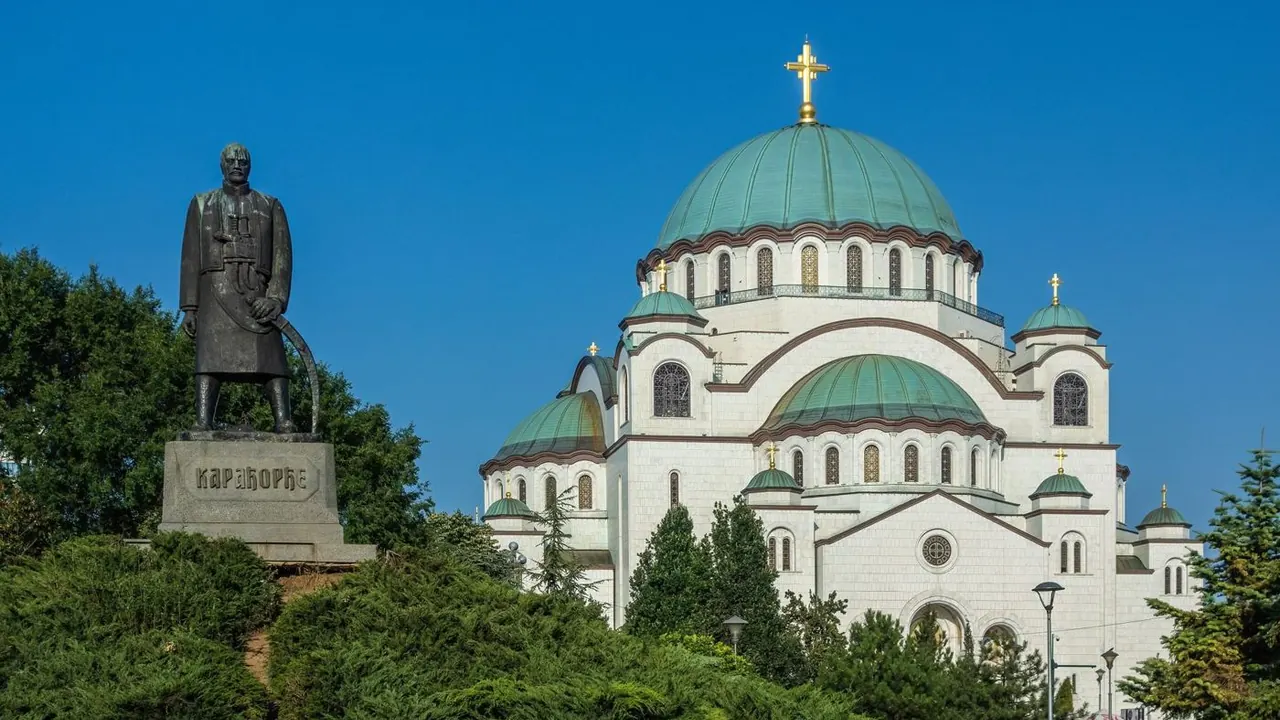
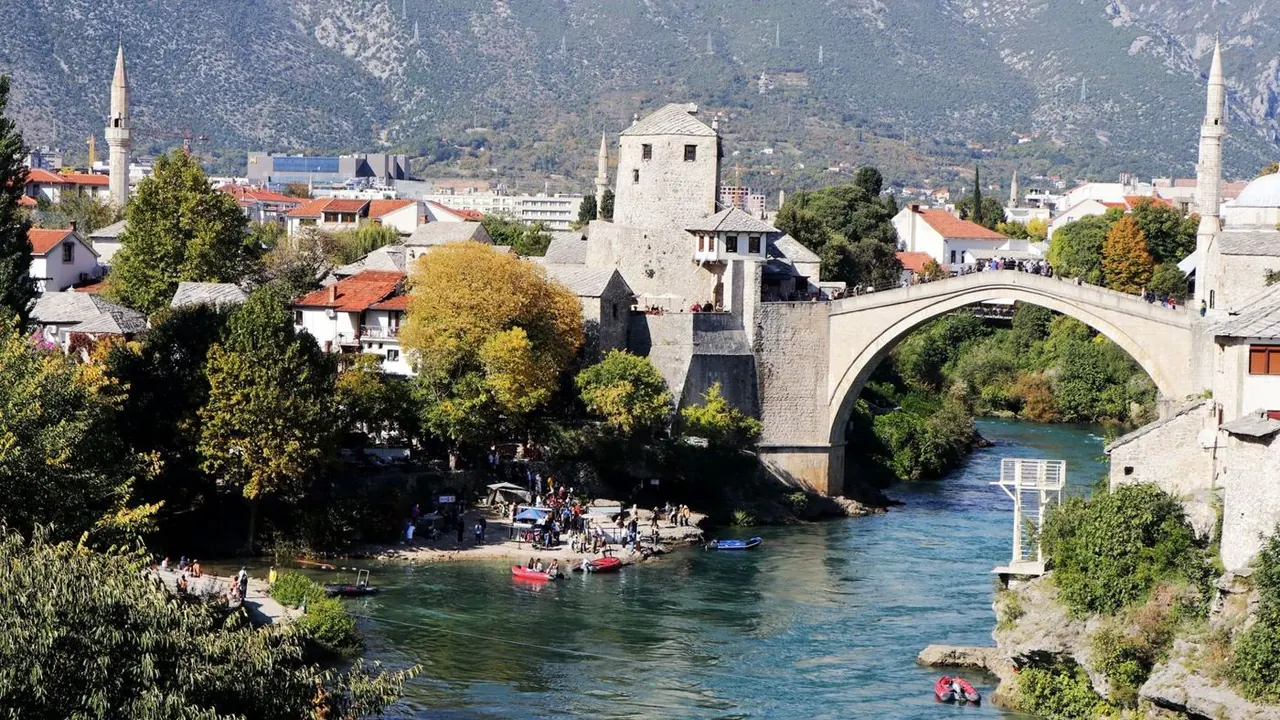
Photos: Belgrade by Petar Milošević, CC BY-SA 4.0, cropped; Mostar by Alan Wang, Pexels License.
Belgrade or Mostar?
Our verdict in twelve categories, each scored against the same fixed benchmark cities, and the climate month by month, so you can choose for your trip.
Choose Belgrade for
- nightlife
- live music and the arts
- food and drink
Belgrade suits a trip built around evenings: floating clubs on the Sava and Danube, long kafana dinners with rakija and a band, and a proper season of opera, ballet and concerts. It is the bigger, fuller city, with more to eat, a summer lake beach at Ada Ciganlija and enough variety for a long weekend. It wants stamina more than rest.
Choose Mostar for
- nature and the outdoors
- prices
- culture and sights
Travellers who would rather spend their days outdoors should look at Mostar. The Old Bridge and its Ottoman quarter make a compact sight you won't forget, but the real draw is the country around them: bare limestone mountains, the green Neretva, rafting canyons and the spring at Blagaj. It is cheaper as well, and quiet after dark, which suits couples and walkers better than anyone looking for a night out.
Scoreboard
Twelve categories on one fixed scale from 0 to 100. The shaded stretch is the gap between the two.
Your match
Pick a travel style or drag the sliders, and both match scores follow your weighting.
Wins on nightlife and live music and the arts with your weighting.
Wins on nature and the outdoors and prices with your weighting.
What matters to you?
Category by category
What the scores mean for a trip.
Beaches & swimming
Neither city is for a beach vacation, but Belgrade has the better swim for a summer visitor. Ada Ciganlija gives it kilometres of gravel shore on a warm lake with lifeguards, and it feels like a real city lido from June to September. The sandy Lido on Great War Island, reached by boat, is a wilder alternative.
Mostar's own river is too cold for more than a quick plunge from the rocks. Swimming there means a drive to the pool under the Kravica waterfalls, about 40km away, or to the Adriatic at Neum, a little over an hour away. Both are day trips rather than somewhere on the doorstep.
Food & drink
Both cities cook from the same Balkan grill, with ćevapi and burek on every menu, but Belgrade offers far more of it. The kafanas of Skadarlija and Zemun, the produce at Kalenić and Zeleni Venac and the café terraces of Dorćol and Vračar give a visitor who cares about food several days of variety.
Mostar's cooking is narrower and more Ottoman: ćevapi in somun bread, pies, stuffed peppers and Bosnian coffee drunk slowly from a copper džezva. Its strength is Herzegovinian wine, especially Žilavka and Blatina. Beyond home cooking the choice runs out quickly, and the terraces nearest the bridge are not where to find the best food.
Culture & sights
Each city has a day or two of sightseeing, but of very different kinds. Belgrade's is spread out and layered: the Kalemegdan fortress above the meeting of the rivers, the huge Temple of Saint Sava, and museums such as the Museum of Yugoslavia with Tito's mausoleum, all set among Austro-Hungarian, Ottoman and socialist streets.
Mostar gathers everything around one image, the rebuilt Old Bridge with its divers, and the UNESCO-listed quarter of bazaar, mosque and carpeted Ottoman houses around it. It has the more striking single sight and the more complete old town. Belgrade has the better museums.
Nightlife
This is the widest gap between the two. People travel to Belgrade just to go out. In summer there are floating splav clubs along the Sava and Danube, in winter basement and warehouse venues, and all year the bars around Strahinjića Bana are packed, with nights running until dawn.
Mostar's evenings mean a long dinner and a drink facing the lit bridge, plus a few cocktail bars and student clubs at weekends. They are pleasant, but nobody picks Mostar for its nights.
Nature & outdoors
Mostar has much the wilder setting. Bare limestone ranges, Velež and the jagged Prenj, rise straight from its valley. The Neretva canyons upstream are made for rafting and kayaking, and Blidinje and the Hutovo Blato wetland are both close enough for a day out.
Belgrade's outdoors is gentler and closer to hand. Long, flat promenades by the two rivers are good for cycling, Great War Island has herons and cormorants, and there are the woods of Košutnjak and Avala and easy vineyard walks on Fruška Gora. It suits a stroll or a bike ride better than a real hike.
Day trips
Both have a good day out in several directions, and most trips need a car or a tour. Belgrade's lean towards towns and history: Novi Sad and its Petrovaradin fortress are under an hour away by fast train, baroque Sremski Karlovci pairs well with the monasteries of Fruška Gora, and the Danube fortress at Smederevo is about an hour away.
Mostar's trips are to smaller, more scenic places: the dervish tekke at Blagaj, the walled village of Počitelj and Stolac's medieval tombstones. The one big city within reach is Sarajevo, a long day's rail trip through the Neretva gorge.
Good for families
Belgrade gives a family more to do, enough for several days. Kalemegdan is the best of it: in one park, children can run along the old walls, look at the armoured vehicles by the military museum and visit a modest zoo. In summer there is also Ada Ciganlija, where the lake shelves gently and there are playgrounds and bikes to rent. There is no theme park or aquarium, though, and the traffic and cluttered pavements make a pushchair a chore, so the city suits school-age children best.
Mostar runs out sooner. The bridge divers, the minaret climb and a swim at Kravica fill a good day or two, but there is little after that. Its slippery lanes and midsummer heat are also harder on small children than anything in Belgrade. Both cities welcome children warmly at the table.
Getting around
You can walk both centres, but Belgrade's public transport reaches further. There is no metro, but trams, trolleybuses and buses cover the whole city and taxis are plentiful, so Zemun and New Belgrade are easy to add. Heavy traffic slows everything down.
Mostar's sights fit into one short stroll along the river, on worn and slippery cobbles. Beyond the old town the buses serve residents rather than visitors, so reaching Blagaj, Počitelj or Kravica means a car, a taxi or a tour.
Shopping & style
Belgrade's best buys are things to eat and drink: honey, ajvar, cheese and rakija from the Kalenić and Zeleni Venac markets. It also has young designers' boutiques in Dorćol and Vračar, and Knez Mihailova and the New Belgrade malls cover the usual chains, although luxury fashion is thin.
Mostar sells copper. On the Kujundžiluk, the old coppersmiths' street leading down to the bridge, a few workshops still hammer coffee sets and plates by hand, among kilims and stalls of imported souvenirs. It is worth an hour if you want one handmade piece, but Belgrade gives a browser far more to look at.
Affordability
Both are cheap by European standards, but Mostar is cheaper still. Family-run guesthouses and apartments cost little, and food and wine prices drop again a few streets away from the bridge.
In Belgrade, meals, drinks and taxis are inexpensive. Central rooms in Dorćol or near Knez Mihailova, though, are priced more like Central Europe, and evenings at the river clubs add up.
Live music & performing arts
Belgrade has a real season. There is opera and ballet at the National Theatre, the Belgrade Philharmonic at the Kolarac hall, musicals at Madlenianum and the BITEF and BEMUS festivals in autumn. In the kafanas of Skadarlija, tamburica bands play at the tables.
Mostar has a national theatre and a youth theatre, both performing mostly in local languages, and open-air concerts in summer. For most of the year, though, there is little put on for visitors.
Wellness & relaxation
Neither city is a place for spa days, so in both you rest by slowing down, usually over coffee. Belgrade gives you a little more to book, with day spas as well as hotel ones. It also has more places to get away from the noise, such as a lazy afternoon on the lakeshore at Ada Ciganlija or a slow walk beside the Danube. The catch is the city around them, which is loud, full of traffic and up late, with smoking common indoors.
Mostar offers less. Its old hammam is something to look at rather than bathe in, and only a few hotels offer treatments. What it does have is quiet at either end of the day. If you sleep in the old town, you have the lanes and the sound of the Neretva almost to yourself at dawn and after dark.
When should you go?
Pick your month. The climate figures are measured averages, not a forecast.
Belgrade in July
Mostar in July
Daytime high, °C
Rainfall in the month, mm
Temperature and rainfall are climate normals, averaged over the years shown. Belgrade: 1991-2020 normals, Beograd (2.1 km from centre). Mostar: 1991-2020 normals, Mostar (0.9 km from centre).
Belgrade has a continental year. Winters are cold and grey, with January highs around 5°C, so the city is at its best from May to September. In those months the terraces and river clubs fill up, and the lake at Ada Ciganlija is warm enough to swim from June. June brings the most rain, mostly in summer storms. July and August are hot but bearable, and they are the sunniest months.
Mostar is hotter and much wetter. July and August reach about 33°C in the valley, too hot for walking the stone lanes at midday but good for a swim at Kravica. Heavy rain sets in from September and peaks near 198mm in December, although winters stay milder than Belgrade's. May and early June are the best months for walking and hiking, before the heat builds. Autumn is warm enough but often wet.
Which traveller are you?
For a food and nightlife trip, Belgrade is the clear choice. Splav clubs on the rivers stay open until dawn, Dorćol's bars spill onto the pavement, and kafana dinners of grilled meat, kajmak and rakija turn into whole nights out. In Mostar the evening ends at a terrace table.
On an outdoors trip, Mostar is the better base. There is rafting and kayaking in the Neretva canyons, rugged trails on Velež and Prenj, the Blidinje plateau and the Hutovo Blato wetland. Belgrade has flat riverside promenades and the gentle slopes of Fruška Gora.
On a trip on a tight budget, your money goes further in Mostar. Family-run guesthouses are cheap, ćevapi and local wine cost little, and prices drop again a few streets back from the bridge. Belgrade is good value too, but its central rooms cost noticeably more.
Before you go
| Measure | Belgrade | Mostar |
|---|---|---|
| Official language | Serbian | Croatian, Serbian, Bosnian |
| Currency | Serbian Dinar (RSD) | Convertible Mark (BAM) |
| Sockets | CF230 V, 50 Hz | CF230 V, 50 Hz |
| Driving side | Right | Right |
| Time zone | UTC+1, UTC+2 in summer | UTC+1, UTC+2 in summer |
| Emergency number | Police 92/192, ambulance 94/194, fire 93/193 | 112 |
| Elevation | 117 m | 60 m |
| Main airport | Belgrade Nikola Tesla Airport (BEG)12 km from centre125 non-stop destinations | Sarajevo International Airport (SJJ)68 km from centre38 non-stop destinations |
| Public holidays this year | 11 days | 8 days |
By the numbers
| Measure | Belgrade | Mostar |
|---|---|---|
| City population | 1,197,714 | 105,448 |
| People per km² | 3,327 | 90 |
| Museums within 10 km | 65 | 3 |
| UNESCO World Heritage sites within 50 km | 0 | 1 |
Where else could you go?
Every comparison below shares a destination with this one, so you can follow Belgrade or Mostar somewhere new.