Bolivia
Sucre
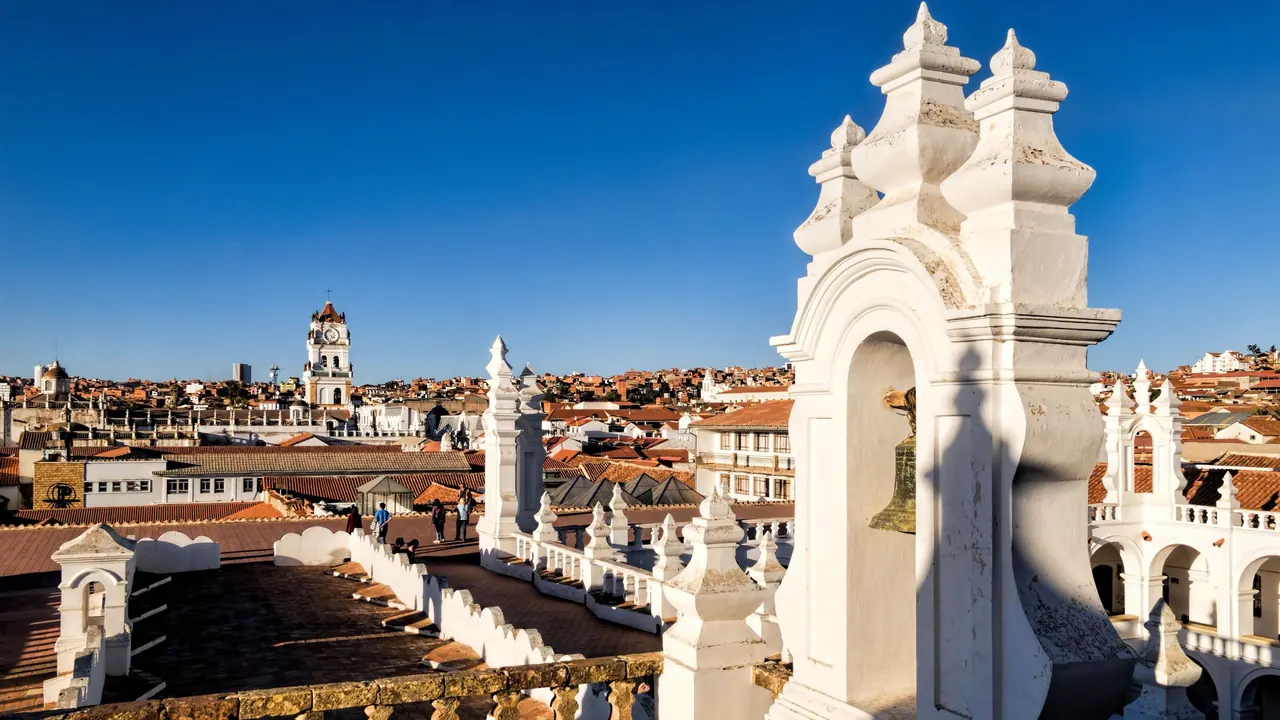
Red roofs and white bell towers from the San Felipe Neri rooftop
- Affordable cities92
- Getting around64
- Culture & sights62
Photo: Dan Lundberg, CC BY-SA 2.0, cropped
Match
42
Every category weighted equally
- Beach & sun39
- Culture & arts46
- Food & nightlife42
- Family trip45
- Outdoors43
- Relax & unwind39
- Shopping & style42
- On a budget47
Sucre in twelve categories
Our verdict on each, scored 0 to 100 against the same fixed benchmark cities, so a score means the same thing on every page.
Beaches & swimming. Scores 3 out of 100.
Food & drink. Scores 42 out of 100.
Culture & sights. Scores 62 out of 100.
Nightlife. Scores 30 out of 100.
Nature & outdoors. Scores 55 out of 100.
Day trips. Scores 30 out of 100.
Good for families. Scores 38 out of 100.
Getting around. Scores 64 out of 100.
Shopping & style. Scores 33 out of 100.
Affordability. Scores 92 out of 100.
Live music & performing arts. Scores 26 out of 100.
Wellness & relaxation. Scores 28 out of 100.
Sucre category by category
Beaches & swimming
3Sucre has no beach of any kind. It sits high in the Andean valleys of a landlocked country, and the only swimming a visitor will find is a hotel or municipal pool. If time in the water matters to your vacation, plan it for another leg of the trip.
Food & drink
42Eating in Sucre is regional and unpretentious. The city is proud of its spicy chorizos chuquisaqueños, mondongo and its morning salteñas, juicy baked pastries eaten standing up before noon. The Mercado Central is the heart of it: upstairs stalls ladle out set lunches and soups, and downstairs the juice counters blend fresh fruit to order. Sucre is also Bolivia's chocolate town, with long-established makers selling bars and filled chocolates around the main square.
Beyond that the choice is modest. A cluster of traveller cafés and a few more ambitious restaurants near the plaza cover international tastes, and singani, the local grape brandy, turns up in most bars, but there is no deep restaurant scene and little fine dining.
Culture & sights
62Sucre's whitewashed colonial centre is a UNESCO World Heritage Site and one of the best preserved in South America, with churches, convents and balconied mansions laid out on a tidy grid around the Plaza 25 de Mayo. The Casa de la Libertad, where Bolivia's independence was declared, holds the founding documents of the republic, and the cathedral and its museum of religious art stand on the same square.
Uphill, the Recoleta convent looks out over red rooftops, and the Museo de Arte Indígena shows the remarkable weaving of the Jalq'a and Tarabuco communities. A few kilometres out, a quarry wall carries thousands of dinosaur footprints, displayed at the Parque Cretácico. It is a rewarding, compact set, seen well in two or three unhurried days.
Nightlife
30Sucre is a university town, and that gives it a modest but genuine night out. A few streets near the main square hold traveller bars, pubs and a couple of clubs that fill with students on Friday and Saturday, staying open past midnight. Midweek the city is quiet early, and many visitors end the evening over a drink of singani after dinner rather than going out.
Nature & outdoors
55The landscape around Sucre is dry, folded Andean country of red and ochre hills. The great draw is the Cordillera de los Frailes to the west, where old stone paths lead past the Maragua crater, a vast bowl of striped rock, rural Jalq'a villages and dinosaur tracks in the open hillside. Many visitors go on guided treks of one to three days, sleeping in community lodges.
Closer in, the Siete Cascadas waterfalls and short walks up the hills behind the Recoleta make easy half days. The climate is mild and sunny for much of the year, with a rainy season in the southern summer that turns the valleys green. There is no skiing, lake or sea for water sports, and most outings need a guide or a hired vehicle on rough roads.
Day trips
30The classic outing is to Tarabuco, a highland town about an hour and a half away whose Sunday market draws Yampara people in their distinctive dress and woven textiles. Nearer the city, the eccentric Castillo de La Glorieta, a turn-of-the-century palace mixing European styles, and the colonial village of Yotala make short half-day trips.
The list ends there. The silver city of Potosí is roughly three hours away by road and is better treated as an overnight stop or the next leg of a journey, and most other excursions from Sucre are into the countryside rather than to other towns.
Good for families
38Sucre's trump card for children is the Parque Cretácico, where life-size dinosaur models stand in front of a cliff covered in real footprints. The centre is calm, compact and friendly, the main square is a good place for a run-around, and Bolivian families make children welcome everywhere.
Beyond the dinosaurs there is little designed for young visitors. At about 2,800m the altitude can tire small children for the first days, pavements are narrow and uneven, and medical care is basic by Western standards. It suits families with older children who enjoy markets, history and walking.
Getting around
64Nearly everything a visitor wants in Sucre lies within a few blocks of the main square, on a regular colonial grid that is easy to read and pleasant to walk. The climb to the Recoleta is steep and the altitude makes itself felt at first, but distances are short.
For anything further, taxis are plentiful and inexpensive, and a dinosaur-themed tourist bus runs out to the Parque Cretácico. The city's minibuses, called micros, cover the rest but have no maps to speak of. Outings into the countryside need a tour, a hired driver or a long-distance bus from the terminal.
Shopping & style
33The shopping worth doing in Sucre is textiles. The weavings of the Jalq'a, with their dark grounds and imagined animals, and the bright geometric work of Tarabuco are sold in fair-trade shops near the indigenous art museum and in craft stores around the centre. Chocolate from the city's old makers is the other obvious thing to take home. The Mercado Central and the stalls around it are good for everyday browsing, but there is no fashion, luxury or design shopping to speak of.
Affordability
92Sucre is one of the least expensive places to travel in South America. Market lunches, salteñas and taxi rides cost very little, entry to museums and churches is modest, and comfortable guesthouses in colonial houses are easy to find at low rates. The restored boutique hotels and the more polished restaurants near the plaza cost more, but still far less than their equivalents in most of the world. It is a city where a long, slow stay is easy on the budget, which is one reason language students settle here for weeks.
Live music & performing arts
26Live performance in Sucre is mostly folkloric. Dinner shows and evening performances present dances from across Bolivia, from the devil masks of the altiplano to the music of the valleys, and weekend peñas offer Andean bands with charango and panpipes. The Teatro Gran Mariscal, an elegant nineteenth-century theatre, hosts concerts by the national symphony and local productions now and then, and the city's patron-saint festivities bring parades and dancers onto the streets. Beyond that, the programme is thin.
Wellness & relaxation
28Sucre has no bathing or spa tradition, and pampering is limited to a few massage rooms and hotel facilities. What it offers instead is a pace. The mild, sunny climate, shaded courtyards of colonial houses and the benches of the Plaza 25 de Mayo make it a place where travellers coming from the harsher altiplano stop to rest for a week or two. The view from the Recoleta arcade at sunset is the city's best place to sit still.
When should you go?
Pick a month to see what it is like. The climate figures are measured averages, not a forecast.
Sucre in July
Daytime high, °C
Rainfall in the month, mm
The whole year
Shaded against this city’s own year: the deepest cell is its best month for that figure and the palest its weakest.
Temperature and rainfall are climate normals, averaged over the years shown. Sucre: 1991-2020 normals, Sucre (5.4 km from centre).
Before you go
| Measure | Sucre |
|---|---|
| Official language | Spanish, Aymara, Quechua, Guarani |
| Currency | Boliviano (BOB) |
| Sockets | AC50 Hz |
| Driving side | Right |
| Time zone | UTC-4 |
| Emergency number | 911 |
| Elevation | 2,810 m |
| Main airport | Alcantarí International Airport (SRE)25 km from centre3 non-stop destinations |
| Public holidays this year | 12 days |
By the numbers
| Measure | Sucre |
|---|---|
| City population | 360,544 |
| People per km² | 204 |
| Museums within 10 km | 4 |
| UNESCO World Heritage sites within 50 km | 1 |
Compare Sucre with
Every comparison with a written verdict behind it.