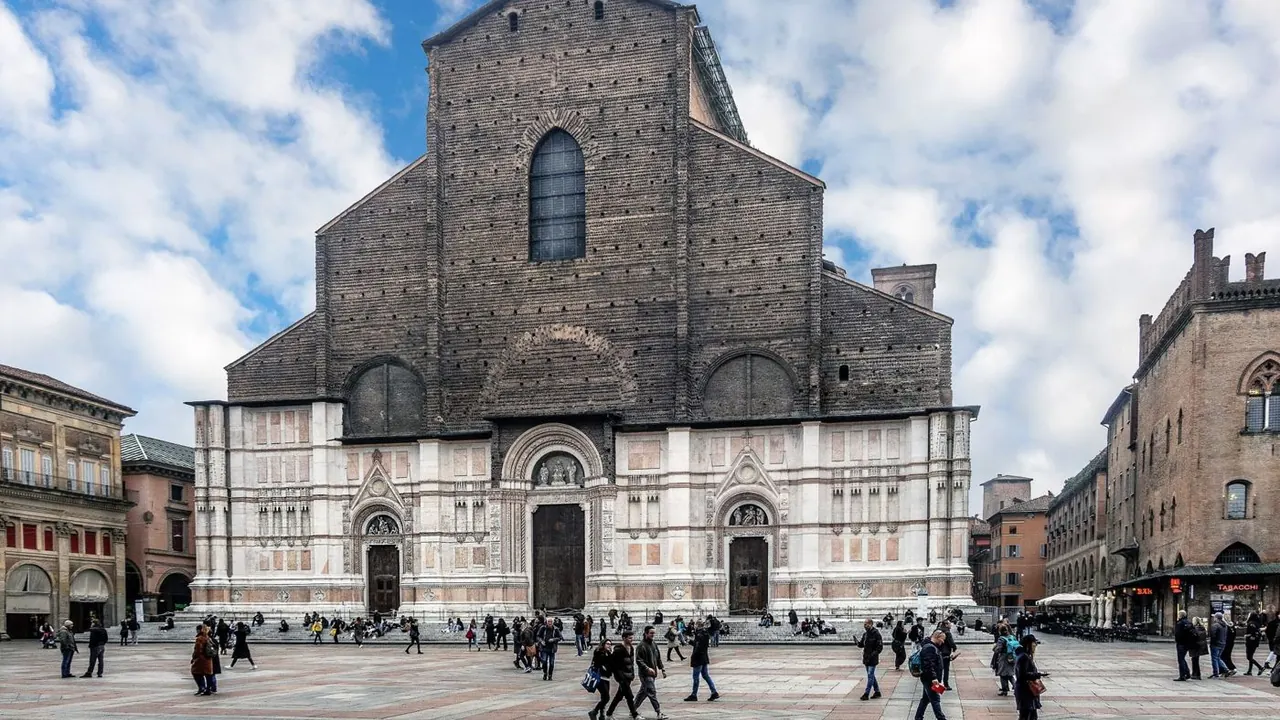
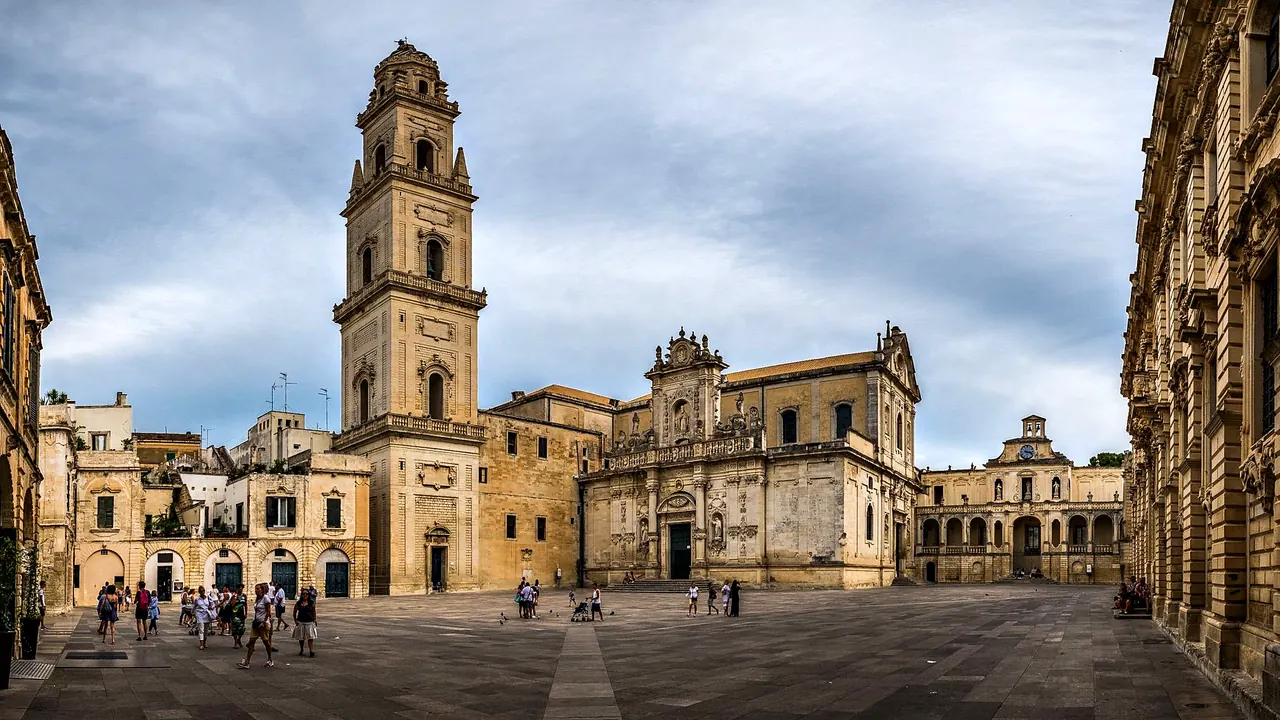
Photos: Bologna by Vanni Lazzari, CC BY-SA 4.0, cropped; Lecce by Giuseppe Milo, CC BY 3.0, cropped.
Bologna or Lecce?
Our verdict in twelve categories, each scored against the same fixed benchmark cities, and the climate month by month, so you can choose for your trip.
Choose Bologna for
- getting around
- day trips
- live music and the arts
Choose Bologna if your trip is about eating, walking and moving on by train. It is the home of fresh egg pasta and mortadella. Its arcaded medieval centre is easy to cover on foot, and the station at the edge of the old town puts Florence, Ravenna, Ferrara and Venice within easy reach. A student population keeps the evenings and the music scene going for most of the year. It suits a spring or autumn city break more than a summer stay.
Choose Lecce for
- beaches
- prices
- wellness
Lecce suits a summer trip built around the sea. The pale coves of the Adriatic shore and the long sandy beaches of the Ionian side are a short drive away, and the Baroque old town makes a handsome place to come back to each evening. Rooms and meals cost less than in the north. You will need a hire car, though, and there is less going on after dark.
Scoreboard
Twelve categories on one fixed scale from 0 to 100. The shaded stretch is the gap between the two.
Your match
Pick a travel style or drag the sliders, and both match scores follow your weighting.
Wins on getting around and day trips with your weighting.
Wins on beaches and prices with your weighting.
What matters to you?
Category by category
What the scores mean for a trip.
Beaches & swimming
Swimming is where Lecce pulls clearly ahead. The Salento coast gives you a choice of two seas: cliffs, coves and sea stacks at Torre dell'Orso and Torre Sant'Andrea on the Adriatic, or long shallow beaches of fine sand and very clear water at Porto Cesareo and Punta Prosciutto on the Ionian. In summer, mornings on the beach can shape the whole stay.
Bologna is a long way from the sea in practice. The nearest option is the Romagna Riviera at Rimini, about an hour by train, with packed rows of sunbeds and greenish water. It works as an escape from the city heat for a day, not as the point of the trip.
Food & drink
Both kitchens are regional and narrow, but Bologna's is the richer and more famous. Tagliatelle al ragù, tortellini in brodo and lasagne verdi are made with real care in old osterie. The Quadrilatero market lanes and producers at Parma and Modena make the whole region a larder, and the aperitivo with Lambrusco is a fixed part of the evening.
Lecce eats more simply and more cheaply, with a daily rhythm of its own. There is a pasticciotto and almond-milk iced coffee in the morning, a rustico mid-morning, then ciceri e tria or orecchiette with turnip tops and a glass of dark Negroamaro. It is honest peasant cooking with few ambitious tables.
Culture & sights
Bologna has the deeper sightseeing. Its medieval brick centre is remarkably intact, with UNESCO-listed porticoes, Piazza Maggiore, the Two Towers and the seven churches of Santo Stefano. The university, the oldest in Europe, adds the anatomical theatre of the Archiginnasio, and the Pinacoteca has a serious painting collection.
Lecce is one of the finest Baroque towns in Italy, carved in soft honey-coloured stone, with Santa Croce and the enclosed Piazza del Duomo as its high points. A half-buried Roman amphitheatre lies right in the main square. Its museums are slighter, so it is a city to walk at dusk more than one to study.
Nightlife
Bologna goes out more. Its large student population fills the bars around Piazza Verdi and the taverns of Via del Pratello late into the night for most of the year, though clubs mean a taxi to the edge of town. It empties in August when the students leave.
That is the month Lecce comes alive, but much of that energy is on the coast. The open-air discos and beach clubs near Gallipoli are a drive away. In town, an evening is a passeggiata, an aperitivo on the piazza and a cocktail in the lanes: sociable, but rarely late.
Nature & outdoors
The outdoors is about equal in the two cities, but in opposite directions. Bologna faces the hills. You can walk up to San Luca, follow paths through the Colli Bolognesi, start the Via degli Dei trail to Florence in Piazza Maggiore, or go hiking and modest skiing in the Apennines at Corno alle Scale.
Lecce's countryside is a flat plain of olive groves, so its outdoors is the sea. There are clifftop paths from Roca Vecchia to Otranto, boat trips into sea caves, wetland birdwatching at Le Cesine, and good snorkelling and diving.
Day trips
Bologna has the edge here, because it sits at the main rail junction of northern Italy. Florence is barely half an hour away by fast train. Ravenna's mosaics, Ferrara, Modena and Parma are short rides, and Verona, Padua and Venice all make a full day out without a car.
Lecce has fine places around it: Otranto's cathedral mosaic, Gallipoli on its island, the frescoes at Galatina, white Ostuni and the trulli of Alberobello. Most of them are much easier with a hire car than by the slow local trains.
Good for families
Children are equally welcome in both, and neither has much built for them, with no zoo or aquarium in either city. Bologna's traffic-free centre and shady porticoes help on foot, and families often add a day at Mirabilandia. Lecce's real asset is the shallow, sandy water around Porto Cesareo, which suits small children well. In both, summer days have to work around the heat.
Getting around
Getting around is much easier in Bologna. The centre is small and flat, the porticoes keep you out of the sun and rain, and the station on the edge of the old town connects to half of northern Italy. You will not miss a car.
Lecce's old town is just as easy on foot, but that is where the ease ends. Local railways across the Salento are slow and infrequent, the beach buses run only in summer, and most visitors hire a car and park outside the walls.
Shopping & style
Bologna has more to buy. The Quadrilatero delicatessens are the highlight, with mortadella, aged Parmigiano and balsamic vinegar to take home. There is also a small luxury cluster on Via Farini and in the Galleria Cavour, the Montagnola market, and bookshops and vintage stores in the university quarter.
Lecce's shopping is mostly crafts. The papier-mâché saints of its cartapesta workshops, small limestone carvings and Grottaglie ceramics are the things worth bringing home, and the fashion shops are few.
Affordability
Lecce goes further on the same budget. Street pastries, trattorias and local wine are cheap, and bed and breakfasts in old palazzi are fairly priced outside high summer. August is the exception, when the Salento fills up and a hire car adds to the bill.
In Bologna, eating out and the aperitivo are reasonable for the north, but rooms in the old town are expensive and become scarce during the big trade fairs.
Live music & performing arts
Bologna offers far more to see and hear. The Teatro Comunale is one of Italy's historic opera houses, the city is a UNESCO City of Music, jazz plays in basement clubs most nights, and summer brings concerts and film screenings to Piazza Maggiore.
Lecce's theatres have a modest season. Its real draw is pizzica, the fast tambourine dance played at village festivals all summer, which reaches its peak at the Notte della Taranta in Melpignano in August. Outside summer there is little on.
Wellness & relaxation
Neither city has its own spa tradition, and they are close here, though Lecce is the more restful of the two. Its long afternoon closures and slow evenings in the piazzas set an easy pace. The sulphur pools of Santa Cesarea Terme sit in grottoes on the sea cliffs, and old masserie farmhouses on the plain have become quiet spa retreats.
Bologna's spa options are a calm half day out rather than a setting: the springs at Castel San Pietro Terme, or the old spa town of Porretta Terme in a green Apennine valley.
When should you go?
Pick your month. The climate figures are measured averages, not a forecast.
Bologna in July
Lecce in July
Daytime high, °C
Rainfall in the month, mm
Where the figures come from
Bologna has no rain gauge within 25 km of the centre, so its rainfall comes from a gridded climate dataset read at the city rather than from a gauge further away.
Bologna's sunshine is measured 82 km from the centre, at Cervia.
Lecce's temperatures are measured 38 km from the centre, at Brindisi.
Lecce has no rain gauge within 25 km of the centre, so its rainfall comes from a gridded climate dataset read at the city rather than from a gauge further away.
Temperature and rainfall are climate normals, averaged over the years shown. Bologna: 1991-2020, 14 years observed normals, Bologna / Borgo Panigale (5.5 km from centre). Lecce: 1991-2020 (sunshine 1981-2010) normals, Brindisi (38 km from centre).
The two cities run on different calendars. Bologna has proper seasons. Winters are grey and chilly, around 7°C in January with little sun, and July and August reach 32°C in humid air that makes sightseeing hard work. October and November bring the heaviest rain. The best months for walking the porticoes and the hills are May and June, then September before the autumn rain sets in.
Lecce is milder and sunnier all year. Winter days stay around 13°C and get about half as much sunshine again as Bologna's, but rain peaks there too in October and November. From June to August it is almost dry and hot, with highs around 30°C. The sea reaches 26°C in August and stays warm enough for swimming from June well into October. Spring and early autumn are the best times to explore the towns.
Which traveller are you?
On a beach and sun trip, Lecce wins easily. Clear water and fine sand at Porto Cesareo and Torre dell'Orso are under an hour away, the summers are long and dry, and the sea stays warm into October. Bologna's nearest beach is the crowded lido strip at Rimini.
For a food and nightlife trip, Bologna is the stronger choice. Its tables are richer, from hand-rolled tortellini to aged Parmigiano, and its student bars on Via del Pratello and around Piazza Verdi stay busy most of the year. Lecce's evenings are pleasant but end earlier.
For a short city break, Bologna is easier. You arrive at a station on the edge of the old town, walk everything under the porticoes and need no car. Lecce's centre is just as walkable, but the coast and towns that make it special need driving time.
Before you go
| Measure | Bologna | Lecce |
|---|---|---|
| Official language | Italian | Italian |
| Currency | Euro (EUR) | Euro (EUR) |
| Sockets | CFL230 V, 50 Hz | CFL230 V, 50 Hz |
| Driving side | Right | Right |
| Time zone | UTC+1, UTC+2 in summer | UTC+1, UTC+2 in summer |
| Emergency number | 112 | 112 |
| Elevation | 54 m | 49 m |
| Main airport | Bologna Guglielmo Marconi Airport (BLQ)6 km from centre98 non-stop destinations | Brindisi Airport (BDS)39 km from centre49 non-stop destinations |
| Public holidays this year | 13 days | 13 days |
By the numbers
| Measure | Bologna | Lecce |
|---|---|---|
| City population | 387,971 | 94,783 |
| People per km² | 2,754 | 393 |
| Museums within 10 km | 68 | 11 |
| UNESCO World Heritage sites within 50 km | 3 | 0 |
| Swim season, months above 21 °C | - | 4 months |
Where else could you go?
Every comparison below shares a destination with this one, so you can follow Bologna or Lecce somewhere new.