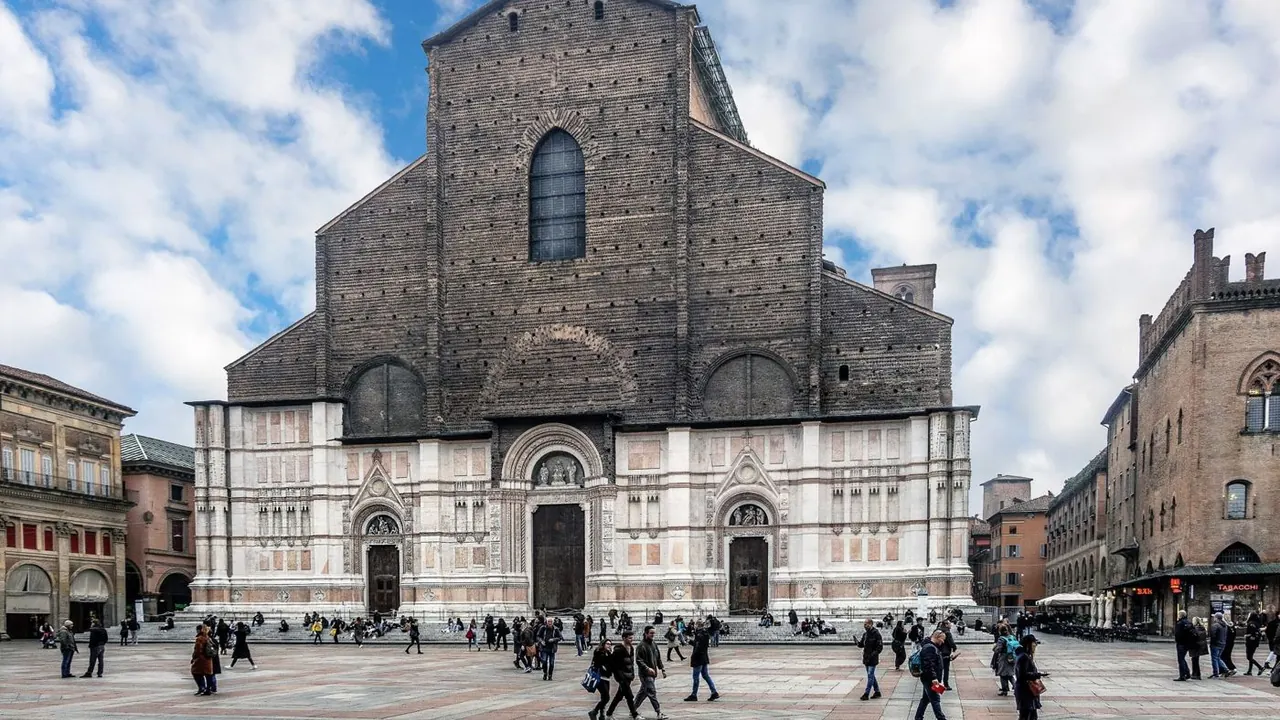
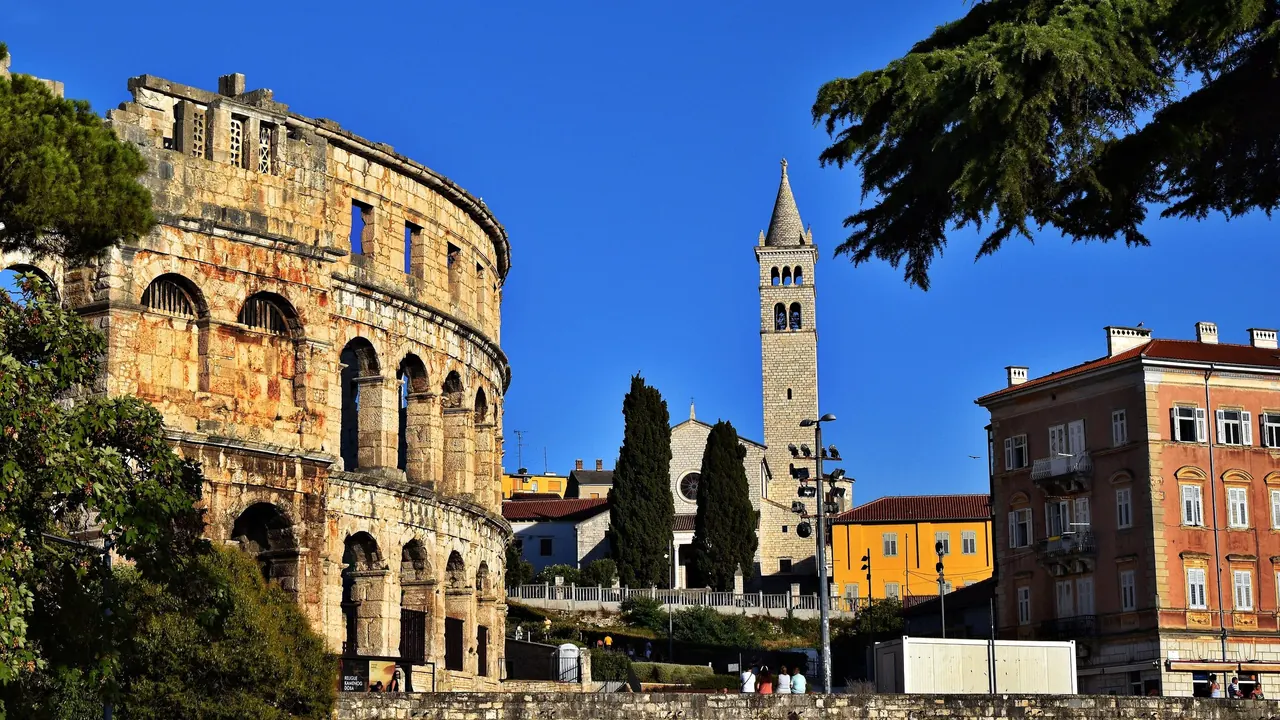
Photos: Bologna by Vanni Lazzari, CC BY-SA 4.0, cropped; Pula by Miroslav.vajdic, CC BY-SA 4.0, cropped.
Bologna or Pula?
Our verdict in twelve categories, each scored against the same fixed benchmark cities, and the climate month by month, so you can choose for your trip.
Choose Bologna for
- food and drink
- getting around
- shopping
Bologna is the choice for travellers who plan their days around the table and the train timetable. It is a whole medieval city of brick and porticoes with some of Italy's most important cooking, a student night scene that runs most of the year, and a station at the edge of the old town that puts Florence, Ravenna and Venice within easy reach. Nobody needs a car, and three or four days pass easily.
Choose Pula for
- beaches
- nature and the outdoors
- families
Pula suits a summer trip where the sea comes first. The swimming is in clear water off rocks and pine-shaded coves, Cape Kamenjak sits at the end of the peninsula, and a Roman amphitheatre stands over the harbour. With a hire car it also makes a good base for the hill towns and truffle country of Istria. Food, nightlife and the arts are thinner, but on a sun-and-sea trip that matters less.
Scoreboard
Twelve categories on one fixed scale from 0 to 100. The shaded stretch is the gap between the two.
Your match
Pick a travel style or drag the sliders, and both match scores follow your weighting.
Wins on food and drink and getting around with your weighting.
Wins on beaches and nature and the outdoors with your weighting.
What matters to you?
Category by category
What the scores mean for a trip.
Beaches & swimming
Pula is a real swimming destination and Bologna is not. In Pula you swim straight off rocks, platforms and pebble coves around Verudela and Stoja, in very clear water. The best of it is at Cape Kamenjak, and the sheltered bays of Medulin suit small children. Bring water shoes, as there is no sand.
From Bologna, the sea means about an hour on the train to Rimini or Cervia. There you find shallow, warm water, often greenish, and long rows of rented umbrellas. It works as an escape from the city heat but not as a beach vacation.
Food & drink
Eating is one of the main reasons to go to Bologna. Ragù, tortellini in brodo, mortadella and hand-rolled pasta are made in the city where they come from, and the delicatessens of the Quadrilatero are stacked with Parmigiano and Parma ham from towns less than an hour away. The weak spot is variety, since almost everything is Emilian.
Istrian cooking in Pula is distinctive, with truffle fuži, scampi buzara and Malvazija wine. But the city's own restaurants are limited and lean towards tourist menus around the Arena, so the best meals often mean a drive to a village konoba inland.
Culture & sights
Bologna's appeal is the whole medieval brick centre. It has kilometres of UNESCO-listed porticoes, the Two Towers, the seven churches of Santo Stefano, the anatomical theatre of Europe's oldest university and a strong gallery of Bolognese painting, enough for two or three full days.
Pula's sights are fewer but very good. The Arena is one of the best-preserved Roman amphitheatres there is, with the Temple of Augustus on the Forum and the Arch of the Sergii close by. Habsburg naval buildings and forts add a second layer, but a day or two covers it all.
Nightlife
Bologna's student population keeps the city out late for most of the year. Crowds spill out of cheap bars around Piazza Verdi, small taverns line Via del Pratello, and wine bars fill after aperitivo. It is casual rather than glamorous, and clubs are a taxi ride out.
Pula's nights are terrace drinks around the Forum and beach bars on Verudela and in Medulin, and only in summer. The two cities peak at opposite times: Pula is at its liveliest in August, just when Bologna's students have left and its streets go quiet.
Nature & outdoors
Pula has more outdoors on its doorstep. Kamenjak's car-free headland has cliffs, wild flowers and dinosaur footprints. You can kayak among the islets, windsurf at Premantura and dive on naval-era wrecks, and the Učka range offers proper hiking.
Bologna's outdoors means hills rather than sea. You can walk the Colli Bolognesi and up to San Luca, see the gypsum caves of the Parco dei Gessi, and set out on the Via degli Dei trail to Florence from Piazza Maggiore itself. There is modest skiing at Corno alle Scale in winter.
Day trips
Bologna is about as good a base as Europe offers. Florence is barely half an hour away by fast train. Ravenna's mosaics, Ferrara, Modena and Parma are all short rides, and Venice and Verona are close enough for a day, all without a car.
From Pula, Rovinj, the Euphrasian Basilica at Poreč, the hill towns of Motovun and Grožnjan, and the Brijuni islands make a fine programme. But buses are thin, so most of these trips depend on hiring a car.
Good for families
Pula is easier with children, mostly because of the sea. The shallow bays around Medulin, the aquarium inside a Habsburg fort and the Arena's underground passages fill the days, and there is a dinosaur park and a water park within an hour. Rocky shores and the need for a car take some effort.
Bologna is pleasant to walk with a pushchair, being flat, traffic-calmed and shaded by porticoes, and gelato never fails. Climbing the Asinelli tower is a treat for older children. Otherwise the city is churches and museums, and Mirabilandia or the Rimini beach means a day out.
Getting around
In Bologna you can do without a car altogether. The centre is flat and walkable under the arcades, much of it is closed to traffic, and the main station sits at its edge with fast trains in every direction. There is no metro, but buses and an airport shuttle cover the gaps.
Pula's old town is just as easy on foot, and city buses reach Verudela. Beyond that, rail and regional buses are of little help, so Kamenjak, the wider coast and inland Istria really need a car or a scooter.
Shopping & style
In both cities the best things to take home are edible. Bologna has more besides: the luxury houses along Via Farini and in the Galleria Cavour, the Montagnola market, an antiques market at Santo Stefano and vintage and book shops in the university quarter.
Pula has truffle products, olive oil, rakija and pršut from the market hall, and not much else beyond chain stores and souvenirs on the main pedestrian street.
Affordability
The overall cost is much the same, but it adds up in different ways. In Bologna the meals are good value and the sights are mostly free churches and squares, while rooms are the expense, especially during the big trade fairs.
In Pula the season matters most. Apartments and konobas are reasonable in spring and autumn, but July and August rooms cost as much as on Western European coasts, and you need to budget for car hire and boat trips.
Live music & performing arts
Bologna has a music scene all year. The Teatro Comunale is one of Italy's historic opera houses, the city is a UNESCO City of Music, and there is jazz in basement clubs on most nights and student gigs in small venues.
Pula has one great setting: concerts and film festival screenings inside the Roman Arena on summer nights. The rest of the year there is little beyond Croatian-language theatre.
Wellness & relaxation
Neither city is a spa destination, but Bologna has real thermal water close by. Castel San Pietro Terme is twenty minutes away and the old spa town of Porretta Terme an hour into the Apennines, both good for a calm half day.
In Pula, wellness means the spa areas of the resort hotels on Verudela and in Medulin. The slower pace helps too, with evening walks on the pine-shaded coastal paths outside high summer.
When should you go?
Pick your month. The climate figures are measured averages, not a forecast.
Bologna in July
Pula in July
Daytime high, °C
Rainfall in the month, mm
Where the figures come from
Bologna has no rain gauge within 25 km of the centre, so its rainfall comes from a gridded climate dataset read at the city rather than from a gauge further away.
Bologna's sunshine is measured 82 km from the centre, at Cervia.
Pula's temperatures are measured 87 km from the centre, at Trieste.
Pula has no rain gauge within 25 km of the centre, so its rainfall comes from a gridded climate dataset read at the city rather than from a gauge further away.
Temperature and rainfall are climate normals, averaged over the years shown. Bologna: 1991-2020, 14 years observed normals, Bologna / Borgo Panigale (5.5 km from centre). Pula: 1991-2020 normals, Trieste (87 km from centre).
Bologna is a city for spring and autumn. May, June and September are warm and sunny without being oppressive, while July and August reach around 32°C in humid inland air, which makes walking the streets hard work even in the shade of the porticoes. Winters are cold and grey, and October and November are the wettest months, at about 95mm.
Pula has milder winters and less fierce summers thanks to the sea. The water is warm enough for swimming from June to September, peaking around 25°C in August and still about 22°C in June and September, so September is a good month for both swimming and sightseeing. The rain arrives later in the year, and November is the wettest month at about 107mm. Through the summer both cities get long sunny days.
Which traveller are you?
On a beach and sun trip, Pula wins easily. Its rocky coves and pebble bays have very clear water and pine shade, with Kamenjak's wild headland close by, while Bologna's nearest sea is a train ride away at Rimini's crowded lidos.
For a food and nightlife trip, Bologna is the better pick. You get tagliatelle al ragù and tortellini in the old osterie, aperitivo in the Quadrilatero, then student bars around Piazza Verdi and Via del Pratello. Pula's evenings are mainly summer terraces and are over early.
On a culture and arts trip, Bologna offers more depth. It has an intact medieval centre, the Archiginnasio and the Pinacoteca, opera at the Teatro Comunale and jazz in basement clubs. Pula's Arena is magnificent, but the city's sights take only a day or two.
Before you go
| Measure | Bologna | Pula |
|---|---|---|
| Official language | Italian | Croatian |
| Currency | Euro (EUR) | Euro (EUR) |
| Sockets | CFL230 V, 50 Hz | CF230 V, 50 Hz |
| Driving side | Right | Right |
| Time zone | UTC+1, UTC+2 in summer | UTC+1, UTC+2 in summer |
| Emergency number | 112 | 112 |
| Elevation | 54 m | 5 m |
| Main airport | Bologna Guglielmo Marconi Airport (BLQ)6 km from centre98 non-stop destinations | Pula Airport (PUY)7 km from centre34 non-stop destinations |
| Public holidays this year | 13 days | 14 days |
By the numbers
| Measure | Bologna | Pula |
|---|---|---|
| City population | 387,971 | 52,220 |
| People per km² | 2,754 | 971 |
| Museums within 10 km | 68 | 4 |
| UNESCO World Heritage sites within 50 km | 3 | 1 |
| Swim season, months above 21 °C | - | 4 months |
Where else could you go?
Every comparison below shares a destination with this one, so you can follow Bologna or Pula somewhere new.