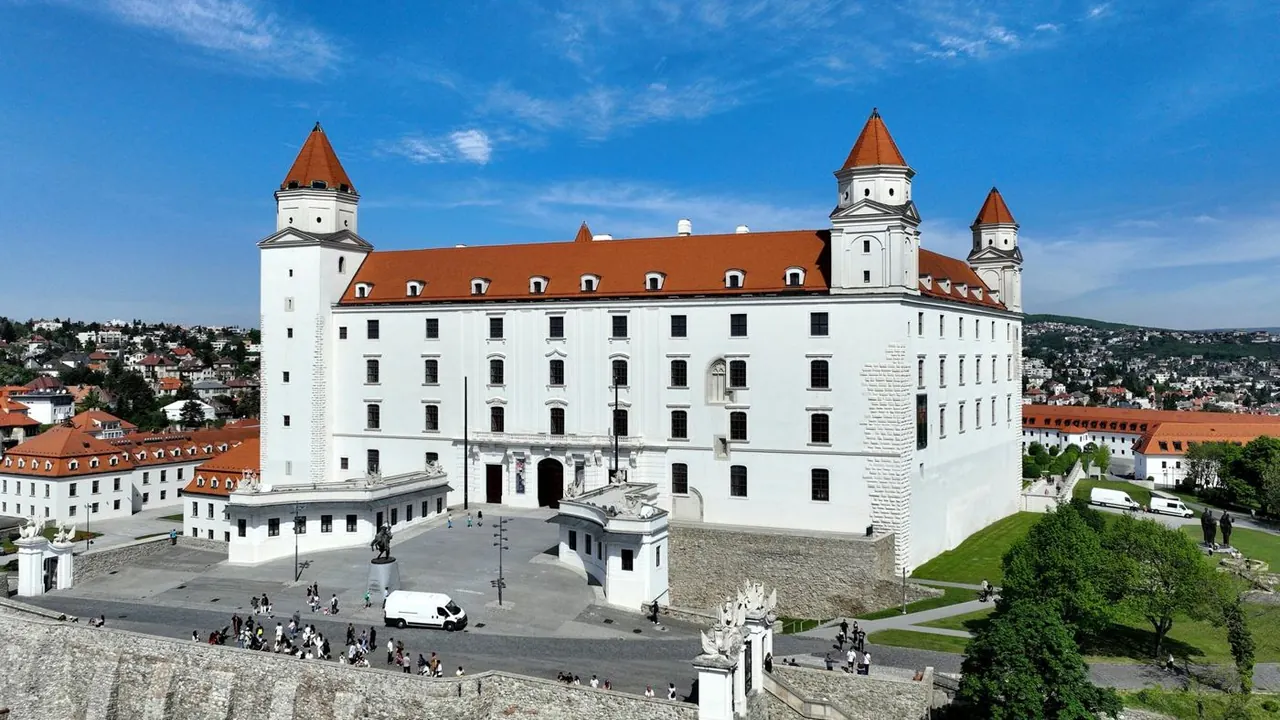
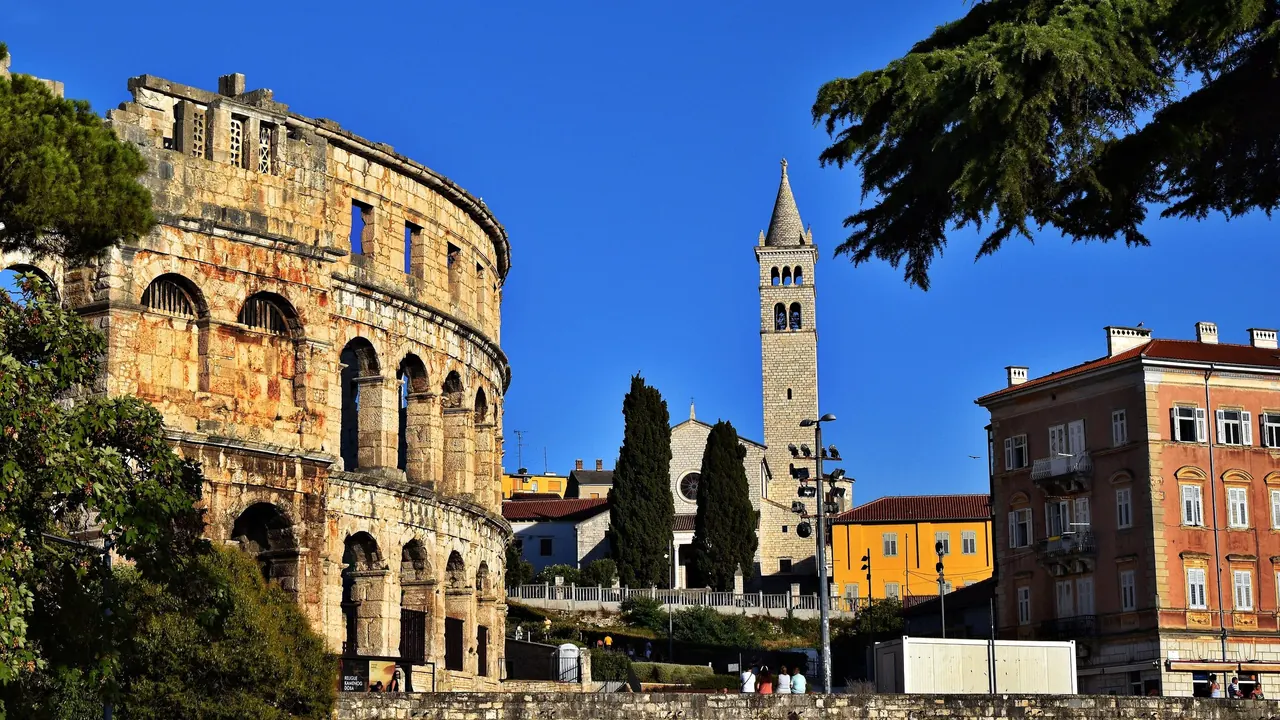
Photos: Bratislava by C.Stadler/Bwag, CC BY-SA 4.0, cropped; Pula by Miroslav.vajdic, CC BY-SA 4.0, cropped.
Bratislava or Pula?
Our verdict in twelve categories, each scored against the same fixed benchmark cities, and the climate month by month, so you can choose for your trip.
Choose Bratislava for
- getting around
- live music and the arts
- prices
Bratislava suits a compact city break built around walking, wine and an evening at the opera, with Vienna an easy train ride away. Everything central is a short walk apart, everyday costs stay lower and you never need a car, which makes it a good choice for two or three days at any time outside high summer.
Choose Pula for
- beaches
- families
- culture and sights
For a summer trip where the sea matters, Pula is the stronger pick. It has clear water off pine-shaded rocks and the coves of Kamenjak, a Roman amphitheatre that still stands whole, Istrian truffle and seafood cooking, and more to keep children busy. All of that favours it, as long as you are happy to hire a car to see the rest of Istria.
Scoreboard
Twelve categories on one fixed scale from 0 to 100. The shaded stretch is the gap between the two.
Your match
Pick a travel style or drag the sliders, and both match scores follow your weighting.
Wins on getting around and live music and the arts with your weighting.
Wins on beaches and families with your weighting.
What matters to you?
Category by category
What the scores mean for a trip.
Beaches & swimming
Here the two barely compete. Bratislava is inland, and the Danube is off limits for swimming. Summer bathing means lake shores such as Zlate piesky on the tram line or the Senec lakes, which are fine for a hot afternoon but nothing to plan a trip around.
Pula sits on the Adriatic with very clear water, though you swim from rock and pebble rather than sand. The coves around Verudela and Stoja are close to town, and Cape Kamenjak, about 10km south, has dozens of wild inlets. Medulin's sheltered bays have shallow water for small children.
Food & drink
Pula has the more interesting food. Istrian cooking means truffle pasta, scampi buzara, grilled fish and pršut, with Malvazija and Teran from estates just inland, and the best meals are in hinterland konobas and harbour taverns.
Bratislava's cooking is heartier and narrower: dumplings with sheep's cheese, roast duck and poppy-seed rolls. Its wine bars pouring Small Carpathian Veltliner and Riesling are a real pleasure, though. In both cities the most central squares lean towards tourist menus.
Culture & sights
Both take a day or two to see, but Pula's sights carry more weight. The Arena is one of the best preserved Roman amphitheatres anywhere. With the intact Temple of Augustus, the Arch of the Sergii and mosaics tucked into the backstreets, you can still trace the Roman town as you walk.
Bratislava offers a neat baroque Old Town, the coronation history of St Martin's Cathedral, the white castle and the Blue Church, plus a communist-era layer in the Most SNP bridge. It is pleasant and well kept rather than remarkable.
Nightlife
Neither city is worth the journey for its nightlife, but the evenings feel different. In Bratislava, going out happens along a few Old Town streets of pubs, wine bars and cocktail bars. They are loud on Friday and Saturday nights all year, thanks to students and weekend groups from abroad, stag parties included.
Pula is a summer place. Evenings start with drinks on terraces around the Forum and move on to beach bars on Verudela and around Medulin, with a few small clubs busy on warm weekends. Out of season most nights end early.
Nature & outdoors
Pula's outdoors is coastal and more varied. Kamenjak is a car-free headland of cliffs and wild flowers, good for walking and cycling, and you can also go sea kayaking, windsurf in Premantura bay or dive on old naval wrecks. The Učka range offers proper hiking further off.
Bratislava has forest trails from Koliba up to Kamzik and along the Little Carpathian ridge, plus floodplain woods along the Danube, the flat cycle route into Austria and whitewater rafting at Cunovo. It is gentle country, good for a half day, but less striking.
Day trips
Both are excellent bases, in different ways. From Bratislava the train does the work: Vienna is about an hour away, and Trnava, Trencin and the wine towns of Svaty Jur, Pezinok and Modra are easy to reach, with Austria, Hungary and Czech sights all close by.
Pula's day trips are Istrian: Rovinj, the mosaics of Poreč, hill towns such as Motovun and Hum, and the Brijuni islands by boat from Fažana. Buses are infrequent, so here a car is close to essential.
Good for families
Pula is the easier choice with children, because the sea fills the days. There are shallow bays at Medulin and Premantura, the aquarium in a Verudela fort and the Arena's underground passages to explore, with a dinosaur park and a water park within an hour.
Bratislava is safe and calm. Children can hunt for the bronze statues, ride the chairlift in the Kamzik forest park, visit the zoo or spend a day at the Senec water park, but the options run out after two or three days.
Getting around
Bratislava is the simpler place to manage without a car. The sights are within a twenty-minute walk, and one ticket covers the trams, trolleybuses and buses out to Kamzik, the zoo and Devin. Trains handle most day trips. Only the lack of a metro slows longer journeys.
Pula's centre is just as compact and flat, and city buses reach Verudela. Beyond that, regional buses are infrequent and the rail line is of little use. Kamenjak, the hill towns and the wider coast are far easier with a car or scooter.
Shopping & style
Neither city is a reason to bring an empty suitcase, but the souvenirs differ in kind. Bratislava's are crafted or bottled: Modra majolica and handmade lace from the folk-craft centre, and Small Carpathian whites that seldom reach shops abroad. Its malls hold little you could not find at home, yet serious fashion is only an hour away by train in Vienna, a big-city fallback Pula has nothing close to.
Pula, by contrast, is a place to shop for the kitchen rather than the shelf. Its olive oil, truffle paste and cured ham are worth carrying home, and they are best bought at the market hall or from farms inland. The old-town streets offer little beyond chain clothing and trinkets, so leave room in your luggage for jars and bottles, not clothes.
Affordability
Bratislava makes a budget go further. Beer, wine, transport and museums are cheap, ordinary pubs serve weekday lunch menus for little, and rooms stay reasonable for most of the year. Only the main squares and the riverside complexes charge Western prices.
Pula is mid-priced and best value in spring and autumn. In July and August rooms cost about as much as on the Western European coasts. Car hire and boat trips, which a stay here tends to rely on, add up quickly.
Live music & performing arts
For a regular programme, Bratislava is clearly ahead. The Slovak National Theatre stages opera and ballet on Hviezdoslav Square and the Slovak Philharmonic plays in the Reduta, with tickets easy to find from autumn to spring. An autumn music festival and a long-running jazz festival add highlights.
Pula's moment is summer, when the Arena hosts touring pop and rock acts, classical galas and Pula Film Festival screenings under the Roman arches. The rest of the year offers little beyond Croatian-language theatre.
Wellness & relaxation
Bratislava has the edge because Slovakia's bathing culture is within easy reach. The Senec thermal water park is half an hour away, and the historic spa town of Piestany, known for its mud and sulphur-water cures, is about an hour by train. In town, unwinding means hotel spas, slow afternoons in cafés and the forest paths above the city, which are quiet on weekdays.
Pula has no spa tradition of its own, so relaxing means the resort hotel spas on Verudela and in Medulin, long coffees on the Forum and evening walks along pine-shaded coastal paths. The pace is at its gentlest outside high summer.
When should you go?
Pick your month. The climate figures are measured averages, not a forecast.
Bratislava in July
Pula in July
Daytime high, °C
Rainfall in the month, mm
Where the figures come from
Bratislava has no rain gauge within 25 km of the centre, so its rainfall comes from a gridded climate dataset read at the city rather than from a gauge further away.
Bratislava's sunshine is measured 56 km from the centre, at Wien / Hohe Warte.
Pula's temperatures are measured 87 km from the centre, at Trieste.
Pula has no rain gauge within 25 km of the centre, so its rainfall comes from a gridded climate dataset read at the city rather than from a gauge further away.
Temperature and rainfall are climate normals, averaged over the years shown. Bratislava: 1991-2020 normals, Bratislava Ivanka (8.6 km from centre). Pula: 1991-2020 normals, Trieste (87 km from centre).
Bratislava has a continental climate. Summers reach about 27°C in July and August, which is warm enough for the lakes, but these are also its wettest months, with heavy showers. Winters are cold, around 3°C by day in January, and the short, dull days push you towards museums and cafés. May, June and September are the most comfortable months for walking the Old Town and the forest trails.
Pula is milder all year, a little warmer in summer and noticeably sunnier in July. The sea is warm enough to swim from June and peaks at about 25°C in August, staying pleasant into September. In autumn the two swap roles. Rain builds steadily in Pula, reaching 107mm in November, while Bratislava's autumn is drier. Spring and late September are best for walking and cycling around Pula, before or after the midday heat.
Which traveller are you?
On a beach and sun trip, Pula wins easily. The clear Adriatic is warm from June to September and Kamenjak's coves give plenty of variety. Bratislava has only lake shores, and the Danube is not for swimming.
For a short city break, Bratislava fits better. The Old Town, castle and riverfront are all within walking distance, no car is needed, an opera evening is easy to arrange, prices stay modest, and Vienna is a simple train ride away for a second day.
On a family trip with young children, Pula is the better base. Its sheltered, shallow bays at Medulin, the aquarium in an old fort and the Arena's underground passages keep children busy for longer than Bratislava's zoo, forest park and lakes.
Before you go
| Measure | Bratislava | Pula |
|---|---|---|
| Official language | Slovak | Croatian |
| Currency | Euro (EUR) | Euro (EUR) |
| Sockets | CE230 V, 50 Hz | CF230 V, 50 Hz |
| Driving side | Right | Right |
| Time zone | UTC+1, UTC+2 in summer | UTC+1, UTC+2 in summer |
| Emergency number | 112 | 112 |
| Elevation | 152 m | 5 m |
| Main airport | M. R. Štefánik Airport (BTS)8 km from centre68 non-stop destinations | Pula Airport (PUY)7 km from centre34 non-stop destinations |
| Public holidays this year | 15 days | 14 days |
By the numbers
| Measure | Bratislava | Pula |
|---|---|---|
| City population | 480,902 | 52,220 |
| People per km² | 1,308 | 971 |
| Museums within 10 km | 22 | 4 |
| UNESCO World Heritage sites within 50 km | 2 | 1 |
| Swim season, months above 21 °C | - | 4 months |
Where else could you go?
Every comparison below shares a destination with this one, so you can follow Bratislava or Pula somewhere new.