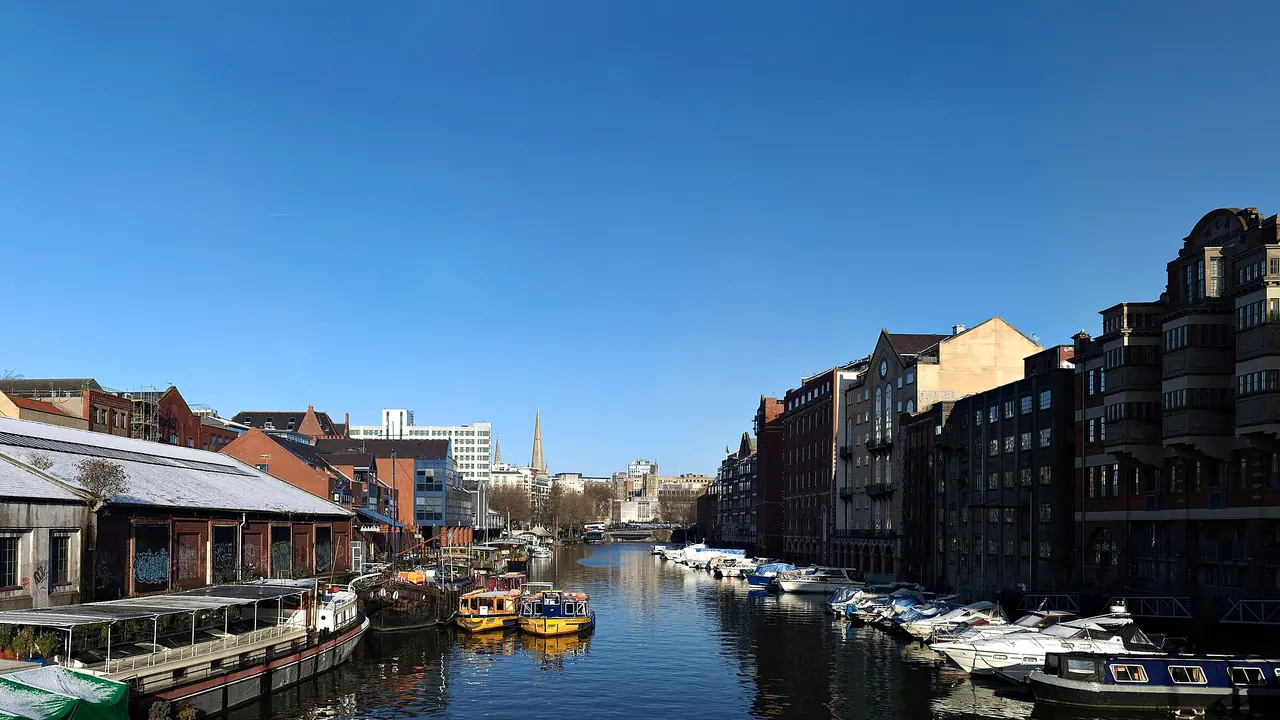
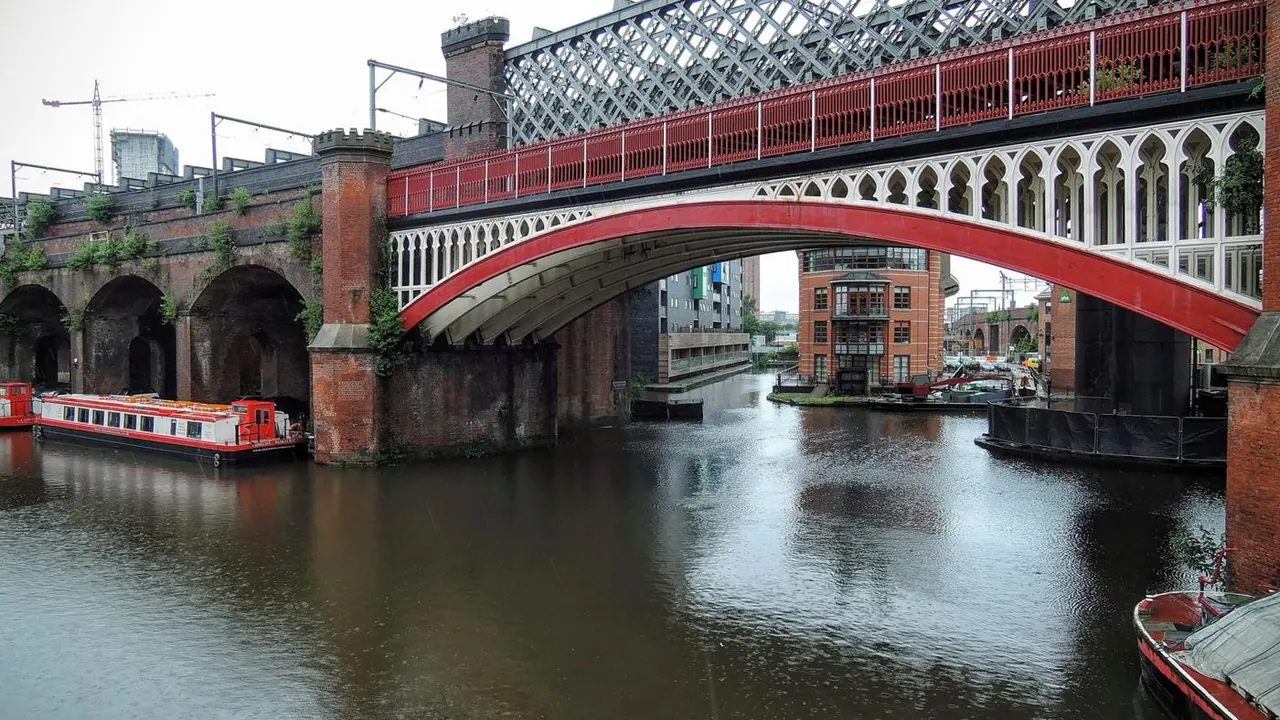
Photos: Bristol by NotFromUtrecht, CC BY-SA 3.0, cropped; Manchester by IIya Kuzhekin, CC BY 3.0, cropped.
Bristol or Manchester?
Our verdict in twelve categories, each scored against the same fixed benchmark cities, and the climate month by month, so you can choose for your trip.
Choose Bristol for
- wellness
- beaches
- food and drink
Bristol suits a slower, more scenic trip. Its harbourside, Georgian Clifton and the Avon Gorge make a handsome base, it is the better city for grazing on market food and West Country cider, and Bath's hot springs are a short train ride away when you want a quiet afternoon. Choose it if you would rather wander and eat well than go out every night, and don't mind steep hills.
Choose Manchester for
- live music and the arts
- getting around
- shopping
Manchester is the pick if you want the city itself to keep you busy after dark. Gigs, orchestras and the Royal Exchange give it the stronger stage, the Northern Quarter and Canal Street give it the bigger nightlife, and it is the north's main shopping city. A flat centre and the Metrolink trams also make it easier to get around.
Scoreboard
Twelve categories on one fixed scale from 0 to 100. The shaded stretch is the gap between the two.
Your match
Pick a travel style or drag the sliders, and both match scores follow your weighting.
Too close to call, 1 point apart
Wins on wellness and beaches with your weighting.
Wins on live music and the arts and getting around with your weighting.
What matters to you?
Category by category
What the scores mean for a trip.
Beaches & swimming
Neither city is a beach destination, but Bristol at least has outdoor water you would want to get into. The Severn estuary itself is brown and muddy, yet the Victorian marine lake at Clevedon gives cold-water swimmers a proper dip, and the sands of Weston-super-Mare are under an hour away if you time the tide.
Manchester is inland, and Formby or Blackpool on the Irish Sea are more than an hour off and better for a bracing walk and fish and chips than a swim. For real beach days, people from both cities drive a long way, to Devon, Cornwall, Gower or beyond.
Food & drink
Bristol is the more rewarding place to graze. The covered stalls of St Nicholas Market, the container kitchens on the harbourside and the bakeries and coffee roasters of Gloucester Road and North Street make an easy, independent day of eating. Farmhouse cider and old cider houses give the drinking a West Country flavour that Manchester has no real match for.
Manchester's strength is range at a low price rather than character. Chinatown, the curry houses along Wilmslow Road in Rusholme and the food halls in the old Ancoats mills feed you well and cheaply, with pies and hotpot as the local staples. In both cities, craft beer counts for more than fine dining.
Culture & sights
Bristol's sights belong to a seafaring port and to Brunel. The SS Great Britain in the dry dock where it was built, the Suspension Bridge high over the Avon Gorge and the crescents of Georgian Clifton give it the more memorable set pieces. St Mary Redcliffe's Gothic nave, M Shed's frank account of the slave trade and Banksy's early walls in Stokes Croft and Bedminster complete the picture.
Manchester's story is cotton and the first industrial city, told through the neo-Gothic Town Hall, the John Rylands Library and the Science and Industry Museum on its early railway site. Its free galleries go deeper, from the Pre-Raphaelites at the Manchester Art Gallery to the Whitworth, so art lovers may lean north, while Bristol has the handsomer streets to wander.
Nightlife
Both cities take going out seriously, but Manchester's scene is larger and wider. The Northern Quarter's warehouses are packed with cocktail bars, dive bars and DJ rooms, Canal Street is one of Europe's oldest gay villages, and Deansgate and Spinningfields cater for dressed-up weekend crowds. Big warehouse raves in autumn and winter bring in famous DJs.
Bristol's nights are smaller and scruffier, built on the sound-system culture behind trip hop and drum and bass, with clubs in the railway arches by Temple Meads and on a boat in the harbour. It is a good alternative if you prefer something more underground than glossy, and its students keep it busy all year round, while Manchester goes quiet in summer.
Nature & outdoors
The outdoors is a draw in both cities, but the settings differ. Bristol keeps its green space close: the Downs and the climbing cliffs of the Avon Gorge, Leigh Woods, the deer park at Ashton Court and the railway path to Bath, with the softer Mendips and Cheddar Gorge under an hour away.
Manchester's centre is flat and built up, but wilder country starts close by. Trains along the Hope Valley line reach Edale in under an hour for the gritstone moors of Kinder Scout and Mam Tor, and the Lake District is within a long day's reach. Choose Bristol for greenery on your doorstep and Manchester for open moorland hiking, with waterproofs.
Day trips
Both are excellent bases for day trips, and the difference is which part of England you want to see. From Bristol you get Bath a quarter of an hour away by train, then Wells, Glastonbury, Cardiff, Stonehenge and the stone villages of the southern Cotswolds, though some of these are easier by car.
Manchester sits at the hub of the northern rail network, so Liverpool, Chester and York are easy without a car. Add Chatsworth and Buxton in the Peak District, Haworth and Saltaire in Yorkshire, and Windermere in the Lakes, and you have northern cities and moorland where Bristol has southern cathedrals and ancient stones.
Good for families
Bristol keeps most of its children's sights along one stretch of harbourside. The SS Great Britain, the We The Curious science centre with its planetarium and the aquarium sit close together, and the little ferries between them are a treat in themselves. The Downs and Leigh Woods give children room to run, though the steep hills are hard work with a pushchair.
Manchester leans on free indoor museums spread around the city, which helps on wet days: working engines at the Science and Industry Museum, dinosaurs at the Manchester Museum, and an aquarium, Lego attraction and indoor snow slope at the Trafford Centre. Chester Zoo and Alton Towers make bigger days out than Bristol can offer nearby, but the centre gets rowdy on weekend evenings.
Getting around
Manchester is the easier city to get around. Its centre is flat and compact, and the Metrolink trams run out to Salford Quays, Old Trafford, the airport and the suburbs, with a dense bus network covering the rest.
Bristol's old city and harbourside are walkable, and the yellow harbour ferries make a pleasant way to get around. But the climb to Clifton is steep, there is no tram or metro, and buses get stuck in traffic. Both have good mainline stations for day trips by train.
Shopping & style
Manchester is the stronger shopping city, the main one for the whole north of England. Big names and two upmarket department stores sit around Exchange Square, designer labels line King Street and Spinningfields, and the Northern Quarter has record shops, vintage clothes and the stalls of Afflecks. The huge Trafford Centre adds more on the edge of the city.
Bristol has the same chain stores at Cabot Circus and Broadmead, but its appeal lies in independent shops along Gloucester Road and the galleries in Clifton Village's Georgian arcades. It makes a pleasant afternoon of browsing rather than a reason to visit.
Affordability
Costs are much the same in both: neither is cheap, and both are clearly cheaper than London. Free entry to most major museums helps in both cities, and in each the hotel bill depends on your dates. In Bristol prices rise at weekends, in Manchester when a home football match or a big arena show is on.
The difference is where you find a cheap meal. In Bristol it is market stalls and street food. In Manchester, the curry houses of Rusholme, Chinatown and the food halls make eating cheaply a little easier.
Live music & performing arts
Manchester has much the stronger stage. Two major orchestras, the Hallé and the BBC Philharmonic, play at the Bridgewater Hall. The Royal Exchange stages theatre in the round inside the old cotton trading hall, and the gig circuit runs from tiny Northern Quarter rooms up to one of Europe's largest indoor arenas.
Bristol has real charm on a smaller scale. The Georgian Bristol Old Vic is the oldest continuously working theatre in the English-speaking world, the Tobacco Factory puts on fringe theatre and Shakespeare, and small venues in Stokes Croft and Old Market host bands most nights. Neither city has a resident opera company.
Wellness & relaxation
Bristol is far better for slowing down. The heated Victorian lido in Clifton, with its spa, makes a restful half day, cold-water swimmers use the tidal pools on the Severn coast, and Bath's rooftop thermal pools above Britain's only natural hot springs are a quarter of an hour away by train.
Manchester offers hotel spas and little else. Victoria Baths can be visited as a heritage building but not swum in, and the city's loud weekend pace works against rest. The nearest real escape is the old spa town of Buxton or the Peak District, about an hour away.
When should you go?
Pick your month. The climate figures are measured averages, not a forecast.
Bristol in July
Manchester in July
Daytime high, °C
Rainfall in the month, mm
Where the figures come from
Bristol's station stands 178 m above the city centre, so the centre is likely a little warmer than the figures say.
Bristol has no rain gauge within 25 km of the centre, so its rainfall comes from a gridded climate dataset read at the city rather than from a gauge further away.
Bristol's sunshine is measured 43 km from the centre, at Lyneham.
Temperature and rainfall are climate normals, averaged over the years shown. Bristol: 1991-2020 normals, Lulsgate Bottom (11.8 km from centre). Manchester: 1991-2020 normals, Manchester Airport (14.8 km from centre).
The two cities share much the same mild, damp British climate, so the choice of month matters more than the choice of city. July and August are the warmest months, with daytime highs around 20°C in both. That is good weather for walking the streets but never beach weather, and the water off Bristol's coast reaches only about 18°C at best. Spring and early autumn are cool but fine for sightseeing, and winter highs of about 7°C make for short, grey days in both places.
The differences are small. Bristol is noticeably sunnier from spring to late summer, with more than 200 hours of sun in May and July, while Manchester runs a degree warmer and a little drier for most of the year. Both get wetter from October to December, when Bristol's rainfall comes close to 100mm a month, so pack waterproofs whichever city you choose.
Which traveller are you?
For a relaxing and wellness trip, Bristol is clearly the better choice. The heated Victorian lido behind Clifton, the quiet of the Downs and Bath's rooftop thermal spa a quarter of an hour away make slowing down easy. Manchester has little beyond hotel spas.
On a culture and arts trip built around evenings, Manchester has the edge. The Hallé and the BBC Philharmonic at the Bridgewater Hall, theatre in the round at the Royal Exchange and a deep gig circuit add up to more than Bristol's smaller stage scene.
For a shopping trip, head to Manchester. Big names around Exchange Square, designer labels on King Street, Afflecks in the Northern Quarter and the vast Trafford Centre cover far more ground than Bristol's Cabot Circus and Gloucester Road.
Before you go
| Measure | Bristol | Manchester |
|---|---|---|
| Official language | English | English |
| Currency | Pound Sterling (GBP) | Pound Sterling (GBP) |
| Sockets | G230 V, 50 Hz | G230 V, 50 Hz |
| Driving side | Left | Left |
| Time zone | UTC, UTC+1 in summer | UTC, UTC+1 in summer |
| Emergency number | 112 or 999 | 112 or 999 |
| Elevation | 11 m | 38 m |
| Main airport | Bristol Airport (BRS)11 km from centre117 non-stop destinations | Manchester Airport (MAN)15 km from centre211 non-stop destinations |
| Public holidays this year | 8 days | 8 days |
By the numbers
| Measure | Bristol | Manchester |
|---|---|---|
| City population | 472,465 | 547,627 |
| People per km² | 4,311 | 4,737 |
| Museums within 10 km | 23 | 28 |
| UNESCO World Heritage sites within 50 km | 3 | 2 |
| Swim season, months above 21 °C | None | None |
Where else could you go?
Every comparison below shares a destination with this one, so you can follow Bristol or Manchester somewhere new.
- Bathvs Bristol
- Cardiffvs Bristol
- Liverpoolvs Manchester
- Yorkvs Manchester
- Oxfordvs Bristol
- Londonvs Bristol