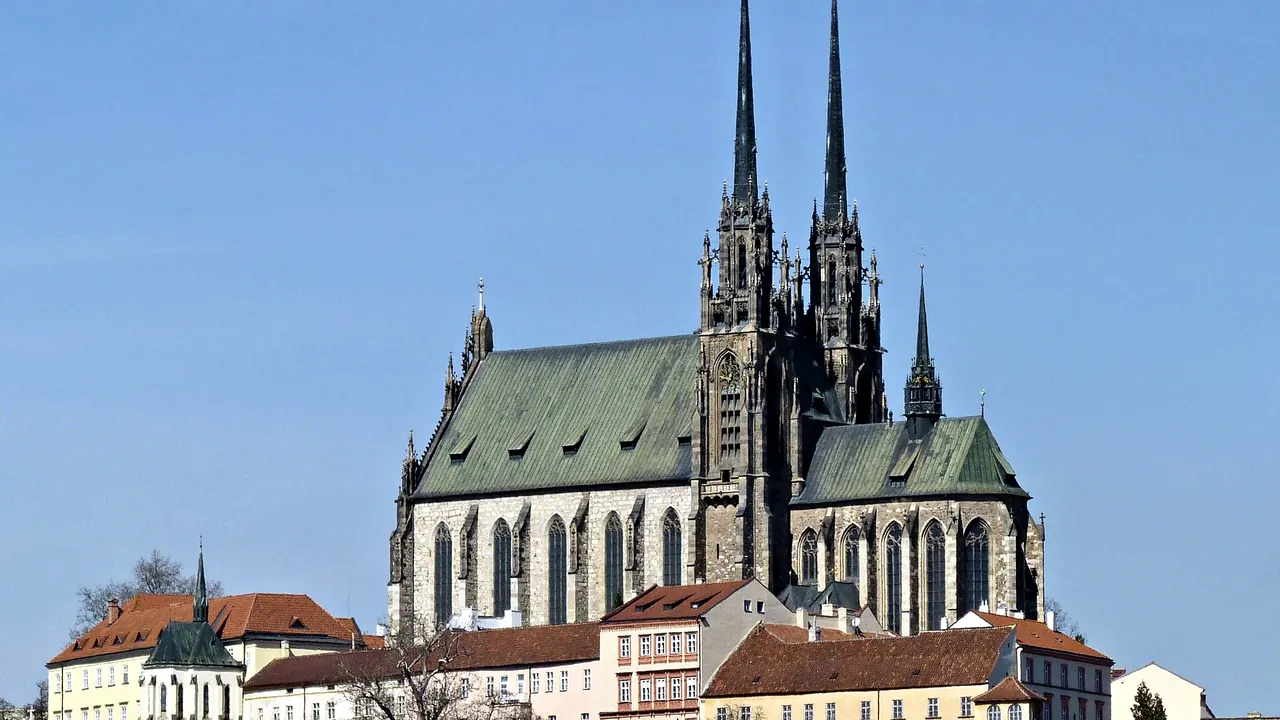
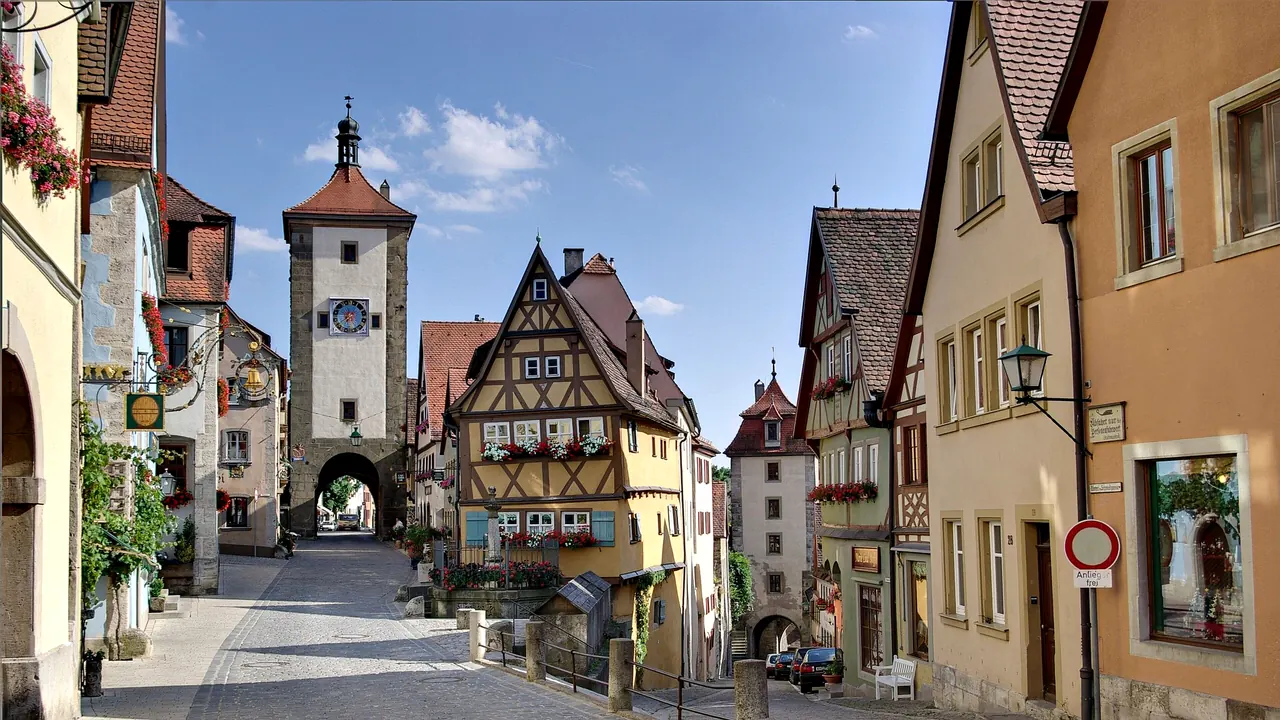
Photos: Brno by Michal Klajban, CC BY-SA 3.0, cropped; Rothenburg ob der Tauber by Berthold Werner, Public domain.
Brno or Rothenburg ob der Tauber?
Our verdict in twelve categories, each scored against the same fixed benchmark cities, and the climate month by month, so you can choose for your trip.
Choose Brno for
- live music and the arts
- nightlife
- prices
Brno suits travellers who want a real city as a base. Evenings can be spent in cocktail cellars and Moravian wine bars, or at Janacek opera, and the city costs little. One ticket covers trams and regional trains, so UNESCO chateaux, the Moravian Karst and even Vienna are easy days out without a car. It is the better choice for a stay of several days that mixes city life with trips out.
Choose Rothenburg ob der Tauber for
- wellness
- culture and sights
Rothenburg is for travellers who come to see the place itself: a medieval walled town with almost nothing modern inside, best seen from the covered ramparts at dawn or after the coach groups have left. Evenings are quiet and the food is plain, so it works best as a short, peaceful stop. Bring a car and add the other Romantic Road towns or a thermal spa.
Scoreboard
Twelve categories on one fixed scale from 0 to 100. The shaded stretch is the gap between the two.
Your match
Pick a travel style or drag the sliders, and both match scores follow your weighting.
Wins on live music and the arts and nightlife with your weighting.
Wins on wellness and culture and sights with your weighting.
What matters to you?
Category by category
What the scores mean for a trip.
Beaches & swimming
Neither is a place to swim on vacation, and there is little between them. Brno at least has water inside the city: the reservoir on the Svratka, reached by tram and river boat, with grassy banks and small beaches, though algae can spoil it in a hot spell. Rothenburg has its outdoor pool, and like Brno with the Nove Mlyny lakes it has an hour's drive to bathing lakes, here the Franconian ones such as the Altmühlsee.
Food & drink
Both cook the same core of roast pork and dumplings, but Brno makes more of it, mainly through drink. It has specialty coffee, careful cocktail bars and Moravian whites and Frankovka by the glass from vineyards close by. The Zelny trh market and a few modern bistros widen the choice, even if fine dining is thin.
Rothenburg's food is narrower: Schäufele, bratwurst, Silvaner in its squat Bocksbeutel bottle and the sugary Schneeball, and many inns near the Marktplatz cook for coach parties. Good meals are found in family-run guesthouses and Tauber valley wine taverns away from the square.
Culture & sights
Rothenburg comes out ahead because the whole town is the sight. The walls with their covered walkway, the Plönlein, the view from the Rathaus tower and Riemenschneider's Holy Blood Altar in St Jakob's make up an intact medieval scene that Brno cannot match. The visit is short, though, and the Medieval Crime Museum is the one substantial museum.
Brno's appeal is of a different kind and spread wider. Mies van der Rohe's Villa Tugendhat and a rich stock of interwar functionalist buildings stand alongside the Gothic cathedral and Spilberk Castle. With the Capuchin Crypt, the Moravian Gallery and the Mendel Museum, it has more variety, though no single setting as striking as Rothenburg's.
Nightlife
After dark the two could hardly be more different. Brno is a university city. During term the bars around Jakubske namesti stay full until late, with serious cocktail bars behind unmarked doors, Moravian wine bars and cheap student cellars, although clubbing is modest and July and August go quiet.
In Rothenburg an evening means dinner in an inn, a glass in a wine tavern and the night watchman's tour, and the lanes are silent by eleven. For anything more you have to go to Würzburg or Nuremberg.
Nature & outdoors
Brno has the more striking outdoors. The Moravian Karst, half an hour north, has more than a thousand caves, a boat ride on an underground river below the Macocha Abyss and wooded trails. To the south are the Palava limestone ridge, the Nove Mlyny lakes and the Dyje valley in Podyji National Park.
Rothenburg's countryside is gentler and starts right at the walls. Paths drop into the Tauber valley with its mills and meadows, and the Tauber valley cycle path is an easy family ride. It looks lovely in spring blossom and autumn colour but has nothing as dramatic as the karst.
Day trips
Both make good bases, but Brno reaches more places. Lednice-Valtice, Kromeriz, Trebic, Telc and Zelena Hora are all UNESCO sites within an hour or two, with the Austerlitz battlefield even closer. Olomouc, Vienna and Bratislava each fit into a day by train.
Rothenburg's strength is the Romantic Road. Dinkelsbühl and Nördlingen, a ring of walls inside a meteorite crater, compete with it for medieval charm, and Würzburg's Residenz and Nuremberg's castle are about an hour away. Most of these trips are far easier with a car.
Good for families
Brno gives children more to do over several days. There are the hands-on VIDA science centre, the hillside zoo, the mammoths at the Anthropos pavilion, the planetarium on Kravi hora and the boat through the Punkva Caves, and trams make it all easy to reach.
Rothenburg is more of a one- or two-day storybook adventure: the ramparts, the Rathaus tower, the night watchman with his lantern and, for older children, the torture devices in the Medieval Crime Museum. Beyond that there is little aimed at them, and the cobbles and steep valley paths are hard on pushchairs and small legs.
Getting around
Inside both old towns you can walk from one side to the other in about a quarter of an hour, on cobbles and with some steep climbs. The real difference starts outside the centre. Brno has a dense network of trams, trolleybuses and buses on one ticket that also covers regional trains across South Moravia, and night buses run late.
Rothenburg sits at the end of a branch line, where most journeys need a change at Steinach and buses to the villages are sparse, especially at weekends. A car is the practical way to explore the area.
Shopping & style
Neither town is worth the trip for shopping, but what you take home differs. Brno has ordinary chains on Ceska and Masarykova, malls, a few independent design, vintage and book shops, and Moravian wine bought straight from the cellars. Rothenburg sells almost entirely to visitors, but its year-round Christmas shops, with glass baubles, nutcrackers and Erzgebirge carvings, and its Christmas market on the Marktplatz draw people in their own right.
Affordability
Brno is clearly the cheaper stay. Rooms cost little for central Europe, weekday pub lunch menus are very good value, and beer, wine, transport and museum entry are all inexpensive. Big trade fairs are the main thing that fills hotels.
Rothenburg adds a tourist premium to rooms inside the walls and meals around the Marktplatz, highest in December and on summer weekends. Staying outside the walls or in a nearby village brings the cost down, and walking the town is free.
Live music & performing arts
Brno has a real stage life, built around Janacek. There is opera and ballet at the Janacek Theatre, drama at the ornate Mahen Theatre, the historic Reduta where the young Mozart played, a Philharmonic season and a festival devoted to the composer. Plays are mostly in Czech, so music and dance suit visitors best.
In Rothenburg, performance mostly means history in costume, above all the annual Meistertrunk play, along with summer open-air theatre and organ and choral concerts in St Jakob's. On most evenings there is no show at all.
Wellness & relaxation
Rothenburg is the better place to unwind, mainly because of its quiet. In the early morning, and again once the coach groups leave, the walls and the Tauber valley are almost empty. Thermal bathing is within about an hour, in the salt-water pool of Bad Windsheim's Franken-Therme or the old spa town of Bad Mergentheim.
Brno has swimming complexes with saunas, a few day spas and calm green spaces such as Luzanky park. It has no springs or spa tradition, and taking the waters means travelling further afield.
When should you go?
Pick your month. The climate figures are measured averages, not a forecast.
Brno in July
Rothenburg ob der Tauber in July
Daytime high, °C
Rainfall in the month, mm
Where the figures come from
Rothenburg ob der Tauber's sunshine is measured 27 km from the centre, at Feuchtwangen-heilbronn.
Temperature and rainfall are climate normals, averaged over the years shown. Brno: 1991-2020 normals, Brno / Turany (8.4 km from centre). Rothenburg ob der Tauber: 1991-2020 normals, Rothenburg ob der Tauber (0.9 km from centre).
Both have an inland central European climate. Summer highs reach about 25°C from June to August, and from December to February days hover just above freezing, too cold for long hours on the streets. May to September is the season for walking, sitting outdoors and cycling. The warmth is only enough for a reservoir, lake or pool, never a beach. Brno is a little warmer and sunnier in high summer, with about 260 hours of sunshine in July. Most of its rain falls in summer showers, and its winters are notably dry.
Rothenburg's rain is spread evenly through the year, so a wet day is as likely in winter as in July, and December is damp at around 63mm against Brno's 32mm. In both towns April and October are mild, at around 14 to 16°C. These months are pleasant for town walks and valley paths if you don't mind cooler evenings.
Which traveller are you?
For a food and nightlife trip, Brno is the clear choice. During term its cocktail bars, Moravian wine bars and student cellars stay full until late, and serious coffee and local wine by the glass lift the hearty Czech cooking. Rothenburg's lanes go silent by eleven.
On a trip on a tight budget, your money goes much further in Brno. Rooms, weekday pub lunch menus, beer and museum entry all cost little, and one ticket covers both trams and regional trains for day trips. Rothenburg charges a tourist premium and practically needs a car.
For a relaxing and wellness trip, Rothenburg is the better fit. Its walls and the Tauber valley paths go very quiet in the early morning and evening, and the thermal pools at Bad Windsheim and Bad Mergentheim are within about an hour. Brno has no spa tradition and no springs nearby.
Before you go
| Measure | Brno | Rothenburg ob der Tauber |
|---|---|---|
| Official language | Czech | German |
| Currency | Czech Koruna (CZK) | Euro (EUR) |
| Sockets | CE230 V, 50 Hz | CF230 V, 50 Hz |
| Driving side | Right | Right |
| Time zone | UTC+1, UTC+2 in summer | UTC+1, UTC+2 in summer |
| Emergency number | 112 | 112 |
| Elevation | 237 m | 430 m |
| Main airport | Brno-Tuřany Airport (BRQ)8 km from centre40 non-stop destinations | Nuremberg Airport (NUE)66 km from centre56 non-stop destinations |
| Public holidays this year | 13 days | 12 days |
By the numbers
| Measure | Brno | Rothenburg ob der Tauber |
|---|---|---|
| City population | 402,739 | 11,331 |
| People per km² | 1,750 | 272 |
| Museums within 10 km | 25 | 6 |
| UNESCO World Heritage sites within 50 km | 2 | 2 |
Where else could you go?
Every comparison below shares a destination with this one, so you can follow Brno or Rothenburg ob der Tauber somewhere new.
- Nurembergvs Rothenburg ob der Tauber
- Bambergvs Rothenburg ob der Tauber
- Stuttgartvs Rothenburg ob der Tauber
- Heidelbergvs Rothenburg ob der Tauber
- Viennavs Brno
- Bratislavavs Brno