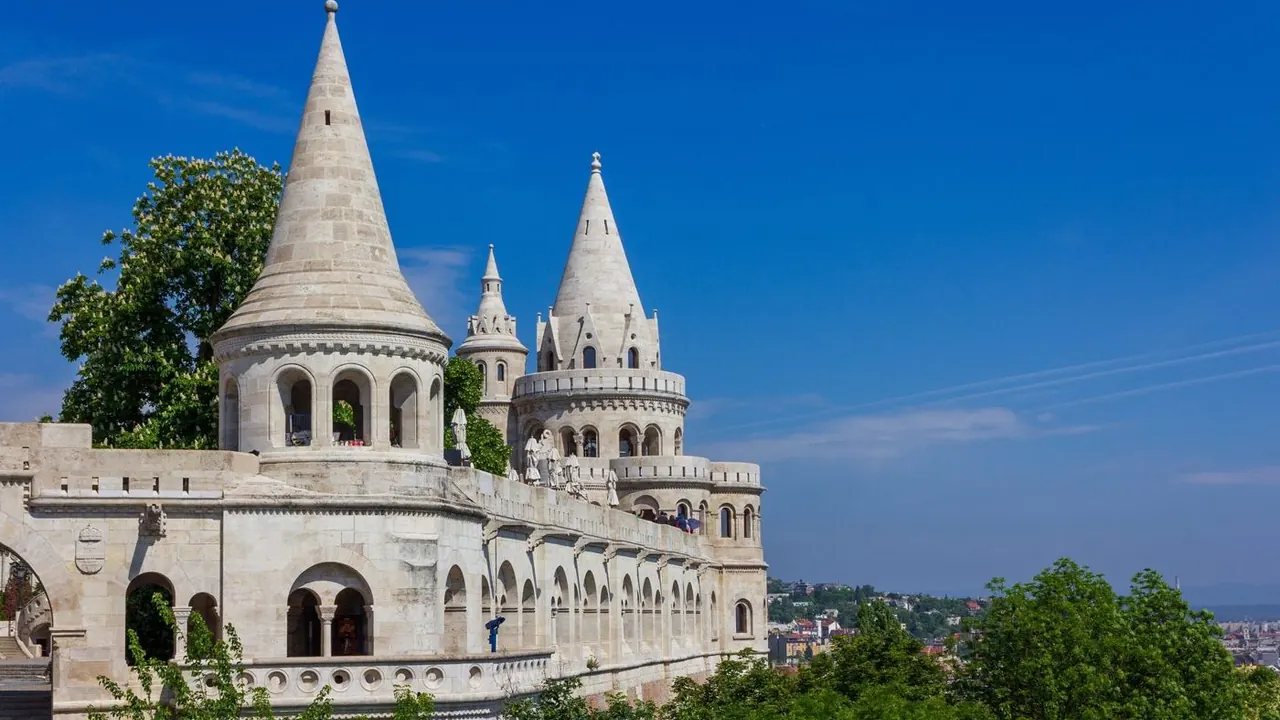
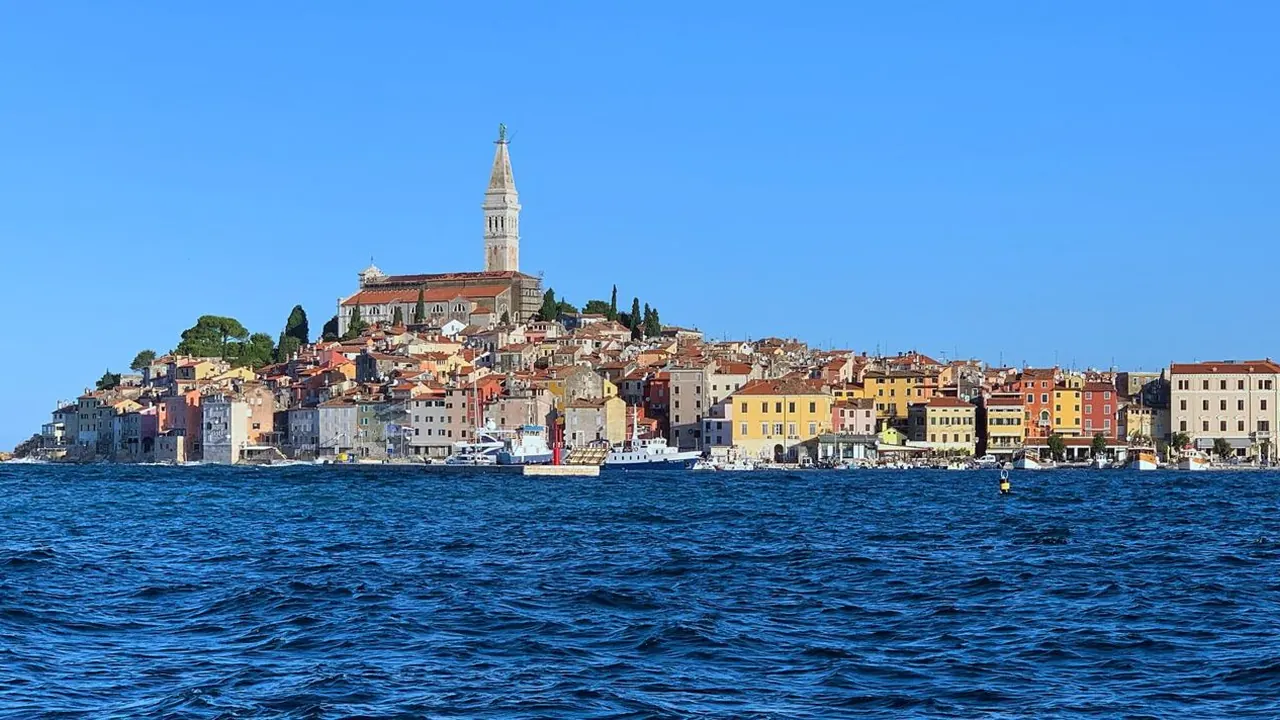
Photos: Budapest by Perituss, CC0; Rovinj by Vyacheslav Bukharov, CC BY-SA 4.0, cropped.
Budapest or Rovinj?
Our verdict in twelve categories, each scored against the same fixed benchmark cities, and the climate month by month, so you can choose for your trip.
Choose Budapest for
- live music and the arts
- wellness
- nightlife
Budapest suits a city trip with plenty to fill both days and nights. It has the river front of Parliament and the Castle District, old-master galleries, opera and the Liszt Academy, ruin bars in District VII and, above all, the thermal baths. It is also the easier and cheaper of the two, with trams doing the work and no need for a car.
Choose Rovinj for
- beaches
- nature and the outdoors
Pick Rovinj when the sea is the point. Days there mean swims off limestone ledges in the Golden Cape, taxi boats to the islands and slow dinners on the harbour, with Istria's hill towns and Roman Pula a drive away. It costs more and offers little after dark, which suits couples who want a quiet week by the water.
Scoreboard
Twelve categories on one fixed scale from 0 to 100. The shaded stretch is the gap between the two.
Your match
Pick a travel style or drag the sliders, and both match scores follow your weighting.
Wins on live music and the arts and wellness with your weighting.
Wins on beaches and nature and the outdoors with your weighting.
What matters to you?
Category by category
What the scores mean for a trip.
Beaches & swimming
Rovinj has the sea and Budapest does not. In Rovinj you swim off flat limestone ledges, from pebble coves and from bathing platforms along the Golden Cape, in very clear water, and St Catherine and Red Island have quieter coves. The shore is rock rather than sand, so pack water shoes.
Budapest's answer is the strand, the open-air lidos such as Palatinus on Margaret Island, with lawns and several pools. For open water, Lake Velence is under an hour by train and Balaton about two hours away. That makes a lake day, not a beach vacation.
Food & drink
Budapest has more to eat and more ways to eat it. There is goulash, lángos and chimney cake from street stalls, the Great Market Hall, grand coffee houses serving Dobos cake, and wine bars pouring Tokaji and Eger reds. It also has a serious modern restaurant tier, even if the range rarely goes beyond Central Europe.
Rovinj's cooking is narrower but comes from a fine food region: grilled fish, scampi buzara, fuži with truffle and Malvazija from the hinterland. The catch is the harbourfront, where many menus are written for passing visitors, and cheap everyday eating is hard to find.
Culture & sights
This is one of the widest gaps between the two. Budapest needs several days. Parliament faces the Royal Palace and the Fishermen's Bastion across the Danube, and there is Andrássy Avenue, the Dohány Street Synagogue, the old masters at the Museum of Fine Arts, and Ottoman and communist layers on top.
In Rovinj the sight is the old town on its former island, with Venetian houses climbing to St Euphemia, whose bell tower gives the view. Add the Batana House and a small town museum, and a slow afternoon covers it all.
Nightlife
Budapest is a city for nights out. The ruin bars of District VII fill courtyard tenements with rooms of different music, Kazinczy and Király streets keep going well past 2am at weekends, and in summer the scene moves to garden bars and Danube boats. The price is weekend rowdiness from stag groups, and the wine bars of District V are the calmer choice.
An evening in Rovinj means a long dinner and a drink on the rocks at sunset, and the town is quiet by midnight. Anyone after clubs has to travel along the coast.
Nature & outdoors
Both offer gentle outdoors rather than mountains, but on very different ground. Budapest's is wooded and inland: oak and beech forest in the Buda Hills, reached by cogwheel railway and chairlift, thermal caves beneath them, and the ridges and riverside cycle path of the Danube Bend an hour north.
Rovinj's is coastal. The pine and cedar forest of the Golden Cape starts at the edge of town, the archipelago is made for kayaking, paddleboarding and diving, and the Lim Fjord and the vineyard trails are a short drive away.
Day trips
Both have a full list of outings, and the difference is how you reach them. From Budapest, suburban trains run to Szentendre, Gödöllő and the castles of the Danube Bend, and Eger, Hollókő and Pannonhalma are about two hours away.
From Rovinj, Roman Pula and the mosaics of the Euphrasian Basilica in Porec are each around forty minutes away. Beyond them are the hill towns of Motovun and Groznjan, the Brijuni islands, and Trieste and Piran across the border. Nearly all of it needs a car.
Good for families
What sets the two apart for children is that Budapest has places made for them, while Rovinj mostly offers a pleasant setting. In Budapest there is the City Park zoo with its Art Nouveau animal houses, the Children's Railway through the Buda Hills run by uniformed schoolchildren, the hands-on Palace of Wonders, and in summer the lidos with wave pools and slides. Trams take a pushchair easily, but metro stairs and the weekend crowds of District VII need planning.
Rovinj is small and easy-going, with resort pools and playgrounds, boat trips to the islands and flat, shaded paths in the Golden Cape. Younger children need water shoes and close watching on the rock and concrete shore, the old town cobbles are a steep push, and the nearest waterparks are a drive up the coast.
Getting around
Budapest covers far more ground without a car. Trams carry much of the load, and line 2 along the embankment doubles as a sightseeing ride. The short metro includes the little yellow carriages of line 1, ferries cross the river, and buses and the funicular deal with the slopes of Buda.
Inside Rovinj you walk everywhere: the old town is closed to cars and a promenade leads to the swimming rocks. Beyond the town there is no railway, so the hill towns and wineries really need a car, and parking is tight in summer.
Shopping & style
Neither city is a shopping destination, but Budapest has more to offer. There is Herend and Zsolnay porcelain, small design boutiques in Districts V and VII, the Great Market Hall for paprika and Tokaji, and Ecseri flea market for communist-era finds.
Shopping in Rovinj means regional produce such as truffle products, olive oil and Teran wine, plus the galleries and studios along Grisia. There are no fashion streets, and the choice thins out after summer.
Affordability
Budapest is the cheaper of the two. Transport, wine and the ordinary coffee houses cost little, mid-range rooms within walking distance of the centre are easy to find, and lunch menus in residential districts keep meals modest if you stay away from Váci utca.
Rovinj in July and August costs what a sought-after Mediterranean resort costs, and fish sold by weight adds up quickly. Private apartments, campsites and a visit in late spring or September make it easier on the budget.
Live music & performing arts
Here the two barely compare. Budapest has music most nights: the State Opera House, the Art Nouveau hall of the Liszt Academy, the national concert hall at Müpa, operetta, folk dance ensembles and jazz in Pest, and tickets are easy to get.
Rovinj has summer concerts in the Church of St Euphemia, music on the squares and the occasional performance of bitinada singing, and very little outside the season. The big summer concerts are in Pula's arena.
Wellness & relaxation
Budapest relaxes you in hot water, and Rovinj through its pace. In Budapest, more than a hundred springs make bathing part of ordinary life rather than a treat. Regulars go to the Lukács for their soak, and Rudas has a rooftop pool looking over the Danube. An afternoon moving between warm pools, saunas and cold plunges, then cake in a coffee house, is how the city unwinds, in midwinter as much as in summer.
Rovinj has no tradition of this kind, so for spa time you go to the pools, saunas and treatment rooms of the larger resort hotels, some of which are open to non-residents. The town is at its most restful in May, June and September, with long lunches and evening walks under the pines. In July and August the harbour is crowded, and you have to go further from the centre to find calm.
When should you go?
Pick your month. The climate figures are measured averages, not a forecast.
Budapest in July
Rovinj in July
Daytime high, °C
Rainfall in the month, mm
Where the figures come from
Rovinj's temperatures are measured 64 km from the centre, at Trieste.
Rovinj has no rain gauge within 25 km of the centre, so its rainfall comes from a gridded climate dataset read at the city rather than from a gauge further away.
Temperature and rainfall are climate normals, averaged over the years shown. Budapest: 1991-2020 normals, Budapest Met Center (2.1 km from centre). Rovinj: 1991-2020 normals, Trieste (63.7 km from centre).
Budapest has a continental year. Winters are properly cold, with daytime highs around 4°C in December and January, though that is when the steaming outdoor pools of the baths look their best. Summer reaches about 28°C in August, warm enough for the lidos but tiring on the pavements. Summer is also the wettest season, though the totals stay modest. May and September are the most comfortable months for walking the city.
Rovinj is milder in winter, and summer is all about the water. The Adriatic is pleasant from June and peaks around 26°C in August, so July and August are the beach months, and the sea is still warm in September. The rain sets in from September and autumn is the wettest stretch, with up to about 102mm in November. For walking and cycling the Golden Cape, late spring is the best time.
Which traveller are you?
On a beach and sun trip, Rovinj wins outright. Budapest has lidos, and a lake an hour away, but Rovinj has clear Adriatic water below the old town walls, rocky coves in the Golden Cape and islands a short taxi boat ride away.
For a culture and arts trip, Budapest is far richer. Parliament, the Castle District and Andrássy Avenue fill several days, the Museum of Fine Arts holds old masters, and the Opera House and Liszt Academy have music most nights. Rovinj's old town takes an afternoon.
On a relaxing and wellness trip, Budapest's thermal baths are hard to match: Ottoman domes at Rudas and Király, the Gellért's mosaics, and Széchenyi's outdoor pools in any weather. Rovinj relaxes you through its slow pace instead, with hotel spas and quiet swims outside high summer.
Before you go
| Measure | Budapest | Rovinj |
|---|---|---|
| Official language | Hungarian | Croatian |
| Currency | Forint (HUF) | Euro (EUR) |
| Sockets | CF230 V, 50 Hz | CF230 V, 50 Hz |
| Driving side | Right | Right |
| Time zone | UTC+1, UTC+2 in summer | UTC+1, UTC+2 in summer |
| Emergency number | 112 | 112 |
| Elevation | 117 m | 0 m |
| Main airport | Budapest Liszt Ferenc International Airport (BUD)18 km from centre157 non-stop destinations | Pula Airport (PUY)31 km from centre34 non-stop destinations |
| Public holidays this year | 13 days | 14 days |
By the numbers
| Measure | Budapest | Rovinj |
|---|---|---|
| City population | 1,675,777 | 12,968 |
| People per km² | 3,191 | - |
| Museums within 10 km | 81 | 1 |
| UNESCO World Heritage sites within 50 km | 1 | 1 |
| Swim season, months above 21 °C | - | 4 months |
Where else could you go?
Every comparison below shares a destination with this one, so you can follow Budapest or Rovinj somewhere new.