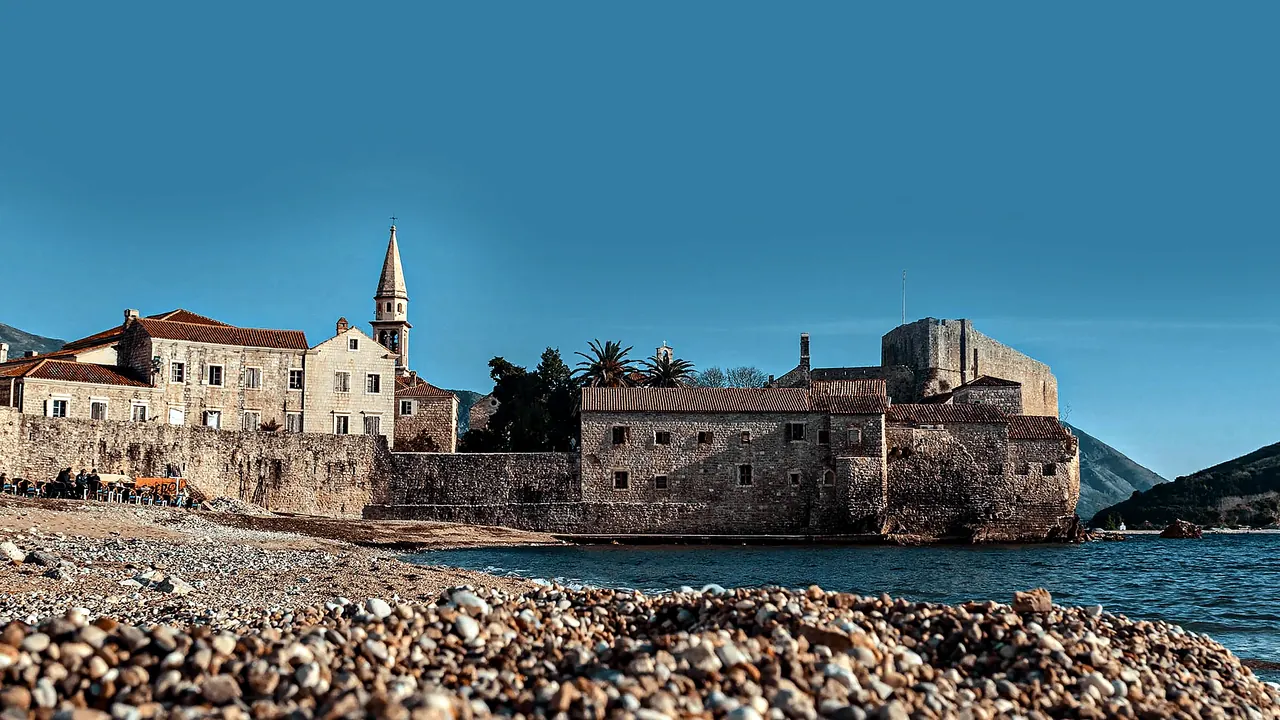
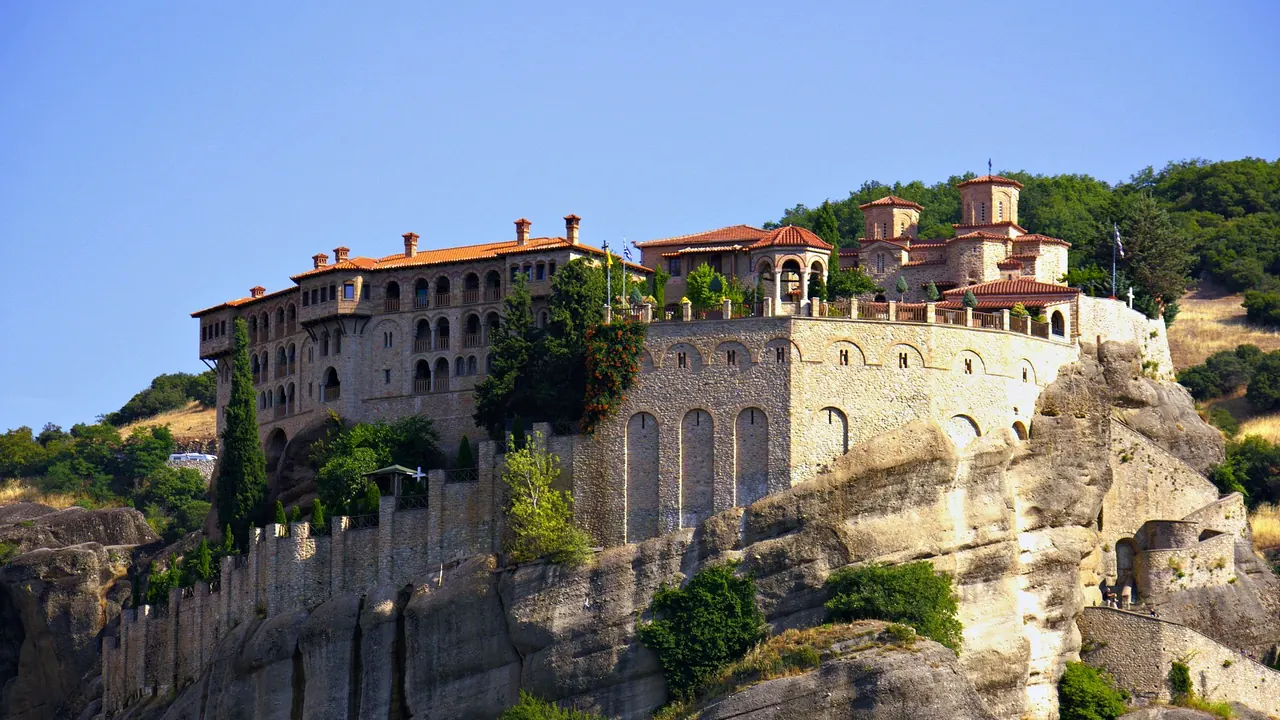
Photos: Budva by Ender Vatan, Pexels License; Kalambaka by José Barbosa, Pexels License.
Budva or Kalambaka?
Our verdict in twelve categories, each scored against the same fixed benchmark cities, and the climate month by month, so you can choose for your trip.
Choose Budva for
- beaches
- nightlife
- families
Budva is the choice for a sea vacation with some life in it. You get town beaches on the doorstep, warm water through the summer and long, loud nights along the seafront. Kotor, Perast and Cetinje are all within easy reach for the days you want off the sand. It suits groups of friends and families who measure a trip in swims and evenings out, and who don't mind crowds in July and August.
Choose Kalambaka for
- culture and sights
- nature and the outdoors
- prices
Kalambaka offers something Budva can't: monasteries on sheer sandstone pillars, with footpaths and climbing routes starting at the edge of town. It rewards walkers, climbers and anyone drawn by Orthodox heritage. Evenings are quiet and prices are kinder, but there is no sea, and two or three nights cover it well, usually as one stop on a longer tour of Greece.
Scoreboard
Twelve categories on one fixed scale from 0 to 100. The shaded stretch is the gap between the two.
Your match
Pick a travel style or drag the sliders, and both match scores follow your weighting.
Wins on beaches and nightlife with your weighting.
Wins on culture and sights and nature and the outdoors with your weighting.
What matters to you?
Category by category
What the scores mean for a trip.
Beaches & swimming
This is Budva's strongest suit and something Kalambaka simply lacks. Budva has Slovenska Plaza along the front, the Mogren coves under the cliffs and a chain of bays down to Petrovac, mostly fine pebble or coarse sand, though crowded with sunbeds in high summer.
Kalambaka sits on the inland edge of the Thessalian plain, well over two hours from any sea. Swimming there means a hotel pool or a cold river in the Pindos.
Food & drink
Neither town is a place to travel for food, and the gap between them is small. The difference is between coast and mountain. Budva has grilled squid, the day's catch at konobas, black risotto, Njegusi ham and Vranac red, alongside uneven promenade menus aimed at summer crowds.
Kalambaka keeps to the hearty cooking of central Greece: grilled lamb, bean soups, pies and feta with house wine or tsipouro. It is plainer and more consistent, and many tables look out on the Meteora rocks at sunset.
Culture & sights
Kalambaka comes out well ahead. The six working monasteries of Meteora, among them the Great Meteoron, Varlaam and Roussanou on its narrow rock, hold frescoed churches, icon collections and old refectories. The Byzantine church of the Dormition in town adds more frescoes. It is enough for two full days.
Budva's heritage fits into a morning: the walled Stari Grad, largely rebuilt after the 1979 earthquake, the Citadel and a small archaeological museum. The region's richer history lies in Kotor and Cetinje.
Nightlife
Budva is the clear winner. In summer it is one of the Balkans' party towns, with seafront bars and terrace clubs on Slovenska Plaza, a big open-air club on the hill and busy late bars in the old town, though nearly all of it closes from October to May.
Kalambaka has dinner and a drink at the café-bars on the central square, and nothing runs late. For a proper night out you would drive half an hour to Trikala.
Nature & outdoors
Both have mountains close by, but Kalambaka's scenery is the reason to go. You can walk straight from town onto old monks' paths between pillars up to 400m high, climb long bolted routes on world-famous conglomerate rock and head west into the fir forests and rafting rivers of the Pindos.
Budva's backdrop is limestone mountains falling to the sea. Here outdoor time is spent on the water: coastal paths, sea kayaking, boat trips and paragliding above Becici. Lovcen National Park and Lake Skadar are about an hour inland.
Day trips
Budva is the better base for exploring. Kotor and its fjord-like bay are half an hour away, with Perast, royal Cetinje, the wine villages of Lake Skadar and Stari Bar all within an easy day. Dubrovnik is possible as a long trip over the border.
From Kalambaka the outings are fewer and further apart: riverside Trikala, the stone village of Metsovo over the Pindos and lakeside Ioannina at the limit of a comfortable day. You will need a car for most of them.
Good for families
Budva suits children better because it gives them a beach. The town beaches shelve gently, Becici has calmer water and there is a water park above town, though July and August nights are loud.
Kalambaka is safe and small, and older children may love the trails or a beginners' climb. Younger ones tend to tire of the long monastery steps, hushed interiors and dress rules, so one or two nights are usually enough.
Getting around
Both are easy on foot in the centre and awkward beyond it, but for different reasons. Budva has buses along the coast and boat taxis to the coves, but no railway, and its single coast road jams in summer.
Kalambaka has the rail link Budva lacks, a branch line connecting to the Athens to Thessaloniki route. The catch is the monasteries, spread along a winding road above town with a sparse bus, so most visitors hike up, take taxis or hire a car.
Shopping & style
Neither town is a shopping destination, but Budva gives you a bit more to browse. Its old town lanes and promenade stalls have a coastal feel, with silver filigree and rakija alongside beachwear. A modest shopping centre by the marina covers anything forgotten at home.
Kalambaka has less, and most of it is religious: one souvenir street of painted icons and carvings, plus the items the monasteries sell themselves. It's a good place to buy an icon to take home, but there's nothing to fill an afternoon.
Affordability
Kalambaka is the cheaper stay. Family guesthouses, generous taverna meals and small monastery entry fees keep costs down. Prices go up only at hotels facing the rocks and over Orthodox Easter and the long weekends around national feast days, when Greek visitors fill the town.
Budva is the most expensive place in Montenegro, and seafront rooms, sunbeds and promenade restaurants cost the most in July and August. Apartments a few streets back, bakeries and local buses are good value, especially in June or September.
Live music & performing arts
Neither town has a year-round stage, but Budva has the one regular event of note. Its long-running Grad Teatar festival puts theatre, concerts and readings in the old town squares each summer. Kalambaka offers the odd folk festival or taverna musician, and Byzantine chant at monastery services, which should be attended as worship, not as a show.
Wellness & relaxation
Budva has the treatments and Kalambaka has the peace. In Budva, wellness means the spas of the big resort hotels at Becici and around Sveti Stefan, plus massage at the beach clubs. The town itself is noisy late into the night in high summer, so May, June or late September is the time to rest there.
Kalambaka has only a few hotel saunas and massage rooms, and like Budva it has no bathing tradition. What it does have is a town that goes to bed early, and morning and evening light over the rocks that suits slow walks.
When should you go?
Pick your month. The climate figures are measured averages, not a forecast.
Budva in July
Kalambaka in July
Daytime high, °C
Rainfall in the month, mm
Where the figures come from
Budva has no rain gauge within 25 km of the centre, so its rainfall comes from a gridded climate dataset read at the city rather than from a gauge further away.
Budva's sunshine is measured 40 km from the centre, at Podgorica-Grad.
Kalambaka's temperatures are measured 68 km from the centre, at Larissa Airport.
Kalambaka's station stands 164 m below the city centre, so the centre is likely a little cooler than the figures say.
Kalambaka has no rain gauge within 25 km of the centre, so its rainfall comes from a gridded climate dataset read at the city rather than from a gauge further away.
Temperature and rainfall are climate normals, averaged over the years shown. Budva: 1991-2020 normals, Tivat (15.8 km from centre). Kalambaka: 1991-2020 normals, Larissa Airport (68.1 km from centre).
Budva's beach season runs from June to early October. The sea is warm enough for a comfortable swim from June and peaks at about 26°C in August, while July and August are hot and very sunny on shore. May and late September are gentler, with warm days and quieter beaches. From October the rain sets in hard, peaking at around 212mm in November, and winter is mild but wet and grey.
Kalambaka is drier through the year but has a harsher summer. The plain reaches about 34°C in July, too hot for the exposed trails and the monastery steps around midday. April, May, late September and October are the months for walking and climbing among the rocks. Winters are cooler than on the coast and wettest in December, though still far less rainy than Budva.
Which traveller are you?
On a beach and sun trip, Budva is the only real option. Its town beaches and the coves at Mogren, Becici and Sveti Stefan sit by a warm sea. Kalambaka is more than two hours from the coast and offers only hotel pools.
For a culture and arts trip, Kalambaka wins clearly. The frescoed monasteries of Meteora, perched on their pillars, are among the great sights of Greece. Budva's walled old town is attractive but takes an hour or two to see.
On a food and nightlife trip, Budva gives far more to do after dark: beach bars, terrace clubs and a hilltop club running until dawn in summer. Kalambaka's evenings end with tsipouro and meze on the square.
Before you go
| Measure | Budva | Kalambaka |
|---|---|---|
| Official language | Montenegrin | Greek |
| Currency | Euro (EUR) | Euro (EUR) |
| Sockets | CF230 V, 50 Hz | CF230 V, 50 Hz |
| Driving side | Right | Right |
| Time zone | UTC+1, UTC+2 in summer | UTC+2, UTC+3 in summer |
| Emergency number | 112 | 112 |
| Elevation | 3 m | 237 m |
| Main airport | Tivat Airport (TIV)17 km from centre42 non-stop destinations | Thessaloniki Macedonia International Airport (SKG)146 km from centre90 non-stop destinations |
| Public holidays this year | - | 15 days |
By the numbers
| Measure | Budva | Kalambaka |
|---|---|---|
| City population | 13,338 | 8,372 |
| People per km² | 109 | 4,925 |
| Museums within 10 km | 0 | 0 |
| UNESCO World Heritage sites within 50 km | 3 | 1 |
| Swim season, months above 21 °C | 5 months | - |
Where else could you go?
Every comparison below shares a destination with this one, so you can follow Budva or Kalambaka somewhere new.