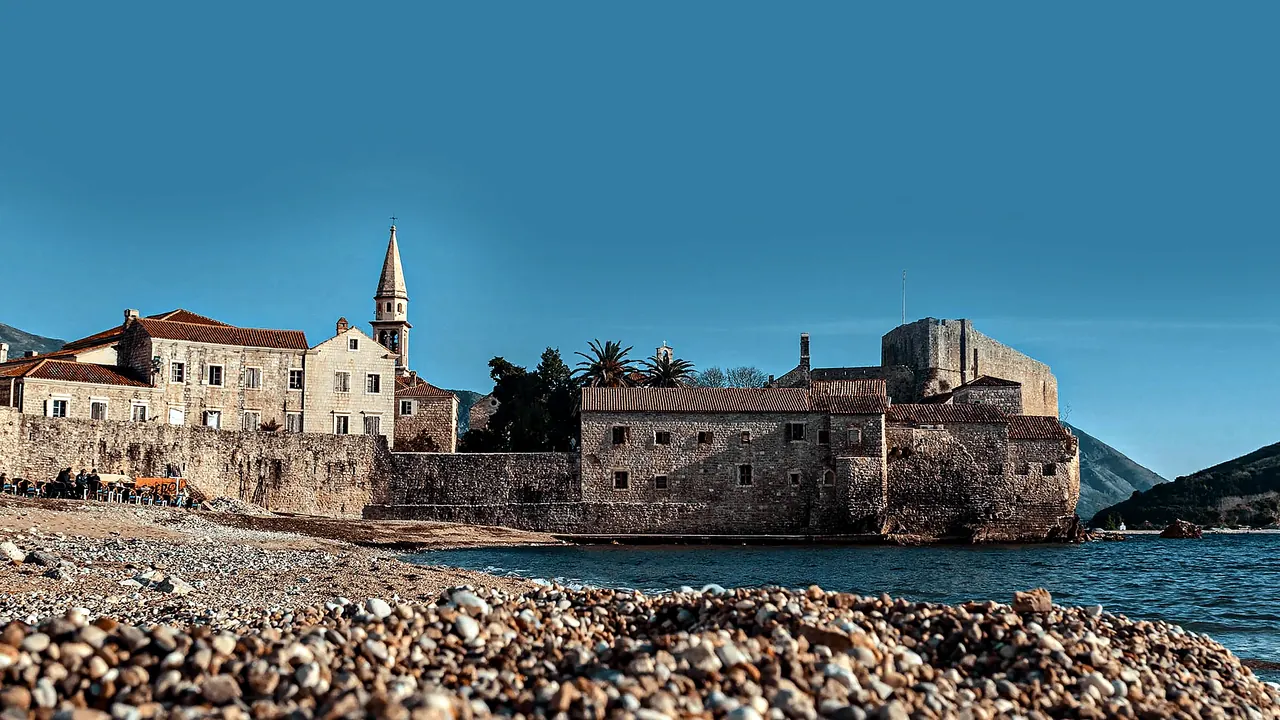
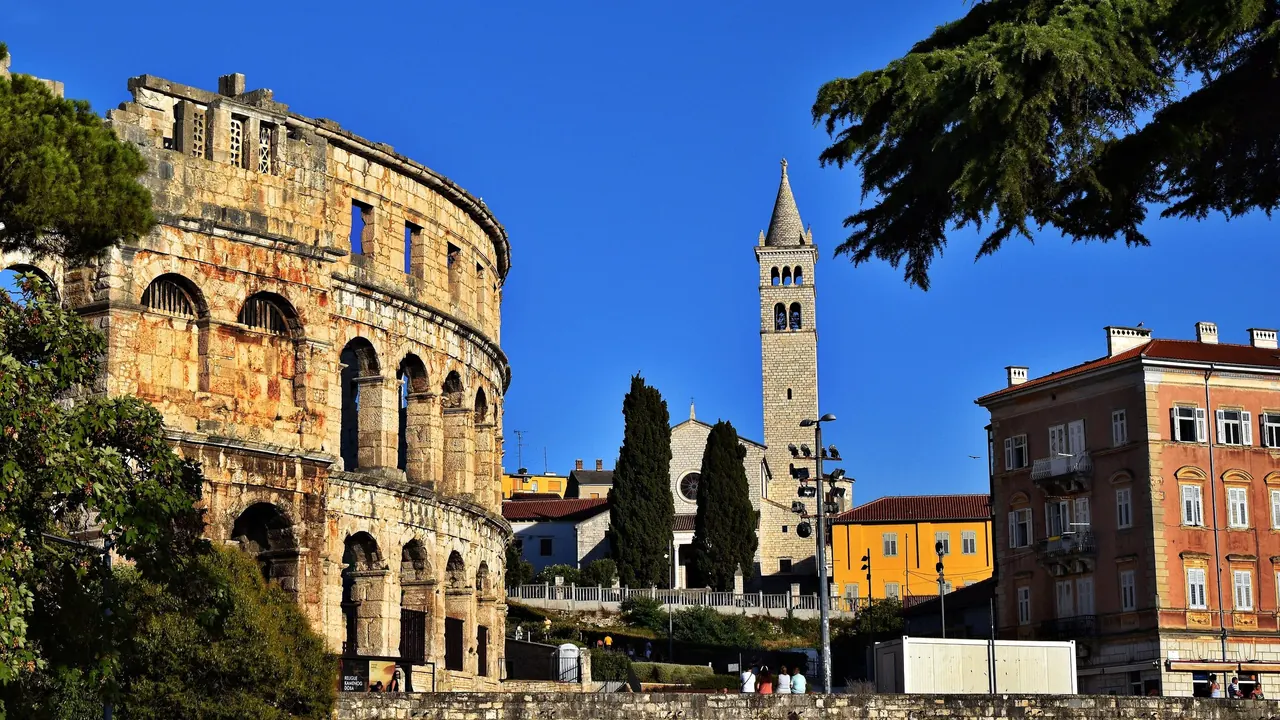
Photos: Budva by Ender Vatan, Pexels License; Pula by Miroslav.vajdic, CC BY-SA 4.0, cropped.
Budva or Pula?
Our verdict in twelve categories, each scored against the same fixed benchmark cities, and the climate month by month, so you can choose for your trip.
Choose Budva for
- nightlife
- prices
- nature and the outdoors
Budva suits a sun-and-sea trip with long nights out. Its town beaches start right below the old walls, bare mountains climb straight up behind the coast, and in summer the seafront clubs run until dawn. Kotor and Lovcen are close, and private apartments a few streets back help a tighter budget go further.
Choose Pula for
- culture and sights
- food and drink
- live music and the arts
Pula is the better pick for travellers who want the sea with history and a proper regional kitchen. The Roman Arena and the Forum are in the centre, Istrian truffle pasta and Malvazija are on the table, and the evenings are quieter, which makes it easier for couples and families. Expect to swim off rocks rather than from a town beach, and to rent a car for most excursions.
Scoreboard
Twelve categories on one fixed scale from 0 to 100. The shaded stretch is the gap between the two.
Your match
Pick a travel style or drag the sliders, and both match scores follow your weighting.
Wins on nightlife and prices with your weighting.
Wins on culture and sights and food and drink with your weighting.
What matters to you?
Category by category
What the scores mean for a trip.
Beaches & swimming
Both towns are fine for a swimming trip, but the swimming is quite different. Budva has beaches in town: Slovenska Plaza runs along the front, Mogren's coves sit under the cliffs, and Becici and Jaz offer long curves of fine pebble and coarse sand. In summer you also get rows of sunbeds and loud music.
Pula has no town beach at all. You swim from rocks, platforms and pine-shaded pebble coves on Verudela and Stoja, or from the wild inlets of Cape Kamenjak, and you should bring water shoes. The water there is very clear, and Budva's sea runs a degree or so warmer at its peak.
Food & drink
Pula eats better, because it sits in Istria, one of the Adriatic's more distinctive regional kitchens. Fuži with truffle or game sauce, scampi buzara, pršut, local olive oil, and Malvazija or Teran show up on menus, and the covered market hall shows what is in season. The best meals are often in taverns in the hinterland villages.
Budva's promenade restaurants are uneven and cater to the summer crowds. The rewarding food is regional: Njegusi ham and mountain cheese, the day's catch at family-run konobas, and Vranac red from around Lake Skadar. Anyone travelling mainly to eat will find more variety in Pula.
Culture & sights
There is far more to see in Pula. Its Roman amphitheatre still has its full three-storey outer ring, the Temple of Augustus stands intact on the Forum, and the Arch of the Sergii leads into lanes with mosaics and old gates. The fortress museum and the Habsburg naval buildings add a second layer of history.
Budva's sights fit into a morning: the marble lanes of Stari Grad, much of it rebuilt after the 1979 earthquake, its small churches, the Citadel and a modest archaeological museum. For serious heritage on the Montenegrin coast you have to go to Kotor or Cetinje.
Nightlife
Budva is the one to choose for going out. In summer the Slovenska Plaza front turns into a row of beach bars and terrace clubs playing pop and house, a big open-air club on the hill keeps going until dawn, and the old-town bars stay busy late. It suits groups of friends better than anyone after craft cocktails.
Pula's evenings are gentler. You might have drinks on the Forum, cocktails at Verudela or Medulin, and visit a few small clubs on summer weekends, and many nights end with a glass of wine by the lit-up Arena. Both towns go quiet out of season.
Nature & outdoors
Budva has the more dramatic setting and a slight edge. Limestone mountains rise straight behind the town, Lovcen's beech forest and high trails are an hour inland, and Lake Skadar offers birdwatching and kayaking. Closer to town you can paraglide from the hills above Becici or walk the coastal paths between the bays.
Pula's landscape is low and gentle: macchia, pines and olive groves, with car-free Cape Kamenjak for walking, cycling and spotting dinosaur footprints. It is better for cycling and wreck diving, but the nearest real mountains, at Učka, are much further away.
Day trips
Both make good touring bases, and what differs is what you tour. From Budva the highlights are medieval and dramatic: Kotor's walls and bay are half an hour away, with baroque Perast, royal Cetinje and Lake Skadar's wine villages not far beyond, and Dubrovnik is a long day across a border.
Pula's trips lead into Istria's towns and countryside: Venetian Rovinj, the Byzantine mosaics of Poreč, the hill towns of Motovun and Hum with truffle estates, and the Brijuni islands by boat. Budva's best trip can be done by bus, while most of Pula's need a car.
Good for families
Pula gives children more to do than swim. The aquarium in an Austro-Hungarian fort, the Arena's underground passages, the shallow bays at Medulin and Premantura, and a dinosaur park and water park within an hour fill a week. The downside is that rocky shores near town and a reliance on the car make it more work.
Budva's town beaches shelve gently and there is a water park above town, but there is no zoo, aquarium or museum for children. Families usually do better staying in Becici, away from the noise of the town on summer nights.
Getting around
Both have compact centres you can walk. In Budva the old town, marina and Slovenska Plaza sit side by side, and in Pula the Arena, Forum, market and harbour are minutes apart on flat streets.
Beyond the centres they work differently. Budva lies along a single coast road with frequent buses and minibuses to Kotor and boat taxis to the coves, but that road jams in summer. Pula has city buses to Verudela and cycling to the southern coves, while its hinterland, with sparse buses and a slow railway, really needs a car or scooter.
Shopping & style
Neither town is worth a shopping trip, though Pula gives you slightly better things to take home. Its market hall, delicatessens and countryside producers sell truffle products, Istrian olive oil, wine and pršut, and the old-town pedestrian street has everyday fashion chains. Budva covers beach essentials, souvenirs and silver filigree, plus olive oil, honey and rakija from small markets and stalls.
Affordability
Budva is a little easier on the wallet. Although it is Montenegro's priciest resort in high summer, bakeries, grill houses, local buses and apartments a few streets back from the sea are cheaper than on most Western European coasts.
Pula is mid-priced. In July and August its rooms cost about as much as on Western European coasts, restaurants near the Arena charge tourist prices, and car hire and boat trips add up. In both towns spring and autumn bring costs down.
Live music & performing arts
Pula has the better stage. In summer the Roman Arena hosts touring pop and rock acts, classical galas and the long-running Pula Film Festival, and the Istrian National Theatre keeps some drama going through the rest of the year, though mostly in Croatian.
Budva's live culture centres on Grad Teatar, a summer festival of theatre and concerts in the old-town squares. Outside the festival you get cover bands in seafront bars and little else.
Wellness & relaxation
Neither town has a spa tradition, and in both, wellness means resort hotel spas: around Becici and Sveti Stefan in Budva, and on Verudela and in Medulin near Pula.
The difference is how restful the town itself feels. In high summer Budva's seafront music carries late into the night, so a slow vacation means a quieter village or a visit in May, June or late September. Pula is calmer, with long coffees on the Forum and evening walks on pine-shaded coastal paths.
When should you go?
Pick your month. The climate figures are measured averages, not a forecast.
Budva in July
Pula in July
Daytime high, °C
Rainfall in the month, mm
Where the figures come from
Budva has no rain gauge within 25 km of the centre, so its rainfall comes from a gridded climate dataset read at the city rather than from a gauge further away.
Budva's sunshine is measured 40 km from the centre, at Podgorica-Grad.
Pula's temperatures are measured 87 km from the centre, at Trieste.
Pula has no rain gauge within 25 km of the centre, so its rainfall comes from a gridded climate dataset read at the city rather than from a gauge further away.
Temperature and rainfall are climate normals, averaged over the years shown. Budva: 1991-2020 normals, Tivat (15.8 km from centre). Pula: 1991-2020 normals, Trieste (87 km from centre).
Budva runs hotter and sunnier. July and August reach about 32°C, which is fine on the beach but hard work in the old town at midday, and the sea is warm enough for swimming from June into October. The weather breaks sharply in autumn. Rain rises from September and peaks at around 212mm in November, so late autumn and winter are mild but often wet.
Pula is a few degrees cooler, with summer highs around 29°C and a beach season that runs from June to September. Its rain is spread much more evenly through the year, so spring and autumn are drier than in Budva and good for walking among the Roman sites. Winters are colder, with January highs near 9°C. For a trip that mixes sightseeing with swimming, June and September suit both towns best.
Which traveller are you?
For a culture and arts trip, Pula is the clear choice. The Arena, the Temple of Augustus and the Austro-Hungarian forts fill a day or two, and summer concerts inside the amphitheatre beat anything Budva stages outside its old-town festival.
On a family trip with young children, Pula has more to offer. There are shallow bays at Medulin, an aquarium inside an old fort, and an Arena children can scramble around. Budva is mostly beach, and in high summer its nights are loud.
On a tight budget, Budva goes a little further. Bakeries, grill houses, local buses and apartments away from the front are cheap, and Kotor is a short bus ride away. Pula's sights are inexpensive too, but the car its countryside needs soon adds up.
Before you go
| Measure | Budva | Pula |
|---|---|---|
| Official language | Montenegrin | Croatian |
| Currency | Euro (EUR) | Euro (EUR) |
| Sockets | CF230 V, 50 Hz | CF230 V, 50 Hz |
| Driving side | Right | Right |
| Time zone | UTC+1, UTC+2 in summer | UTC+1, UTC+2 in summer |
| Emergency number | 112 | 112 |
| Elevation | 3 m | 5 m |
| Main airport | Tivat Airport (TIV)17 km from centre42 non-stop destinations | Pula Airport (PUY)7 km from centre34 non-stop destinations |
| Public holidays this year | - | 14 days |
By the numbers
| Measure | Budva | Pula |
|---|---|---|
| City population | 13,338 | 52,220 |
| People per km² | 109 | 971 |
| Museums within 10 km | 0 | 4 |
| UNESCO World Heritage sites within 50 km | 3 | 1 |
| Swim season, months above 21 °C | 5 months | 4 months |
Where else could you go?
Every comparison below shares a destination with this one, so you can follow Budva or Pula somewhere new.