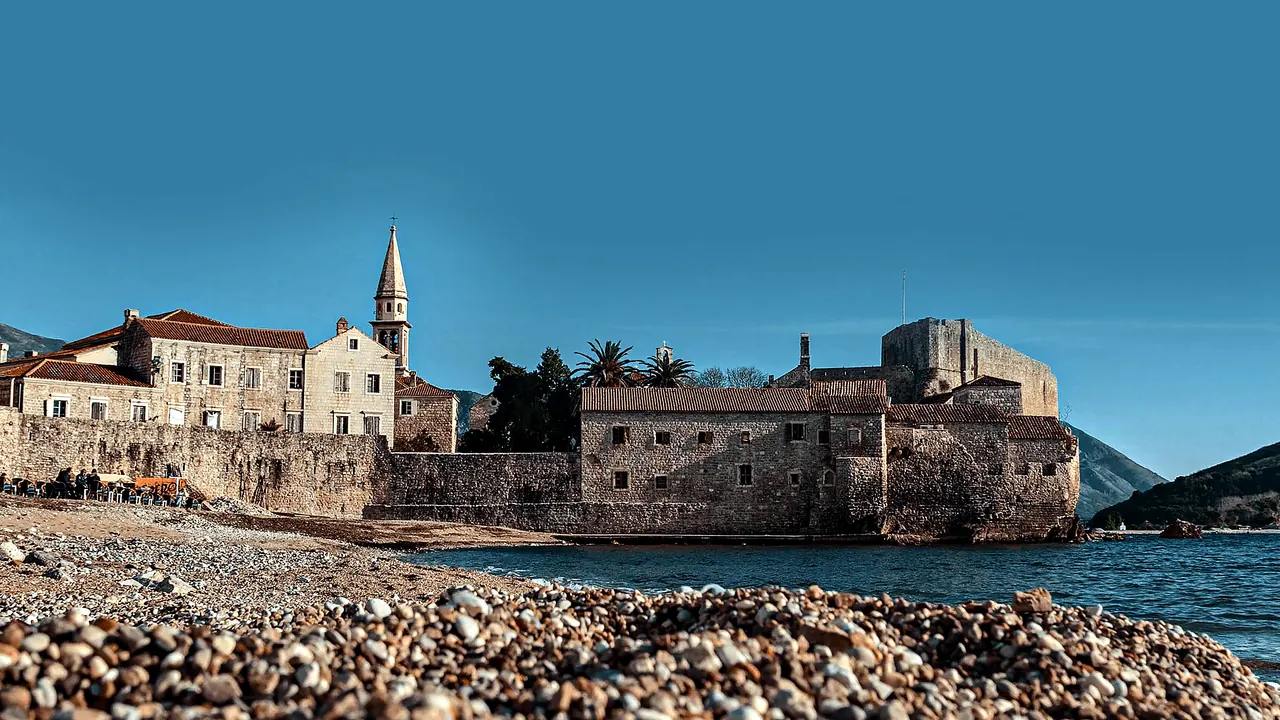
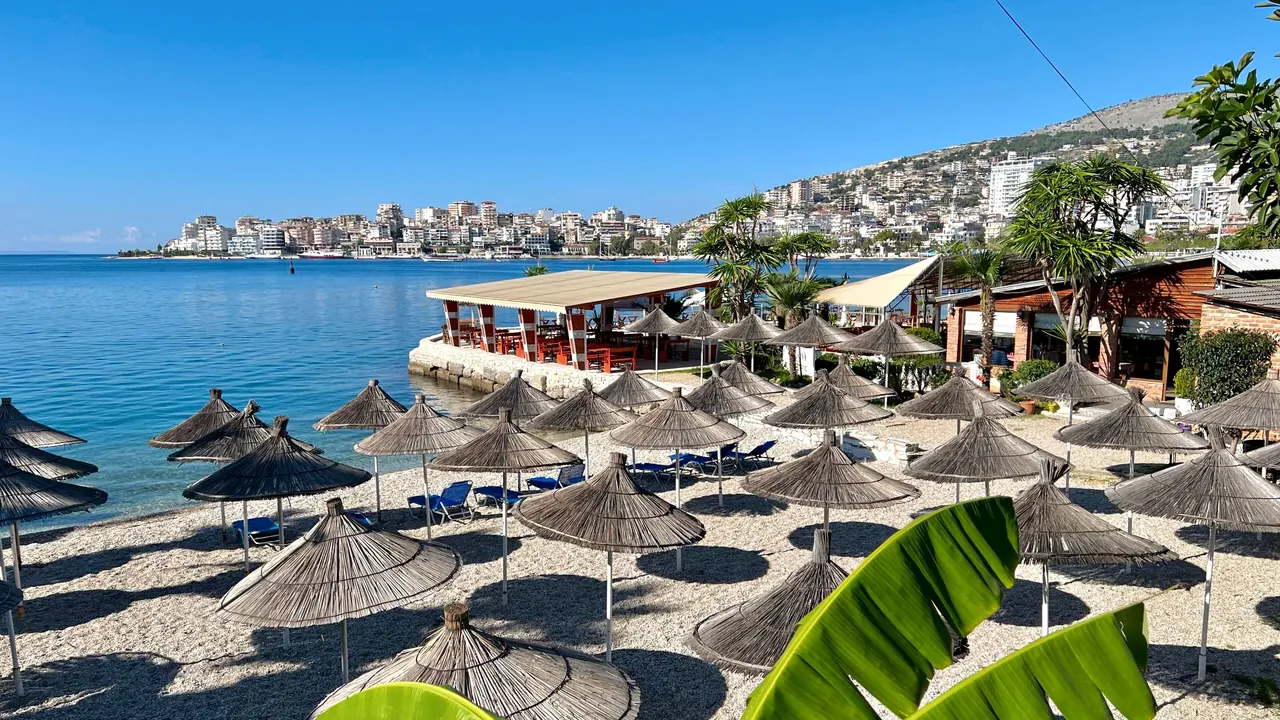
Photos: Budva by Ender Vatan, Pexels License; Saranda by Sharon Hahn Darlin, CC BY 2.0, cropped.
Budva or Saranda?
Our verdict in twelve categories, each scored against the same fixed benchmark cities, and the climate month by month, so you can choose for your trip.
Choose Budva for
- nightlife
- families
- live music and the arts
Budva suits travellers who want a fuller resort around the beach. The walled old town gives evenings a setting, the seafront clubs keep going until dawn in summer, and Lovcen and Lake Skadar are within reach for days off the sand. Families also get a little more here, with gently shelving town beaches, calmer bays at Becici and a water park.
Choose Saranda for
- prices
- food and drink
- beaches
Saranda is the better pick for a cheaper, simpler stay built around the water itself. The clear coves and islets at Ksamil are the highlight, Butrint and Gjirokaster make two outstanding outings, and Corfu is a short ferry ride away. Nights are quieter and the town has less to fill a rainy afternoon, but your money goes noticeably further.
Scoreboard
Twelve categories on one fixed scale from 0 to 100. The shaded stretch is the gap between the two.
Your match
Pick a travel style or drag the sliders, and both match scores follow your weighting.
Wins on nightlife and families with your weighting.
Wins on prices and food and drink with your weighting.
What matters to you?
Category by category
What the scores mean for a trip.
Beaches & swimming
Both are true beach towns, and the difference lies in where the best swimming is. In Budva it starts right in town, with the long sweep of Slovenska Plaza and the coves at Mogren under the old town walls, then continues along the coast to Becici, Jaz and the sand facing Sveti Stefan, with quieter bays further on towards Petrovac.
Saranda's own shore is a string of small pebble beaches, so the real draw is twenty minutes south at Ksamil, where islets sit in startlingly clear water. Further north, Lukova and Borsh are longer pebble bays backed by olive groves, Saranda's answer when the nearer beaches fill up.
Food & drink
Neither town is a place to travel for food, and in both the back-street family places beat the promenade terraces. What changes is the region on the plate. Budva draws on the mountains and the lake behind it, with smoked Njegusi ham, mountain cheese and Vranac red, and has better coffee and a few resort restaurants for a smart dinner.
Saranda leans on the Butrint lagoon and southern Albanian home cooking: farmed mussels, octopus, stuffed peppers and salads in local olive oil, with raki rather than any real wine culture.
Culture & sights
Neither town holds much, and serious history means leaving town. Budva at least has a coherent centre: the marble lanes of Stari Grad, its small churches, the Citadel and a museum of Greek and Roman finds, worth an unhurried couple of hours. Saranda is a modern town with scattered fragments instead, such as the mosaic floors of the old synagogue among the apartment blocks, plus Lekuresi Castle and the Forty Saints ruins on the hills, which are visited mostly for their views.
Nightlife
Budva is the bigger night out by some way. In summer it is known across the Balkans as a party town, with clubs on the Slovenska Plaza seafront, busy late bars in the old town and a large open-air club above town that runs until dawn.
Saranda's summer nights begin with families strolling the promenade and move on to loud cocktail bars, with a few beach clubs at Ksamil going later. It is lively in July and August, but on a smaller scale, and in both towns the scene fades once the season ends.
Nature & outdoors
Both towns sit under bare limestone mountains, but Budva has more within reach. Lovcen National Park offers beech forest, high trails and views over the Bay of Kotor, Lake Skadar is good for kayaking and birdwatching, and paragliding launches from the hills above Becici.
Saranda's natural sights are smaller in scale but memorable: the lagoon and oak woods of Butrint National Park, the deep blue spring of the Blue Eye, and cliff roads and sea caves along the Riviera. Its hiking is largely unmarked, which suits confident walkers more than casual ones.
Day trips
Both make excellent bases, and the choice comes down to what you want to see. From Budva, the medieval walls of Kotor are half an hour away, with baroque Perast, royal Cetinje and the wine villages of Lake Skadar close behind, all rewarding without a border to cross.
Saranda's list is shorter but includes one of the great ancient sites of the Mediterranean in Butrint, the Ottoman tower houses of Gjirokaster and, by ferry, Corfu's Venetian old town, an extra country for the price of an hour at sea.
Good for families
Budva is the easier choice with children. Its town beaches shelve gently, Becici has calmer water and a water park sits on the hill, though families do better staying outside the centre in midsummer, when nights are loud.
Saranda's sheltered coves at Ksamil are lovely for young swimmers and the evening promenade is a family ritual, but the town is harder work, with steep streets, patchy pavements and heavy summer traffic. A pool hotel and a June or September visit make the most of it.
Getting around
The two are much alike: a walkable seafront, coastal buses, no railway and one main road that jams in summer. Budva's centre is flatter, with the old town, marina and beach close together, a pleasant shore walk to Becici and boat taxis to nearby coves. In Saranda the promenade ties things together but hillside hotels mean steep climbs, and the buses to Ksamil and Butrint run without printed timetables. In both towns, a car or a driver makes the inland trips far easier.
Shopping & style
Shopping is a sideline in both towns, but Budva gives you slightly more to browse, with silver filigree jewellery in the old town lanes and a modest shopping centre near the marina. Saranda offers little beyond beachwear and everyday goods, so the best buys are olive oil, mountain honey and dried herbs, with crafts better found in Gjirokaster's bazaar.
Affordability
Saranda is the cheaper stay. Family hotels and apartments are good value for most of the year, simple meals and local transport cost little, and only July and August push prices up, at Ksamil in particular.
Budva is Montenegro's most expensive resort and charges for its seafront in high summer, though it remains cheaper than most Western European coasts once you step a few streets back. In both towns, June or September brings the same sea for noticeably less.
Live music & performing arts
Budva has the one real fixture between them: Grad Teatar, the long-running summer festival of theatre, concerts and readings on open-air stages in the old town squares. In Saranda there is almost nothing to book, beyond occasional summer concerts on the seafront, the odd performance in Butrint's ancient theatre and live Albanian music in restaurants.
Wellness & relaxation
Neither has a bathing tradition, and in both wellness means a hotel spa or a massage by the beach, with July and August too loud to rest well. Budva's better spas are in the large resorts at Becici and around Sveti Stefan, and the quieter villages down the coast offer a calmer base. Saranda unwinds by itself out of season, settling into long lunches and evening walks by the bay in May, June and late September.
When should you go?
Pick your month. The climate figures are measured averages, not a forecast.
Budva in July
Saranda in July
Daytime high, °C
Rainfall in the month, mm
Where the figures come from
Budva has no rain gauge within 25 km of the centre, so its rainfall comes from a gridded climate dataset read at the destination rather than from a gauge further away.
Budva's sunshine is measured 40 km from the centre, at Podgorica-Grad.
Saranda's temperatures are measured 30 km from the centre, at Kerkyra Airport.
Saranda has no rain gauge within 25 km of the centre, so its rainfall comes from a gridded climate dataset read at the destination rather than from a gauge further away.
Temperature and rainfall are climate normals, averaged over the years shown. Budva: 1991-2020 normals, Tivat (15.8 km from centre). Saranda: 1991-2020 normals, Kerkyra Airport (29.8 km from centre).
The two towns follow almost the same calendar. The sea becomes properly warm in June, peaks in August at around 26°C off Budva and a degree less off Saranda, and stays swimmable into October. July and August are hot in both, with afternoons too warm for walking old streets or climbing to the castles, so sightseeing belongs to the early morning or the evening. May, June and September are the best all-round months, warm enough for the beach and comfortable for day trips.
Where they differ is in how dry and sunny the summer is. Saranda's high summer is almost rainless at about 13mm in July and a little sunnier, while Budva gets the odd summer shower. Both turn wet from September, and the heaviest rain falls in November and December, when Saranda is slightly milder but no drier. Winter in either suits a quiet visit rather than a beach trip.
Which traveller are you?
On a food and nightlife trip, Budva suits groups of friends who want long, loud summer nights, the kind that have made it a party town across the Balkans. At the table the two are evenly matched, so the evenings decide it.
On a family trip with children, Budva makes the days simpler. Swimming starts at the end of the promenade, and Becici puts calm water a shore walk from town, while Saranda's best water for children means a daily trip to Ksamil.
For a trip on a tight budget, Saranda stretches money further. Byrek breakfasts, grilled fish suppers and the bus to Ksamil cost little, and Butrint's entrance fee is modest, whereas Budva, Montenegro's priciest resort, asks more for seafront rooms and sunbeds in high summer.
Before you go
| Measure | Budva | Saranda |
|---|---|---|
| Official language | Montenegrin | Albanian |
| Currency | Euro (EUR) | Lek (ALL) |
| Sockets | CF230 V, 50 Hz | CF220 V, 50 Hz |
| Driving side | Right | Right |
| Time zone | UTC+1, UTC+2 in summer | UTC+1, UTC+2 in summer |
| Emergency number | 112 | 112 |
| Elevation | 3 m | 0 m |
| Main airport | Tivat Airport (TIV)17 km from centre41 non-stop destinations | Corfu Ioannis Kapodistrias International Airport (CFU)32 km from centre88 non-stop destinations |
| Public holidays this year | - | 14 days |
By the numbers
| Measure | Budva | Saranda |
|---|---|---|
| Population | 13,338 | 22,613 |
| People per km² | 109 | 383 |
| Museums within 10 km | 0 | 0 |
| UNESCO World Heritage sites within 50 km | 3 | 3 |
| Swim season, months above 21 °C | 5 months | 5 months |
Where else could you go?
Every comparison below shares a destination with this one, so you can follow Budva or Saranda somewhere new.