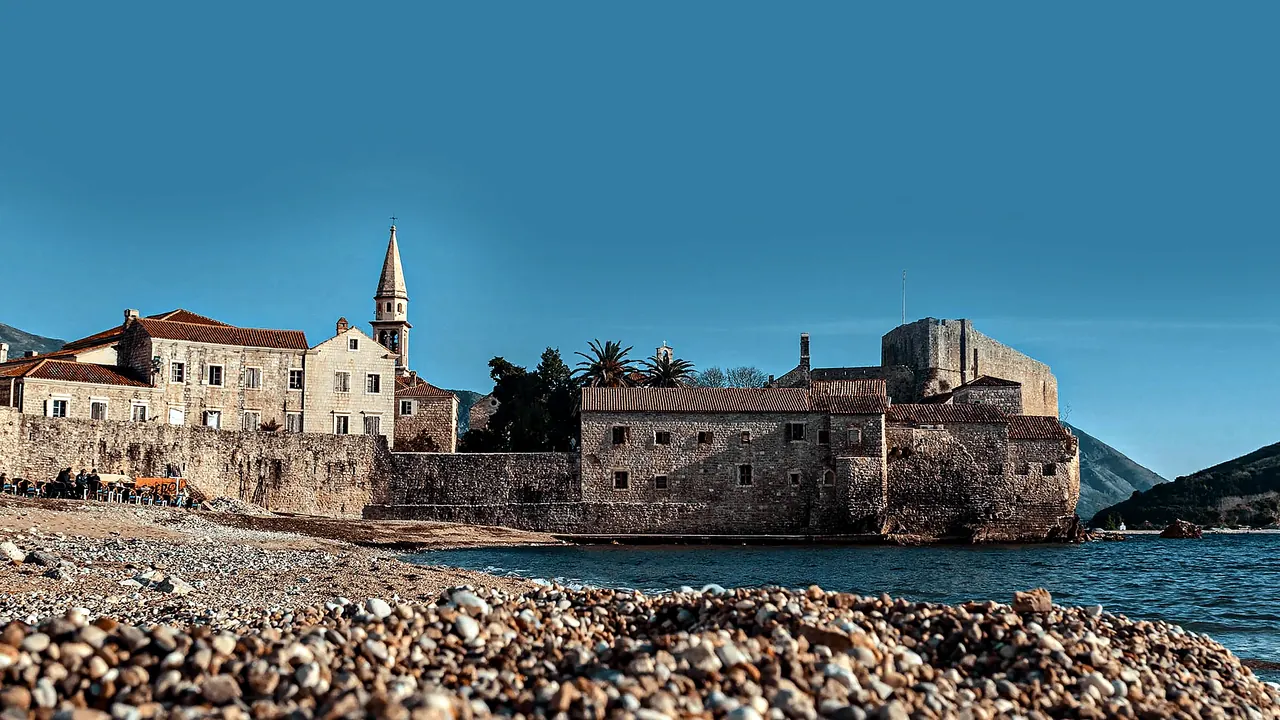
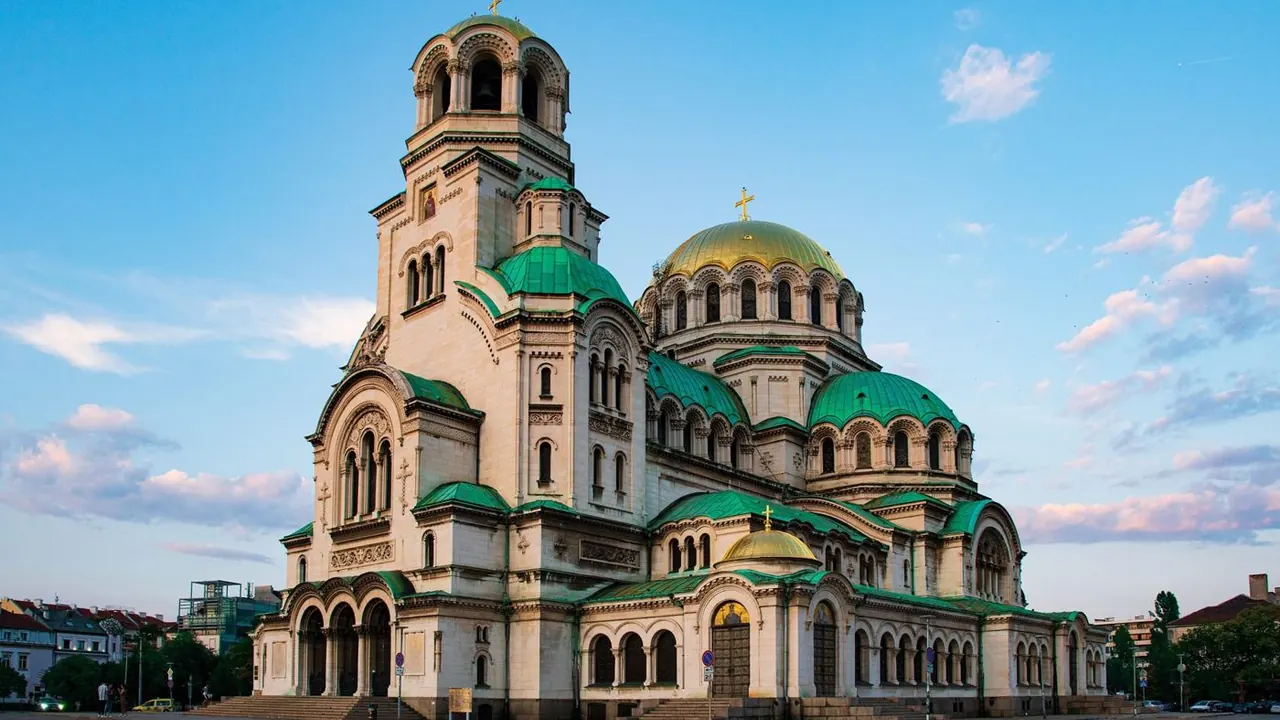
Photos: Budva by Ender Vatan, Pexels License; Sofia by Jose Ligero Loarte, CC BY-SA 4.0, cropped.
Budva or Sofia?
Our verdict in twelve categories, each scored against the same fixed benchmark cities, and the climate month by month, so you can choose for your trip.
Choose Budva for
- beaches
- day trips
- families
Budva is the choice for a summer by the sea. The town beaches start at the old town walls, quieter coves and the sand facing Sveti Stefan are a short ride away, and Kotor, Perast and Cetinje all make easy outings. Add loud nights on the seafront and you have a warm-weather trip built around swimming, boats and the coast, with little need for museums or a theatre programme.
Choose Sofia for
- culture and sights
- live music and the arts
- getting around
Sofia suits a traveller who wants a city to explore rather than a shore to lie on. Roman Serdica, the gold domes of Alexander Nevsky and the frescoes of Boyana sit alongside a year-round opera and ballet season, and a real mountain rises at the end of the tram lines. It is noticeably cheaper, easy to get around by metro, and works in spring, autumn and even winter, when Budva goes quiet.
Scoreboard
Twelve categories on one fixed scale from 0 to 100. The shaded stretch is the gap between the two.
Your match
Pick a travel style or drag the sliders, and both match scores follow your weighting.
Wins on beaches and day trips with your weighting.
Wins on culture and sights and live music and the arts with your weighting.
What matters to you?
Category by category
What the scores mean for a trip.
Beaches & swimming
This is Budva's home ground and Sofia has nothing to set against it. Budva has a full seafront of beaches in town, the coves at Mogren, the long curve of Becici and the reddish sand opposite Sveti Stefan, though most of it is fine pebble or coarse sand and the town beaches are packed with sunbeds in high summer.
Sofia is a high inland capital, and the Black Sea is a separate trip by plane or a long drive. Summer swimming there means park pools or the lake at Pancharevo, which is fine for cooling off but nobody's idea of a beach vacation.
Food & drink
Sofia eats better, though neither city is a reason to travel for food. Its mehana taverns serve kebapche, shopska salad and clay-pot dishes, mornings start with banitsa from the corner bakery, and wine bars pour Mavrud and Melnik reds. A row of small bistros around Vitosha Boulevard lightens things up.
Budva's promenade is mostly feeding summer crowds, and quality varies a lot. The rewards are in family-run konobas: grilled squid, the day's catch, Njegusi ham and cheese, and a glass of Vranac from around Lake Skadar.
Culture & sights
Sofia has far more to see. Within a few minutes' walk of Serdika you pass excavated Roman streets, a fourth-century rotunda, a mosque and a cathedral, and the gold-domed Alexander Nevsky and the UNESCO-listed frescoes at Boyana are close by. The Thracian gold in the National Museum of History and the Museum of Socialist Art add more.
Budva's sights are its walled Stari Grad, much of it rebuilt after the 1979 earthquake, the Citadel and a small archaeological museum, and together they make a pleasant hour or two. The coast's major heritage is in Kotor and Cetinje, not in Budva itself.
Nightlife
The two cities are broadly level for a night out, but the nights could hardly be more different. Budva is a summer party town of beach bars, terrace clubs and a big open-air club on the hill that runs until dawn, ideal for groups but mostly shut from October to May.
Sofia's scene is smaller and runs all year: cocktail and craft beer bars around Shishman Street, cellar bars under old buildings, a few electronic clubs and park terraces in summer. Choose Budva for loud, late nights and Sofia for conversation over good drinks.
Nature & outdoors
Sofia has the edge because its mountain is right next to the city. A bus or the gondola puts you on Vitosha's spruce forest and boulder rivers within an hour, the Seven Rila Lakes and the slopes of Borovets are within reach, and winter brings real snow and skiing.
Budva's setting is more dramatic from the beach, with bare limestone rising straight behind the town. Lovcen and Lake Skadar are about an hour away by winding road, and nearer at hand there are coastal paths, sea kayaking and paragliding above Becici, though midsummer heat drives most activity onto the water.
Day trips
Budva is the better base for day trips, mainly because everything is close. Kotor and its bay are half an hour away, Perast lies just beyond, and Cetinje, the Skadar wine villages, Stari Bar and Ulcinj are all comfortable outings. Dubrovnik is possible as a long day if the border is kind.
Sofia's two great excursions, Rila Monastery and Plovdiv, are both excellent but take about two hours each way. Koprivshtitsa and the Iskar Gorge round out the list, while Veliko Tarnovo and Melnik need an overnight stay.
Good for families
Budva works better for families, almost entirely because of the beaches. Gently shelving town beaches, calmer bays at Becici and a water park on the hill keep children busy, though the town is loud at night in July and August and June or September is easier.
Sofia is calm and safe enough but offers less for children: big parks with playgrounds, a hands-on science centre, a modest zoo and the gondola up Vitosha, which is the best day out. Uneven pavements make pushchairs hard work.
Getting around
Sofia is much easier to move around. A clean metro runs from the airport through the centre to the railway station and Vitosha's foothills, trams and buses cover the rest, and the main sights are within walking distance of each other. The main drawbacks are Cyrillic signs away from the centre and cracked pavements.
In Budva the old town, marina and promenade are an easy stroll, but beyond them you depend on one coast road that jams in summer. There is no railway, and Lovcen, Cetinje or the quieter bays are far easier with a car, a driver or a boat taxi.
Shopping & style
Neither city is a shopping destination, but Sofia gives you more to browse. Vitosha Boulevard and the outer malls cover the chain stores, and the local finds are better: rose oil, Troyan pottery, embroidery and the icon flea market by Alexander Nevsky.
Budva sells beachwear, sunglasses, silver filigree, olive oil, honey and rakija from old town lanes and promenade stalls, with a modest centre near the marina for basics.
Affordability
Sofia is the cheaper trip at any time of year. Hotels, tavern meals, wine, transport and museum tickets all cost far less than in Western Europe, and even its smarter bistros feel moderate.
Budva is Montenegro's most expensive town, and seafront rooms, sunbeds and promenade meals carry resort prices in July and August. Bakeries, grill houses, buses and back-street apartments are still good value, and going in June or September makes a clear difference.
Live music & performing arts
Sofia has an actual season, which Budva lacks. The National Opera and Ballet performs through most of the year, the Philharmonic plays at Bulgaria Hall, and Orthodox choral singing is a distinctive local sound. Plays at the Ivan Vazov theatre are in Bulgarian, though.
Budva's one fixture is the Grad Teatar summer festival on open-air stages in the old town. The rest of the time live performance means cover bands in seafront bars.
Wellness & relaxation
Sofia is the more restful choice and has a real spa tradition. Mineral water flows from public taps beside the old Central Mineral Baths, Bankya's pools are about half an hour west, and the hot-spring resorts such as Velingrad lie further out. The city's slow café pace helps too.
Budva has no bathing culture of its own, so wellness means the spas of the big resort hotels at Becici and Sveti Stefan. In high summer music from the seafront carries late into the night, so a quiet stay there means coming in May, June or late September.
When should you go?
Pick your month. The climate figures are measured averages, not a forecast.
Budva in July
Sofia in July
Daytime high, °C
Rainfall in the month, mm
Where the figures come from
Budva has no rain gauge within 25 km of the centre, so its rainfall comes from a gridded climate dataset read at the city rather than from a gauge further away.
Budva's sunshine is measured 40 km from the centre, at Podgorica-Grad.
Temperature and rainfall are climate normals, averaged over the years shown. Budva: 1991-2020 normals, Tivat (15.8 km from centre). Sofia: 1991-2020 normals, Sofia Observ. (7.3 km from centre).
Budva is at its best in summer. The Adriatic is warm enough for long swims from June to September, peaking around 26°C in August. June to August are also the sunniest and driest months of the year. July and August are hot, with afternoons around 32°C, so the old town is best walked early or late. Rain starts to return in September and gets much heavier through the autumn, peaking around 212mm in November, and the coastal winter is mild but wet and grey. May and June, and September before the autumn rain builds, are the easiest months to combine swimming with walking.
Sofia sits on a high plain and has a proper continental year. Summer afternoons reach about 28°C, warm but rarely too hot for sightseeing, and May to September is the best time for the streets and the mountain trails, though May and June bring the most showers. Rain is spread far more evenly than on the coast, so Sofia's autumn stays fairly dry while Budva turns wet. Winters are cold, with January highs near 4°C, which suits skiing on Vitosha or at Borovets more than strolling. Choose Budva for high summer by the sea, and Sofia for October or a winter trip, when Budva is at its wettest.
Which traveller are you?
On a beach and sun trip, Budva is the obvious pick. Sofia is far inland, while Budva has Slovenska Plaza in town, Mogren's coves under the cliffs and a warm Adriatic from June into October, with boat taxis to quieter bays.
For a culture and arts trip, Sofia wins clearly. Roman ruins, the Rotunda of St George, Alexander Nevsky Cathedral and Boyana's frescoes fill two or three days, and evenings can go to the National Opera and Ballet or the Philharmonic. Budva's walled old town takes an afternoon.
On a trip with a tight budget, Sofia goes further. Central hotels, mehana meals, Bulgarian wine and metro rides all cost little, and a trip to Vitosha adds almost nothing. Budva is Montenegro's priciest resort in high summer, and is only reasonable off-season or a few streets back from the sea.
Before you go
| Measure | Budva | Sofia |
|---|---|---|
| Official language | Montenegrin | Bulgarian |
| Currency | Euro (EUR) | Euro (EUR) |
| Sockets | CF230 V, 50 Hz | CF230 V, 50 Hz |
| Driving side | Right | Right |
| Time zone | UTC+1, UTC+2 in summer | UTC+2, UTC+3 in summer |
| Emergency number | 112 | 112 |
| Elevation | 3 m | 560 m |
| Main airport | Tivat Airport (TIV)17 km from centre42 non-stop destinations | Sofia Airport (SOF)8 km from centre97 non-stop destinations |
| Public holidays this year | - | 15 days |
By the numbers
| Measure | Budva | Sofia |
|---|---|---|
| City population | 13,338 | 1,213,134 |
| People per km² | 109 | 2,466 |
| Museums within 10 km | 0 | 43 |
| UNESCO World Heritage sites within 50 km | 3 | 1 |
| Swim season, months above 21 °C | 5 months | - |
Where else could you go?
Every comparison below shares a destination with this one, so you can follow Budva or Sofia somewhere new.