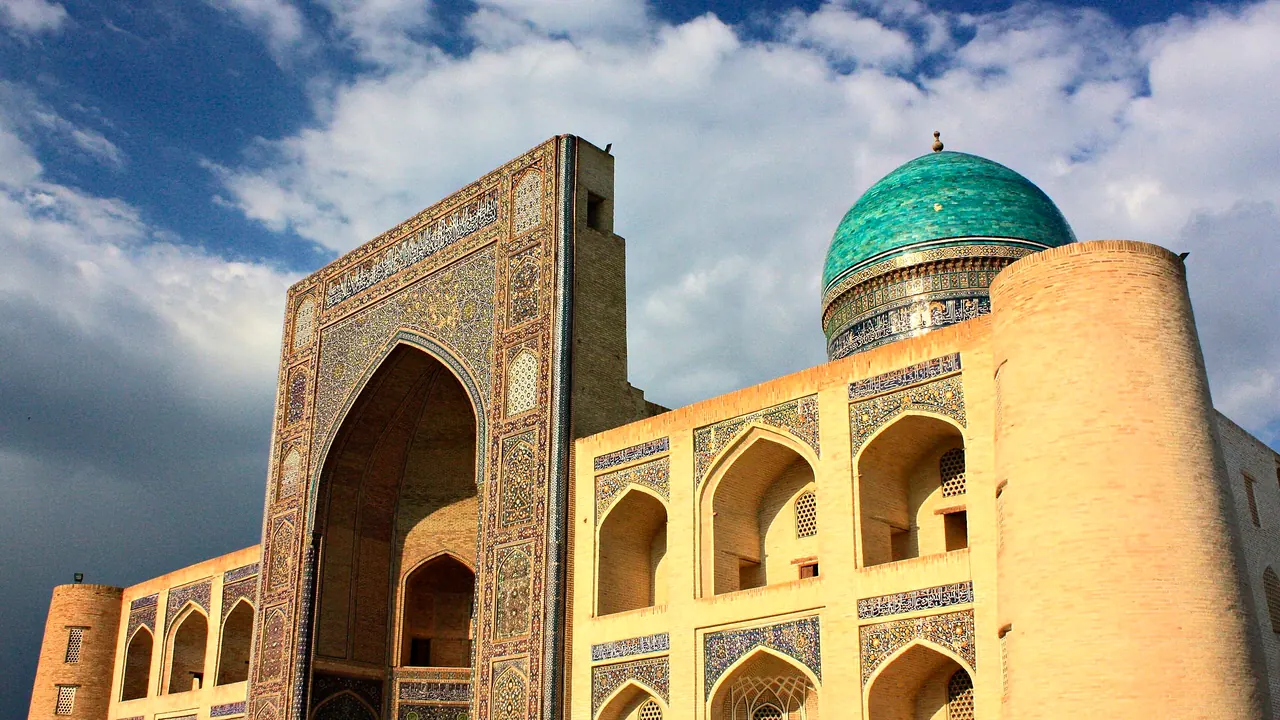
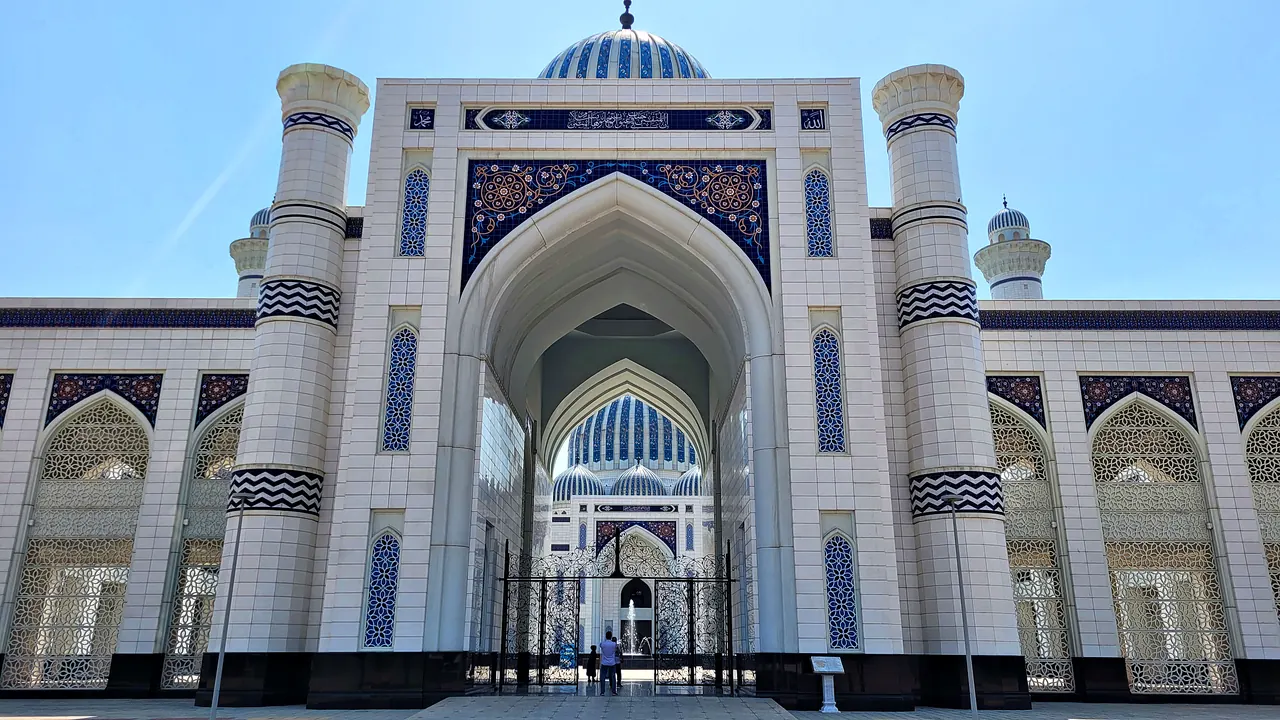
Photos: Bukhara by RK, CC BY-SA 4.0, cropped; Dushanbe by Michael Kabus, Pexels License.
Bukhara or Dushanbe?
Our verdict in twelve categories, each scored against the same fixed benchmark cities, and the climate month by month, so you can choose for your trip.
Choose Bukhara for
- culture and sights
- day trips
- shopping
Bukhara is the choice for anyone who travels to look at buildings and walk through history. Its old centre of madrasas, minarets, trading domes and caravanserais holds together on foot. You can browse craft workshops between the monuments, sweat in an ancient brick bathhouse, and take the fast train to Samarkand. It suits a slow, architecture-led trip, and it can fill several days without a car.
Choose Dushanbe for
- nature and the outdoors
- live music and the arts
- prices
Dushanbe makes sense if the mountains are the point. The city itself is a Soviet-built capital of boulevards, parks and one excellent museum of antiquities. The real draw is the gorges and walnut woods just to the north, with the Fann lakes further off. Come here to hike, hire a driver and see the high valleys of Tajikistan, and treat the capital as a comfortable, cheap base rather than a sight in itself.
Scoreboard
Twelve categories on one fixed scale from 0 to 100. The shaded stretch is the gap between the two.
Your match
Pick a travel style or drag the sliders, and both match scores follow your weighting.
Wins on culture and sights and day trips with your weighting.
Wins on nature and the outdoors and live music and the arts with your weighting.
What matters to you?
Category by category
What the scores mean for a trip.
Beaches & swimming
Neither city has anywhere to swim in the sea, and both are about as far from a coast as you can get. In Bukhara the old pools such as Lyabi-Hauz are for sitting beside, so a hotel pool is the only option in summer.
Dushanbe gives you a little more choice. Locals cool off at the artificial lake on the city's edge and in the cold rivers of the Varzob valley, and the turquoise Norak reservoir to the south makes a full day out for a swim.
Food & drink
The two kitchens are cousins and equally satisfying within narrow limits. Both cook plov in great cauldrons at lunchtime and serve samsa or sambusa from the tandoor and shashlik off the grill. Bukhara's charm is the setting: platforms under the mulberry trees around the old pools. Its menus vary little, though, and vegetarians struggle.
Dushanbe adds qurutob, flatbread soaked in dried-yoghurt sauce and shared from a wooden platter, and its bazaars are piled with apricots, walnuts and melons. It also has a handful of Russian, Turkish and Persian restaurants for a change, though neither city has fine dining to speak of.
Culture & sights
This is where Bukhara pulls far ahead. The Kalon Minaret, the Poi Kalon mosque and madrasa, the Ark, the Samanid Mausoleum, Bolo Hauz and Chor Minor all sit within a walkable old town whose lanes are still lived in. Its museums are modest, but the architecture itself is the exhibit.
Dushanbe has no old town, since it was a village until the Soviet era. Its sights are monumental: Rudaki Avenue, the Somoni statue, the giant flagpole and the Ayni opera house. The Museum of Antiquities and its long reclining Buddha from Ajina Tepa is a genuine highlight, and Bukhara has nothing to match it as a collection. Still, the whole city fits into a couple of days.
Nightlife
Both cities go quiet after dinner, so neither is a place for a night out. In Bukhara the evening means tea and a meal by the floodlit madrasas of Lyabi-Hauz, then bed, with beer or wine mostly in restaurants and hotels.
Dushanbe has a few more doors to open: pubs, hookah lounges, karaoke rooms and small clubs for expats. The crowds are thin and they close early, and the liveliest sight is families strolling the fountains on Rudaki Avenue.
Nature & outdoors
Dushanbe has the mountains on its doorstep and Bukhara does not. Half an hour north, the Varzob gorge leads into side valleys such as Kondara and Siama with wild walnut and juniper. Takob and Safed Dara offer simple winter skiing, and the Fann Mountains with Iskanderkul and the Seven Lakes reward an overnight trip. Trails are unmarked, so a guide or driver helps.
Bukhara sits on a flat oasis of cotton fields and canals at the edge of the Kyzylkum. Its outdoor offer is a long drive to a desert yurt camp and a camel ride near Nurata.
Day trips
Bukhara is the better base for outings, chiefly because Samarkand and the Registan are a little under two hours away by high-speed train. Closer in are the pottery workshops of Gijduvon, the slender minaret at Vabkent and the walled tombs of Chor Bakr.
From Dushanbe, the Hisor fortress about 30km west fills half a day. Beyond it, Penjikent, Khujand and Ajina Tepa all need long drives and nights away. Excursions there tend to head into the mountains rather than to other historic towns.
Good for families
Both are safe and warm towards children, and both are limited on actual entertainment. The difference is in kind. Bukhara's flat, mostly pedestrian old town is easy with a pushchair, but the sights are mosques and fortresses, with only a puppet show or a camel for fun.
Dushanbe is better for letting children run around. It has big parks with fountains, small funfairs and playgrounds, a modest zoo, a botanical garden and the lawns of Victory Park. In both cities the summer heat rules out July and August with young children.
Getting around
Bukhara is the easier of the two on foot. The Kalon Minaret, the Ark, Bolo Hauz and the trading domes are all within a short walk across a flat, largely car-free centre. You only need a taxi for the summer palace, the Naqshband shrine and the distant railway station.
Dushanbe's central strip along Rudaki Avenue is walkable too, but it is a long boulevard rather than a compact old quarter. Anything beyond it, including the valleys you probably came for, means app taxis, a hired driver or a shared taxi.
Shopping & style
Bukhara is a working craft market and well worth the browsing. Under the trading domes and in madrasa courtyards you can buy suzani, ikat, carpets, gold-embroidered caps, miniatures, copper and the famous stork scissors, often watching the maker at work. The quality is mixed, so take your time.
In Dushanbe the souvenirs sit on the fringes of the Mehrgon market and the Green Bazaar: skullcaps, chapan robes and atlas silk, plus a few craft shops for suzani. Otherwise the city offers ordinary malls.
Affordability
Both are very cheap by any Western measure, and food, taxis and entry tickets cost little in either. Where they differ is the bed. Bukhara's family guesthouses in old merchant houses, with tiled courtyards and big breakfasts, are its best value, while boutique mansions and poolside dinners cost more.
Dushanbe is a touch cheaper day to day, and hiring a driver for the mountains is inexpensive. Good mid-range rooms are scarce, though, and the international hotels charge well above the rest of the city.
Live music & performing arts
Dushanbe has the stronger stage. The Ayni Opera and Ballet Theatre puts on classical ballet and Tajik opera, and there are a philharmonic and several drama theatres. It takes some asking around to find out what is on. Shashmaqom and mountain falak music turn up at concerts and festivals.
Bukhara's performances are mostly put on for visitors: folk dance and costume shows in a madrasa courtyard by Lyabi-Hauz, and small puppet shows. Its own theatre rarely figures in a trip.
Wellness & relaxation
Bukhara is the more restful stay. Its centuries-old bathhouses under brick domes near the trading halls still offer steam, scrub and herbal massage, and the courtyard mornings and slow tea afternoons make the whole town feel calm.
Dushanbe's best treatment is an hour away, at the Khoja Obi Garm sanatorium with its radon springs in the Varzob valley. In the city itself there are only Russian-style banyas and a few hotel spas, though its shaded avenues and teahouses keep the pace unhurried.
When should you go?
Pick your month. The climate figures are measured averages, not a forecast.
Bukhara in July
Dushanbe in July
Daytime high, °C
Rainfall in the month, mm
Temperature and rainfall are climate normals, averaged over the years shown. Bukhara: 2004-2020 (rainfall 1991-2020) normals, Bukhara / Tsyplan (3.4 km from centre). Dushanbe: 1991-2020 normals, Dushanbe (2.6 km from centre).
The two cities share the same fierce summer. From June to August it is too hot for comfortable sightseeing in either, with July highs of 38°C in Bukhara and 37°C in Dushanbe, so a trip in those months means early starts and long rests indoors through the middle of the day. Neither city has a beach season to plan around. The real difference is rain. Bukhara is a desert city and stays dry for most of the year, with its little rain falling mainly from late winter into spring. Dushanbe is properly wet from late autumn through spring, and April alone brings about 154mm.
October is Bukhara's best month, mild for walking at around 22°C and almost rainless. April is just as pleasant for temperature, but it falls in the town's wettest stretch, though here that still means only light showers. May and September also work if you start early. Dushanbe is at its best in late September and October, when the heat has gone and the rains have not yet set in, which suits both the streets and the mountain valleys. Winter is chilly in Bukhara, and a little milder but damp in Dushanbe.
Which traveller are you?
On a culture and arts trip, Bukhara is the clear pick. Its walkable old town of madrasas, mosques, fortress and mausoleums is among the finest in the Islamic world, while Dushanbe offers one outstanding antiquities museum and a Soviet boulevard that two days cover.
For an outdoors trip, Dushanbe wins easily. The Varzob gorge and its walnut and juniper side valleys start half an hour from the centre, and the Fann Mountains lie beyond. Bukhara is ringed by cotton fields and flat desert scrub.
On a shopping trip, Bukhara is far more rewarding. Its sixteenth-century trading domes are full of suzani, ikat, carpets and stork-shaped scissors, often made in the next room. Dushanbe's bazaars sell some textiles, but mostly dried fruit and household goods.
Before you go
| Measure | Bukhara | Dushanbe |
|---|---|---|
| Official language | Uzbek | Tajik |
| Currency | Uzbekistan Sum (UZS) | Somoni (TJS) |
| Sockets | CFI220 V, 50 Hz | CFI220 V, 50 Hz |
| Driving side | Right | Right |
| Time zone | UTC+5 | UTC+5 |
| Emergency number | 112 | 112 |
| Elevation | 225 m | 706 m |
| Main airport | Bukhara International Airport (BHK)5 km from centre11 non-stop destinations | Dushanbe International Airport (DYU)5 km from centre44 non-stop destinations |
By the numbers
| Measure | Bukhara | Dushanbe |
|---|---|---|
| Population | 280,187 | 948,251 |
| People per km² | 7,111 | 7,610 |
| Museums within 10 km | 2 | 4 |
| UNESCO World Heritage sites within 50 km | 1 | 0 |
Where else could you go?
Every comparison below shares a destination with this one, so you can follow Bukhara or Dushanbe somewhere new.
- Samarkandvs Dushanbe
- Samarkandvs Bukhara
- Tashkentvs Dushanbe
- Khivavs Bukhara
- Tashkentvs Bukhara
- Ashgabatvs Bukhara