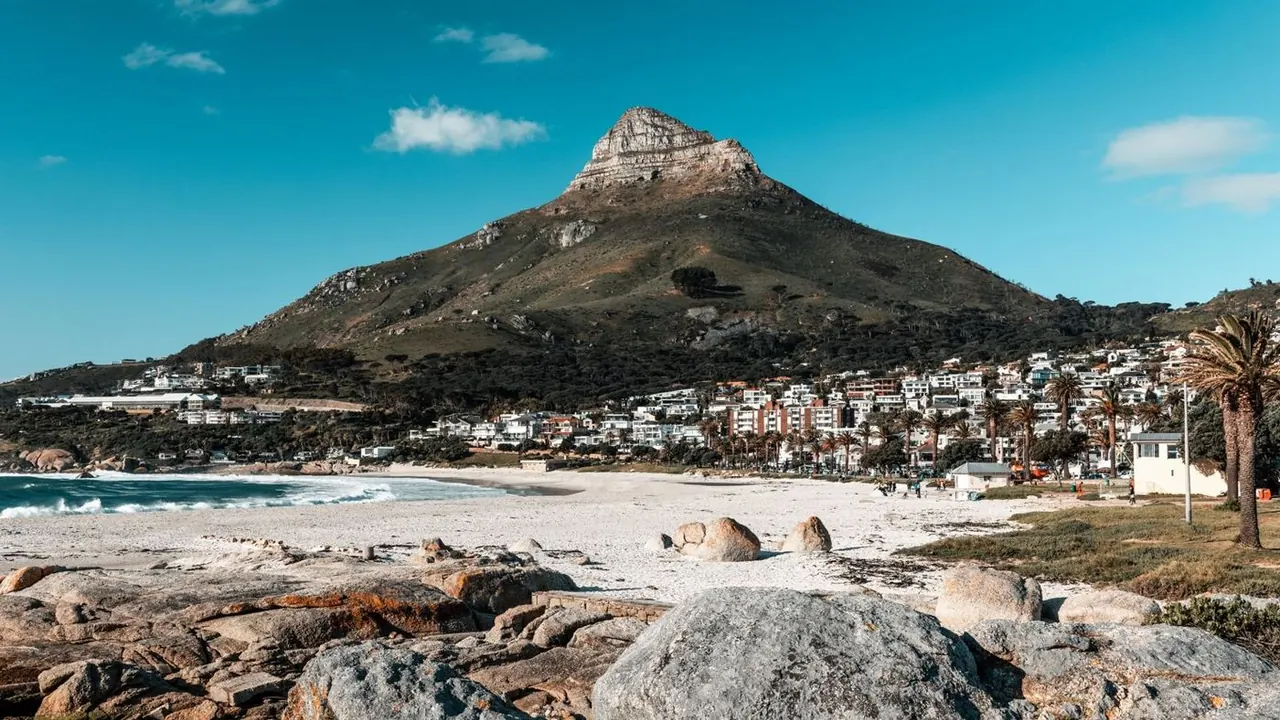

Photos: Cape Town by Stephan Louis, Pexels License; Nairobi by Lmwangi, CC BY-SA 3.0, cropped.
Cape Town or Nairobi?
Our verdict in twelve categories, each scored against the same fixed benchmark cities, and the climate month by month, so you can choose for your trip.
Choose Cape Town for
- beaches
- day trips
- culture and sights
Cape Town suits travellers who want a lot of variety from one base: summer beaches, a mountain rising behind the centre, the Winelands close by and a history told through Robben Island and the Bo-Kaap. It also gives better value and has enough sights and excursions to fill a week or more without running out of ideas.
Choose Nairobi for
Nairobi does not lead in any category we score.
Choose Nairobi if wild animals are the main reason for the trip. Lions and rhinos roam a national park at the edge of the city, children can feed giraffes and watch orphaned elephants, and the Rift Valley is a couple of hours away. It works best as a few days before or after a safari or a stay on the coast, not as a city break on its own.
Scoreboard
Twelve categories on one fixed scale from 0 to 100. The shaded stretch is the gap between the two.
Your match
Pick a travel style or drag the sliders, and both match scores follow your weighting.
Wins on beaches and day trips with your weighting.
Has no clear advantage with the weighting you have chosen.
What matters to you?
Category by category
What the scores mean for a trip.
Beaches & swimming
Cape Town has beaches on two very different coasts. The white coves of Clifton and Camps Bay lie beneath the Twelve Apostles, but the Atlantic there is cold enough that most people only take a quick dip. On the False Bay side, Muizenberg, St James and the tidal pools are warm enough in summer for a proper swim.
Nairobi has nothing like this. It sits on a highland plateau far inland, and the Kenyan coast is a flight away. A swim means a hotel pool unless you add separate days by the Indian Ocean.
Food & drink
Cape Town eats better and more widely. It has its own Cape Malay cooking, with bobotie, fragrant curries and koeksisters, plus snoek and yellowtail by the harbour at Kalk Bay or Hout Bay. Ambitious chefs work around Bree Street and Woodstock, and wine estates are less than an hour away.
Nairobi does fewer things, but it does them well. Weekend afternoons are spent around nyama choma, the long-settled South Asian community makes excellent Indian food, Ethiopian restaurants are easy to find, and the coffee is grown just outside the city. Upmarket dining has much less depth.
Culture & sights
Neither city has a grand old quarter, but Cape Town has far more to see. Robben Island, the District Six Museum and the Castle of Good Hope tell the story of Dutch settlement and apartheid. The museums around the Company's Garden, the painted Bo-Kaap and Zeitz MOCAA add enough for three or four days.
Nairobi was founded as a railway depot in 1899, and its sights fit into a day or two. The highlights are the National Museum with its early human fossils, the Karen Blixen farmhouse and the city view from the roof of the convention centre.
Nightlife
Both cities stay out late, and in both you take a ride-hailing car between districts after dark rather than walking. The difference is in style. Cape Town spreads its evenings across Long Street's backpacker bars, the cocktail and wine bars of Bree and Kloof Streets, the gay quarter of De Waterkant and summer sundowners above the Atlantic, and it is much calmer outside December to March.
Nairobi's scene is more local and more about music. Rooftops and clubs in Westlands play Afrobeats, amapiano and gengetone until dawn, mostly from Thursday to Saturday, while neighbourhood pubs fill up for football and grilled meat.
Nature & outdoors
Table Mountain rises straight behind Cape Town's centre, and the wild country runs from there to the sea. You can hike Platteklip Gorge or climb Lion's Head for sunrise, walk through fynbos found nowhere else on earth, see penguins at Boulders and whales in False Bay from June to November, and learn to surf at Muizenberg. Chapman's Peak Drive then takes you down the peninsula to the cliffs of Cape Point.
Nairobi offers savanna and big game instead of mountain and ocean. Buffalo and giraffes graze in the national park at its southern edge, Karura Forest has shaded trails and waterfalls, and the Ngong Hills give ridge walks above the Rift Valley. Within two hours you can cycle through Hell's Gate or walk the crater rim of Mount Longonot.
Day trips
Here Cape Town is well ahead. Stellenbosch, Franschhoek, Paarl and the smaller wine valleys are under an hour away and could fill several days on their own. Further out, Hermanus is known for whale watching from its cliffs and Tulbagh for its street of Cape Dutch houses, though you will need a car or a tour.
Nairobi's nearby outings are modest: the tea estates of Limuru and the prehistoric hand axes at Olorgesailie. Kenya's great heritage towns, Lamu and old Mombasa, are on the coast and too far for a day.
Good for families
Children get memorable days in either city, but the settings are very different. Cape Town mixes sea and mountain: the Two Oceans Aquarium at the Waterfront, penguins on the sand at Boulders, the cableway up Table Mountain and the treetop walkway at Kirstenbosch. In summer the calm tidal pools at St James and Fish Hoek suit small swimmers, though the Atlantic beaches are too cold for long swims. These places lie far apart around the peninsula, so you will need a car to get from one to the next.\n\nIn Nairobi the days revolve around animals.
At the Giraffe Centre in Langata, children hand-feed Rothschild's giraffes from a raised platform. At the Sheldrick Wildlife Trust they can watch young elephants at their bottle feed and mud bath, and the national park is close enough for a morning game drive. Heavy traffic and few pavements make the city tiring with small children, so staying in Karen or Langata, close to these sights, saves hours on the road.
Getting around
Cape Town at least has a core you can walk by day, covering the City Bowl, the Bo-Kaap and the Waterfront, and MyCiTi buses that a visitor can actually use to reach the airport, the Atlantic beaches and Hout Bay. For the peninsula and the Winelands you will want a car, and the roads are good and a pleasure to drive.
Nairobi asks for more patience. The sights are scattered across distant suburbs and linked by some of Africa's most congested roads, so a short hop can take an hour. Matatu routes are hard for visitors to work out and pavements are scarce, so most people rely on ride-hailing or a hired driver.
Shopping & style
Cape Town is the place for South African design, Nairobi for handmade crafts. In Woodstock's warehouses and along Bree and Kloof Streets you will find local ceramics, leather, homeware and fashion, and wine and rooibos make easy things to take home. The Waterfront mall covers the chains.
Nairobi's Maasai Market moves between sites around the city during the week, selling beadwork, soapstone and kiondo baskets, and bargaining is expected. In the workshops around Karen you can watch glass and textiles being made. The malls in Westlands and Gigiri are comfortable but could be anywhere.
Affordability
Cape Town gives you more for your money. Good restaurants, even tasting menus, cost a fraction of prices back home, and wine, car hire and fuel are cheap. Rooms are the exception, but they are only really expensive at the December to January peak.
Nairobi is cheap at street level, but most visitors stay in secure international hotels priced well above local costs. Non-residents also pay much higher park fees than Kenyans, and a game drive means paying for a vehicle and driver, so wildlife viewing adds a lot to the bill.
Live music & performing arts
Cape Town has more on stage. Cape jazz is the city's own sound, its annual jazz festival is one of the largest in Africa, and Kirstenbosch holds sunset concerts on its lawns in summer. Artscape, the Baxter Theatre and the Cape Philharmonic cover opera, drama and orchestral music.
Nairobi's best nights are live bands playing benga, rumba and Afro-fusion, and the traditional dances at Bomas of Kenya. There are plays, spoken word and comedy, but almost no opera or classical music.
Wellness & relaxation
Cape Town has a slow outdoor pace that does much of the work a spa would. You can spend a long lunch on a wine estate, go to a morning yoga class on the Atlantic seaboard, wander Kalk Bay or swim in a False Bay tidal pool with the regulars. The spas on the grander Winelands estates are good value, and hot springs are a drive inland in the Overberg.
Nairobi is noisy and congested, so it is harder to unwind there. Rest means a hotel spa or a garden hotel in Karen with cool mornings and breakfast on the veranda, and many visitors save their downtime for a safari lodge.
When should you go?
Pick your month. The climate figures are measured averages, not a forecast.
Cape Town in July
Nairobi in July
Daytime high, °C
Rainfall in the month, mm
Temperature and rainfall are climate normals, averaged over the years shown. Cape Town: 1991-2020 normals, Cape Town Airport (17.5 km from centre). Nairobi: 1991-2020 normals, Nairobi ACC/FIC/RCC/MET/COM/ (13.3 km from centre).
Cape Town is at its best in summer. From December to March it is dry and very sunny, with highs near 28°C, and it is the only time of year when False Bay's water, around 18°C at its warmest, is pleasant for a proper swim. From May to August the days are cool and grey and most of the year's rain falls. That is fine for museums and whale watching but not for the beach.
Nairobi's altitude keeps it mild all year, with daytime highs between about 24°C and 28°C, so heat never gets in the way of sightseeing. Rain shapes the calendar instead. The long rains of April and May and a second wet spell in November each bring around 126mm in their wettest month, which makes game drives muddy. June to September is dry but the cloudiest part of the year, so January and February, which are dry and sunny, are the most comfortable months.
Which traveller are you?
On a beach and sun trip, Cape Town is the only real choice. You can lie on the white sand at Clifton and Camps Bay, and from December to March False Bay is warm enough to swim. Nairobi is on an inland plateau, where swimming means a hotel pool.
For a food and nightlife trip, Cape Town comes out ahead on the food: Cape Malay cooking, the chefs around Bree Street and cheap estate wine. Nights out are just as good in both, but Nairobi's food is mainly nyama choma and Indian cooking.
For travellers who want to see big game, Nairobi is the better base. A real safari starts at the city's southern edge, with lions and rhinos in front of office towers, and the hippos and zebras of the Rift Valley are a short drive away. Cape Town has penguins and whales but no savanna.
Before you go
| Measure | Cape Town | Nairobi |
|---|---|---|
| Official language | English, Zulu, Xhosa, Afrikaans, Venda, Northern Sotho, Swazi, Tswana, Tsonga, Sesotho, Southern Ndebele, South African Sign Language | English, Swahili |
| Currency | Rand (ZAR) | Kenyan Shilling (KES) |
| Sockets | CMN230 V, 50 Hz | G240 V, 50 Hz |
| Driving side | Left | Left |
| Time zone | UTC+2 | UTC+3 |
| Emergency number | 112 | Police 112/999, ambulance 112/999, fire 112/999 |
| Elevation | 5 m | 1,661 m |
| Main airport | Cape Town International Airport (CPT)18 km from centre45 non-stop destinations | Jomo Kenyatta International Airport (NBO)13 km from centre60 non-stop destinations |
| Public holidays this year | 13 days | 10 days |
By the numbers
| Measure | Cape Town | Nairobi |
|---|---|---|
| City population | 3,776,313 | 5,545,000 |
| People per km² | 1,538 | 7,967 |
| Museums within 10 km | 22 | 4 |
| UNESCO World Heritage sites within 50 km | 3 | 0 |
| Swim season, months above 21 °C | None | - |
Where else could you go?
Every comparison below shares a destination with this one, so you can follow Cape Town or Nairobi somewhere new.