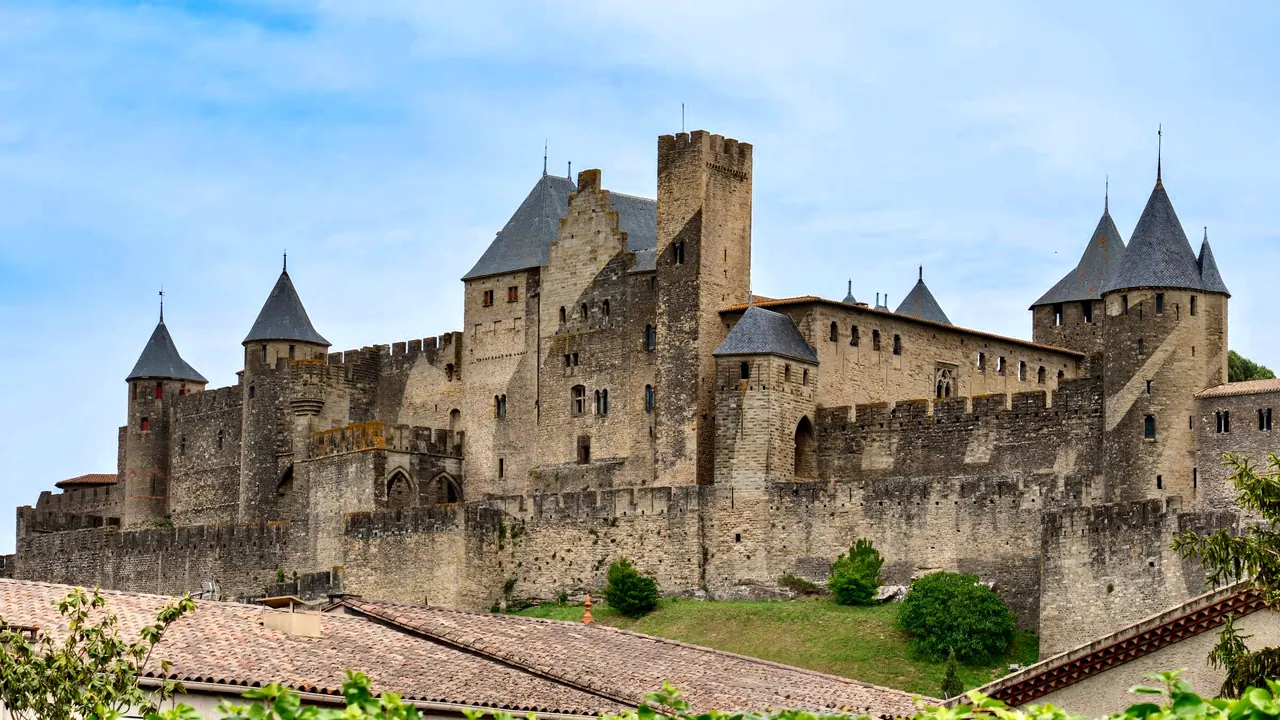
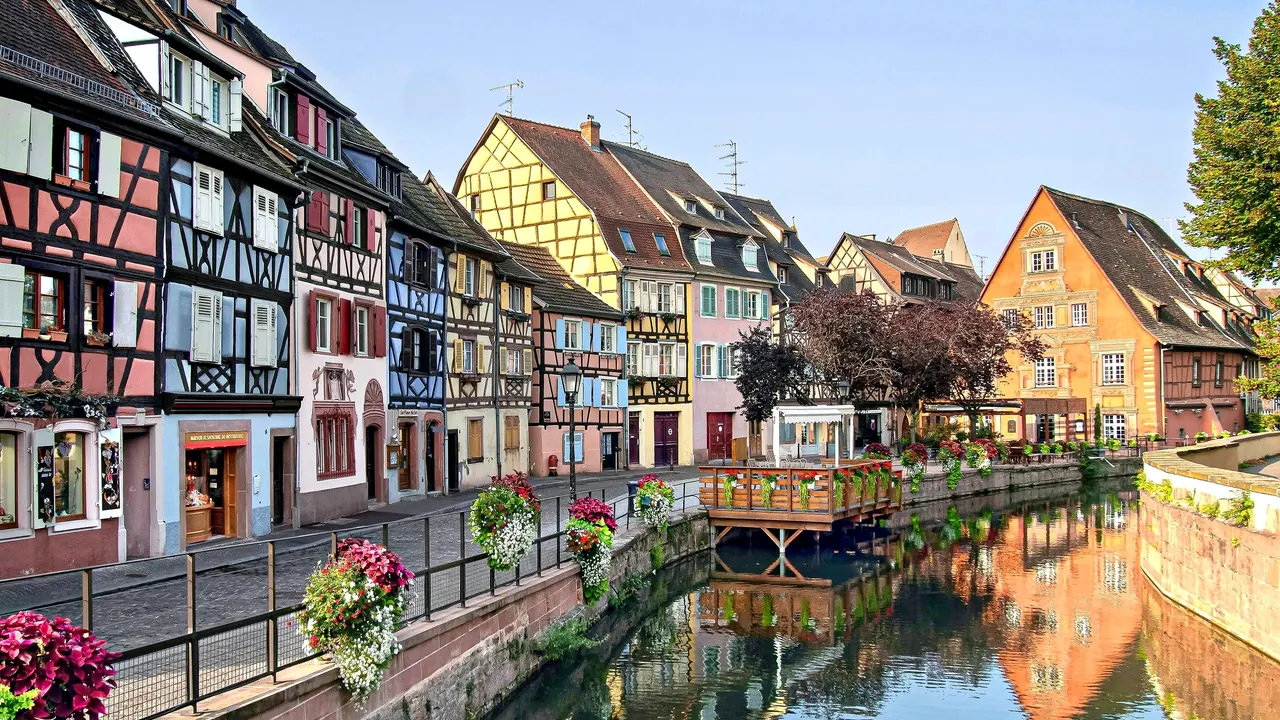
Photos: Carcassonne by Susanne Jutzeler, suju-foto, Pexels License; Colmar by Rolf Kranz, CC BY-SA 4.0, cropped.
Carcassonne or Colmar?
Our verdict in twelve categories, each scored against the same fixed benchmark cities, and the climate month by month, so you can choose for your trip.
Choose Carcassonne for
- beaches
- prices
- nightlife
Carcassonne suits travellers who want sun, warmth and a single great spectacle: the walled Cité on its hill, the Cathar castles on the ridges to the south, and a lake or the Mediterranean within reach on hot afternoons. It is also the easier town on the wallet, provided you sleep in the Bastide rather than inside the walls, and it fits a vacation where a car carries you through wine country and up into the Pyrenean foothills.
Choose Colmar for
- food and drink
- shopping
- getting around
Colmar is the better pick for anyone who travels to eat, drink and wander. Its Alsace cooking and white wines are richer than anything around Carcassonne, the Unterlinden Museum gives it a masterpiece of real weight, and the painted wine villages, Strasbourg, Basel and Freiburg are all close. Families and walkers do better here too, as long as they accept cooler, wetter weather and dearer rooms.
Scoreboard
Twelve categories on one fixed scale from 0 to 100. The shaded stretch is the gap between the two.
Your match
Pick a travel style or drag the sliders, and both match scores follow your weighting.
Wins on beaches and prices with your weighting.
Wins on food and drink and shopping with your weighting.
What matters to you?
Category by category
What the scores mean for a trip.
Beaches & swimming
Carcassonne has the real advantage here. The Lac de la Cavayère gives it a sandy, supervised lake beach a few minutes from the Cité, and the long, shallow Mediterranean beaches at Gruissan and Narbonne-Plage make a straightforward day out by car, wind permitting.
Colmar sits deep inland on the Alsace plain, and swimming means municipal pools or a small lake up in the Vosges valleys. It is fine for cooling off, but there is nothing to plan a day around.
Food & drink
Both towns eat regionally, but Colmar's table is richer and more varied. Alsace cooking, with choucroute garnie, baeckeoffe, tarte flambée and munster cheese, comes in wood-panelled winstubs, the whites of the surrounding slopes are poured everywhere, and a handful of ambitious kitchens add a fine-dining tier.
Carcassonne is cassoulet country, backed by sturdy Corbières and Minervois reds and the sparkling blanquette of Limoux. The best meals are down in the Bastide around Place Carnot rather than in the Cité, and beyond southern French cooking the range is thin.
Culture & sights
The two are evenly matched, but they offer different things. Carcassonne is one tremendous monument: the double-walled Cité with its fifty-two towers, the Château Comtal ramparts and the stained glass of Saint-Nazaire, with the Bastide's grid streets and the Canal du Midi below.
Colmar spreads its interest across a whole late-medieval townscape of painted half-timbered houses and canals, and adds what Carcassonne lacks, a museum of real stature in the Unterlinden and Grünewald's Isenheim Altarpiece. Both are covered well in about two days.
Nightlife
Neither town keeps late hours, and in both the evening is dinner followed by a drink on a terrace. Carcassonne's distinctive pleasure is a walk on the floodlit walls once the day crowds leave, with locals gathering in the Bastide cafés around Place Carnot. Colmar's evenings centre on wine bars and brasseries around Petite Venise. For a real night out, Carcassonne sends you to Toulouse or Montpellier and Colmar to Strasbourg.
Nature & outdoors
Colmar has the stronger outdoors. Marked paths run through the vines between wine villages within half an hour, and above them the Route des Crêtes climbs past the Hohneck and the Grand Ballon, with glacial lakes, dense trail networks, some winter skiing and the Black Forest across the Rhine.
Carcassonne's landscape is drier and wilder: the forested Montagne Noire to the north, the garrigue and castle ridges of the Corbières to the south, and the Aude gorges with summer rafting. The flat, shaded Canal du Midi towpath is the easy option, but hot summers and strong wind push walking into spring and autumn.
Day trips
Both are excellent bases, and Colmar has the edge mainly because so much lies so close. Riquewihr, Eguisheim and Kaysersberg are a few kilometres apart, Strasbourg is half an hour by train, and Basel and Freiburg add two more countries within about an hour.
Carcassonne's outings take longer but are spectacular in their own way: the Cathar castles of Peyrepertuse and Quéribus on their limestone crags, Narbonne's Roman road, Toulouse by train and villages such as Lagrasse and Minerve. Nearly all of it needs a car.
Good for families
Colmar is the easier family base. The centre is flat and small, with boat rides through Petite Venise and storks on the roofs, and the surroundings are full of things built for children, from the monkey forest and eagle show at Kintzheim to the Mulhouse museums and Europa-Park.
Carcassonne has the more thrilling single attraction, a real castle with drawbridges and summer jousting, plus the lake and water park. But the Cité is steep, cobbled and hot in high summer, and after a couple of days there is less to fill the time.
Getting around
Colmar is simpler to manage. Old town, museums and station are all a short, flat walk apart, and fast regional trains run to Strasbourg, Mulhouse and on to Basel, with gentle vineyard roads that make a hired bicycle a real alternative to a car.
Carcassonne splits in two: the Bastide is flat, but the Cité is a steady climb across the Pont Vieux, with a seasonal shuttle. Trains serve Toulouse and Narbonne well, yet the castles and wine villages are close to unreachable without a car or a tour.
Shopping & style
Carcassonne's shopping rarely gets beyond the Cité lanes, which lean heavily towards plastic swords and knight costumes, and a plain provincial high street in the Bastide. The buys worth packing are edible: tinned cassoulet, Limoux blanquette and produce from the Place Carnot market.
Colmar gives you more to carry home, though it is no shopping destination either. Soufflenheim pottery, printed Alsatian linen, gingerbread, foie gras and wine bought straight from the producer fill the lanes around the Grand'Rue, and in December the Christmas markets spread over several squares.
Affordability
Carcassonne is the cheaper stay. Rooms in the Bastide and by the canal are moderately priced outside high summer, and wine and set lunches are good value, though sleeping or eating inside the Cité walls costs noticeably more.
Colmar's food and wine are reasonable, with village tastings often free, but rooms are its weak point: the town is small, and summer and the Christmas market weeks push hotel prices up sharply. Staying in a nearby village helps.
Live music & performing arts
The two are level, and both are essentially festival towns. Carcassonne's moment is July, when the Festival de Carcassonne brings headline acts to the open-air stage inside the Cité walls, followed by the Bastille Day fireworks over the ramparts. For the rest of the year, opera and major concerts mean the train to Toulouse.
Colmar leans more classical, with a small Italian-style theatre where the Opéra national du Rhin performs on tour, an international classical festival in early July and jazz in autumn. Outside those weeks, serious performances mean Strasbourg or Basel.
Wellness & relaxation
Neither town has a bathing tradition, and spa options in both come down to hotels. Carcassonne has the slight extra of the small thermal villages of the upper Aude valley, Rennes-les-Bains and Alet-les-Bains, within an hour's drive.
Their calm is otherwise of a similar kind and differs only in setting: plane-shaded walks along the Canal du Midi and the empty ramparts at dusk in Carcassonne, against canal-side evenings and unhurried walks through the vines in Colmar.
When should you go?
Pick your month. The climate figures are measured averages, not a forecast.
Carcassonne in July
Colmar in July
Daytime high, °C
Rainfall in the month, mm
Where the figures come from
Carcassonne has no rain gauge within 25 km of the centre, so its rainfall comes from a gridded climate dataset read at the city rather than from a gauge further away.
Carcassonne's sunshine is measured 68 km from the centre, at Perpignan.
Temperature and rainfall are climate normals, averaged over the years shown. Carcassonne: 1999-2020 (sunshine 1991-2020, rainfall 1991-2020) normals, Carcassonne (2.8 km from centre). Colmar: 1991-2020 normals, Ihringen (21.1 km from centre).
Carcassonne is the warmer and much sunnier of the two for most of the year, though both reach about the same warmth in May. Its summer is hot and dry, with highs around 29°C in July and August and very little rain, which suits the lake and the coast but makes the steep, exposed ramparts heavy going at midday. Late spring and September are the best months for walking the Cité and the castle country. The rain returns from October, and winter is mild but grey.
Colmar runs several degrees cooler, peaking at about 27°C in August, and its rain follows the opposite pattern. Winters are dry but cold, with highs near 6°C and short, dull days, while late spring and summer are the wettest time, around 87mm in May. June to September is the comfortable stretch for vineyard walks and the Vosges ridges. December is cold and crisp, weather that suits its Christmas markets far better than Carcassonne's damp winter suits sightseeing.
Which traveller are you?
On a beach and sun trip, Carcassonne is the clear choice. It has far more summer sunshine, a lifeguarded lake beach just outside town and the sandy Mediterranean at Gruissan within an hour, while Colmar offers only pools and small mountain lakes.
For a food and nightlife trip, Colmar wins on the plate and in the glass: winstubs serving choucroute and baeckeoffe, Riesling and Gewurztraminer tasted at the cellar door, and a fine-dining tier. Late nights are equally scarce in both towns, so plan around long dinners.
On a family trip with children, Colmar is easier. The town is flat and pushchair-friendly, and the stork park, monkey forest, Mulhouse train museum and Europa-Park are nearby, whereas Carcassonne's castle magic comes with steep cobbles and hot, crowded summer days.
Before you go
| Measure | Carcassonne | Colmar |
|---|---|---|
| Official language | French | French |
| Currency | Euro (EUR) | Euro (EUR) |
| Sockets | CE230 V, 50 Hz | CE230 V, 50 Hz |
| Driving side | Right | Right |
| Time zone | UTC+1, UTC+2 in summer | UTC+1, UTC+2 in summer |
| Emergency number | 112 | 112 |
| Elevation | 81 m | 185 m |
| Main airport | Carcassonne Salvaza Airport (CCF)4 km from centre10 non-stop destinations | EuroAirport Basel–Mulhouse–Freiburg (BSL)55 km from centre112 non-stop destinations |
| Public holidays this year | 11 days | 11 days |
By the numbers
| Measure | Carcassonne | Colmar |
|---|---|---|
| City population | 46,080 | 66,970 |
| People per km² | 708 | 1,006 |
| Museums within 10 km | 6 | 9 |
| UNESCO World Heritage sites within 50 km | 2 | 3 |
Where else could you go?
Every comparison below shares a destination with this one, so you can follow Carcassonne or Colmar somewhere new.
- Freiburgvs Colmar
- Baselvs Colmar
- Strasbourgvs Colmar
- Toulousevs Carcassonne
- Baden-Badenvs Colmar
- Zurichvs Colmar