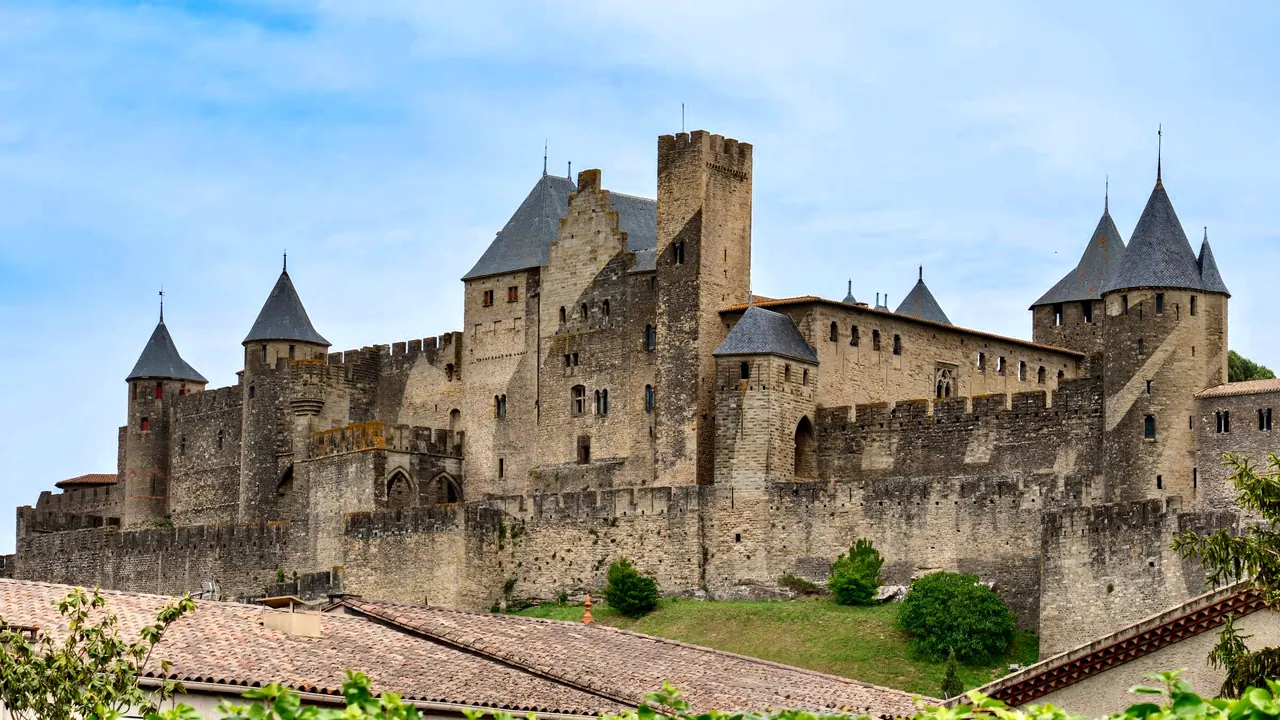
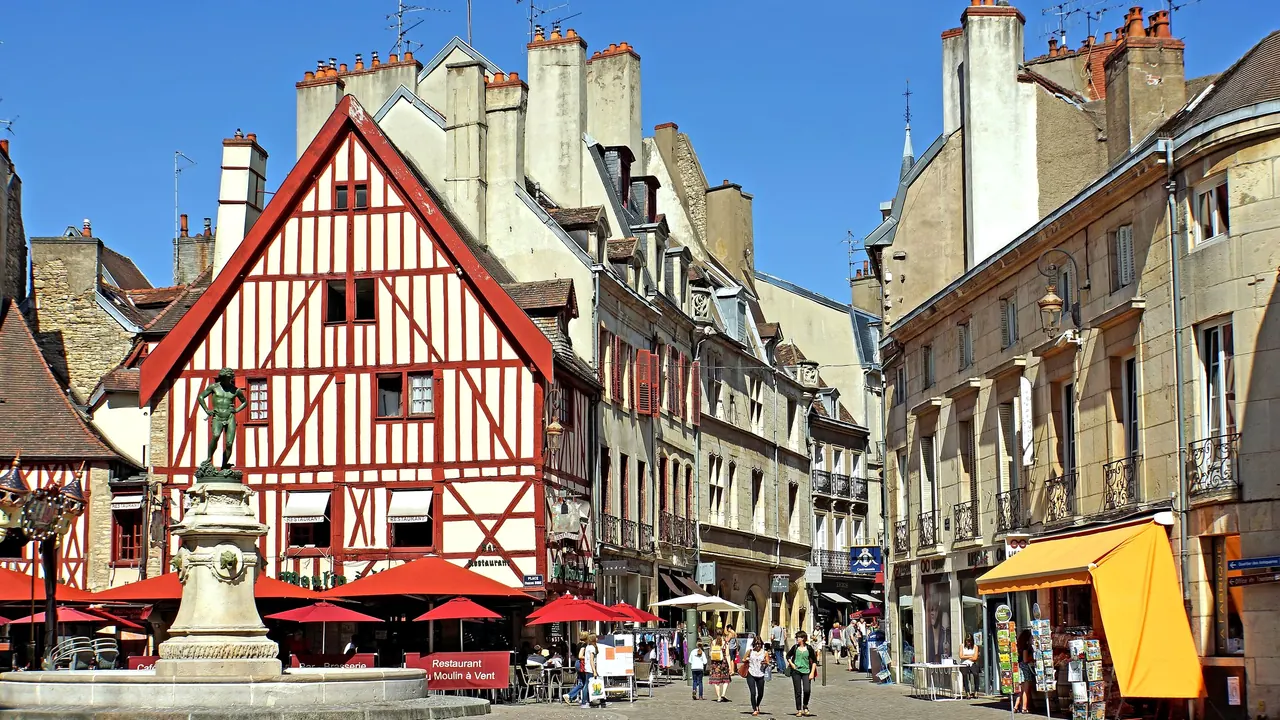
Photos: Carcassonne by Susanne Jutzeler, suju-foto, Pexels License; Dijon by Dennis G. Jarvis, CC BY-SA 2.0, cropped.
Carcassonne or Dijon?
Our verdict in twelve categories, each scored against the same fixed benchmark cities, and the climate month by month, so you can choose for your trip.
Choose Carcassonne for
- beaches
- families
- nature and the outdoors
Carcassonne suits travellers who want one unforgettable sight and wild country around it. The walled Cité is a sight that families and first-time visitors to the south never forget, and the Cathar castles on their ridges, the Corbières hills and the gorges towards the Pyrenees give it rougher, sunnier scenery. It is also within reach of the Mediterranean for a beach day. Come for the castle and the landscape, and expect quiet evenings and simple southern cooking.
Choose Dijon for
- food and drink
- getting around
- shopping
Dijon is the better choice if the trip is about eating, drinking and an easy city to live in for a few days. Its market hall, Burgundian cooking and village wines by the glass are far ahead of anything in Carcassonne, and a compact pedestrian centre, trams, fast trains and an opera house make it a more complete city. The Côte de Nuits starts at the edge of town. It is cooler and greyer, and has no coast within reach.
Scoreboard
Twelve categories on one fixed scale from 0 to 100. The shaded stretch is the gap between the two.
Your match
Pick a travel style or drag the sliders, and both match scores follow your weighting.
Wins on beaches and families with your weighting.
Wins on food and drink and getting around with your weighting.
What matters to you?
Category by category
What the scores mean for a trip.
Beaches & swimming
Neither city is a beach destination, but Carcassonne gets you much closer to a swim. The Lac de la Cavayère, a short drive from the Cité, has sandy shores, lifeguards and warm water in high summer. The long sandy beaches of Gruissan and Narbonne-Plage are about an hour away, with the sea near 23°C in August.
Dijon is several hours from any coast. Lac Kir, with its lawns and a small sandy strip, is a place for a hot afternoon's paddle rather than a reason to travel.
Food & drink
Dijon is the stronger table by a wide margin. Boeuf bourguignon, jambon persillé, snails and Époisses fill its bistros, Les Halles is a proper working market, and the Côte de Nuits starts at the city's edge, so you can drink fine village wines by the glass. There is also a serious fine-dining tier for a special evening.
Carcassonne is simpler: cassoulet, Corbières and Minervois reds and cheap blanquette de Limoux. You need to eat down in the Bastide around Place Carnot, because set menus inside the Cité are uneven. Both stay firmly regional, but Burgundy simply offers more to explore.
Culture & sights
The two are broadly level, but the experience is very different. Carcassonne's culture is one overwhelming sight: the double walls and fifty-two towers of La Cité, the ramparts of the Château Comtal and the stained glass of Saint-Nazaire. The grid of the Bastide and the Canal du Midi lie below, and museums are few.
Dijon spreads its interest through a whole townscape. It has the ducal palace with its fine-arts museum and the mourner-ringed Valois tombs, along with streets of half-timbered houses, the gargoyles and lucky owl of Notre-Dame, and Sluter's Well of Moses at Champmol. Carcassonne is the bigger spectacle, while Dijon has more to see indoors.
Nightlife
Dijon has the livelier evenings, thanks largely to its university. Rue Berbisey's small bars and the terraces of Place Émile Zola stay busy into the night in term time, though the scene is about wine and beer more than clubs.
Carcassonne winds down early. The draw after dark is a stroll on the floodlit walls once the day crowds have left, then a drink around Place Carnot. Anyone wanting a late night drives to Toulouse.
Nature & outdoors
Carcassonne has the slightly wilder country around it. The forests of the Montagne Noire, the garrigue of the Corbières with ruined castles on its ridges, and the gorges of Galamus and the upper Aude lead into the Pyrenean foothills, with rafting in summer.
Dijon's surroundings are gentler. You can walk and climb in the limestone combes just west of town, cycle through the vineyards to Beaune or head to the granite hills of the Morvan. Both have a flat canal towpath for easy cycling, the Canal du Midi in one and the Burgundy Canal in the other.
Day trips
From Carcassonne you drive out to Cathar ruins on bare southern ridges; from Dijon you head into grand cru villages and Cistercian valleys. Peyrepertuse and Quéribus cling to their limestone crests, the four ruined towers of Lastours are closer to town, and Minerve above its gorges and the abbey at Lagrasse are worth a slow drive. Toulouse and Roman Narbonne are easy by train, and Collioure on the coast and Albi's brick cathedral make longer days.
Burgundy's outings start at Dijon's edge. Beaune, with the glazed tile roof of the Hospices, is twenty minutes by train, and Vauban's citadel at Besançon is about an hour. The Route des Grands Crus through Gevrey-Chambertin and past the château at Vougeot is best done by car, bike or a small tour. So is a day pairing Fontenay Abbey with the ramparts of Semur-en-Auxois and the battlefield at Alésia.
Good for families
Carcassonne gives children far more. A real castle with drawbridges and ramparts, summer jousting and falconry, a supervised lake beach with a water park, and kangaroos at the animal park fill several days. The catch is a steep, cobbled Cité that is hot and crowded in high summer.
Dijon is calm, safe and largely pedestrian, and the planetarium at the Jardin de l'Arquebuse and the lawns of the Parc de la Colombière help. Even so, wine tastings and fine-art galleries are aimed at parents, not their children.
Getting around
Dijon is much easier to get around. The station, market, palace and cathedral are a few minutes apart on foot, trams cover the outskirts, regional trains run along the wine route and the TGV links it to Paris.
Carcassonne's flat Bastide is walkable, but the Cité is a steady twenty-five minute climb across the Pont Vieux. Away from the Toulouse and Narbonne line, the castles and villages are hard to reach without a car.
Shopping & style
Neither is a shopping destination, and in both the best buys are edible, but Dijon gives you more. Mustard in dozens of flavours, cassis, pain d'épices and wine merchants line its streets, and Rue de la Liberté adds a department store, boutiques and antique shops in the side lanes.
Carcassonne's Cité is mostly plastic swords and Cathar trinkets. The things worth carrying home are tinned cassoulet, Limoux blanquette and produce from the Place Carnot market.
Affordability
Costs are much the same, both well below Paris, but the bill climbs for different reasons. In Carcassonne the premium is for sleeping or eating inside the walls, for the summer price jump and for the hire car you will probably need. Base yourself in the Bastide in spring or autumn and it stays easy on the budget.
In Dijon, rooms and a glass of wine are modest. The costs come from what draws people there: serious restaurants, cellar tastings, wine tours and good bottles.
Live music & performing arts
Dijon has the fuller programme, and it runs through most of the year. The Opéra de Dijon stages work in the nineteenth-century Grand Théâtre and the acoustically fine Auditorium, alongside a national drama centre and a venue for touring bands.
Carcassonne's moment is July. Concerts and theatre fill the open-air theatre inside the Cité walls, and Bastille Day ends with fireworks over the ramparts. Outside summer, its stage life is thin, so the two cities are at their best in opposite seasons.
Wellness & relaxation
Neither has a spa culture, so rest in both comes from the slow pace. Carcassonne has a small extra: the old thermal villages of Rennes-les-Bains and Alet-les-Bains are within an hour in the upper Aude. Its calm also disappears in the July and August crowds.
Dijon's version is long lunches, quiet squares and afternoons in the vineyards, with a few wine-village hotels offering grape-based treatments. It stays unhurried right through the year.
When should you go?
Pick your month. The climate figures are measured averages, not a forecast.
Carcassonne in July
Dijon in July
Daytime high, °C
Rainfall in the month, mm
Where the figures come from
Carcassonne has no rain gauge within 25 km of the centre, so its rainfall comes from a gridded climate dataset read at the city rather than from a gauge further away.
Carcassonne's sunshine is measured 68 km from the centre, at Perpignan.
Temperature and rainfall are climate normals, averaged over the years shown. Carcassonne: 1999-2020 (sunshine 1991-2020, rainfall 1991-2020) normals, Carcassonne (2.8 km from centre). Dijon: 1991-2020 normals, Dijon (7 km from centre).
Carcassonne is the warmer and sunnier of the two all year. Its summers are hot and dry, with July around 29°C and only about 22mm of rain. That is the time for the Lac de la Cavayère and a day on the coast, though midday on the ramparts is hard work. May, June and September are the best months for walking the walls and the hills. October and November bring the wettest weather, and winter is mild but grey.
Dijon runs several degrees cooler, with a gentler summer that is better for long walks through the vineyards, but rain stays steady from May through November rather than easing off. Winters are properly cold, around 6°C, and short on sunshine, so the city is at its best from May to September. Late spring and early autumn are the pleasant shoulder months.
Which traveller are you?
On a food and nightlife trip, Dijon is the clear pick. It has Les Halles, Burgundian classics, wine bars pouring village Burgundies and the student bars of Rue Berbisey. Carcassonne offers cassoulet and good cheap wine, but its evenings go quiet early.
On a family trip with children, Carcassonne wins. The Cité is a real castle to explore, with jousting and falconry in summer, and the lake has a supervised beach, a water park and an animal park nearby. Dijon is safe and easy but has little built for children.
For a short city break, Dijon is the easier choice. The station, market, palace and cathedral are a few minutes apart on foot, the TGV comes from Paris and Beaune is a short train ride away. Carcassonne's best excursions mostly need a car.
Before you go
| Measure | Carcassonne | Dijon |
|---|---|---|
| Official language | French | French |
| Currency | Euro (EUR) | Euro (EUR) |
| Sockets | CE230 V, 50 Hz | CE230 V, 50 Hz |
| Driving side | Right | Right |
| Time zone | UTC+1, UTC+2 in summer | UTC+1, UTC+2 in summer |
| Emergency number | 112 | 112 |
| Elevation | 81 m | 220 m |
| Main airport | Carcassonne Salvaza Airport (CCF)4 km from centre10 non-stop destinations | Lyon Saint-Exupéry Airport (LYS)178 km from centre141 non-stop destinations |
| Public holidays this year | 11 days | 11 days |
By the numbers
| Measure | Carcassonne | Dijon |
|---|---|---|
| City population | 46,080 | 161,830 |
| People per km² | 708 | 3,890 |
| Museums within 10 km | 6 | 8 |
| UNESCO World Heritage sites within 50 km | 2 | 1 |
Where else could you go?
Every comparison below shares a destination with this one, so you can follow Carcassonne or Dijon somewhere new.
- Toulousevs Carcassonne
- Montpelliervs Carcassonne
- Gironavs Carcassonne
- Lausannevs Dijon
- Genevavs Dijon
- Lyonvs Dijon