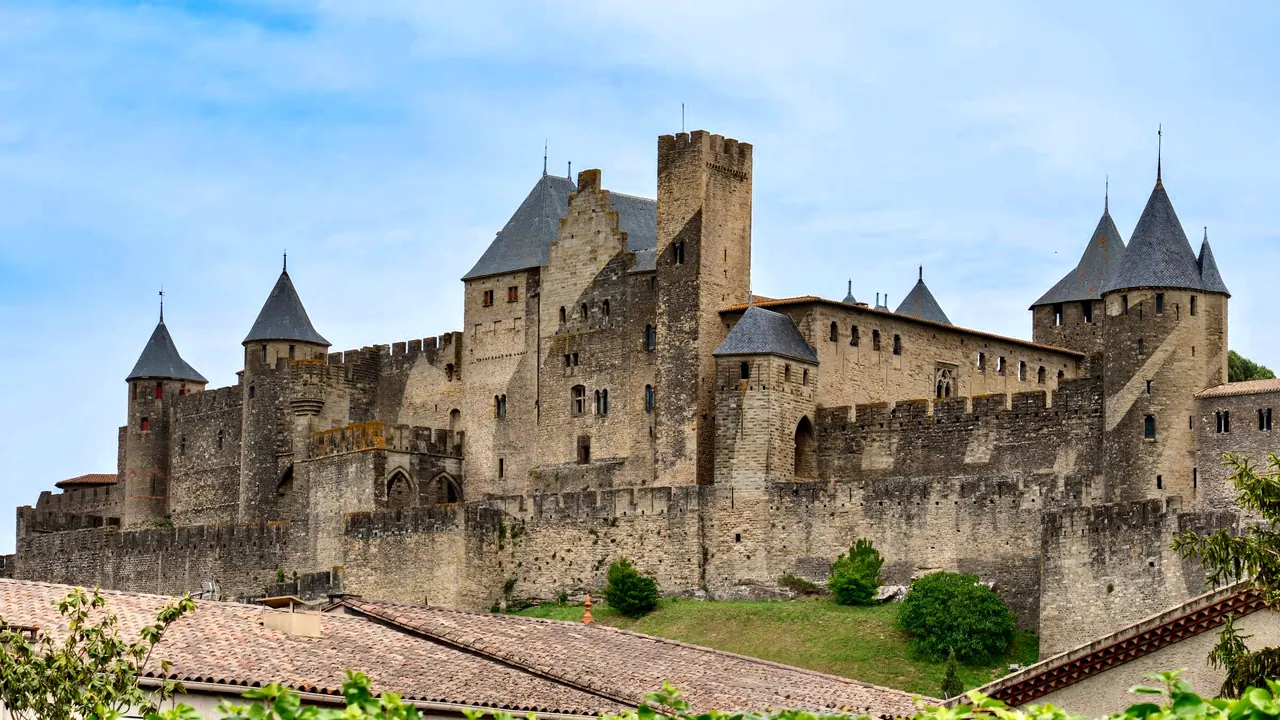
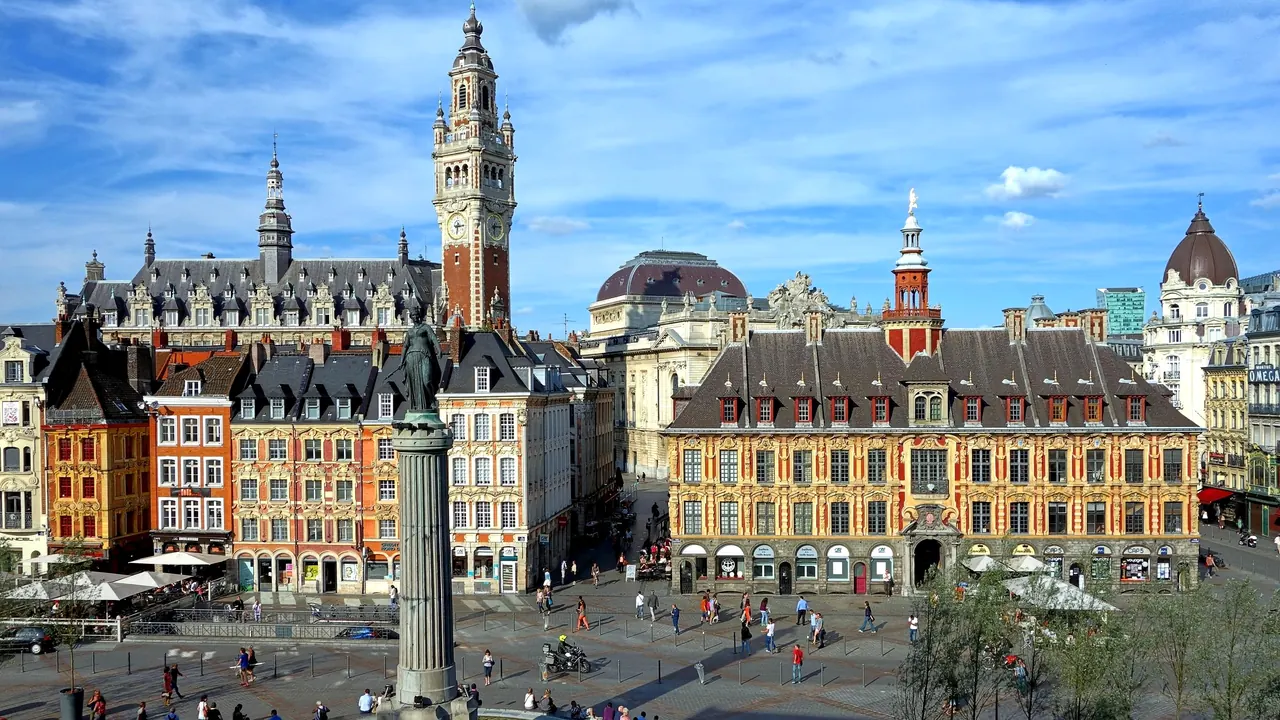
Photos: Carcassonne by Susanne Jutzeler, suju-foto, Pexels License; Lille by Velvet, CC BY-SA 3.0, cropped.
Carcassonne or Lille?
Our verdict in twelve categories, each scored against the same fixed benchmark cities, and the climate month by month, so you can choose for your trip.
Choose Carcassonne for
- nature and the outdoors
- beaches
- prices
Carcassonne suits a slower, sunnier trip built around history and landscape. You get the walled Cité and the Canal du Midi on foot, then a hire car out to the Cathar castles, the Corbières vineyards and the gorges of the upper Aude. It costs a little less, and it is for travellers who are content with quiet evenings and a glass of local wine on a terrace.
Choose Lille for
- nightlife
- shopping
- getting around
Lille is the better pick for anyone who wants a real city. It has livelier bars, better shopping, hearty Flemish food and a metro. Its two stations sit beside the old town, so Brussels, Bruges and Paris are easy days out by train. The weather is cooler and greyer, but a major art museum and the warm estaminets of Vieux-Lille make a wet day easy to fill.
Scoreboard
Twelve categories on one fixed scale from 0 to 100. The shaded stretch is the gap between the two.
Your match
Pick a travel style or drag the sliders, and both match scores follow your weighting.
Wins on nature and the outdoors and beaches with your weighting.
Wins on nightlife and shopping with your weighting.
What matters to you?
Category by category
What the scores mean for a trip.
Beaches & swimming
Neither city is a beach base, but Carcassonne comes closer. The Lac de la Cavayère, a short drive from the Cité, has sandy shores, lifeguards in summer and warm water for a proper swim. The long, shallow Mediterranean beaches at Gruissan and Narbonne-Plage are about an hour away by car.
From Lille, the nearest sand is Malo-les-Bains at Dunkirk, an hour by train. The North Sea there is windy and seldom warmer than about 17°C, which makes it a bracing walk rather than a swim.
Food & drink
Carcassonne's cooking is narrow and southern: cassoulet on almost every menu, solid bistros and a few ambitious kitchens. Its real strength is in the glass, with Corbières, Minervois and Limoux blanquette poured cheaply everywhere. Eat down in the Bastide around Place Carnot, not inside the Cité walls.
Lille gives you more to explore. Its wood-panelled estaminets serve beer-braised carbonnade, potjevleesch and waterzooi, Maroilles cheese turns up in everything, and specialist beer bars are part of the evening. The Sunday market at Wazemmes adds a multi-ethnic mix that Carcassonne lacks.
Culture & sights
These two are close on culture, but their sights are very different. Carcassonne is all about one monument: the double-walled Cité with its fifty-two towers, the Château Comtal ramparts and the Gothic glass of Saint-Nazaire, with the Bastide's grid streets and the Canal du Midi below. Its museums are few and small.
Lille is a city of art and townscape. The Palais des Beaux-Arts holds Flemish masters and Goya, and the Flemish baroque of the Vieille Bourse and Grand Place is all around. La Piscine and the LaM are a metro or tram ride out. Come to Carcassonne for one great sight, and to Lille for galleries and streets.
Nightlife
Lille is far livelier after dark. Student bars along Rue Masséna and Rue Solférino are packed on Thursday nights, and Vieux-Lille has beer cafés and cocktail bars in brick cellars for an older crowd. Real clubbing traditionally means a short hop into Belgium.
In Carcassonne, the evening means a floodlit walk on the empty walls, then a drink at a café around Place Carnot. Anyone wanting a late night has to travel to Toulouse or Montpellier.
Nature & outdoors
Carcassonne has far more varied country on its doorstep. The beech and chestnut forest of the Montagne Noire lies to the north and the dry Corbières hills with their ruined castles to the south, and the Aude valley climbs into the Pyrenean foothills. The plane-shaded canal towpath is the easy option, but most of the rest needs a car.
Around Lille, French Flanders is flat and farmed. The Citadel park, the Deûle towpaths and the low Monts de Flandre are pleasant for a gentle afternoon. The chalk cliffs of Cap Blanc-Nez on the Opal Coast are the only real scenery, and they take a long day.
Day trips
Both cities make good bases, but Lille's rail links put it ahead. Brussels is about half an hour away by fast train and Paris about an hour, and Ghent, Bruges, Antwerp and even London are within reach without a car. Arras, Amiens cathedral, the Louvre-Lens and the First World War battlefields fill more days on the French side.
Carcassonne's outings are more rural and more scenic. You can visit the Cathar castles of Peyrepertuse and Quéribus, the abbey village of Lagrasse, Minerve on its rock, and wine estates in the Corbières and Minervois. Toulouse and Narbonne are easy by train, but most of the rest needs a hire car.
Good for families
The two are about equal for families, but the days look different. In Carcassonne, the castle itself is the treat, with ramparts to walk and jousting and falconry in summer, and the lake adds a supervised beach and a water park. The catch is the summer heat and crowds on the steep cobbles.
Lille is easier in poor weather. It has the Citadel zoo and playgrounds, a natural history museum and a hands-on science centre reached by metro. Its biggest draws, Pairi Daiza and the Nausicaá aquarium, are day trips.
Getting around
Lille is much easier to get around. Its flat centre is walkable, the two main stations stand beside the old town, and the automated VAL metro and the tram reach Roubaix and Tourcoing. A car would only be a burden.
Carcassonne's town is simple enough on foot: a flat Bastide, then a steady climb over the Pont Vieux to the Cité. Once you leave town, though, the castles and villages are poorly served by buses and trains, so a car or a tour becomes essential.
Shopping & style
Carcassonne's shopping comes in two halves, and neither is a reason to come. The lanes of the Cité sell souvenirs to the day crowds: plastic swords, knight costumes and Cathar trinkets, plus the odd shop with nougat and soaps. Down in the Bastide, Rue de Verdun and Rue Georges Clemenceau make a small provincial high street. It is fine for picking up something you forgot to pack, and not much more.
Lille is a regional capital, and its shops can fill a whole afternoon rather than half an hour. The pedestrian Rue de Béthune is the main street for well-known brands, and the city has a few luxury labels, which Carcassonne has none of. On Sundays the Wazemmes market goes beyond food into clothes and bric-a-brac, which makes for a cheerful rummage with nothing like it in the southern town.
Affordability
Carcassonne is the cheaper stay, as long as you sleep and eat in the Bastide rather than inside the walls. Local wine and lunchtime set menus are good value, and spring and autumn are noticeably cheaper. Car hire is the cost that catches people out.
In Lille, prices are those of urban France, comfortable rather than cheap. Transport costs little, since the metro is inexpensive and you need no car. Hotel rates climb during the Braderie and the big trade fairs.
Live music & performing arts
Lille has a full season all year: opera and dance at the Opéra on Place du Théâtre, a national orchestra, the Théâtre du Nord, and touring bands at the Zénith and the Aéronef.
Carcassonne's arts life is mostly packed into July. The Festival de Carcassonne puts headline acts on the open-air stage inside the Cité walls, which is a memorable setting, and Bastille Day brings fireworks over the ramparts. For the rest of the year there is little beyond the municipal theatre.
Wellness & relaxation
Neither city is a place to come for spas, though Carcassonne is slightly more restful. Outside high summer it offers long lunches, canal walks under the plane trees and quiet evenings on the walls. The small thermal villages of Rennes-les-Bains and Alet-les-Bains are within an hour by car.
Lille's calm is more indoors: tea rooms, café terraces in Vieux-Lille and hotel spas. For thermal water there is a short train ride to Saint-Amand-les-Eaux.
When should you go?
Pick your month. The climate figures are measured averages, not a forecast.
Carcassonne in July
Lille in July
Daytime high, °C
Rainfall in the month, mm
Where the figures come from
Carcassonne has no rain gauge within 25 km of the centre, so its rainfall comes from a gridded climate dataset read at the city rather than from a gauge further away.
Carcassonne's sunshine is measured 68 km from the centre, at Perpignan.
Temperature and rainfall are climate normals, averaged over the years shown. Carcassonne: 1999-2020 (sunshine 1991-2020, rainfall 1991-2020) normals, Carcassonne (2.8 km from centre). Lille: 1991-2020 normals, Lille (7.8 km from centre).
Carcassonne is much the warmer and sunnier of the two. From June to September it is warm enough for swimming at the lake or on the coast, with highs near 29°C in July and August. July is also the driest month, at about 22mm. Midday heat makes the steep Cité hard work in high summer, so May, June and September are the best months for walking the town and the hills. The rain returns in October and November, and winters are mild but often grey.
Lille never gets hot. Summer highs are around 24°C, which is comfortable for walking the streets all day, but summer is not its dry season: July and August bring about 69mm each, more than three times Carcassonne's July. From November to January the days are short and dull, with far less sunshine than in the south. Late spring and early autumn are the most reliable months for a visit.
Which traveller are you?
For an outdoors trip, Carcassonne is the clear choice. The Montagne Noire forests, the garrigue and castle ridges of the Corbières, and rafting in the Aude gorges are all close by. Lille's flat Flemish farmland offers little beyond canal towpaths and gentle hills.
For a food and nightlife trip, choose Lille. Estaminets serve carbonnade and welsh, Belgian ales flow in cellar bars, and a big student population keeps Rue Masséna busy. Carcassonne has cassoulet and good wine, but its evenings wind down early.
For a shopping trip, Lille wins easily. Vieux-Lille has independent fashion, design shops and delicatessens, the main streets and Euralille cover the chains, and in early September the Braderie fills the city. In Carcassonne the best things to buy are wine and tinned cassoulet.
Before you go
| Measure | Carcassonne | Lille |
|---|---|---|
| Official language | French | French |
| Currency | Euro (EUR) | Euro (EUR) |
| Sockets | CE230 V, 50 Hz | CE230 V, 50 Hz |
| Driving side | Right | Right |
| Time zone | UTC+1, UTC+2 in summer | UTC+1, UTC+2 in summer |
| Emergency number | 112 | 112 |
| Elevation | 81 m | 17 m |
| Main airport | Carcassonne Salvaza Airport (CCF)4 km from centre10 non-stop destinations | Lille Airport (LIL)8 km from centre61 non-stop destinations |
| Public holidays this year | 11 days | 11 days |
By the numbers
| Measure | Carcassonne | Lille |
|---|---|---|
| City population | 46,080 | 238,246 |
| People per km² | 708 | 6,846 |
| Museums within 10 km | 6 | 23 |
| UNESCO World Heritage sites within 50 km | 2 | 6 |
Where else could you go?
Every comparison below shares a destination with this one, so you can follow Carcassonne or Lille somewhere new.
- Brugesvs Lille
- Ghentvs Lille
- Toulousevs Carcassonne
- Brusselsvs Lille
- Antwerpvs Lille
- Montpelliervs Carcassonne