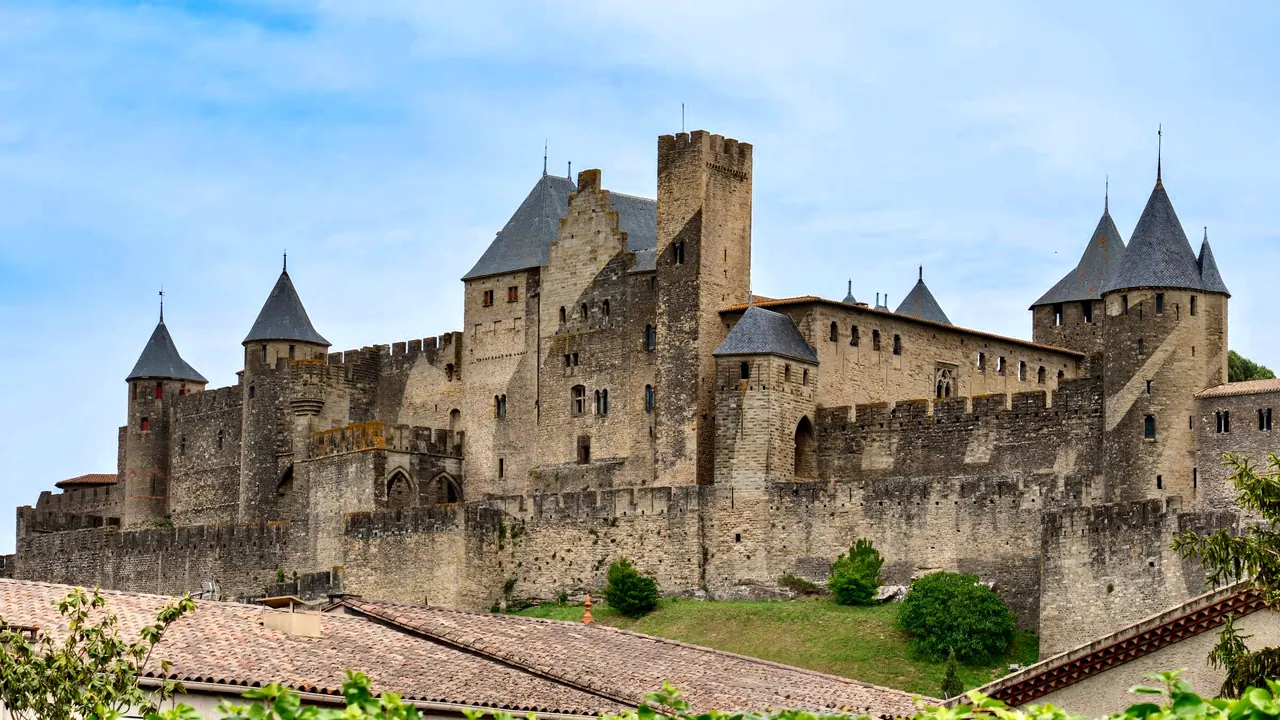
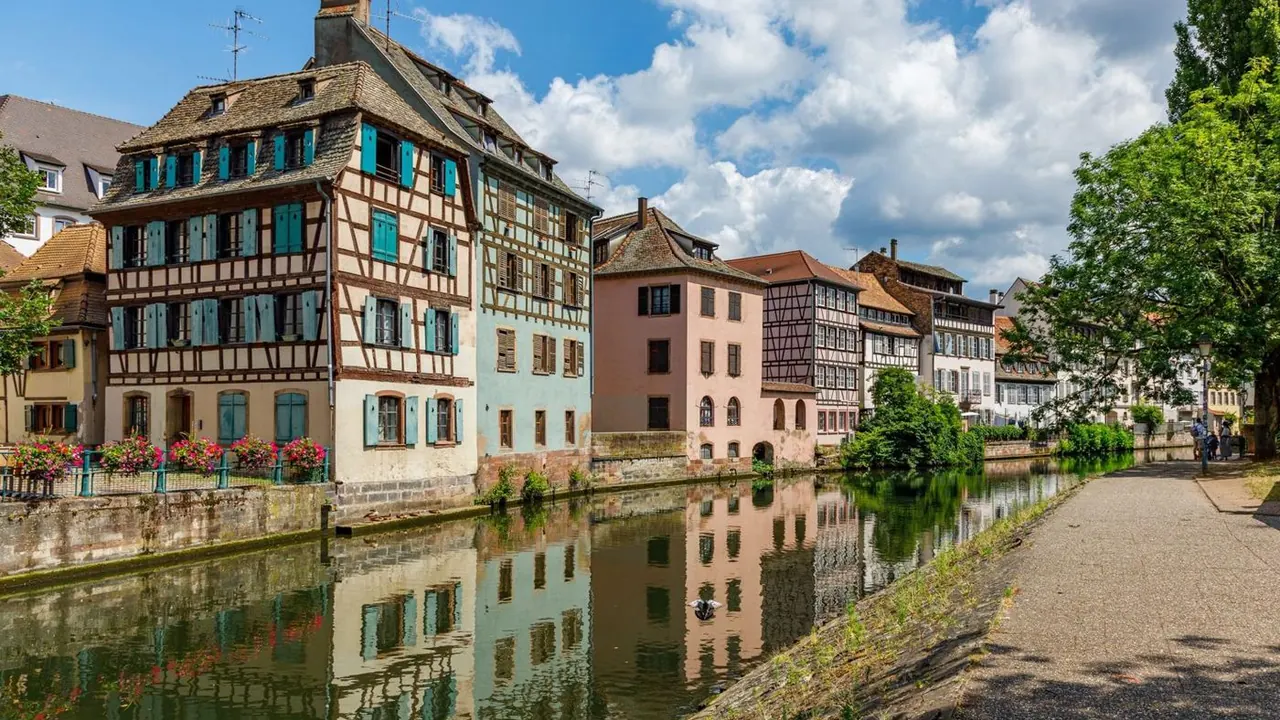
Photos: Carcassonne by Susanne Jutzeler, suju-foto, Pexels License; Strasbourg by Edoardo Colombo, Pexels License.
Carcassonne or Strasbourg?
Our verdict in twelve categories, each scored against the same fixed benchmark cities, and the climate month by month, so you can choose for your trip.
Choose Carcassonne for
- beaches
- prices
Carcassonne is the trip for travellers who want one unforgettable sight and a sunny, slow-paced region around it. The walled Cité gives the visit its drama, the Cathar castles and wine villages fill the days after, and Mediterranean beaches and a swimming lake are close enough for hot afternoons. It costs less, its summers are drier and brighter, and it suits people happy to hire a car and leave the city behind.
Choose Strasbourg for
- getting around
- shopping
- live music and the arts
Strasbourg is better for anyone who wants a proper small city rather than a monument town. You get a cathedral quarter and several serious museums, opera and theatre, livelier student bars and richer, more varied cooking, all in a flat centre you can cover on foot, by tram or by bike. It is easier with children and without a car, and Germany, the Vosges and the Alsace wine route are all within reach.
Scoreboard
Twelve categories on one fixed scale from 0 to 100. The shaded stretch is the gap between the two.
Your match
Pick a travel style or drag the sliders, and both match scores follow your weighting.
Wins on beaches and prices with your weighting.
Wins on getting around and shopping with your weighting.
What matters to you?
Category by category
What the scores mean for a trip.
Beaches & swimming
Neither city is on the coast, but Carcassonne is far closer to real swimming. The Lac de la Cavayère, a short drive from the Cité, has sandy shores and lifeguards. The long, shallow beaches of Gruissan and Narbonne-Plage are about an hour away, which makes a Mediterranean day out easy.
Strasbourg has no sea within reach. Locals cool off in old gravel-pit lakes such as the Baggersee, which you can reach by tram, lying out on grassy banks beside calm fresh water. They are pleasant on a hot afternoon, but the Rhine itself is not for swimming.
Food & drink
Strasbourg eats better and more widely. In the wood-panelled winstubs you can have choucroute, baeckeoffe or tarte flambée with a pichet of Riesling, and the city and nearby villages also have a strong fine-dining tier, good markets and plenty of local beer.
Carcassonne's table rests mainly on cassoulet and excellent cheap wine from Corbières, Minervois and Limoux. Range is narrow beyond southern French bistro cooking. Both cities have a tourist trap around their main sight, and in Carcassonne the better meals are down in the Bastide around Place Carnot.
Culture & sights
Carcassonne has one great set piece: the double-walled Cité with its fifty-two towers, the Château Comtal and the stained glass of Saint-Nazaire. Below it, the Bastide grid town and the Canal du Midi round out the visit, but there are few museums to fill a wet afternoon.
Strasbourg has more depth. The pink sandstone cathedral with its astronomical clock, the timber-framed lanes of the Grande Ile and Petite France, and the imperial Neustadt make a full townscape. The Palais Rohan, the Oeuvre Notre-Dame and the modern art museum add collections that Carcassonne cannot match.
Nightlife
Neither city is made for late nights, but Strasbourg has more going on after dark. Its large student population keeps the bars and beer cellars of the Krutenau and Place Saint-Étienne busy, and in summer the riverside terraces stay full well into the evening.
Carcassonne's evenings are quieter. You walk the floodlit walls once the day visitors have gone, then have a drink on a terrace on Place Carnot, and people wanting a real night out drive to Toulouse or Montpellier.
Nature & outdoors
There is about as much outdoors around each city, but the landscapes differ. Around Carcassonne it is dry and southern: garrigue hills crowned with Cathar ruins, the beech woods of the Montagne Noire, and gorges in the upper Aude where you can raft in summer. Nearly all of it needs a car.
Strasbourg's outdoors starts at the edge of town, with flat cycle routes along the Rhine and riverside forests where storks and beavers live. Within an hour are the fir-covered Vosges and the Black Forest, with some snow on the higher ground in winter and trains to the main trailheads.
Day trips
Both are excellent bases for day trips. Carcassonne's are mostly rural: the cliff-top castles of Peyrepertuse and Quéribus, villages such as Minerve and Lagrasse, and wine estates, with Toulouse and Narbonne the easy rail trips.
Strasbourg's are more varied and easier to reach by train. Colmar is half an hour away, Freiburg, Baden-Baden and Basel are across the border, and the Alsace wine route with Riquewihr and Haut-Koenigsbourg runs between them.
Good for families
Carcassonne has the more thrilling single sight for children. The Cité looks like a storybook castle, with jousting and falconry in summer, and the lake with its water park fills the rest of the time. Against that, the cobbles are steep, the summer crowds are thick, and you will be pushing a pushchair uphill in midday heat.
Strasbourg is easier day to day. The centre is flat and largely car-free, and children have boat trips, the stork-filled Orangerie and the hands-on Le Vaisseau science centre. Europa-Park is about an hour away across the border.
Getting around
In Strasbourg you will not need a car. The island centre is walkable and largely pedestrianised, and trams run to the station, the European quarter and over the Rhine to Kehl. A dense network of separate cycle lanes often makes a bike the quickest option.
Carcassonne's flat Bastide is easy on foot, but the Cité means a steady uphill walk or the seasonal shuttle. Beyond the Toulouse and Narbonne rail lines, the castles and villages are poorly served by public transport, so you will probably end up hiring a car.
Shopping & style
Strasbourg has proper shopping streets around Place Kléber and the Rue des Grandes Arcades, a department store, bookshops and delicatessens. Soufflenheim pottery and Alsatian linens make good souvenirs, and the old Christmas market turns December into the season for crafts.
Carcassonne's Cité is lined with toy swords and Cathar trinkets, and the Bastide has an ordinary provincial high street. The things worth bringing home are edible: tinned cassoulet, blanquette and wine from the Place Carnot market.
Affordability
Carcassonne is the cheaper stay. It is priced like a provincial southern town, and you can walk everywhere, with the walled Cité's hotels and restaurants as the expensive exception. Spring and autumn cost much less than July and August, and car hire is the cost most visitors add.
Strasbourg costs what a large regional city does. Meals in the winstubs and getting around by tram are fair, and the cathedral and old streets are free. Hotels are the main expense, and rates jump during the Christmas market and the sitting weeks of the European Parliament.
Live music & performing arts
Strasbourg has a year-round calendar that Carcassonne cannot match. The Opéra national du Rhin plays on Place Broglie, a full philharmonic season and the Théâtre National de Strasbourg fill the winter, and the autumn Musica festival is devoted to contemporary music.
Carcassonne's big moment is July, when the Festival de Carcassonne brings headline acts to the open-air theatre inside the walls, and Bastille Day brings fireworks over the ramparts. Outside summer there is little beyond the municipal theatre.
Wellness & relaxation
Strasbourg has its own bathing tradition in the Bains municipaux, an early twentieth-century bathhouse with tiled pools, a hammam and saunas. The grand thermal baths of Baden-Baden are less than an hour away.
Carcassonne's nearest springs are small spa villages in the upper Aude, such as Alet-les-Bains, which are modest and local. Its calm comes instead from slow lunches and shaded walks along the canal, at least outside the crowded summer months.
When should you go?
Pick your month. The climate figures are measured averages, not a forecast.
Carcassonne in July
Strasbourg in July
Daytime high, °C
Rainfall in the month, mm
Where the figures come from
Carcassonne has no rain gauge within 25 km of the centre, so its rainfall comes from a gridded climate dataset read at the city rather than from a gauge further away.
Carcassonne's sunshine is measured 68 km from the centre, at Perpignan.
Temperature and rainfall are climate normals, averaged over the years shown. Carcassonne: 1999-2020 (sunshine 1991-2020, rainfall 1991-2020) normals, Carcassonne (2.8 km from centre). Strasbourg: 1991-2020 normals, Strasbourg (9.1 km from centre).
Carcassonne has the warmer and sunnier climate. June to September is properly hot, with July and August around 29°C, and July is the driest month at about 22mm, so this is the season for the lake and the coast. Midday on the ramparts can be tiring then, and May, June and September are kinder for walking. The rain comes mostly in autumn and winter, October being the wettest month, though winters stay mild enough for sightseeing in daylight.
Strasbourg is cooler and greyer for much of the year. Summer highs peak around 26°C, comfortable for walking and cycling, but late spring and summer are its wettest months, with May bringing about 77mm. Winters are cold, with January near 5°C, and very short of sunshine from November to January. May to September is the best time to visit, and that is also when Carcassonne is at its hottest.
Which traveller are you?
On a beach and sun trip, Carcassonne is the better choice. It has hotter, drier summers, a lifeguarded sandy lake beach just outside town and long Mediterranean beaches about an hour's drive away. Strasbourg only has gravel-pit lakes for a hot afternoon.
For a culture and arts trip, choose Strasbourg. Its cathedral, the Grande Ile and the Palais Rohan museums give you more to see than Carcassonne's single great fortress, and the opera, philharmonic and national theatre fill the evenings for most of the year.
On a trip on a tight budget, Carcassonne goes further. Rooms in the Bastide are moderately priced outside high summer, set lunches and local wine are cheap, and the town is small enough to walk everywhere, provided you stay outside the walls of the Cité.
Before you go
| Measure | Carcassonne | Strasbourg |
|---|---|---|
| Official language | French | French |
| Currency | Euro (EUR) | Euro (EUR) |
| Sockets | CE230 V, 50 Hz | CE230 V, 50 Hz |
| Driving side | Right | Right |
| Time zone | UTC+1, UTC+2 in summer | UTC+1, UTC+2 in summer |
| Emergency number | 112 | 112 |
| Elevation | 81 m | 132 m |
| Main airport | Carcassonne Salvaza Airport (CCF)4 km from centre10 non-stop destinations | Strasbourg Airport (SXB)10 km from centre43 non-stop destinations |
| Public holidays this year | 11 days | 11 days |
By the numbers
| Measure | Carcassonne | Strasbourg |
|---|---|---|
| City population | 46,080 | 293,771 |
| People per km² | 708 | 3,752 |
| Museums within 10 km | 6 | 21 |
| UNESCO World Heritage sites within 50 km | 2 | 3 |
Where else could you go?
Every comparison below shares a destination with this one, so you can follow Carcassonne or Strasbourg somewhere new.
- Baden-Badenvs Strasbourg
- Colmarvs Strasbourg
- Freiburgvs Strasbourg
- Toulousevs Carcassonne
- Stuttgartvs Strasbourg
- Baselvs Strasbourg