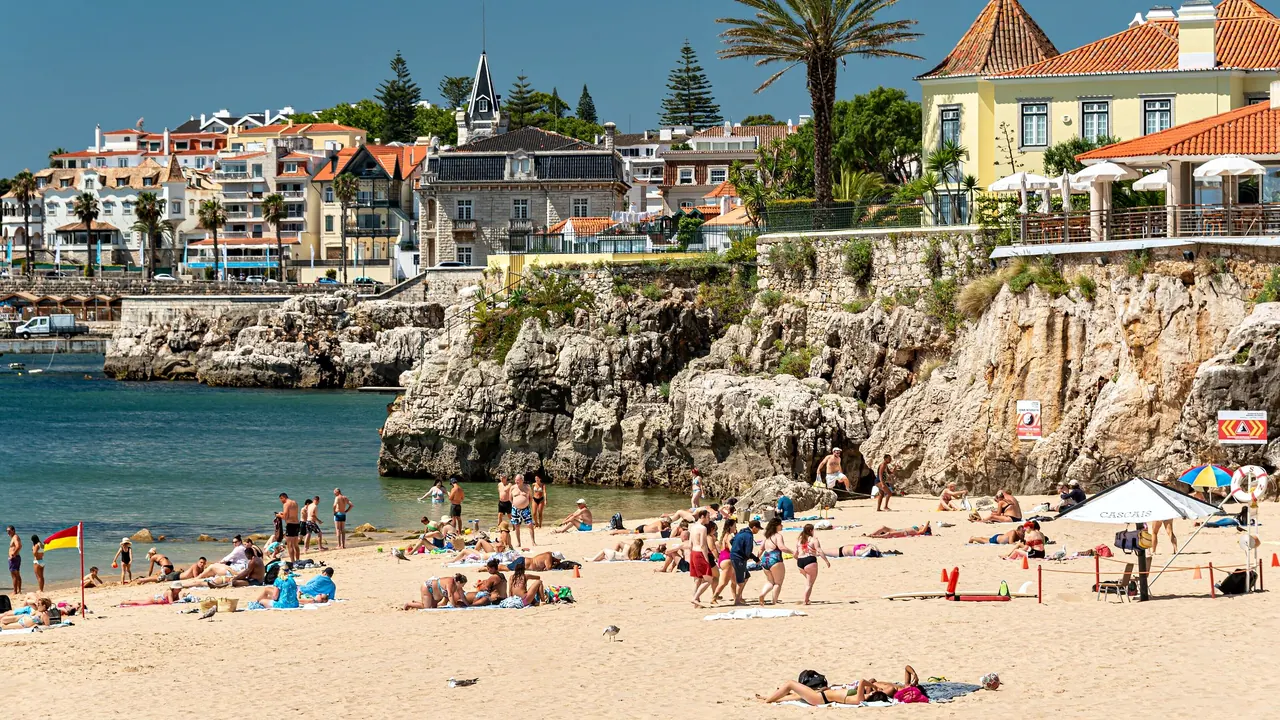

Photos: Cascais by Jorge Franganillo, CC BY 2.0, cropped; Salamanca by Jiuguang Wang, CC BY-SA 3.0 ES, cropped.
Cascais or Salamanca?
Our verdict in twelve categories, each scored against the same fixed benchmark cities, and the climate month by month, so you can choose for your trip.
Choose Cascais for
- beaches
- nature and the outdoors
- families
Cascais suits a vacation built around the coast. You can swim from a cove below the old town, cycle out to watch the surf at Guincho and walk the cliffs at Cabo da Roca, and the train runs into Lisbon whenever you want the capital. It is the better choice for families with small children and for anyone who wants sea air, outdoor days and a calm, well-kept resort. In return you accept resort prices and quiet evenings.
Choose Salamanca for
- culture and sights
- nightlife
- prices
Travellers after golden stone, late nights and a smaller bill should pick Salamanca. A few unhurried days are enough for its UNESCO old town, its two cathedrals and its ancient university. Students keep the tapas bars full until well after midnight, and eating and sleeping cost noticeably less. There is no sea, though, and the finest country around it is only easy to reach by car.
Scoreboard
Twelve categories on one fixed scale from 0 to 100. The shaded stretch is the gap between the two.
Your match
Pick a travel style or drag the sliders, and both match scores follow your weighting.
Too close to call, 1 point apart
Wins on beaches and nature and the outdoors with your weighting.
Wins on culture and sights and nightlife with your weighting.
What matters to you?
Category by category
What the scores mean for a trip.
Beaches & swimming
Cascais is a real beach town, and Salamanca is not one at all. In Cascais the coves of Conceição, Duquesa and Rainha are a short walk from the old streets, and Carcavelos, a broader beach with surf, is a few stops up the line. The Atlantic stays cool, so expect short, bracing swims rather than long lazy ones, and keep Guincho for watching the waves.
Salamanca is a long drive from any coast. In high summer the locals cool off in the city's open-air pools or at river beaches on the Tormes, which is fine for an afternoon but no reason to go.
Food & drink
Salamanca gives you more to eat your way through. You can spend an evening moving between bars around the Plaza Mayor and Calle Van Dyck, eating Guijuelo ham, hornazo and farinato, with Toro and Ribera del Duero wines and roast suckling pig for a proper meal. The student crowd keeps all of it informal and generous.
Cascais is the place for fish. Expect sardines and sea bream from the harbour, clams with coriander and long seafood lunches on the Guincho road, which is exactly what Salamanca lacks. Beyond the sea, though, the choice in Cascais thins out quickly, and serious eaters take the train into Lisbon for dinner.
Culture & sights
Salamanca is the clear choice for sightseeing. Its whole centre is a heritage site, and the Plateresque university façade, the Old and New Cathedrals, the Casa de las Conchas and the Roman bridge all sit within a few minutes of one another. Come back after dark, when the floodlit sandstone glows. Its museums are modest, apart from the Art Nouveau collection at Casa Lis.
Cascais offers a pleasant afternoon rather than a programme. You can see the royal-era seafront villas, the Citadel, the red towers of the Casa das Histórias Paula Rego and a turreted museum by a cove, and then the town sends you on to Lisbon or Sintra for anything grander.
Nightlife
Cascais keeps its evenings low-key. In July and August the pubs, wine bars and cocktail terraces in the narrow streets of the old centre fill with locals and visitors, and the Estoril casino offers a dressier night. Even in summer, though, the town is mostly quiet by midnight, and the rest of the year it winds down earlier still. For a proper night out you go into Lisbon and plan around the last train back, or take a taxi.
Salamanca is by far the livelier place after dark. From Thursday to Saturday, university and language-school students pack the bars around the Plaza Mayor, Calle Bordadores and Gran Vía, and the night carries on in dance bars and small clubs until the small hours. It is cheap and easy to join, but it is aimed at a young crowd and has little serious clubbing or polished cocktail bars. The two run on opposite calendars: Cascais is at its liveliest in high summer, and that is exactly when Salamanca empties out between terms.
Nature & outdoors
Cascais wins on landscape you can reach straight from town. A cycle path runs past Boca do Inferno and the dunes to Guincho's kitesurfing beach, cliff walks lead on to Cabo da Roca, and the misty forests of the Serra de Sintra rise just inland. The summer nortada suits sailors more than cyclists.
Salamanca's own surroundings are flat Meseta with riverside paths. The impressive country starts about an hour away: chestnut forests in the Sierra de Francia, peaks above 2,000m in Béjar and Gredos, and the granite gorge of the Arribes del Duero. You will need a car for all of it.
Day trips
Both towns make good bases, but Cascais has the easier and grander excursions. Lisbon is about 40 minutes away by coastal train, passing Belém on the way, and the palaces of Sintra are about half an hour over the ridge, so the two best outings need no car. Mafra, Ericeira and Óbidos fill further days.
From Salamanca, the trips are to quieter historic towns: walled Ávila, Romanesque Zamora, fortified Ciudad Rodrigo and Toro's wine country. Valladolid is an easy train ride. The hill villages such as La Alberca and Mogarraz are lovely, but they are hard to reach without your own wheels.
Good for families
Cascais is the easier place for young children. It has shallow coves on a calm bay, a flat promenade for scooters and pushchairs, and peacocks and a playground in the Marechal Carmona park. Neither town has a zoo or theme park, but from Cascais the Lisbon Oceanarium is a train ride away.
Salamanca works best as a stop of a day or two. Children enjoy hunting for the university frog and the cathedral astronaut and climbing the towers, and Spanish terraces welcome them late into the evening. Its hot summer afternoons and cold winters are harder on small travellers than the Cascais seafront.
Getting around
Cascais is pleasant on foot. The harbour, the coves and the old centre lie close together, and the seafront path carries on to Estoril. Its real asset is the coastal train, which runs along the shore straight into Lisbon. Beyond that, things slow down: buses to Guincho and over the Serra de Sintra are infrequent, and the hill roads fill up in summer.
Salamanca has the edge for getting around the place itself. Nearly everything you will want to see sits in one compact, largely pedestrian old town that you can cross in about 20 minutes, from the Plaza Mayor down to the Roman bridge, so you will rarely need a bus. Trains run to Madrid and Valladolid, but the hill villages and the Arribes del Duero are really car country. A few cobbled slopes in the centre call for care with a pushchair.
Shopping & style
Neither town is a shopping destination, and each points serious shoppers elsewhere, Lisbon in one case and anywhere bigger in the other. Cascais is good for surf brands, azulejo tiles, cork and tins of fish in handsome packaging.
Salamanca's best buys are edible, ibérico ham and cheese from the Mercado Central, along with charro silver filigree. High-street chains line Calle Toro and Calle Zamora.
Affordability
Salamanca is much kinder to the budget. Student demand keeps tapas and drinks cheap, often with a free tapa alongside, and there are plenty of simple guesthouses near the old town. The main extra costs are admission charges at the cathedrals and university, plus higher room prices at Easter and on festival weekends.
Cascais is an upmarket resort, and its seafront hotels and harbour restaurants are priced to match, especially in July and August. You can save by eating set lunches in the back streets and coming outside high summer.
Live music & performing arts
Salamanca has a little more going on. The Teatro Liceo and the municipal arts centre host touring theatre, dance and flamenco, and the university puts on choral concerts in its historic halls. The city's signature sound is the caped tunas singing under the Plaza Mayor arcades.
Cascais relies on the Teatro Experimental's Portuguese-language plays, cabaret at the Estoril casino and a summer jazz tradition. For opera or fado, both towns send you to a bigger city, Lisbon in the case of Cascais.
Wellness & relaxation
Both towns are restful rather than spa destinations, and Cascais has a slight edge. Estoril grew up as a thermal resort, and its thalassotherapy and hotel spas sit beside slow mornings on the seafront and yoga by the sea in summer.
Salamanca offers a different kind of calm: long lunches, a proper siesta and the quiet cloisters of San Esteban and Las Dueñas. For bathing there are Arab-style bath houses in town, the old balneario at Ledesma or a drive to the Roman-era springs at Baños de Montemayor.
When should you go?
Pick your month. The climate figures are measured averages, not a forecast.
Cascais in July
Salamanca in July
Daytime high, °C
Rainfall in the month, mm
Temperature and rainfall are climate normals, averaged over the years shown. Cascais: 1991-2020 normals, Lisboa / Geof (23.6 km from centre). Salamanca: 1991-2020 normals, Salamanca / Matacan (13.9 km from centre).
Cascais has a mild Atlantic climate. June to August are dry and very sunny, with highs around 28°C, which is the only real beach season. Even then the sea reaches just 19°C at most. Rain comes back in October and stays through January, with November the wettest month at 121mm. Winter days are still mild enough for walks along the promenade between showers, and May and September are pleasant months for the coast paths.
Salamanca is drier but much more extreme. July afternoons reach 31°C on the open plain, which makes sightseeing slow, and winter highs drop to around 9°C under clear, cold skies. Its best months are May and June, then late September and October, when walking the old town is comfortable. Midsummer favours Cascais by a wide margin, and winter is milder there too, although it is also wetter.
Which traveller are you?
On a beach and sun trip, choose Cascais. It has sandy coves right below the town, a promenade to Estoril and calm water in a south-facing bay. Salamanca sits far inland on the plain, and the best it can offer is a municipal pool or a river beach.
For a culture and arts trip, Salamanca is far richer. It has a UNESCO old town in glowing sandstone, one of Spain's finest baroque squares, a university among Europe's oldest, and two cathedrals side by side. Cascais has pretty villas and a Paula Rego museum, but most of its visitors go to Lisbon for major sights.
On a food and nightlife trip, Salamanca wins easily. Its tapas bars pour generous plates of ibérico ham, students fill the streets from Thursday to Saturday, and the dance bars stay open past 3am. Cascais offers fine grilled fish, but the town is largely asleep by midnight.
Before you go
| Measure | Cascais | Salamanca |
|---|---|---|
| Official language | Portuguese | Spanish |
| Currency | Euro (EUR) | Euro (EUR) |
| Sockets | CF230 V, 50 Hz | CF230 V, 50 Hz |
| Driving side | Right | Right |
| Time zone | UTC, UTC+1 in summer | UTC+1, UTC+2 in summer |
| Emergency number | 112 | 112 |
| Elevation | 0 m | 798 m |
| Main airport | Lisbon Humberto Delgado Airport (LIS)26 km from centre157 non-stop destinations | Adolfo Suárez Madrid–Barajas Airport (MAD)184 km from centre241 non-stop destinations |
| Public holidays this year | 14 days | 12 days |
By the numbers
| Measure | Cascais | Salamanca |
|---|---|---|
| City population | 214,124 | 146,110 |
| People per km² | 2,198 | 3,690 |
| Museums within 10 km | 6 | 13 |
| UNESCO World Heritage sites within 50 km | 3 | 1 |
| Swim season, months above 21 °C | None | - |
Where else could you go?
Every comparison below shares a destination with this one, so you can follow Cascais or Salamanca somewhere new.
- Sintravs Cascais
- Lisbonvs Cascais
- Segoviavs Salamanca
- Madridvs Salamanca
- Toledovs Salamanca
- Coimbravs Cascais