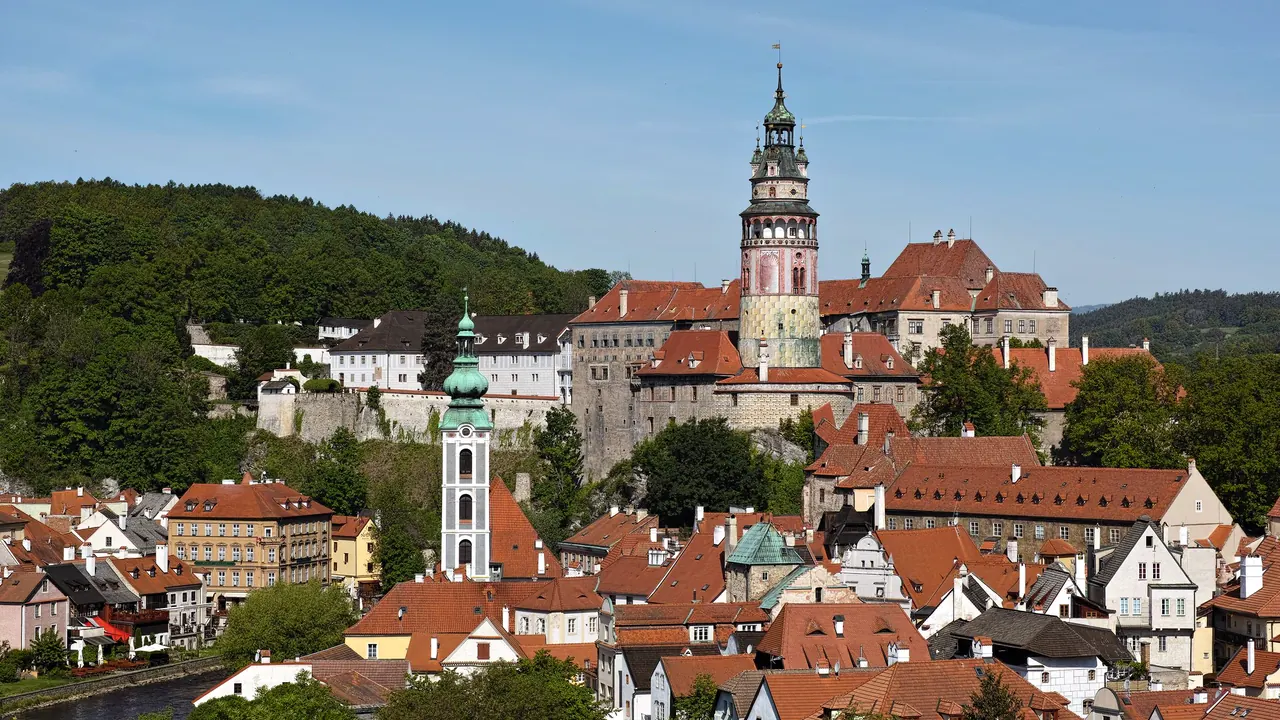
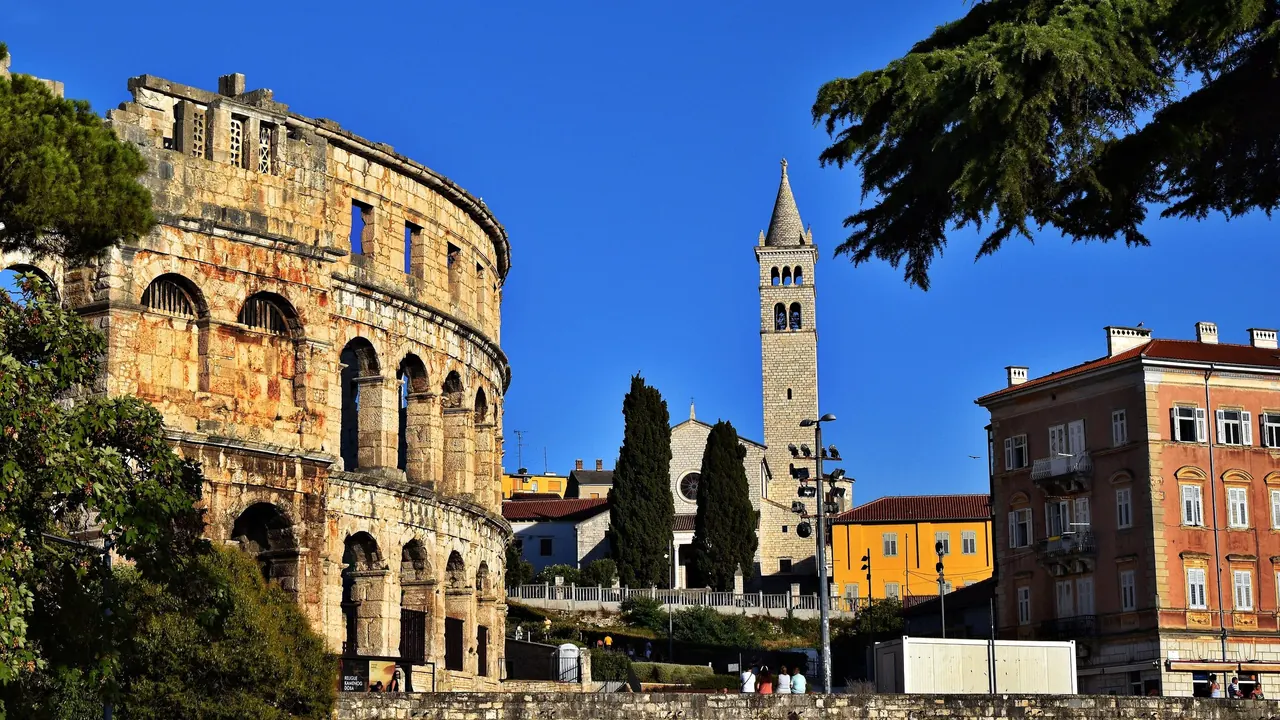
Photos: Cesky Krumlov by Xth-Floor, CC BY-SA 4.0, cropped; Pula by Miroslav.vajdic, CC BY-SA 4.0, cropped.
Cesky Krumlov or Pula?
Our verdict in twelve categories, each scored against the same fixed benchmark cities, and the climate month by month, so you can choose for your trip.
Choose Cesky Krumlov for
- prices
- getting around
- culture and sights
Cesky Krumlov suits a traveller who wants a storybook townscape, quiet evenings and a slower pace inland. The castle above the bend in the Vltava, a canoe trip through wooded meanders and walks in the Bohemian Forest make a calm, green stay of a few days. It also costs less than the Istrian coast, especially outside summer.
Choose Pula for
- beaches
- food and drink
- nightlife
Choose Pula for a summer trip that mixes sea and sights. It offers clear water off pine-shaded coves, Istrian cooking with truffles and Malvazija, and a long list of excursions to Rovinj, the hill towns and Brijuni. The Roman Arena makes a striking backdrop for evenings that run later than anything in South Bohemia.
Scoreboard
Twelve categories on one fixed scale from 0 to 100. The shaded stretch is the gap between the two.
Your match
Pick a travel style or drag the sliders, and both match scores follow your weighting.
Wins on prices and getting around with your weighting.
Wins on beaches and food and drink with your weighting.
What matters to you?
Category by category
What the scores mean for a trip.
Beaches & swimming
There is no real contest here. Cesky Krumlov's only swimming is at the Lipno reservoir, half an hour south, which has grassy and sandy shores for July and August. The Vltava in town is for rafting, not bathing.
Pula has a long, indented coastline of clear water, with pebble coves and concrete platforms around Verudela and Stoja and the wild inlets of Cape Kamenjak as the high point. It is rock and pebble rather than sand, so water shoes help, and Medulin's sheltered bays suit small children.
Food & drink
Cesky Krumlov's cooking is heavy and hearty: roast pork, duck and dumplings, river trout and game. It is best with the town's own beer in a vaulted cellar. It is pleasant but limited, and many menus are aimed at day-trippers.
Pula draws on the Istrian kitchen, which brings more variety and lighter dishes: fuži with truffle, scampi buzara, pršut, and olive oil with Malvazija or Teran from nearby estates. The city's own restaurants are only modest, so the best meals tend to be in hinterland taverns or harbourside konobas.
Culture & sights
Both towns' sights take a day or two, but they come from different eras. Cesky Krumlov is a complete Renaissance and Baroque townscape below one of the largest castles in the country, with the three-level Cloak Bridge and a Baroque theatre that still has its original stage machinery.
Pula's draw is Roman: the Arena with its outer ring still complete, the Temple of Augustus on the Forum and the Arch of the Sergii, with Venetian and Austro-Hungarian layers on top. In Krumlov the appeal is the whole ensemble, while Pula has single, striking monuments set in a working port city.
Nightlife
Neither is a party town, but Pula gives you more to do after dinner. Cesky Krumlov has a handful of pubs and cellar bars and busy riverside terraces in summer, and no clubs at all.
In Pula, summer evenings start on the terraces around the Forum and move on to cocktail and beach bars on Verudela and in Medulin, and a few small clubs fill up at weekends. Out of season it goes quiet too, apart from a few student bars.
Nature & outdoors
Both have good, gentle outdoors, one inland among rivers and forest and the other on the coast. Around Cesky Krumlov the highlights are a canoe or raft trip down the Vltava, the spruce woods and peat bogs of the Bohemian Forest, cross-country skiing there in winter, and the wide views from Klet.
Around Pula the land is stony macchia, pine and olive groves, with car-free Cape Kamenjak for walking and cycling, plus sea kayaking, windsurfing and wreck diving. Pula's countryside is best in spring and autumn, Krumlov's from late spring to early autumn.
Day trips
Pula has the wider choice of day trips. Rovinj, the Euphrasian Basilica in Poreč, the hill towns of Motovun and Grožnjan with their truffle and wine estates, and the Brijuni islands are all about an hour away or less, and Piran and Trieste are further out.
Cesky Krumlov's region is quieter. It has the arcaded square of České Budějovice, Hluboká castle, the Baroque farmhouses of Holašovice and the fish ponds of Třeboň. In both places a car makes the difference.
Good for families
Pula works better with children, mainly because of the sea. It has shallow bays at Medulin and Premantura, the aquarium in a Verudela fort, the Arena's underground passages and the safari park on Brijuni. The drawbacks are summer heat and rocky shores.
Cesky Krumlov charms younger children with the bears in the castle moat and a gentle raft trip, and its centre is largely car-free. But the steep cobbles are hard work with a pushchair, and the castle interiors suit adults.
Getting around
Both have small historic centres you can cover on foot, and both need a car for the surrounding region. Cesky Krumlov is slightly easier while you stay in town: the bus and railway stations are within walking distance and you can cross the town in a quarter of an hour, despite the cobbles and the climb to the castle.
Pula's centre is flat, but the hotels and swimming coves are out on Verudela and towards Premantura, so you will use buses or a bike every day. Parking near the centre is tight in summer.
Shopping & style
Neither town is worth a trip for shopping, and the real difference is what you bring home. Cesky Krumlov sells things for a shelf: Bohemian crystal, garnets and the region's green moldavite, plus a few craft workshops, all in the same old-town lanes you walk for the sights. Once you have browsed those, there is little else, not even everyday clothes shops.
Pula has a bit more variety, and most of what is worth buying there can be eaten or drunk. Truffle products, olive oil and a bottle of rakija from the market hall or straight from a farm in the hinterland tend to last longer in the memory than any trinket. The pedestrian street through the old town also has ordinary high-street chains if you forgot something you need for the trip.
Affordability
Cesky Krumlov is the cheaper stay. It has guesthouses in old houses and reasonably priced Czech meals and beer, although rooms with castle views and the separately priced tours add up.
Pula is reasonable in spring and autumn, but in July and August rooms cost about as much as on Western European coasts, and car hire and boat trips add to the bill.
Live music & performing arts
In both towns, live performance is mostly a summer thing. Pula has the stronger draw: its Roman Arena hosts touring concerts, classical galas and screenings for the Pula Film Festival, and the Istrian National Theatre puts on some drama all year.
Cesky Krumlov has the revolving open-air theatre in the castle garden and a classical music festival in the castle and churches. Out of season there is very little to attend.
Wellness & relaxation
For a proper spa day from Cesky Krumlov, you need to go to Třeboň's peat baths. In town there are only a few hotel wellness rooms and beer baths. What Krumlov has instead is stillness: once the day visitors leave, the old town goes quiet, and a winter stay there is especially restful.
Pula's spas are inside the large resort hotels on Verudela and in Medulin, so pools, saunas and massages may be right where you sleep. Beyond the hotels, you unwind with long coffees on the Forum and evening walks along the pine-shaded coastal paths, and both are best outside high summer.
When should you go?
Pick your month. The climate figures are measured averages, not a forecast.
Cesky Krumlov in July
Pula in July
Daytime high, °C
Rainfall in the month, mm
Where the figures come from
Cesky Krumlov's temperatures are measured 50 km from the centre, at Grainet-Rehberg.
Cesky Krumlov has no rain gauge within 25 km of the centre, so its rainfall comes from a gridded climate dataset read at the city rather than from a gauge further away.
Pula's temperatures are measured 87 km from the centre, at Trieste.
Pula has no rain gauge within 25 km of the centre, so its rainfall comes from a gridded climate dataset read at the city rather than from a gauge further away.
Temperature and rainfall are climate normals, averaged over the years shown. Cesky Krumlov: 1991-2020 normals, Grainet-Rehberg (50.3 km from centre). Pula: 1991-2020 normals, Trieste (87 km from centre).
Cesky Krumlov is a warm-season town. From June to August days reach about 23°C, the best time for canoeing on the river and swimming at Lipno, although these are also the wettest months, with July the peak. May and September are mild and comfortable for walking. Winter is cold, with highs near freezing from December to February and little sunshine, so it suits a quiet stay in the lanes rather than long outings.
Pula is hotter and drier through summer. July and August highs are around 29°C and the sea reaches about 25°C, and it is warm enough for swimming from June to September. Spring and October are better for walking the Roman sites and cycling Kamenjak. The rain comes in autumn and is heaviest in November. Winters are far milder than in Bohemia, but too cool for the sea.
Which traveller are you?
On a beach and sun trip, Pula is the obvious choice. It has clear sea that is warm enough for swimming from June to September, pebble coves around Verudela and the wild inlets of Kamenjak. Near Cesky Krumlov, the only swimming is a reservoir.
For a food and nightlife trip, Pula again offers more. Istrian truffle pasta, seafood and local wines beat Bohemian roasts for variety. Summer evenings move on from Forum terraces to beach bars, while Krumlov winds down after a beer by the river.
On a trip on a tight budget, Cesky Krumlov makes your money go further. Family guesthouses and good-value beer and Czech meals keep costs down, and the whole town is walkable. Pula's rooms get much more expensive in July and August.
Before you go
| Measure | Cesky Krumlov | Pula |
|---|---|---|
| Official language | Czech | Croatian |
| Currency | Czech Koruna (CZK) | Euro (EUR) |
| Sockets | CE230 V, 50 Hz | CF230 V, 50 Hz |
| Driving side | Right | Right |
| Time zone | UTC+1, UTC+2 in summer | UTC+1, UTC+2 in summer |
| Emergency number | 112 | 112 |
| Elevation | 492 m | 5 m |
| Main airport | Václav Havel Airport Prague (PRG)143 km from centre178 non-stop destinations | Pula Airport (PUY)7 km from centre34 non-stop destinations |
| Public holidays this year | 13 days | 14 days |
By the numbers
| Measure | Cesky Krumlov | Pula |
|---|---|---|
| City population | 12,797 | 52,220 |
| People per km² | 576 | 971 |
| Museums within 10 km | 4 | 4 |
| UNESCO World Heritage sites within 50 km | 2 | 1 |
| Swim season, months above 21 °C | - | 4 months |
Where else could you go?
Every comparison below shares a destination with this one, so you can follow Cesky Krumlov or Pula somewhere new.