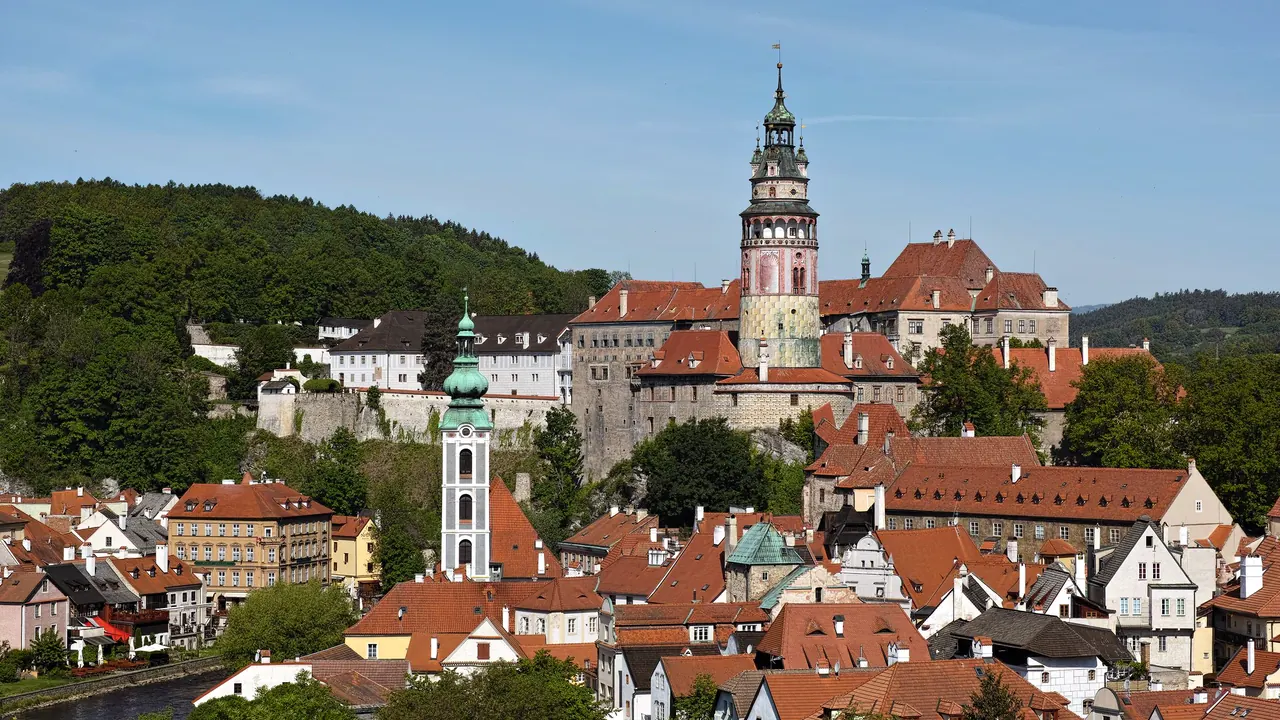
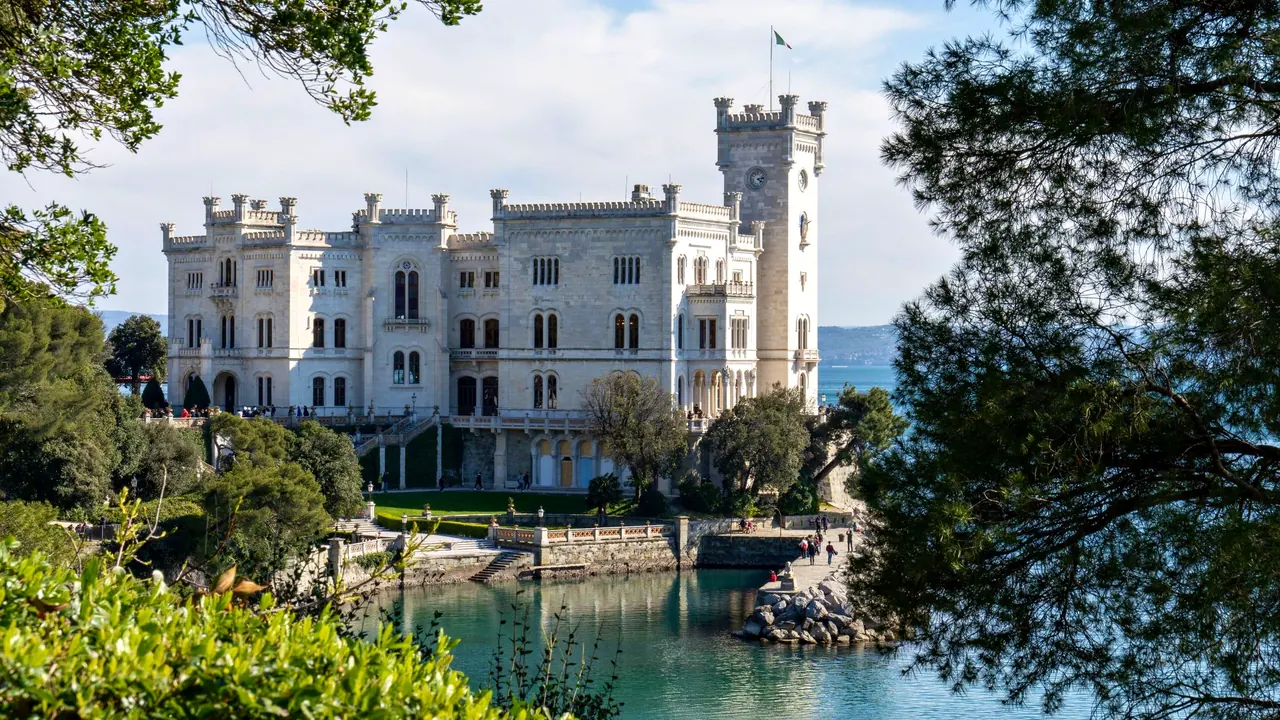
Photos: Cesky Krumlov by Xth-Floor, CC BY-SA 4.0, cropped; Trieste by Tibor Szabo, Pexels License.
Cesky Krumlov or Trieste?
Our verdict in twelve categories, each scored against the same fixed benchmark cities, and the climate month by month, so you can choose for your trip.
Choose Cesky Krumlov for
- prices
Cesky Krumlov suits travellers who want one perfect picture of old Bohemia and don't need much else around it. The castle, the painted lanes and a day drifting down the Vltava fill a short stay well. Evenings are quiet, the beer is good and the costs are gentle, so it works as a calm stop on a wider Central European trip.
Choose Trieste for
- beaches
- food and drink
- live music and the arts
Trieste is the better choice for a longer stay with more to do each day. It has the Adriatic to swim in, a food and coffee culture of its own, an opera season and three countries within reach for day trips. It asks for more time and a little more money, but you are much less likely to run out of things to do.
Scoreboard
Twelve categories on one fixed scale from 0 to 100. The shaded stretch is the gap between the two.
Your match
Pick a travel style or drag the sliders, and both match scores follow your weighting.
Wins on prices with your weighting.
Wins on beaches and food and drink with your weighting.
What matters to you?
Category by category
What the scores mean for a trip.
Beaches & swimming
Cesky Krumlov has nowhere to swim in town, since the Vltava is for rafts and canoes. In summer you have to drive to Lipno reservoir, about half an hour away, where there are grassy and sandy shores and the water reaches around 20°C.
Trieste lives by the sea from June to September. Locals swim off the stepped concrete platforms and ladders at Barcola, or from pebble coves at Sistiana, Duino and Grignano, in clear, warmer water. There is almost no sand, but anyone happy to climb down into the Adriatic will swim every day.
Food & drink
Meals in Cesky Krumlov are solid South Bohemian cooking: roast duck and pork with dumplings, svíčková and river trout, eaten in cellars and on riverside terraces. The local beer is the highlight, and many menus are written for day visitors.
Trieste gives you far more to explore. There are the buffets carving boiled pork with horseradish, jota soup, marinated sardoni and Central European cakes such as presnitz. The city's Habsburg coffee rituals have their own vocabulary, and the farmhouse osmize on the Karst sell their own Terrano and Vitovska.
Culture & sights
The two are equally rewarding but very different. Cesky Krumlov is one intact Renaissance and Baroque townscape around a single great castle, with its Cloak Bridge and a rare Baroque theatre that still has its original stage machinery. Most visitors have seen it all within a day or two.
Trieste's history is spread across a whole port city. There is the grand Piazza Unità facing the sea, the Borgo Teresiano grid along the Canal Grande, San Giusto's mosaics and Roman theatre, and Miramare Castle on the coast. A large synagogue and the Risiera memorial add a heavier side of the twentieth century.
Nightlife
Neither is a place for clubbing, but Trieste has more life after dinner. Its aperitivo hour fills Piazza Unità, the Canal Grande and Cavana with spritz drinkers, and students keep a few streets of wine bars going. In summer the kiosks at Barcola stay open into warm nights.
Cesky Krumlov is quieter still. A handful of cellar bars and backpacker pubs stay open, and the river terraces are busy on summer evenings. Outside the peak months the lanes empty early.
Nature & outdoors
Both put good outdoors close at hand, but of different kinds. Cesky Krumlov's is river and forest: canoeing the Vltava's wooded meanders, walking or cycling the spruce ridges of the Bohemian Forest, and cross-country skiing in winter.
Trieste's is limestone and sea. You can walk the clifftop Strada Napoleonica and the Rilke Path, hike and climb in the Val Rosandra gorge, and go underground at the Grotta Gigante. On the water there is sailing on the gulf and snorkelling in the Miramare marine reserve.
Day trips
Trieste is the stronger base, with Italy, Slovenia and Croatia all within reach. Aquileia's mosaics, star-shaped Palmanova, Piran and Ljubljana are easy, and Venice works as a long day by train.
From Cesky Krumlov, the outings stay within South Bohemia. You can visit the arcaded square of České Budějovice, Hluboká's white castle, the Baroque farmhouses of Holašovice and the fish ponds of Třeboň. Most of them are much easier with a car.
Good for families
Trieste gives children more variety. There is the Grotta Gigante, a small aquarium, a hands-on science centre and summer days at Barcola, although swimming is off rocks rather than sandy shallows.
Cesky Krumlov has the storybook appeal of the castle, the bears in its moat and a gentle family raft trip. Its steep cobbled lanes are hard with a pushchair, though, and once the castle and river are done there is little left for children.
Getting around
Cesky Krumlov's old town takes about a quarter of an hour to cross on foot, but trips into the countryside depend on thin bus and train links or a hire car.
Trieste's centre is flat and walkable along the sea, apart from the stepped climb to San Giusto. City buses run out to Miramare and up onto the Karst, and passenger boats cross the bay to Muggia, so you need a car far less often.
Shopping & style
Neither is a shopping destination. In Cesky Krumlov it means souvenirs: Bohemian glass, garnet jewellery, marionettes and the green moldavite stone found in the region. Trieste has a bit more, with ordinary Italian clothing shops around Corso Italia and antique dealers in the old-town lanes. Its best buys are edible: freshly roasted coffee, Karst wine and presnitz.
Affordability
Cesky Krumlov is the cheaper stay. Guesthouses in old houses, Czech meals and local beer are moderately priced, although rooms with castle views and the separately priced castle tours cost more.
Trieste is fairly priced for northern Italy rather than cheap. Buffet lunches and standing coffees cost little, and the sea and the Karst are free, but seafood restaurants and better hotels cost what they would in other Italian cities.
Live music & performing arts
Trieste has a real season. Opera and ballet play at the Teatro Verdi on the waterfront, operetta is a rare Habsburg legacy, and the city also has prose theatre and a Slovenian-language stage.
Cesky Krumlov's performances are almost all in summer. Plays and opera are staged in the castle garden's revolving open-air theatre, and a music festival brings classical concerts to the castle and churches. The rest of the year is close to silent.
Wellness & relaxation
Cesky Krumlov is calm for only part of the day. Once the day visitors have gone, the old town falls still around the river. Trieste is unhurried from morning onwards, with long sittings over a newspaper in the old coffee houses and sunset walks out along the Molo Audace pier, which makes it the more restful stay.
For treatments, Cesky Krumlov has a few hotel wellness rooms and beer baths, with Třeboň's peat baths a day trip away. Trieste's spas are in hotels and a few day spas, and proper thermal baths mean leaving the city.
When should you go?
Pick your month. The climate figures are measured averages, not a forecast.
Cesky Krumlov in July
Trieste in July
Daytime high, °C
Rainfall in the month, mm
Where the figures come from
Cesky Krumlov's temperatures are measured 50 km from the centre, at Grainet-Rehberg.
Cesky Krumlov has no rain gauge within 25 km of the centre, so its rainfall comes from a gridded climate dataset read at the city rather than from a gauge further away.
Temperature and rainfall are climate normals, averaged over the years shown. Cesky Krumlov: 1991-2020 normals, Grainet-Rehberg (50.3 km from centre). Trieste: 1991-2020 normals, Trieste (1.6 km from centre).
Cesky Krumlov has a short season. Late spring to early autumn is the time for walking, rafting and the forest, with summer highs only around 23°C. Summer is also the wettest part of the year, so expect showers in July. From November to March the town is cold, with daytime highs near 2°C in midwinter. That can be lovely for a quiet, frosty stay, but the countryside is mostly closed off.
Trieste is milder all year and much warmer in summer, with highs around 29°C in July and August and the sea at about 25°C. That makes June to September the swimming months. Spring and early autumn are the best weeks for walking the city and the Karst. The heavy rain comes from September to November, peaking around 125mm. Winter stays mild enough for sightseeing.
Which traveller are you?
For a beach and sun trip, Cesky Krumlov's nearest swimming is Lipno reservoir, half an hour's drive away. Trieste is the clear choice, with daily swims from the Barcola platforms or the rocky coves near Duino all summer, in sea around 25°C.
On a trip on a tight budget, Cesky Krumlov goes further if you sleep just outside the old town, come outside summer and pick one castle tour rather than several. In Trieste, avoid high summer and the autumn regatta, ride the buses and eat at buffets.
For a short city break, Cesky Krumlov fits neatly into two days, with the castle and painted lanes all on foot, best early and late once the tour buses leave. Trieste deserves longer, since much of its appeal lies along the coast and up on the Karst.
Before you go
| Measure | Cesky Krumlov | Trieste |
|---|---|---|
| Official language | Czech | Italian |
| Currency | Czech Koruna (CZK) | Euro (EUR) |
| Sockets | CE230 V, 50 Hz | CFL230 V, 50 Hz |
| Driving side | Right | Right |
| Time zone | UTC+1, UTC+2 in summer | UTC+1, UTC+2 in summer |
| Emergency number | 112 | 112 |
| Elevation | 492 m | 2 m |
| Main airport | Václav Havel Airport Prague (PRG)143 km from centre178 non-stop destinations | Trieste Airport (TRS)31 km from centre32 non-stop destinations |
| Public holidays this year | 13 days | 13 days |
By the numbers
| Measure | Cesky Krumlov | Trieste |
|---|---|---|
| City population | 12,797 | 198,417 |
| People per km² | 576 | 2,332 |
| Museums within 10 km | 4 | 33 |
| UNESCO World Heritage sites within 50 km | 2 | 5 |
| Swim season, months above 21 °C | - | 4 months |
Where else could you go?
Every comparison below shares a destination with this one, so you can follow Cesky Krumlov or Trieste somewhere new.
- Rovinjvs Trieste
- Ljubljanavs Trieste
- Bledvs Trieste
- Venicevs Trieste
- Praguevs Cesky Krumlov
- Salzburgvs Cesky Krumlov