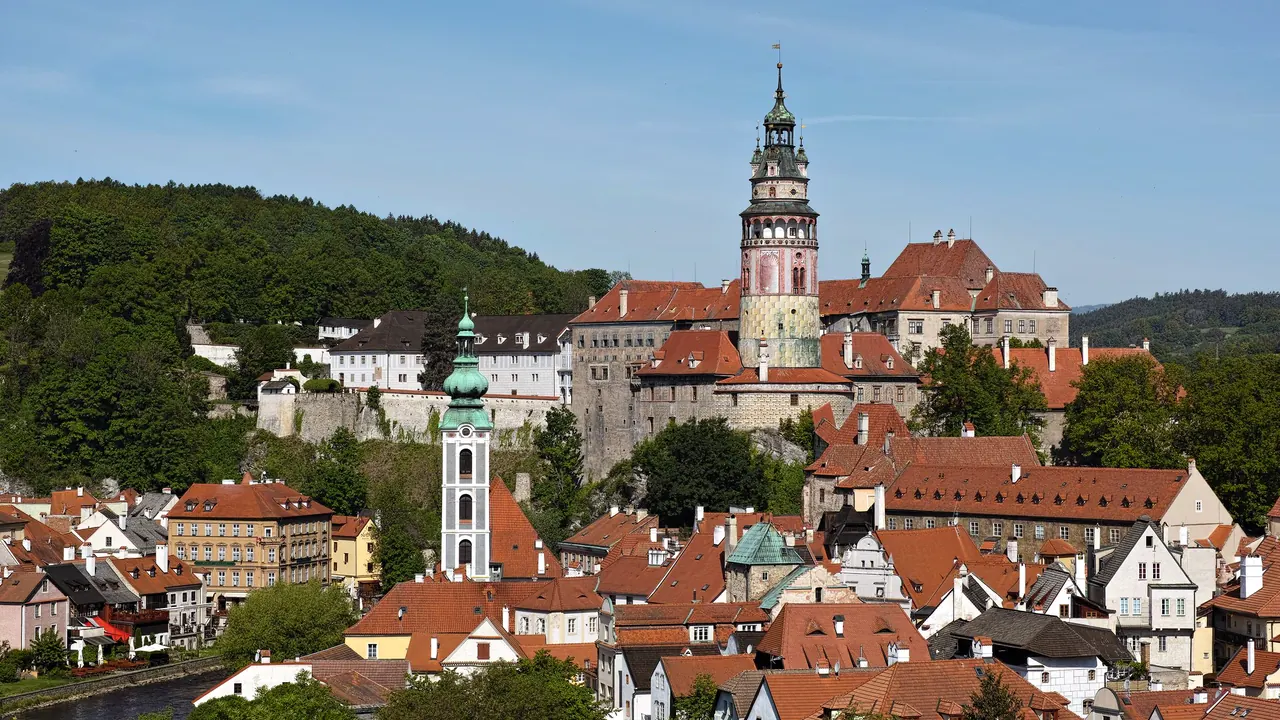
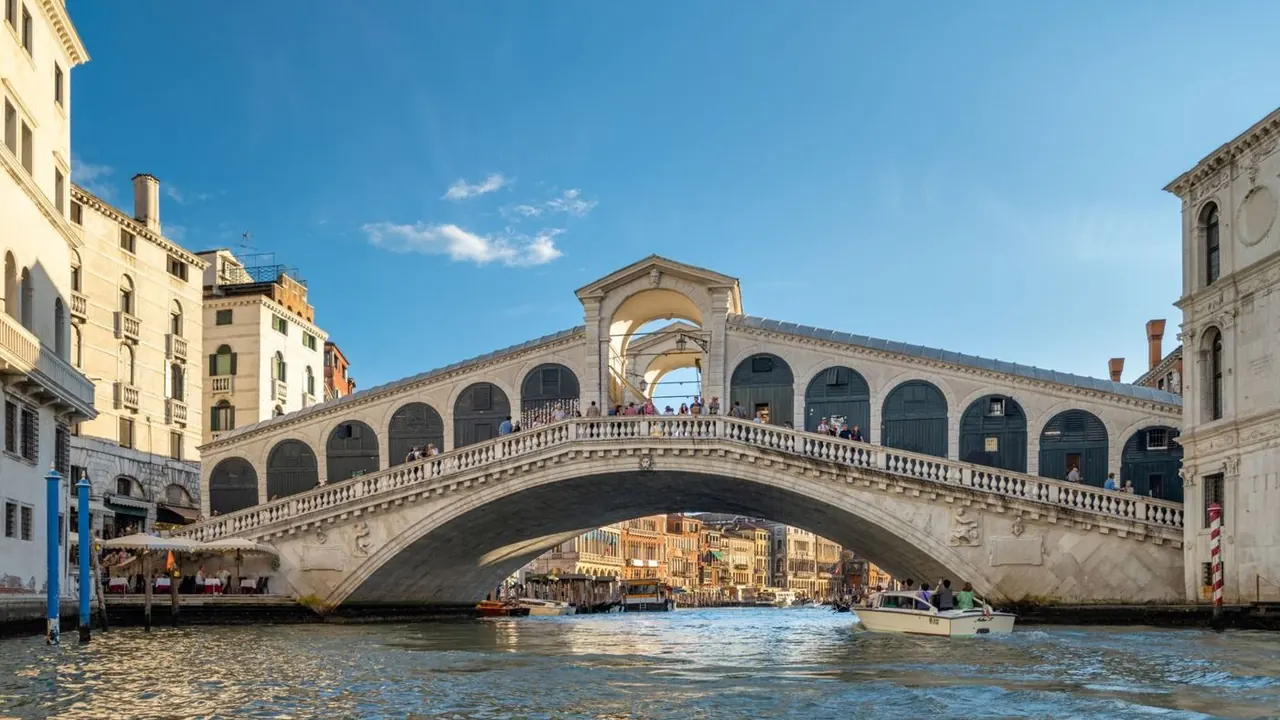
Photos: Cesky Krumlov by Xth-Floor, CC BY-SA 4.0, cropped; Venice by David Vives, Pexels License.
Cesky Krumlov or Venice?
Our verdict in twelve categories, each scored against the same fixed benchmark cities, and the climate month by month, so you can choose for your trip.
Choose Cesky Krumlov for
- prices
- nature and the outdoors
Cesky Krumlov suits a slower, cheaper trip built around one intact castle town and the green countryside beyond it. Come for a canoe down the Vltava, walks in the Bohemian Forest and a beer by the river, and accept that the sights take two days and that evenings end early.
Choose Venice for
- shopping
- live music and the arts
- beaches
Venice is the choice when art, architecture and music are the point of the trip. Its galleries, churches and opera house go much deeper, the cities of the Veneto are an easy train ride away, and the Lido adds a beach. It costs a great deal more, though, and you have to plan around the crowds at San Marco.
Scoreboard
Twelve categories on one fixed scale from 0 to 100. The shaded stretch is the gap between the two.
Your match
Pick a travel style or drag the sliders, and both match scores follow your weighting.
Wins on prices and nature and the outdoors with your weighting.
Wins on shopping and live music and the arts with your weighting.
What matters to you?
Category by category
What the scores mean for a trip.
Beaches & swimming
Cesky Krumlov has no beach. Swimming means a half-hour drive to the Lipno reservoir, which has grassy and sandy shores and water warm enough only in July and August. The Vltava in town is for rafting, not swimming.
Venice is no seaside resort either, but it does have sand on its doorstep. The Lido is a short vaporetto ride away, with kilometres of fine beach and a warmer, shallow Adriatic that suits children. Quieter Pellestrina and the big strip at Jesolo are also within reach.
Food & drink
Food in Cesky Krumlov is hearty and simple: roast pork, duck and dumplings, river trout and game, eaten in vaulted cellars, with the town's own beer as the highlight. It is satisfying but narrow, and nobody makes the journey for it.
Venice gives you far more to explore, above all in the bacari. Cicchetti and a spritz at the counter, or lagoon dishes such as black cuttlefish risotto made with fish from the Rialto market, become part of the trip. The catch is the many tourist restaurants around San Marco, so good meals need seeking out.
Culture & sights
In both places the town itself is the main sight, but on very different scales. Cesky Krumlov is a single UNESCO-listed set piece: painted houses and a huge castle with a rare Baroque theatre, wrapped in a bend of the Vltava. A day or two covers it.
Venice gives you the same pleasure many times over. There is San Marco, the Doge's Palace and the Grand Canal, and then a depth of painting that a week barely covers, from Titian in the Frari and Tintoretto at San Rocco to modern art at the Guggenheim.
Nightlife
Cesky Krumlov winds down even earlier than Venice. An evening there means a cellar bar, some popular with backpackers, or a riverside terrace in summer, and outside the peak months the lanes are empty soon after dinner. There are no clubs at all.
Venice has a real social hour. At aperitivo time the bacari near the Rialto and along the Fondamenta della Misericordia fill with people holding spritzes, and students keep a few bars around Campo Santa Margherita going later. Even so, the city goes quiet around midnight, and for clubbing you would head to the mainland or, in summer, to Jesolo.
Nature & outdoors
Cesky Krumlov is the better choice for time outdoors. You can canoe the wooded meanders of the Vltava straight into town and walk or cycle among the spruce woods and peat bogs of the Bohemian Forest, half an hour away. In winter there is cross-country skiing there too.
Nature in Venice means the lagoon: salt marshes around Torcello with herons and flamingos, kayaking or a lesson in rowing Venetian-style, and cycling along the sea walls of the Lido. It is flat, watery country, and real mountains are a long journey away.
Day trips
Cesky Krumlov has a good handful of outings: the arcaded square and Budvar brewery in České Budějovice, Hluboká castle, the farmhouses of Holašovice and the fish ponds of Třeboň. Most are much easier with a car, and Prague is too far for a comfortable day.
Venice opens up far more, and by fast train. Padua, Vicenza and Verona each make an easy day out, and Bologna and Trieste are also within reach. The lagoon islands of Murano, Burano and Torcello add another full day without a train at all.
Good for families
For children the two come out roughly even, and the problems are similar: cobbles and slopes in Cesky Krumlov, hundreds of stepped bridges in Venice, both hard work with a pushchair.
What differs is the fun. Cesky Krumlov has the bears in the castle moat, a gentle family raft trip and the treetop walk at Lipno, all in a small, calm town. Venice has boats instead of buses, glass-blowing on Murano and the shallow Lido beach, but also summer crowds and humid heat.
Getting around
Both centres are best on foot. Cesky Krumlov's old town takes a quarter of an hour to cross, but reaching the forest or the smaller castles usually means hiring a car or joining a tour.
Venice is easier overall. Its centre is larger and full of confusing alleys, but vaporetti run to the Lido and the islands, and trains from Santa Lucia let you explore the region without driving. The price is the stepped bridges and the slow, crowded boats.
Shopping & style
Shopping in Cesky Krumlov is mostly souvenirs: Bohemian glass, garnet jewellery, marionettes and green moldavite, plus a few ceramic workshops. Venice offers much more, with Murano glass, Burano lace, masks and marbled paper made in real workshops, and the big fashion names along the Mercerie, though imported fakes crowd the main routes.
Affordability
The gap in cost is wide, and the money goes in different places. In Cesky Krumlov you mostly pay extra for location: a room looking onto the castle or the river, or a table on the main lanes, costs more, and each castle tour is paid for separately. Step a few streets back, or come outside summer, and the bill drops noticeably.
Venice is expensive almost everywhere, and its peaks are sharper. Rooms around San Marco climb highest in summer and at carnival, and sitting down at a café on the piazza is famously steep. Late autumn and winter, outside the festivals, are the gentlest time on the wallet, and eating standing at a bar counter rather than at a table keeps meals sensible.
Live music & performing arts
Performance in Cesky Krumlov belongs to summer. Plays and opera are staged in the revolving open-air theatre in the castle garden, and a classical festival brings concerts to the castle and churches. Most visitors only see the Baroque theatre on a tour.
Venice has a full season all year, led by opera, ballet and concerts at La Fenice, with drama at the Teatro Goldoni and the Biennale's festivals. On most evenings you can also hear Vivaldi in a church.
Wellness & relaxation
Neither town has a bathing tradition of its own, and both offer calm more than spas. Cesky Krumlov has a few hotel wellness rooms and beer baths, with the peat baths of Třeboň a day out away, and the town grows still once the day visitors leave.
Venice offers more: hotel spas in palazzi and on the Lido and Giudecca, thermal pools at Abano Terme about an hour away, and quiet residential corners in Castello and Cannaregio, as long as you keep away from San Marco by day.
When should you go?
Pick your month. The climate figures are measured averages, not a forecast.
Cesky Krumlov in July
Venice in July
Daytime high, °C
Rainfall in the month, mm
Where the figures come from
Cesky Krumlov's temperatures are measured 50 km from the centre, at Grainet-Rehberg.
Cesky Krumlov has no rain gauge within 25 km of the centre, so its rainfall comes from a gridded climate dataset read at the city rather than from a gauge further away.
Temperature and rainfall are climate normals, averaged over the years shown. Cesky Krumlov: 1991-2020 normals, Grainet-Rehberg (50.3 km from centre). Venice: 1991-2020 (sunshine 1971-2000, rainfall 1981-2010) normals, Venezia / Tessera (6.7 km from centre).
Cesky Krumlov is at its best from May to September. The days are mild, peaking around 23°C in July and August, which is ideal for walking the lanes and floating down the river. Summer is also the wettest stretch, with about 111mm falling in July. From November to March daytime highs stay only a few degrees above freezing, so winter means short, cold strolls rather than days outdoors.
Venice is warmer all year. July and August reach about 29°C and feel humid. That is hot for crossing bridges at midday but right for the Lido, where the sea is around 25°C. May and September are the most comfortable months for walking, while June and October bring the heaviest rain. Winters are cool but noticeably milder than in South Bohemia, and summer is sunnier too.
Which traveller are you?
On a trip on a tight budget, Cesky Krumlov is much easier to manage. Guesthouses, Czech meals and local beer stay moderately priced. Venice charges heavily for rooms, water buses and entry to churches, and the main way to save there is sleeping on the mainland.
For an outdoors trip, Cesky Krumlov wins comfortably. You can canoe the Vltava, walk or cycle in the Bohemian Forest and climb Klet, all close to town. Outdoors in Venice mostly means the flat lagoon and its marshes, and the mountains are far away.
On a culture and arts trip, Venice is in another league. Titian and Tintoretto, the Accademia, the palaces of the Grand Canal and opera at La Fenice can fill a week. Cesky Krumlov's castle and painted old town take a day or two.
Before you go
| Measure | Cesky Krumlov | Venice |
|---|---|---|
| Official language | Czech | Italian |
| Currency | Czech Koruna (CZK) | Euro (EUR) |
| Sockets | CE230 V, 50 Hz | CFL230 V, 50 Hz |
| Driving side | Right | Right |
| Time zone | UTC+1, UTC+2 in summer | UTC+1, UTC+2 in summer |
| Emergency number | 112 | 112 |
| Elevation | 492 m | 2 m |
| Main airport | Václav Havel Airport Prague (PRG)143 km from centre178 non-stop destinations | Venice Marco Polo Airport (VCE)7 km from centre103 non-stop destinations |
| Public holidays this year | 13 days | 13 days |
By the numbers
| Measure | Cesky Krumlov | Venice |
|---|---|---|
| City population | 12,797 | 250,369 |
| People per km² | 576 | 602 |
| Museums within 10 km | 4 | 52 |
| UNESCO World Heritage sites within 50 km | 2 | 5 |
| Swim season, months above 21 °C | - | 4 months |
Where else could you go?
Every comparison below shares a destination with this one, so you can follow Cesky Krumlov or Venice somewhere new.
- Veronavs Venice
- Rovinjvs Venice
- Triestevs Venice
- Cortina d'Ampezzovs Venice
- Bolognavs Venice
- Praguevs Cesky Krumlov