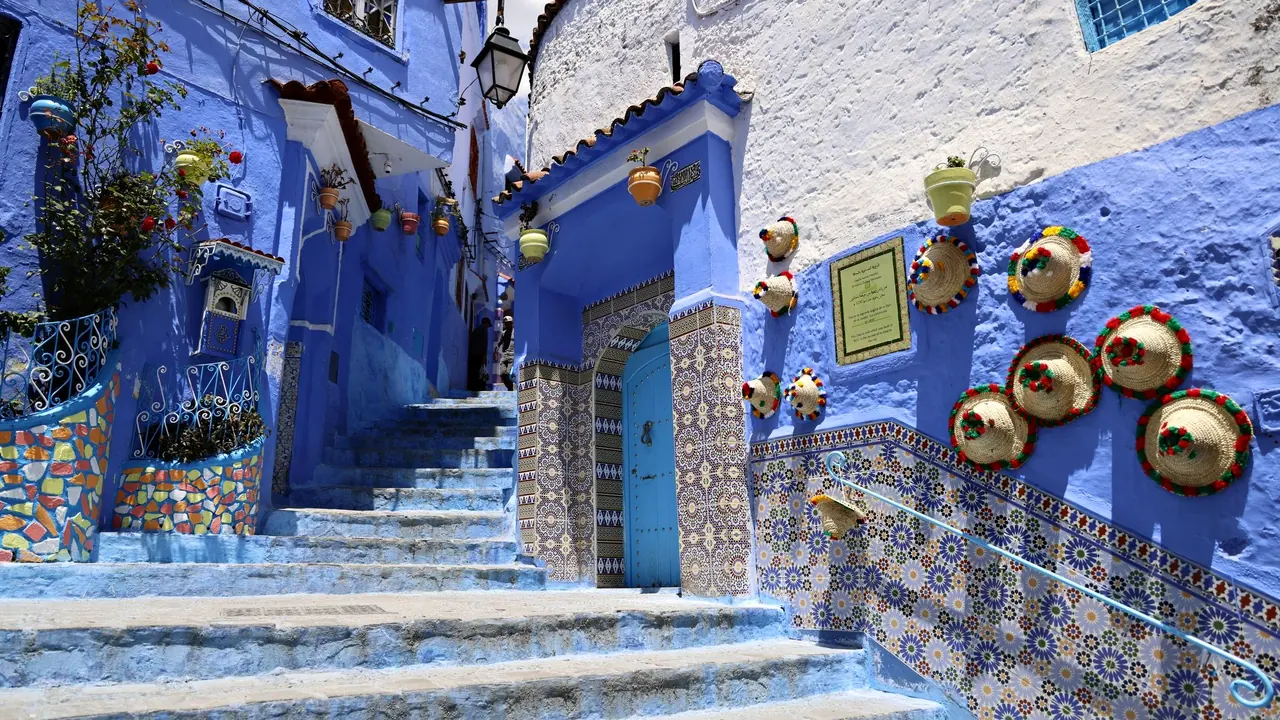
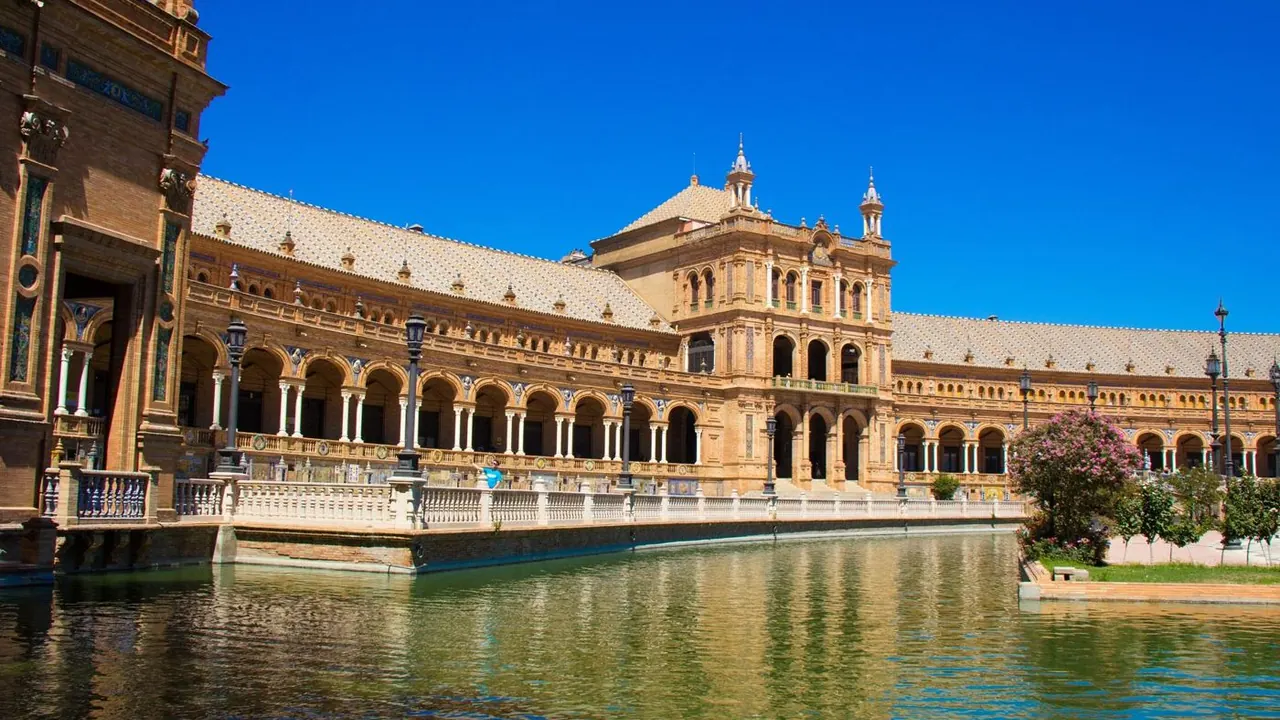
Photos: Chefchaouen by Christophe RASCLE, Pexels License; Seville by Tibor Kovacs, CC BY 2.0, cropped.
Chefchaouen or Seville?
Our verdict in twelve categories, each scored against the same fixed benchmark cities, and the climate month by month, so you can choose for your trip.
Choose Chefchaouen for
- prices
- nature and the outdoors
- wellness
Chefchaouen suits a slow, inexpensive stay with the mountains in view. You get a few days wandering the blue medina, a walk through Talassemtane to God's Bridge, and quiet evenings over mint tea. It is the better choice for walkers, for travellers watching their money and for anyone who wants real quiet. It works best as a stop on a route through northern Morocco rather than a week in one place.
Choose Seville for
- live music and the arts
- nightlife
- day trips
For a city with depth, Seville is the clear pick. It has the Alcázar and the cathedral, flamenco every night, tapas bars that stay full until late, and Córdoba or Cádiz within easy reach by train. It rewards a long weekend or a full week, as long as you avoid the height of summer.
Scoreboard
Twelve categories on one fixed scale from 0 to 100. The shaded stretch is the gap between the two.
Your match
Pick a travel style or drag the sliders, and both match scores follow your weighting.
Wins on prices and nature and the outdoors with your weighting.
Wins on live music and the arts and nightlife with your weighting.
What matters to you?
Category by category
What the scores mean for a trip.
Beaches & swimming
Neither is a beach destination, and from both the sea is about an hour and a quarter away. From Chefchaouen it is the Mediterranean at Oued Laou, a grey-sand beach at the end of a winding gorge road, with the cold, shallow river pools at Akchour as the local alternative. From Seville it is the open Atlantic sand of Huelva, with the long beaches of Cádiz beyond, and in town a rooftop or municipal pool is how people cool off in summer.
Food & drink
Food is one of the great pleasures of Seville and a minor part of a stay in Chefchaouen. In Seville you eat tapas standing at tiled bars in Triana or El Arenal with a cold manzanilla, and one evening there gives more variety than Chefchaouen's restaurants manage in a week.
In the blue town the menus repeat tagine, couscous and harira, and the best eating is local: Rif goat cheese from the market, bissara for breakfast and bread from the communal ovens. Alcohol is hard to find, so wine with dinner is something you will have in Seville but rarely in Chefchaouen.
Culture & sights
Seville has one of Europe's great historic centres. There are the Mudéjar courtyards of the Alcázar, the Gothic cathedral with the Giralda and the Archivo de Indias, then Plaza de España, Casa de Pilatos and the Murillos at the Bellas Artes. Three or four days still leave things unseen.
In Chefchaouen the culture is the medina itself, a 15th-century town shaped by refugees from Andalusia, so it shares a thread of history with Seville. Its formal sights stop at the kasbah and its small museum, and most visitors have seen everything within a day or two.
Nightlife
This is the starkest difference between the two. Chefchaouen goes quiet after dinner and mint tea in Outa el-Hammam, and alcohol is limited to a couple of hotel bars. Seville sits down to dinner at ten and stays out late on the terraces of the Alameda de Hércules, Triana and the Alfalfa, though it is a city of long evenings in bars rather than clubs.
Nature & outdoors
Chefchaouen has the mountains on its doorstep. Paths climb from Ras el-Maa into the Rif, and Akchour is the entrance to Talassemtane National Park, with its river gorge, God's Bridge, cedar forests and Barbary macaques. Trails are poorly marked, so a local guide helps.
Around Seville the land is flat farmland and orchards. Its best nature is the Doñana wetlands with their flamingos, a guided outing an hour and a half away. In the city itself, outdoor time means María Luisa Park and paddling on the river.
Day trips
Seville is by far the better base. Córdoba is under an hour by high-speed train, Itálica, Carmona, Jerez and Cádiz all make easy days out, and the white villages and baroque towns lie beyond.
From Chefchaouen, the one outing that really repays the journey is Tetouan and its UNESCO-listed medina, with Martil just beyond. With no railway, Tangier and Fes are better treated as your next stop than as a return trip.
Good for families
Seville is easier with children, who are welcome in bars and squares late into the evening. María Luisa Park, the maze in the Alcázar gardens and the theme park on La Cartuja give them places of their own. The summer heat is the main difficulty.
Chefchaouen is calm, with little traffic inside the walls, but its steep stairs make pushchairs useless and little in town is aimed at children. Older children will probably enjoy the river pools at Akchour most.
Getting around
In both cities you get around the centre on foot, but the walking is very different. Seville's centre is flat, and a tram, a metro line, buses and a good bike scheme cover longer hops, so the only real obstacle is the summer heat. Chefchaouen is tiny but built on a slope, so every walk means stairs and slippery steps. Beyond the petit taxis to the gates there is no public transport, and no railway to arrive by.
Shopping & style
Both are better for crafts than for fashion, but Seville has more range. There are tiles and ceramics in Triana, flamenco dresses, mantillas and fans around Calle Sierpes, high-street stores, and the Thursday market on Calle Feria, which together fill a full day of browsing.
Chefchaouen's lanes sell Rif blankets, djellabas, leather slippers and blue pigment, often made locally and sold with only mild bargaining, but the stock repeats after a few streets.
Affordability
Chefchaouen is much cheaper. Guesthouses and riads cost a fraction of European rates, meals are inexpensive and the town itself, the main attraction, is free to walk. Seville is reasonable for Western Europe, with tapas and drinks the clearest saving, but rooms rise steeply around Holy Week and the April Fair, and you pay to enter the Alcázar and the cathedral.
Live music & performing arts
Seville is the home of flamenco, performed every night in tablaos, cultural centres and peñas, with opera at the Teatro de la Maestranza and drama at the Lope de Vega. Chefchaouen has no stage at all: Andalusian music appears at the occasional festival, and otherwise the call to prayer over the rooftops is all the music most visitors hear.
Wellness & relaxation
Chefchaouen is the more restful of the two. Mountain air, roof terraces and silent evenings set the pace, and the neighbourhood hammams give a genuine scrub, though polished spa treatments are few.
Seville has atmospheric Arab-style bath houses and hotel spas, and the slow afternoons and shady courtyards ease the day. Noisy streets at night and the festival crowds make it less of a place to recharge.
When should you go?
Pick your month. The climate figures are measured averages, not a forecast.
Chefchaouen in July
Seville in July
Daytime high, °C
Rainfall in the month, mm
Where the figures come from
Chefchaouen has no weather station within reach, so its figures come from a gridded climate model rather than a measured record, and read a broad area rather than the city itself.
Temperature and rainfall are climate normals, averaged over the years shown. Chefchaouen: 2001-2020 normals, NASA POWER reanalysis grid, no weather station within 90 km. Seville: 1991-2020 (sunshine 1981-2010, rainfall 1981-2010) normals, Sevilla / San Pablo (8.1 km from centre).
Chefchaouen is at its best in May, early June and September, when the days are warm enough for the hills and the lanes are mostly dry. From October to April the rain is heavy, peaking at 141mm in November, and winter days in the mountains are cool and damp. July and August reach 35°C, too hot for walking in the valleys, although this is also when the sea at Oued Laou is warmest, around 23°C, if you want a beach day.
Seville is several degrees milder than Chefchaouen through winter and spring, so its good season starts earlier. March to May are warm and fairly dry, ideal for walking the streets, and its winters are gentler. In July and August the two are about equally hot, with Seville at 36°C under long, cloudless days that make sightseeing at midday hard work. Late September and October are pleasant again before the heavier rain of November and December.
Which traveller are you?
On a culture and arts trip, Seville wins clearly. The Alcázar, the cathedral and the Museo de Bellas Artes fill several days, and evenings bring flamenco in tablaos and peñas or opera at the Maestranza. Chefchaouen's lanes and small kasbah take a day.
For an outdoors trip, Chefchaouen is the better base. The Rif begins at the edge of the medina, and the gorges, waterfalls and cedar forests of Talassemtane are a short taxi ride away. Around Seville the land is flat, and Doñana is a longer guided outing.
On a tight budget, Chefchaouen makes your money go much further. Guesthouses are cheap, meals in the lanes cost little and the main sight is the town itself. In Seville, tapas keep eating affordable, but rooms and monument tickets add up, especially around Holy Week.
Before you go
| Measure | Chefchaouen | Seville |
|---|---|---|
| Official language | Arabic, Standard Moroccan Tamazight | Spanish |
| Currency | Moroccan Dirham (MAD) | Euro (EUR) |
| Sockets | CE50 Hz | CF230 V, 50 Hz |
| Driving side | Right | Right |
| Time zone | UTC+1 | UTC+1, UTC+2 in summer |
| Emergency number | Police 19/112, ambulance 15, fire 15 | 112 |
| Elevation | 564 m | 18 m |
| Main airport | Tangier Ibn Battuta Airport (TNG)86 km from centre50 non-stop destinations | Seville Airport (SVQ)9 km from centre96 non-stop destinations |
| Public holidays this year | 11 days | 12 days |
By the numbers
| Measure | Chefchaouen | Seville |
|---|---|---|
| City population | 46,168 | 689,423 |
| People per km² | 2,998 | 4,896 |
| Museums within 10 km | 1 | 24 |
| UNESCO World Heritage sites within 50 km | 1 | 1 |
| Swim season, months above 21 °C | 3 months | - |
Where else could you go?
Every comparison below shares a destination with this one, so you can follow Chefchaouen or Seville somewhere new.
- Tangiervs Chefchaouen
- Cadizvs Seville
- Rondavs Seville
- Cordobavs Seville
- Fesvs Chefchaouen
- Marbellavs Seville