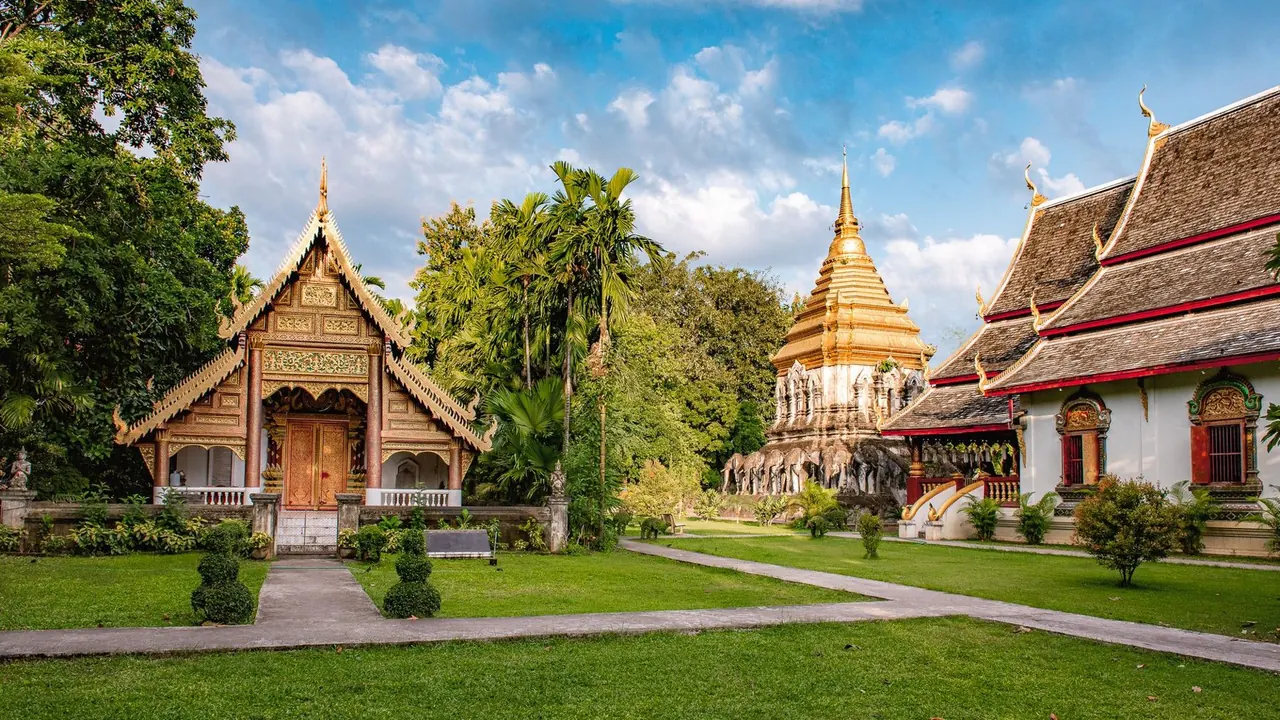
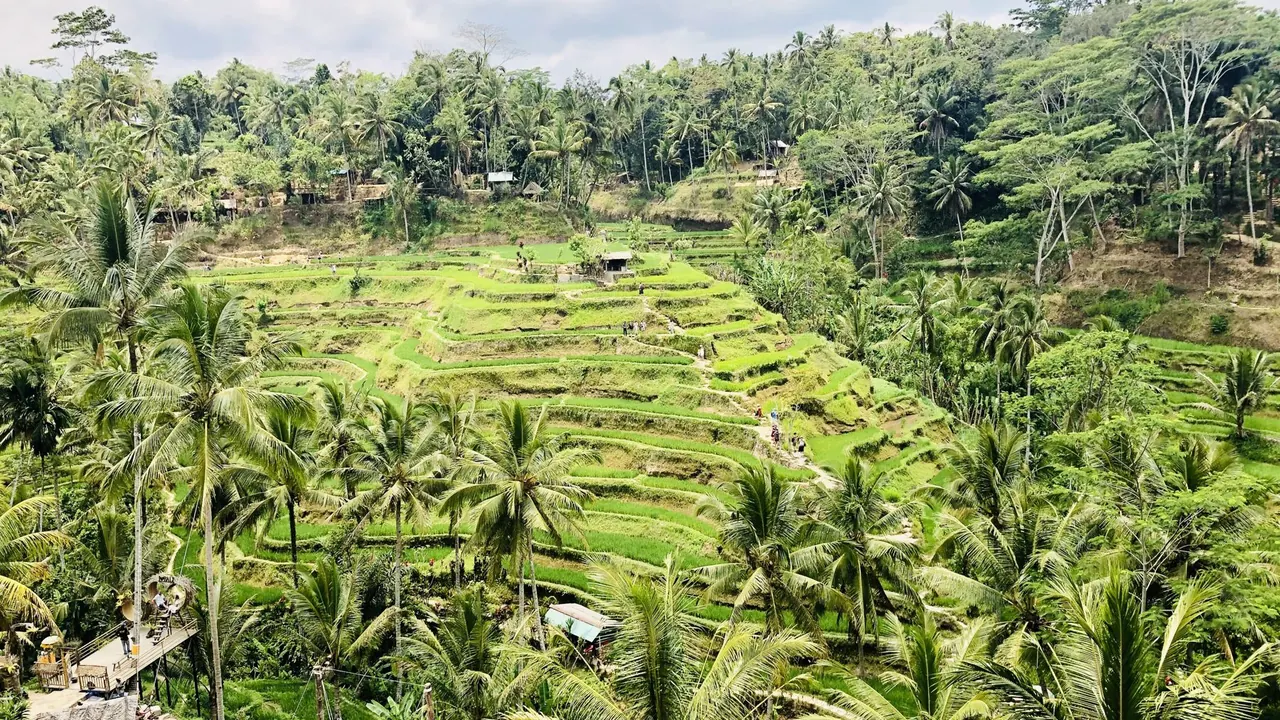
Photos: Chiang Mai by Gije Cho, Pexels License; Ubud by Pinterpandai, CC BY-SA 3.0, cropped.
Chiang Mai or Ubud?
Our verdict in twelve categories, each scored against the same fixed benchmark cities, and the climate month by month, so you can choose for your trip.
Choose Chiang Mai for
- nightlife
- getting around
- food and drink
Chiang Mai is the better pick for a traveller who wants a real town to explore on foot and by songthaew. The moated old city is full of temples to wander between, northern Thai food is a reason to come in itself, and the evenings offer more, from cocktail bars in Nimmanhaemin to market stalls at the city gates. It is also the cheaper and easier of the two, and it suits curious independent travellers who like to fill their days.
Choose Ubud for
- beaches
- day trips
- live music and the arts
Ubud rewards people who come to slow down. Yoga, spas and retreats shape the whole town, rice terraces start at the edge of the centre, and dance with live gamelan is staged somewhere every evening. It also makes a better base for seeing the rest of its island, with Bali's great temples and the sea at Sanur within a drive. Expect quiet nights and days planned around a hired driver.
Scoreboard
Twelve categories on one fixed scale from 0 to 100. The shaded stretch is the gap between the two.
Your match
Pick a travel style or drag the sliders, and both match scores follow your weighting.
Too close to call, 1 point apart
Wins on nightlife and getting around with your weighting.
Wins on beaches and day trips with your weighting.
What matters to you?
Category by category
What the scores mean for a trip.
Beaches & swimming
Neither town has a beach, but Ubud is far closer to one. Sanur's calm water inside the reef makes an easy day out, and the black-sand Gianyar coast is good for watching surfers. Chiang Mai is a long day's travel from any coast, so swimming there means the Huay Tung Tao reservoir, quarry lakes or waterfall pools.
If sea swimming matters to you, Ubud lets you add a day by the sea without changing base. From Chiang Mai, the sea means a separate stay on the southern islands.
Food & drink
Chiang Mai is the stronger eating town, because its northern Thai cooking is a cuisine of its own. Think khao soi, herb-heavy sai ua sausage and nam prik noom with sticky rice, served cheaply at Warorot market and the Chang Phueak Gate stalls. Coffee from the surrounding hills adds a serious café scene.
Ubud's Balinese dishes, babi guling and slow-cooked bebek betutu above all, are worth seeking out in the warungs off the main street. Where Ubud goes further is international and plant-based cafés, a range Chiang Mai largely lacks.
Culture & sights
Chiang Mai gives the sightseer more to see in a small space. Inside the moat, dozens of temples sit within walking distance, from the ruined chedi of Wat Chedi Luang to the Lanna halls of Wat Phra Singh, and Doi Suthep looks down from above.
Ubud's culture is less about monuments and more about daily ritual: offerings on doorsteps, processions on feast days and the palace at the centre. It does have the better art museums, as Puri Lukisan, Neka and ARMA trace Balinese painting in a way Chiang Mai's modest museums cannot match.
Nightlife
Chiang Mai has a real if gentle night out. You can choose between the cocktail and craft beer bars of Nimmanhaemin, backpacker terraces near Tha Phae Gate and the brasher beer bars of Loi Kroh Road, though most places close around midnight.
Ubud keeps early hours for the dawn yoga and volcano crowd, so an evening there usually means a long dinner and perhaps a band in a garden bar. Anyone who wants to stay out late has to make the long drive to Seminyak or Canggu.
Nature & outdoors
Both sit among green hills, but Ubud's landscape is closer and more striking. Rice terraces begin within walking distance along the Campuhan Ridge, the Ayung gorge offers rafting, macaques roam the Monkey Forest in town, and the dark climb up Mount Batur ends with sunrise over the crater lake.
Chiang Mai's outdoors is mountain forest instead. Doi Suthep-Pui begins at the town's edge, cloud forest covers Doi Inthanon and the Mae Taeng valley has treks and sanctuaries. The spring haze can spoil hiking there for weeks.
Day trips
Ubud is the better base for excursions, because much of Bali's temple heritage is within a day: the holy spring of Tirta Empul, the cliff-cut tombs of Gunung Kawi, Besakih on Mount Agung and the Jatiluwih terraces, with the coast as well. Slow roads limit how much fits into each day.
Chiang Mai's easy outings are fewer: old Lamphun, quieter Lampang and the craft villages of Bo Sang and San Kamphaeng. Its most famous trips, Chiang Rai and Pai, are far enough to need an overnight stay.
Good for families
Chiang Mai has a slight edge for children, with more set attractions in and around town: the zoo on Doi Suthep, the Night Safari, sanctuaries where families feed elephants, and quarry swimming parks. Avoid the burning season with young ones.
Ubud is warm towards children too, and a villa pool makes the hot afternoons easy. Still, the grabbing macaques, missing pavements and long car rides make it a better fit for older, outdoorsy children than for toddlers.
Getting around
Neither has a metro or tram, but Chiang Mai is much simpler to move around in. The old city is compact enough to walk, and red songthaews and ride-hailing link it cheaply to Nimmanhaemin and the airport.
Ubud has no public transport worth relying on, and its distances stretch further than they look across steep river valleys. Most days there are planned around a hired driver or ride-hailing, so staying near the centre matters if you want to walk to dinner.
Shopping & style
Both towns are for handmade goods rather than labels, and Chiang Mai has more of them. Its Sunday Walking Street, the Saturday market on Wualai Road and the nightly Night Bazaar sell textiles, silver and hill-tribe embroidery, and celadon, umbrellas and woven silk come from nearby villages. Large malls cover the basics too.
Ubud's Art Market calls for haggling, and the villages on the road south each have a trade: woodcarving in Mas, silver in Celuk, painting in Batuan. Its boutiques lean towards linen, yoga wear and natural cosmetics.
Affordability
Chiang Mai's money goes further because the everyday costs stay low at every step. Rooms in old teak guesthouses, street and market meals, songthaew rides and temple visits all cost very little. The spending that builds up comes from organised outings such as sanctuary visits, trekking and cooking classes, and from the resorts in the hills.
Ubud can come close in a family homestay with meals at the warungs, but its expensive side is easy to slip into. The jungle resorts above the gorges and the cafés aimed at visitors charge close to European rates. A hired driver is also a daily cost there rather than an occasional one, so transport adds up in a way it rarely does in Chiang Mai.
Live music & performing arts
Ubud offers far more to watch. Every evening Legong, Barong or the chanted Kecak is performed with live gamelan at the palace, by the Saraswati lotus pond or in village temples, by troupes whose dances still belong to local temple festivals.
Chiang Mai's evenings are about bar music: nightly jazz and blues jams near the north gate, and bands around Nimmanhaemin and Tha Phae Gate. Khantoke dinners with Lanna dance and Muay Thai fight nights fill out the programme.
Wellness & relaxation
For a stay given over entirely to rest, Ubud goes further, though Chiang Mai has real strengths of its own. It is Thailand's best-known place to learn Thai massage, with long-established schools teaching the stretching style, and Wat Umong and Wat Suan Dok offer meditation and talks with monks. The San Kamphaeng hot springs are under an hour away.
What sets Ubud apart is that the rest of the day keeps the same slow pace. Balinese massage is gentler and oil-based, and it often comes with flower baths and scrubs, while sound healing and meditation sessions fill the hours in between. Early starts, vegetarian cafés and villas facing the rice fields keep you in that mood. In Chiang Mai, by contrast, you step back out into a working city with heavy traffic around the moat. Ubud's main road is busy too, but the paddies are quiet only a few steps away.
When should you go?
Pick your month. The climate figures are measured averages, not a forecast.
Chiang Mai in July
Ubud in July
Daytime high, °C
Rainfall in the month, mm
Where the figures come from
Ubud's temperatures are measured 29 km from the centre, at Denpasar / Ngurah-Rai.
Ubud's station stands 209 m below the city centre, so the centre is likely a little cooler than the figures say.
Ubud has no rain gauge within 25 km of the centre, so its rainfall comes from a gridded climate dataset read at the city rather than from a gauge further away.
Temperature and rainfall are climate normals, averaged over the years shown. Chiang Mai: 1991-2020 normals, Chiang Mai (0.6 km from centre). Ubud: 1991-2020 normals, Denpasar / Ngurah-Rai (29 km from centre).
Chiang Mai has sharply different seasons. From November to January the days are dry, sunny and as mild as it gets here, which is the most comfortable time for temple walks and hill trails. The heat builds through spring to about 37°C in April, when field burning also hazes the valley. The rains arrive in May and are heaviest around August, at about 234mm, though the hills are at their greenest then.
Ubud is warm and steady all year, with highs barely moving from about 30°C, so the deciding question is rain. The wet months run roughly November to March, peaking near 297mm in January. The dry stretch from June to September is the sunniest, with August down to about 36mm, ideal for terrace walks and the Batur sunrise climb. The sea off Sanur stays warm enough to swim in every month. Taken together, the dry seasons fall at opposite times of year: Chiang Mai in the northern winter, Ubud in the northern summer.
Which traveller are you?
On a relaxing and wellness trip, Ubud is the natural choice. Yoga pavilions, multi-day retreats, gorge-side spas and Balinese healers set the rhythm of the whole town. Chiang Mai is good for massage and meditation, but Ubud is built around rest.
For a food and nightlife trip, Chiang Mai is clearly better. Khao soi, sausages and chilli dips fill its markets and night stalls, and afterwards there are bars in Nimmanhaemin and around Tha Phae Gate, while Ubud is mostly asleep before midnight.
On a beach and sun trip, Ubud is the closer fit, though neither city is a beach resort. The calm reef-sheltered water at Sanur is within an hour's drive, whereas from landlocked Chiang Mai the sea means a flight south.
Before you go
| Measure | Chiang Mai | Ubud |
|---|---|---|
| Official language | Thai | Indonesian |
| Currency | Baht (THB) | Rupiah (IDR) |
| Sockets | ABCF220 V, 50 Hz | CF50 Hz |
| Driving side | Left | Left |
| Time zone | UTC+7 | UTC+8 |
| Emergency number | Police 191, ambulance 1669, fire 199 | 112 |
| Elevation | 310 m | 210 m |
| Main airport | Chiang Mai International Airport (CNX)3 km from centre28 non-stop destinations | Denpasar I Gusti Ngurah Rai International Airport (DPS)29 km from centre64 non-stop destinations |
By the numbers
| Measure | Chiang Mai | Ubud |
|---|---|---|
| City population | 1,198,000 | - |
| People per km² | 2,958 | - |
| Museums within 10 km | 6 | 14 |
| UNESCO World Heritage sites within 50 km | 0 | 1 |
| Swim season, months above 21 °C | - | 12 months |
Where else could you go?
Every comparison below shares a destination with this one, so you can follow Chiang Mai or Ubud somewhere new.