China
Xi'an
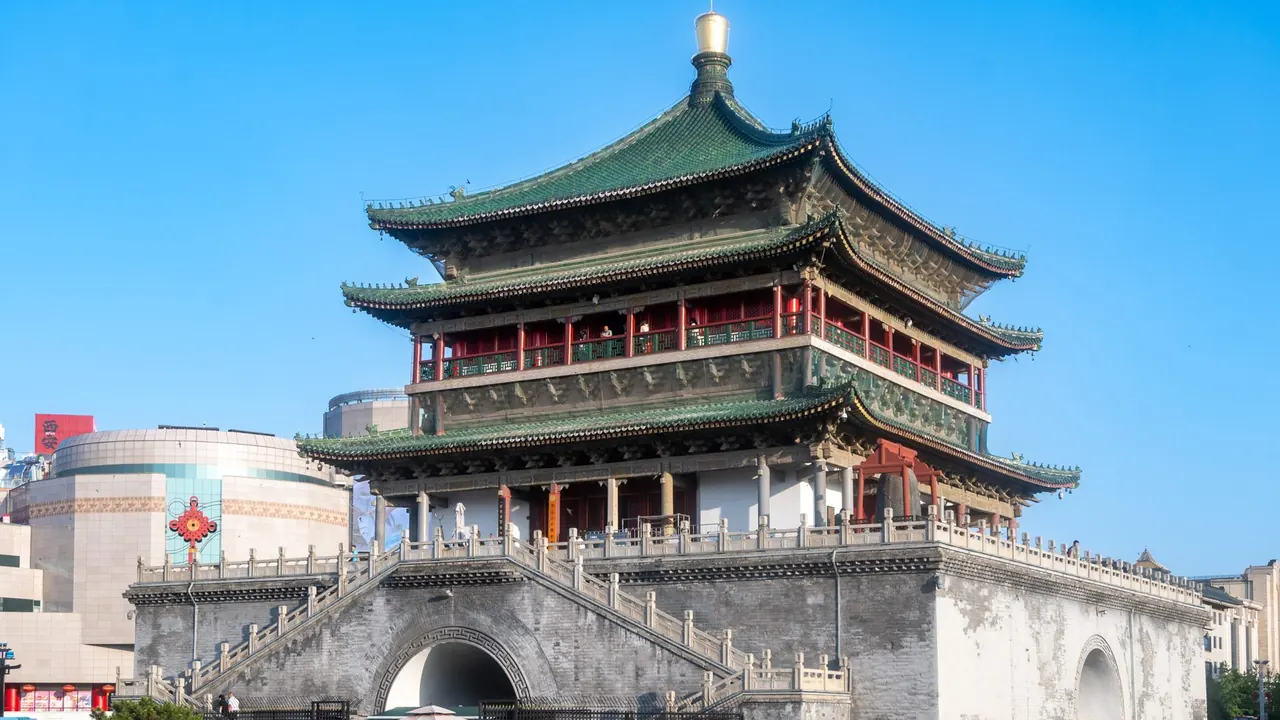
The Bell Tower of Xi'an under a blue sky
- Culture & sights81
- Day trips80
- Affordable cities80
Photo: xiquinhosilva, CC BY 2.0, cropped
Match
55
Every category weighted equally
- Beach & sun50
- Culture & arts62
- Food & nightlife56
- Family trip56
- Outdoors59
- Relax & unwind52
- Shopping & style57
- On a budget58
Xi'an in twelve categories
Our verdict on each, scored 0 to 100 against the same fixed benchmark cities, so a score means the same thing on every page.
Beaches & swimming. Scores 4 out of 100.
Food & drink. Scores 70 out of 100.
Culture & sights. Scores 81 out of 100.
Nightlife. Scores 42 out of 100.
Nature & outdoors. Scores 62 out of 100.
Day trips. Scores 80 out of 100.
Good for families. Scores 48 out of 100.
Getting around. Scores 66 out of 100.
Shopping & style. Scores 50 out of 100.
Affordability. Scores 80 out of 100.
Live music & performing arts. Scores 40 out of 100.
Wellness & relaxation. Scores 40 out of 100.
Xi'an category by category
Beaches & swimming
4Xi'an lies deep in China's interior, a very long way from any coast, and beaches play no part in a visit. Swimming means a hotel pool or a hot-spring resort in the Lintong district. Travellers who want sand and sea pair Xi'an with a coastal city elsewhere in China.
Food & drink
70Xi'an is a wheat city, and eating here is about noodles and bread rather than rice. Hand-pulled and belt-wide biangbiang noodles, roujiamo (shredded meat in a griddled bun), cold liangpi noodles and yangrou paomo, a mutton soup into which you crumble flatbread yourself, are the local staples. The Hui Muslim Quarter behind the Drum Tower is the great eating street, with lamb skewers, persimmon cakes and sesame sweets from open stalls late into the evening.
Beyond that the range narrows. Dumpling banquets and Shaanxi home cooking are easy to find, but wine, coffee and international dining are modest, and the fine-dining tier is small. This is a city for cheap, hearty, spicy and sour food eaten fast.
Culture & sights
81As the capital of thirteen dynasties and the start of the Silk Road, Xi'an carries more of ancient China than almost any other city. Its Ming-era city wall survives complete, a 14km rampart with gate towers that you can walk or cycle around, enclosing the Bell and Drum Towers at the centre. The Shaanxi History Museum holds one of the country's finest collections, from Zhou bronzes to Tang gold and murals, and the Forest of Steles keeps a millennium of carved calligraphy.
The Tang dynasty survives in the Big and Small Wild Goose Pagodas and the vast site of the Daming Palace. The Great Mosque, built as a Chinese courtyard temple, sits in the lanes of the Muslim Quarter. Much of the city outside the wall is modern, and some reconstructed streets feel staged.
Nightlife
42Evenings in Xi'an are lively but mostly early and public. Crowds stroll the floodlit Tang-style boulevard south of the Big Wild Goose Pagoda, the Muslim Quarter and the lit-up wall gates, eating as they go. For drinks there is a cluster of bars along Defu Xiang near the South Gate and in the student districts, plus a few big, loud clubs aimed at local crowds. It is fine for a beer and people-watching, but few visitors plan their trip around going out here.
Nature & outdoors
62The city sits on the flat, often hazy Guanzhong plain, but the Qinling Mountains rise abruptly to the south. The Zhongnan foothills, long a retreat for Taoist hermits, are about an hour away, with forested valleys, temples and walking trails. Mount Hua, one of China's sacred peaks, is a short fast-train ride east: sheer granite ridges, cable cars and narrow cliff paths make for a hard, thrilling day.
Taibai Mountain, the highest in the Qinling, is a longer outing for serious hikers. Within the city, green space is limited to parks and the moat gardens below the wall. Summers are hot and winters dry and cold, so spring and autumn suit the hills best.
Day trips
80Xi'an's most famous sight lies outside the city: the Terracotta Army, about an hour east in Lintong, where thousands of clay soldiers stand in their excavation pits beside the burial mound of the first emperor. Huaqing Palace, the Tang imperial hot-spring retreat, sits at the foot of the same hill, so the two make a natural day together.
West and north of the city, the Hanyangling tomb with its miniature figures, the Tang Qianling mausoleum and its avenue of stone statues, and Famen Temple with its Buddhist relics all make good excursions. High-speed trains reach Luoyang in about an hour and a half, for the Buddhist carvings of the Longmen Grottoes and the White Horse Temple.
Good for families
48Children tend to love cycling on top of the city wall, and the Terracotta Army impresses most ages for an hour or so. The Qinling wildlife park south of the city has giant pandas and golden monkeys, and the evening lights around the pagodas and the wall gates keep families entertained after dark. Beyond that, the attractions are museums and tombs aimed at adults. Crowds during China's national vacation weeks can be overwhelming, summers are hot, and traffic makes pushing a buggy hard going outside the walled centre.
Getting around
66The walled centre is compact and laid out on a grid, so the Bell and Drum Towers, the Muslim Quarter and the Forest of Steles are all within walking distance. A large metro network links the centre with the pagodas, the railway stations and the airport, and stations have English signage. Line 9 runs east to Lintong and Huaqing Palace, and from there a short bus or taxi ride covers the last stretch to the Terracotta Army. Taxis and ride-hailing are plentiful and cheap. Roads are congested at rush hour, and most things outside the metro are signed only in Chinese.
Shopping & style
50Shopping here leans towards crafts and souvenirs. Shuyuanmen, an old lane inside the South Gate, sells calligraphy brushes, ink stones, seals and paper, and is the best place for a lasting memento. The Muslim Quarter offers dried fruit, tea, shadow puppets and a great deal of tourist trinkets. Replica terracotta warriors are sold everywhere, in every size. Large malls around the Bell Tower and in the high-tech districts carry international brands and luxury labels, but fashion is not why anyone comes to Xi'an.
Affordability
80Xi'an is an inexpensive city by any Western standard and cheaper than China's big coastal cities. Noodles, dumplings and street snacks cost very little, metro and taxi fares are low, and comfortable hotels, even inside the wall, are good value. The main expense is admission: the Terracotta Army, the wall and the larger palace and tomb sites charge noticeable fees, and these add up over a few days of sightseeing.
Live music & performing arts
40The performances most visitors see are staged for them: Tang dynasty music-and-dance dinner shows in the city, and large outdoor spectacles on the hillside at Huaqing Palace that retell the story of an emperor and his consort. More rooted is Qinqiang, the loud, raw local opera of Shaanxi, performed in small theatres and parks, along with drum music and shadow puppetry. The city has a provincial grand theatre and a symphony orchestra, but the classical, theatre and live-music circuit is modest.
Wellness & relaxation
40Xi'an is a city for sightseeing rather than slowing down. The hot springs at Lintong were bathed in by Tang emperors, and resort hotels there still pipe the spring water into pools, a calm contrast to the city. In town, foot-massage parlours and Chinese bathhouses with saunas and rest halls are common and cheap. The quietest corners are the temple courtyards, the parks around the pagodas and the city wall early in the morning.
When should you go?
Pick a month to see what it is like. The climate figures are measured averages, not a forecast.
Xi'an in July
Daytime high, °C
Rainfall in the month, mm
The whole year
Shaded against this city’s own year: the deepest cell is its best month for that figure and the palest its weakest.
Temperature and rainfall are climate normals, averaged over the years shown. Xi'an: 1991-2020 normals, Xi'An (4.4 km from centre).
Before you go
| Measure | Xi'an |
|---|---|
| Official language | Putonghua |
| Currency | Yuan Renminbi (CNY) |
| Sockets | ACI220 V, 50 Hz |
| Driving side | Right |
| Time zone | UTC+8 |
| Emergency number | Police 110, ambulance 120, fire 119 |
| Elevation | 405 m |
| Main airport | Xi'an Xianyang International Airport (XIY)26 km from centre178 non-stop destinations |
| Public holidays this year | 6 days |
By the numbers
| Measure | Xi'an |
|---|---|
| City population | 12,952,907 |
| People per km² | 1,283 |
| Museums within 10 km | 9 |
| UNESCO World Heritage sites within 50 km | 2 |
Compare Xi'an with
Every comparison with a written verdict behind it.