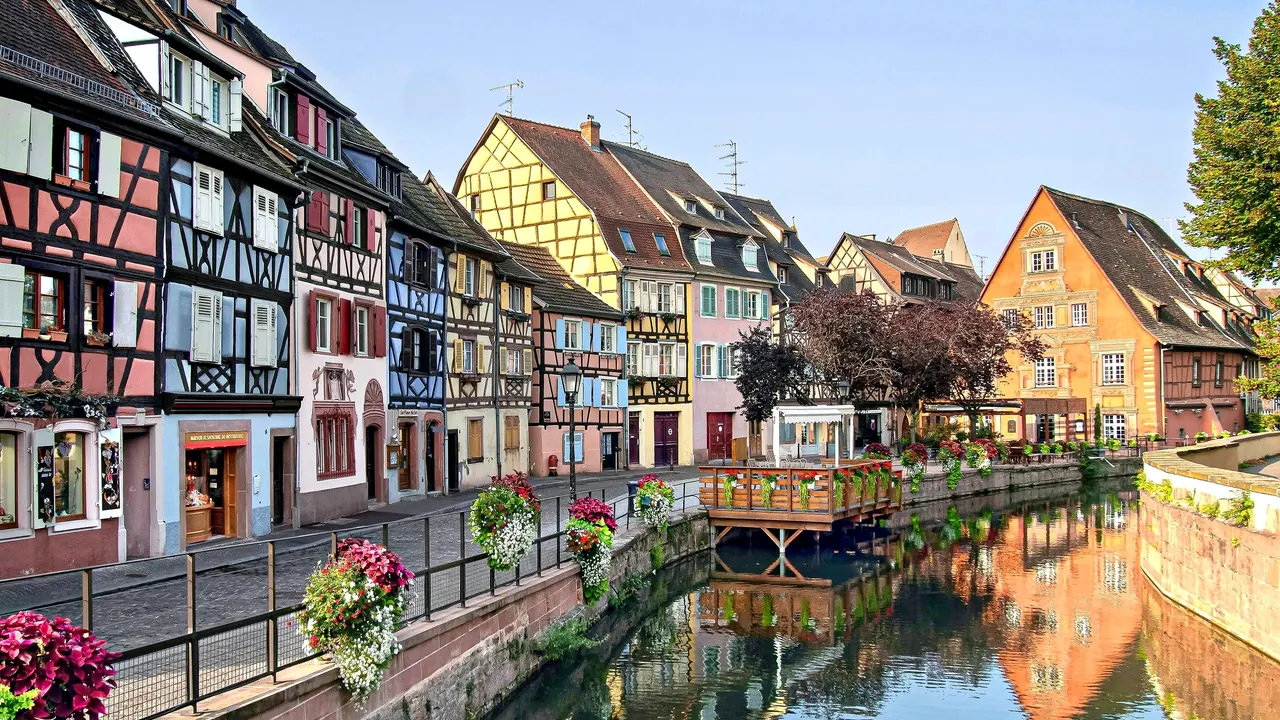
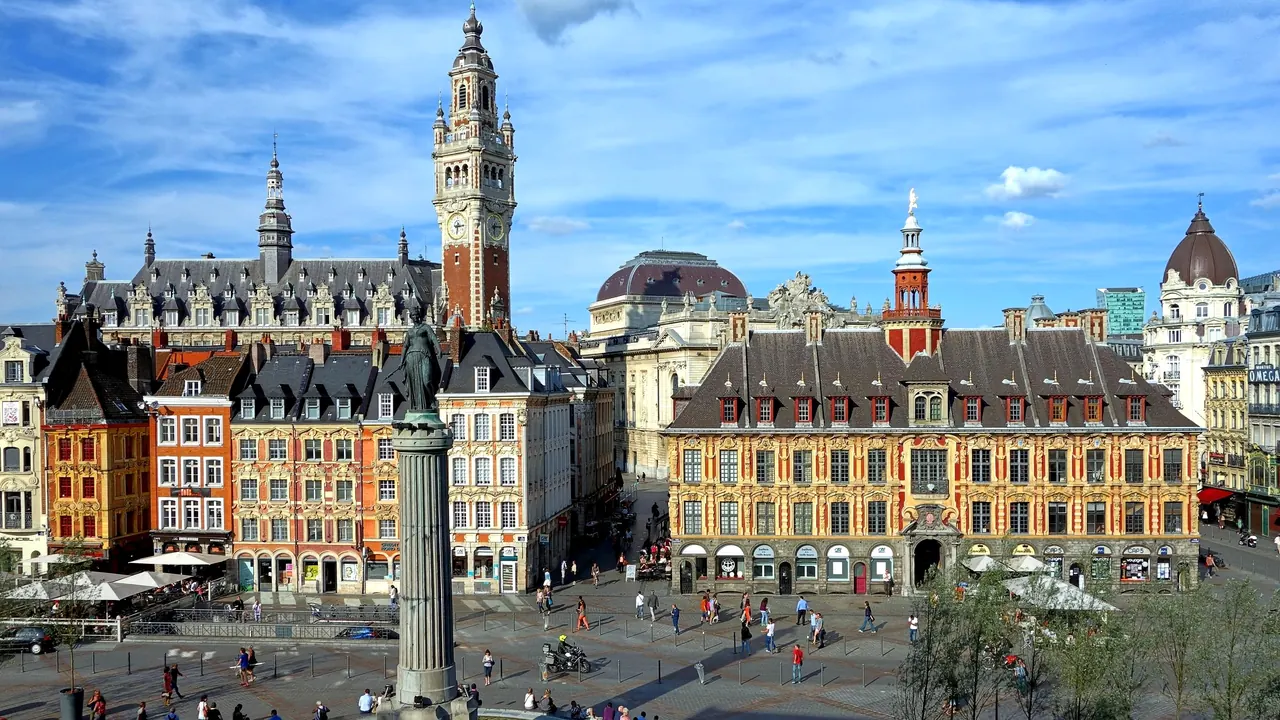
Photos: Colmar by Rolf Kranz, CC BY-SA 4.0, cropped; Lille by Velvet, CC BY-SA 3.0, cropped.
Colmar or Lille?
Our verdict in twelve categories, each scored against the same fixed benchmark cities, and the climate month by month, so you can choose for your trip.
Choose Colmar for
- nature and the outdoors
- families
- wellness
Colmar suits a slower trip built around landscape, wine and small towns. The old town survives as a single preserved whole, and the Isenheim Altarpiece alone justifies the journey. Just outside town the vineyards climb into the Vosges, with walled wine villages a few kilometres apart. It works best for couples, walkers, cyclists and families with a car, and for anyone happy to end the day with a long dinner rather than a night out.
Choose Lille for
- nightlife
- live music and the arts
- shopping
Pick Lille if you want a proper city with evenings to match. Its student bars and Vieux-Lille beer cafés keep going long after Colmar has gone quiet. The opera, orchestra and national theatre give it a real cultural season, and the shopping runs from chains to independent boutiques. With two stations beside the old town and a metro, you won't need a car, and Brussels, Bruges and Paris are easy trips by train.
Scoreboard
Twelve categories on one fixed scale from 0 to 100. The shaded stretch is the gap between the two.
Your match
Pick a travel style or drag the sliders, and both match scores follow your weighting.
Wins on nature and the outdoors and families with your weighting.
Wins on nightlife and live music and the arts with your weighting.
What matters to you?
Category by category
What the scores mean for a trip.
Beaches & swimming
Neither city is a beach destination, but Lille at least has the sea within reach. Malo-les-Bains at Dunkirk is about an hour away by train. It is a wide, windy North Sea beach, better for a bracing walk than a swim, and the dune beaches of the Opal Coast lie further on.
Colmar has no coast within any sensible day trip. Summer swimming there means the municipal pools or a lake up in the Vosges valleys.
Food & drink
Both cities eat regionally and well, in wood-panelled rooms, but what you drink sets them apart. Colmar is wine country. Choucroute, baeckeoffe and tarte flambée come with Riesling or Gewurztraminer from the slopes outside town, cellar tastings in the villages are part of the trip, and there are some ambitious restaurants in town and along the wine route.
Lille cooks Flemish: carbonnade simmered in beer, potjevleesch and the cheese-soaked welsh, with ales from brewery taps and specialist bars in place of wine. Its Sunday market at Wazemmes is a broader, more multi-ethnic affair than Colmar's covered market by the Lauch. In both cities the choice beyond regional cooking is limited.
Culture & sights
The two are evenly matched, and each has one museum worth the journey on its own. Colmar's strength is concentration. Its painted half-timbered old town, Petite Venise and the Isenheim Altarpiece at the Unterlinden all lie within a short walk, and two days covers them.
Lille is broader and more spread out. The Palais des Beaux-Arts is a large general collection of Flemish and Dutch masters, Goya and Delacroix. Vieux-Lille is Flemish baroque in brick and carved stone rather than painted timber. La Piscine in Roubaix and the LaM modern art museum both need a metro or tram ride.
Nightlife
Lille is far ahead here. Its large student population fills the cheap bars of Rue Masséna and Rue Solférino on Thursday nights. Vieux-Lille adds beer cafés and cocktail bars in old brick cellars, and the Belgian border is close for later nights.
In Colmar, an evening means dinner and a glass of wine on a terrace by the canals, and the streets empty early. Even the Christmas markets and the wine fair bring crowds rather than late nights.
Nature & outdoors
Colmar is much better placed for the outdoors. Vineyard paths start within half an hour of town, and the Munster and Kaysersberg valleys lead up to the Route des Crêtes and its glacial lakes. There is modest skiing in winter, and the Black Forest is about an hour away.
Around Lille the land is flat and farmed. You get the Citadel park and canal towpaths for easy rides, and short walks on Mont Noir and Mont des Cats. For real scenery you need the Opal Coast cliffs, a long day out.
Day trips
Both are first-rate bases, but the day trips differ in kind. From Colmar they are small and close: Eguisheim, Riquewihr and Kaysersberg a few kilometres apart, and Haut-Koenigsbourg on its ridge. Strasbourg is half an hour by train, and Basel and Freiburg are across the borders. The villages really need a car or a bike.
From Lille the trips are to big cities on fast trains. Brussels is about half an hour away, Paris about an hour, and Ghent, Bruges and even London are within reach. On the French side, Arras, Amiens cathedral and the First World War battlefields fill out the list.
Good for families
Colmar does more for children, though much of it needs a car. In town there are boat rides through Petite Venise, the little tourist train and storks on the rooftops. Out of town are the stork and otter park at Hunawihr, the macaques and eagle show at Kintzheim, the train and car museums in Mulhouse, and Europa-Park about an hour away.
Lille's offer centres on the Citadel park, with its small zoo and playgrounds, plus a hands-on science centre reached by metro. The cobbles of Vieux-Lille are hard work with a pushchair, and the bigger draws, Pairi Daiza and Nausicaá, are further out.
Getting around
Lille is the easier place to be without a car. Its two main stations sit beside the old town, the automated VAL metro and the tram reach out to Roubaix and Tourcoing, and the centre is flat and walkable.
Colmar is just as walkable within town, and trains to Strasbourg and Mulhouse are quick. But its best country is in the wine villages and Vosges valleys, where buses are thin, so most visitors hire a car or a bicycle.
Shopping & style
Lille is a real shopping city by comparison. It has chains on Rue Neuve, the Euralille mall by the stations, and independent fashion, design shops and delicatessens in Vieux-Lille. At the start of September, the huge Braderie flea market spreads over kilometres of streets.
Shopping in Colmar is for things to take home from Alsace: wine bought from the producer, Soufflenheim pottery, printed table linen and gingerbread. Its Christmas markets are the high point of the year, but fashion is limited.
Affordability
Costs are much the same in both, moderate for Western Europe, and the difference is when rooms get expensive. Colmar is small, so hotels fill in summer and are expensive during the Christmas market weeks. Free or cheap tastings in the villages help, and staying in a nearby village eases the cost.
Lille has more rooms at reasonable rates for most of the year, with prices rising during the Braderie and the big trade fairs. Its inexpensive metro and fairly priced estaminets keep day-to-day spending steady.
Live music & performing arts
Lille has a full season that Colmar cannot match. It has the Opéra de Lille, the Orchestre National de Lille and the Théâtre du Nord, one of France's national theatres. Roubaix and Tourcoing add contemporary dance, and touring bands play the Zénith and the Aéronef.
Colmar has a small Italian-style theatre and visits from the Opéra national du Rhin, but most of its music comes at festival times: classical in early July, jazz in autumn, and the concerts of the summer wine fair.
Wellness & relaxation
Neither is a spa destination, and in both, spas mostly mean hotel spas. Colmar's restfulness lies in its pace: quiet evenings by the canals once the day-trippers leave, and unhurried walks through the vines.
Lille is less restful in itself, but there is a real thermal bath a short train ride away at Saint-Amand-les-Eaux. The tea rooms of Vieux-Lille are good for slow afternoons.
When should you go?
Pick your month. The climate figures are measured averages, not a forecast.
Colmar in July
Lille in July
Daytime high, °C
Rainfall in the month, mm
Temperature and rainfall are climate normals, averaged over the years shown. Colmar: 1991-2020 normals, Ihringen (21.1 km from centre). Lille: 1991-2020 normals, Lille (7.8 km from centre).
Colmar has the warmer, sunnier summer of the two. July and August reach about 27°C with close to 250 hours of sunshine a month, so late spring through early September is good for walking the old town and the vineyards. May is its wettest month, at 87mm. Autumn brings the harvest and is the finest time in the vines. Winter is cold but fairly dry. Neither city is ever warm enough for beach weather.
Lille's year is more even. Its winters are a touch less cold and its summers cooler, peaking around 24°C. It is wetter overall, and the rain gets heavier in late autumn and winter, up to 76mm in December. Summers rarely get uncomfortably hot, so June to September suits long days on foot. Because the city is built around its museums, a city break works in any month, rain or not.
Which traveller are you?
On an outdoors trip, Colmar wins clearly. Marked paths run through the vines between wine villages, the Route des Crêtes climbs past the Hohneck and the Grand Ballon, and the plain is easy cycling. Around Lille, flat Flanders offers only canal towpaths and low hills.
For a food and nightlife trip, Lille is the better bet. Estaminet dinners of carbonnade and welsh lead on to beer cafés in Vieux-Lille and loud student bars on Rue Masséna. Colmar eats just as well, with Alsace wine, but goes quiet early.
On a family trip with young children, Colmar has more to do, provided you have a car. There are boat rides through Petite Venise, the stork park at Hunawihr, the macaques at Kintzheim and Europa-Park across the Rhine. Lille relies mainly on its Citadel park and small zoo.
Before you go
| Measure | Colmar | Lille |
|---|---|---|
| Official language | French | French |
| Currency | Euro (EUR) | Euro (EUR) |
| Sockets | CE230 V, 50 Hz | CE230 V, 50 Hz |
| Driving side | Right | Right |
| Time zone | UTC+1, UTC+2 in summer | UTC+1, UTC+2 in summer |
| Emergency number | 112 | 112 |
| Elevation | 185 m | 17 m |
| Main airport | EuroAirport Basel–Mulhouse–Freiburg (BSL)55 km from centre112 non-stop destinations | Lille Airport (LIL)8 km from centre61 non-stop destinations |
| Public holidays this year | 11 days | 11 days |
By the numbers
| Measure | Colmar | Lille |
|---|---|---|
| City population | 66,970 | 238,246 |
| People per km² | 1,006 | 6,846 |
| Museums within 10 km | 9 | 23 |
| UNESCO World Heritage sites within 50 km | 3 | 6 |
Where else could you go?
Every comparison below shares a destination with this one, so you can follow Colmar or Lille somewhere new.