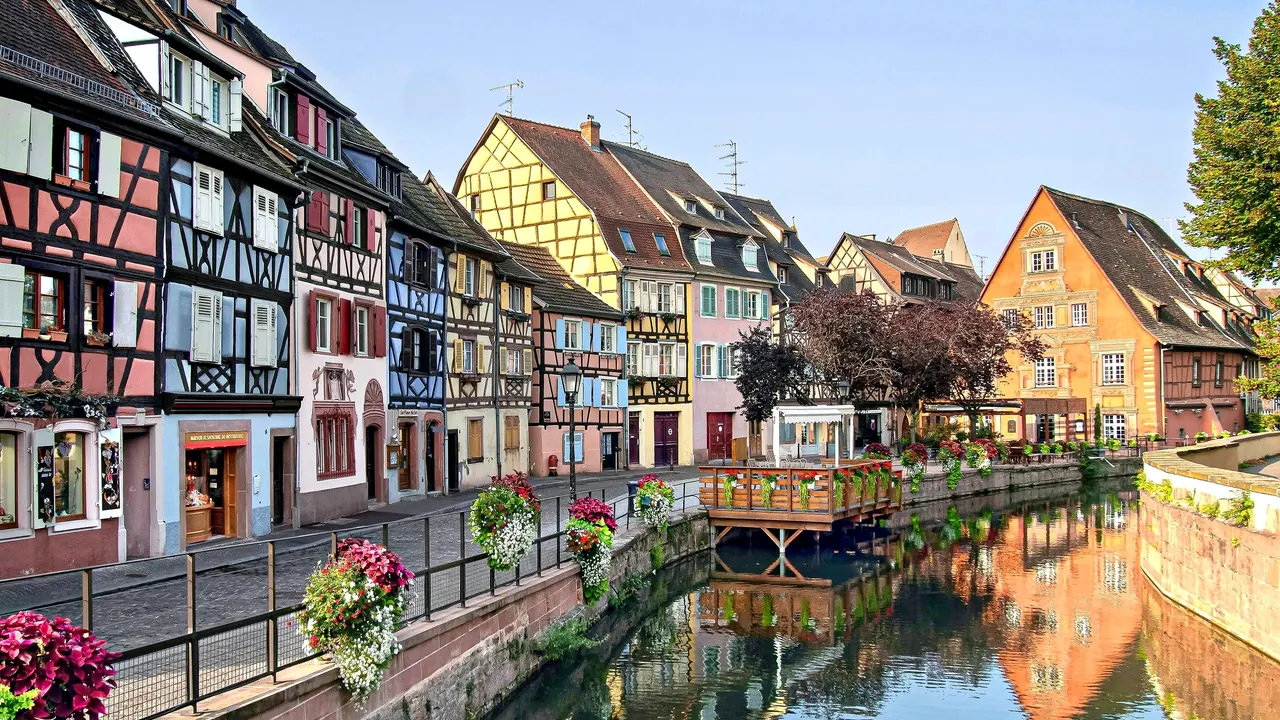
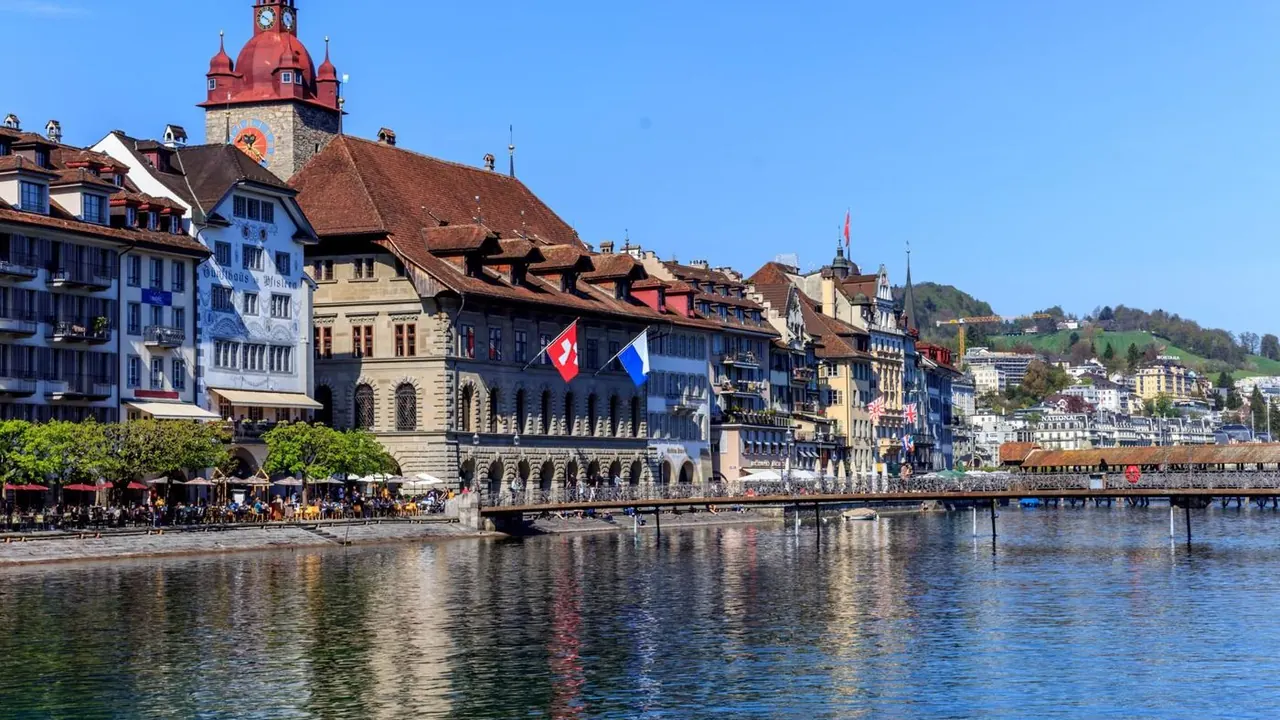
Photos: Colmar by Rolf Kranz, CC BY-SA 4.0, cropped; Lucerne by ILOVESwitzerland, Pexels License.
Colmar or Lucerne?
Our verdict in twelve categories, each scored against the same fixed benchmark cities, and the climate month by month, so you can choose for your trip.
Choose Colmar for
- prices
- food and drink
- day trips
Colmar is the better pick for a slow trip built around eating, drinking and old towns. The cooking of Alsace and the wines from the slopes above town are reasons to come in their own right, and the painted half-timbered centre rewards a couple of unhurried days. The wine villages, Strasbourg, Basel and Freiburg all make easy outings. It also costs far less than Lucerne, as long as you avoid the Christmas market weeks or stay in a village.
Choose Lucerne for
- live music and the arts
- beaches
- getting around
Travellers who come for mountains and lake will be happier in Lucerne. The paddle steamers leave from piers right in front of the station, and from there boats, trains, cogwheel railways and cable cars connect you to Pilatus and Rigi, all on one integrated network. You never need a car, and a day of boat, cogwheel train and ridge walk is simple to put together. Add the world-class orchestras of the late-summer festival and summer swims from the old lake baths, and it suits an active, scenic trip, provided the budget can take Swiss prices.
Scoreboard
Twelve categories on one fixed scale from 0 to 100. The shaded stretch is the gap between the two.
Your match
Pick a travel style or drag the sliders, and both match scores follow your weighting.
Wins on prices and food and drink with your weighting.
Wins on live music and the arts and beaches with your weighting.
What matters to you?
Category by category
What the scores mean for a trip.
Beaches & swimming
Neither city has a coast, but only Lucerne gives you somewhere real to swim. In July and August locals swim from the Lido, the old wooden lake baths and the lawns at Ufschötti, in clean water backed by mountains. The shore is grass and jetties rather than sand, and the season is short.
In Colmar a swim means a municipal pool or a drive up to a small lake in the Vosges valleys. If cooling off in open water matters to you, Lucerne is the one.
Food & drink
Colmar is the clear winner at the table. The winstubs serve the hearty, half-German cooking of Alsace, from baeckeoffe and choucroute to tarte flambée and munster cheese. The covered market by the canal is good for picnic supplies, and a few ambitious kitchens along the wine route add a fine-dining option. Above all there is the wine, poured everywhere and tasted at the cellar door.
Lucerne's Chügelipastete, fondue and lake perch are reliable but narrow in range, and many places near the Chapel Bridge cater to coach parties. You will eat well and pay a lot, but food is rarely the reason to choose it.
Culture & sights
Colmar has a slight edge for sightseeing. Its old town has survived as one continuous late-medieval and Renaissance whole, from the carved faces of the Maison des Têtes to the canals of the tanners' quarter. The Unterlinden Museum adds Grünewald's Isenheim Altarpiece, and Schongauer's Madonna in the Dominican church gives the town a depth of medieval art that Lucerne cannot match.
Lucerne packs a handful of Switzerland's best-known sights into and around its compact Old Town: the Chapel Bridge and Water Tower over the Reuss, the towers of the Musegg Wall that you can climb, the Lion Monument carved into its cliff, and the Picasso and Klee of the Rosengart Collection. It is more a set of famous images than a deep collection, and like Colmar it is seen in a day or two.
Nightlife
Neither city is for late nights, but Lucerne has a little more going on. Cocktail bars in the Neustadt, a small club scene near the station and student weekends keep a few places open, and at Fasnacht the whole town stays out in costume until dawn.
Colmar's evenings end with dinner and a last glass in a wine bar by Petite Venise, and for anything more you take the train to Strasbourg.
Nature & outdoors
Lucerne's setting is in another league. You can be on Pilatus by cogwheel railway, walking the ridge of Rigi or out on the glacier at Titlis within the hour. Paddle steamers on the branching lake tie it all together, and in winter there is proper skiing. The one catch is low cloud, which can hide the peaks for days.
Colmar offers gentler country: walks through the vines between wine villages, the rounded, forested Vosges with glacial lakes along the Route des Crêtes, and flat roads that make for easy cycling. It is lovely, especially at harvest time, but softer than the Alps and mostly needs a car.
Day trips
Colmar is slightly the better base for day trips. The wine villages of Eguisheim, Riquewihr, Kaysersberg and Ribeauvillé lie a few kilometres apart, Haut-Koenigsbourg looks down from its ridge, and Strasbourg, Basel and Freiburg take you into three different cities and two countries. The villages are much easier with a car or bike, though.
Lucerne's outings rely on fast trains to Zurich, Bern and Basel and on the lake, where boats run to the Rütli meadow and the William Tell country around Altdorf. Getting there is easier, but the range of places is a little narrower.
Good for families
Both work well with children, in different ways. Colmar's own pleasures are small, like boat rides through Petite Venise and storks on the rooftops. Its big draws are outside town: the macaques at the Montagne des Singes, the stork park at Hunawihr, the train and car museums in Mulhouse, and Europa-Park about an hour across the Rhine, almost all needing a car.
Lucerne has one major attraction in the Swiss Museum of Transport, and the outings themselves become the fun: steamers, cogwheel trains and the summer toboggan run on Pilatus. These depend on the weather and are costly, and with no zoo nearby, wet days can be hard to fill.
Getting around
Lucerne is much easier to get around. Station, boat piers and Old Town sit together on the lakefront, and the steamers, cogwheel railways and cable cars into the mountains all run on integrated tickets, so you can do everything without a car.
Colmar's centre is just as walkable and trains reach Strasbourg and Mulhouse quickly. The gap shows once you head for the wine villages and the Vosges, where buses are thin and most visitors hire a car or a bicycle.
Shopping & style
Lucerne is a little stronger for shopping, mainly if you are after a Swiss watch. The big watch and jewellery houses on Schwanenplatz and the lakefront are the main event, alongside army knives and chocolate. Fashion is thin.
Colmar's shopping is about the region: wine bought from the producer, Soufflenheim pottery, kougelhopf moulds and printed table linen, with the Christmas markets as the high point. It is better for gifts than for anything else.
Affordability
Colmar is far kinder to the wallet. Prices are moderate for provincial France and tastings in the villages are often free. The real cost is rooms in summer and at Christmas, which a village base can soften.
Lucerne is among the most expensive places you could choose. Rooms, even simple meals and the mountain railways that are the point of the trip all add up. A Swiss travel pass and supermarket picnics by the lake help, but only at the margins.
Live music & performing arts
For music, Lucerne is clearly ahead. The Lucerne Festival brings the world's leading orchestras to Jean Nouvel's lakefront hall, which keeps a year-round programme with its own symphony orchestra, and the city theatre stages opera and dance.
Colmar has a small Italian-style theatre, a classical festival in July and an autumn jazz festival. Between those weeks, serious concerts mean going to Strasbourg or Basel.
Wellness & relaxation
Colmar's idea of rest is the slow evening: walks by the canals once the day-trippers have gone, long lunches and unhurried strolls through the vines. Hotel spas are the only real pampering on offer.
Lucerne gives you more to work with. Botta's mineral bath high on the Rigi offers a soak with a mountain view, and the resorts on the slopes above the lake have proper spas. A long steamer trip with nothing to do but watch the shore makes an easy afternoon. Visit the Old Town early or late, though, because the tour groups arrive in the middle of the day.
When should you go?
Pick your month. The climate figures are measured averages, not a forecast.
Colmar in July
Lucerne in July
Daytime high, °C
Rainfall in the month, mm
Where the figures come from
Lucerne has no rain gauge within 25 km of the centre, so its rainfall comes from a gridded climate dataset read at the city rather than from a gauge further away.
Lucerne's sunshine is measured 42 km from the centre, at Zurich Town / Ville..
Temperature and rainfall are climate normals, averaged over the years shown. Colmar: 1991-2020 normals, Ihringen (21.1 km from centre). Lucerne: 2005-2025 (sunshine 1991-2020, rainfall 1991-2020) normals, Emmen (4.2 km from centre).
Colmar is the warmer and much drier of the two. Summer highs reach about 27°C in August and the town gets plenty of sun from May to August, though July and August can feel close on the plain. Even its wettest month, May at about 87mm, gets far less rain than Lucerne. Autumn is its finest season: September is still mild and the grape harvest colours the vines. Winters are cold and grey, so December is really for the Christmas markets.
Lucerne runs a few degrees cooler, peaking around 24°C in July and August, which suits hiking but leaves only a short window for swimming in the lake. Summer is also its wettest stretch, with about 141mm in July and August, so plan for some rainy or cloudy mountain days. Late spring and September are a good compromise for walking. December to February are cold and dull in town but bring snow to the mountains.
Which traveller are you?
On a trip on a tight budget, Colmar is much the easier choice. Set lunches, regional wine and free village tastings keep the days affordable, while in Lucerne meals, rooms and mountain railways are all expensive and no amount of planning makes it cheap.
For an outdoors trip, Lucerne is ahead. Pilatus, Rigi, the Stanserhorn and the Titlis glacier are all reached by train, boat or cable car without a car. Colmar's vineyard paths and Vosges ridges are lovely, but mostly need wheels.
For wine lovers, Colmar is the obvious place. Riesling, Gewurztraminer and Pinot Gris come from slopes a short drive away, with cellar tastings in Eguisheim, Riquewihr and Kaysersberg. Lucerne pours some pleasant Swiss whites by the river, but has nothing comparable.
Before you go
| Measure | Colmar | Lucerne |
|---|---|---|
| Official language | French | French, German, Italian, Romansh |
| Currency | Euro (EUR) | Swiss Franc (CHF) |
| Sockets | CE230 V, 50 Hz | CJ230 V, 50 Hz |
| Driving side | Right | Right |
| Time zone | UTC+1, UTC+2 in summer | UTC+1, UTC+2 in summer |
| Emergency number | 112 | 112 |
| Elevation | 185 m | 436 m |
| Main airport | EuroAirport Basel–Mulhouse–Freiburg (BSL)55 km from centre112 non-stop destinations | Zürich Airport (ZRH)49 km from centre226 non-stop destinations |
| Public holidays this year | 11 days | 12 days |
By the numbers
| Measure | Colmar | Lucerne |
|---|---|---|
| City population | 66,970 | 86,234 |
| People per km² | 1,006 | 2,963 |
| Museums within 10 km | 9 | 14 |
| UNESCO World Heritage sites within 50 km | 3 | 1 |
Where else could you go?
Every comparison below shares a destination with this one, so you can follow Colmar or Lucerne somewhere new.