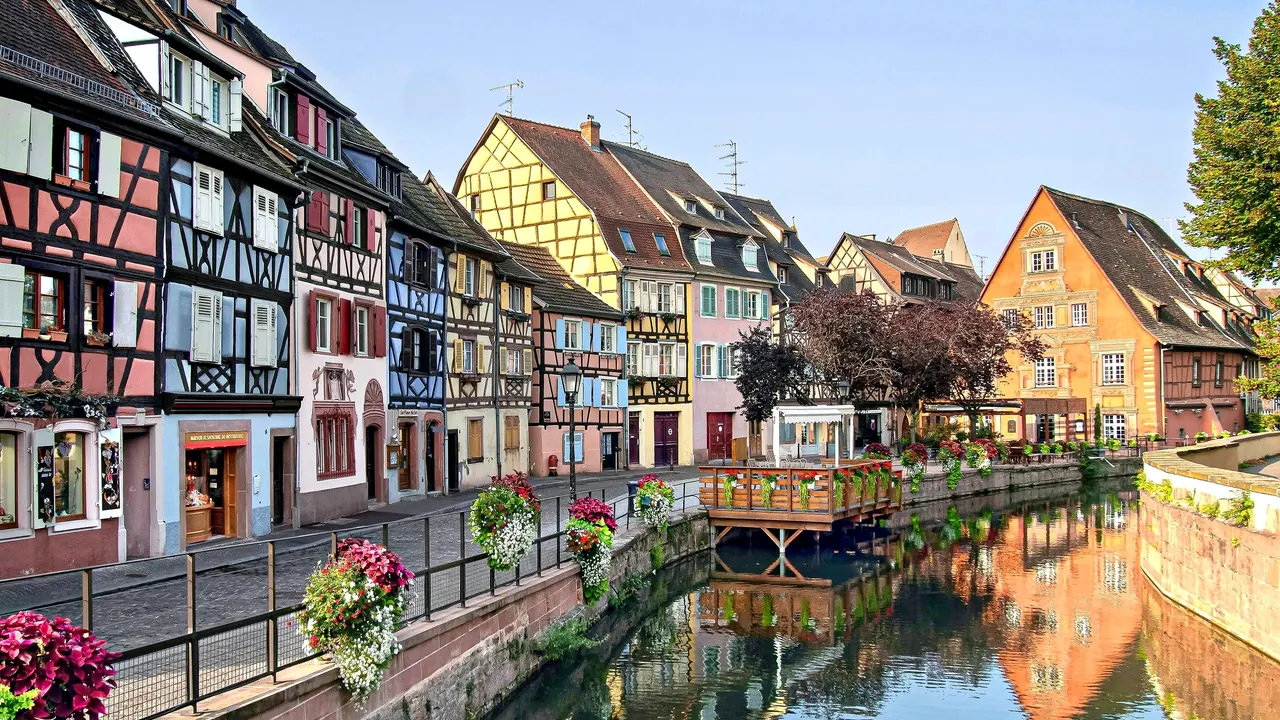
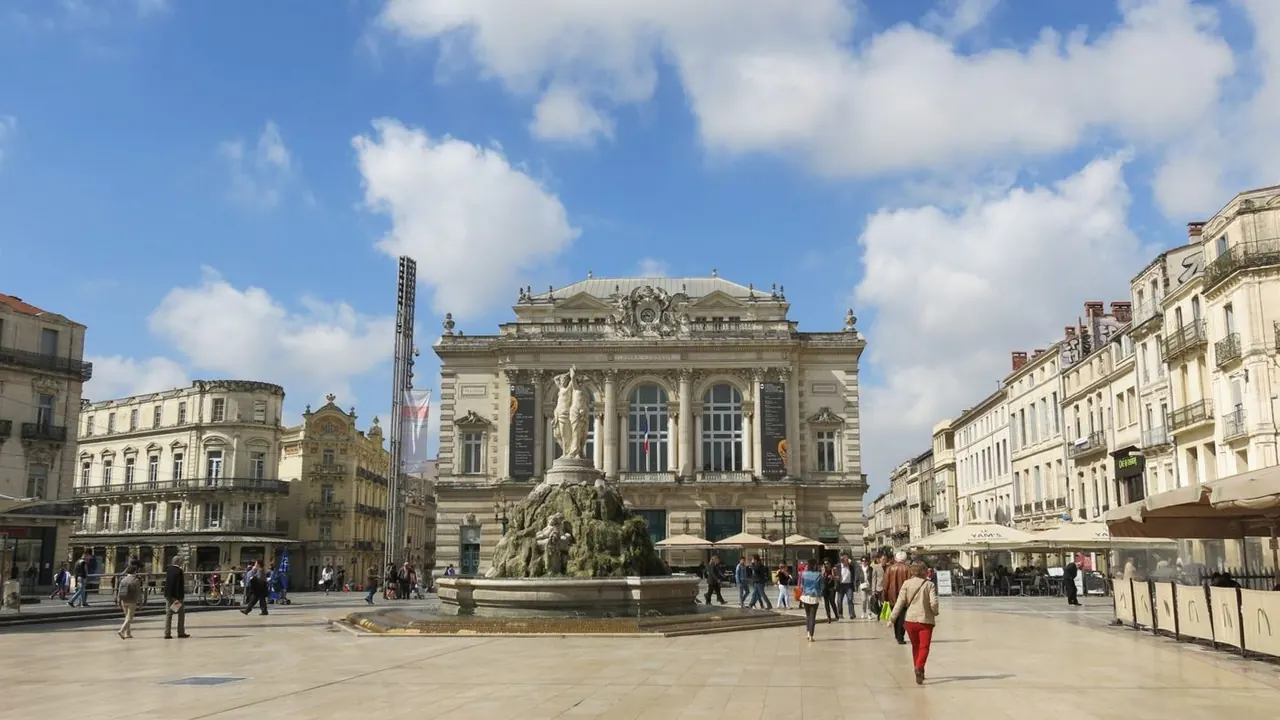
Photos: Colmar by Rolf Kranz, CC BY-SA 4.0, cropped; Montpellier by Peter, CC BY 2.0, cropped.
Colmar or Montpellier?
Our verdict in twelve categories, each scored against the same fixed benchmark cities, and the climate month by month, so you can choose for your trip.
Choose Colmar for
- culture and sights
- families
Colmar suits a slower, more contained trip built around wine, painted half-timbered streets and short drives into the vineyards and the Vosges. It is the better choice for couples and older travellers who want long dinners in a winstub, a great altarpiece in a former convent, and quiet evenings by the canals. In December the Christmas markets make it a destination in their own right. Plan on a car or a bicycle for the villages, and expect the town to go quiet after dinner.
Choose Montpellier for
- beaches
- nightlife
- live music and the arts
Montpellier gives you more of a living city. A large student population keeps the terraces busy late, the opera houses and the summer dance festival give it a real stage, and a tram network makes it easy to get around without a car. The Mediterranean is close enough for afternoons on the sand, and the sun lasts far longer through the year. Choose it if you want the beach, some nightlife and Roman Provence within reach of one base.
Scoreboard
Twelve categories on one fixed scale from 0 to 100. The shaded stretch is the gap between the two.
Your match
Pick a travel style or drag the sliders, and both match scores follow your weighting.
Wins on culture and sights and families with your weighting.
Wins on beaches and nightlife with your weighting.
What matters to you?
Category by category
What the scores mean for a trip.
Beaches & swimming
Montpellier has a real coast within reach. A long run of fine sand starts at Palavas and Carnon and stretches past La Grande-Motte to the dunes of l'Espiguette, with gently shelving water that suits swimmers of every level. It is a flat, open shore that gets busy in high summer, better for a few beach days than a whole beach vacation.
Colmar has nothing comparable. It lies hundreds of kilometres from the sea, and a swim means a municipal pool or a small lake up in the Vosges.
Food & drink
Both cities eat well on their own region's cooking, and the difference is in the kind. Colmar is northern and hearty: choucroute, baeckeoffe, tarte flambée and munster cheese in wood-panelled winstubs, with Riesling and Gewurztraminer from slopes you can see from town.
Montpellier eats from the south and the sea: Thau lagoon oysters and mussels, octopus tielle from Sète, Pic Saint-Loup reds. Students keep plenty of cheap, casual places busy. Colmar has the slightly more distinctive regional table, while Montpellier gives you more variety at the bottom of the price range.
Culture & sights
Colmar's draw is one unusually complete old town: painted half-timbered houses, the gabled Maison Pfister, the carved faces of the Maison des Têtes and the canals of Petite Venise, all reading as a single whole. Then there is Grünewald's Isenheim Altarpiece at the Unterlinden Museum, a painting worth planning a visit around. It is compact, and two days does it justice.
Montpellier spreads its sights over more centuries and needs two or three days. Stone mansions with hidden courtyards line the car-free lanes of the Écusson. The Peyrou terrace looks down its aqueduct, the Jardin des Plantes is France's oldest botanical garden, and the Musée Fabre runs from the Flemish masters to Soulages. Bofill's Antigone adds twentieth-century architecture, which Colmar has no match for.
Nightlife
Here Montpellier is clearly ahead. Its students fill the bars around Place Jean-Jaurès and the squares of the old town all week, and the night goes on at clubs towards Lattes and the coast. It is a young, casual crowd, and things quieten outside term time.
Colmar's evenings end with dinner and a glass of wine on a terrace by the canals. There are a few wine bars and pubs, but almost no clubs, and anyone after a late night heads to Strasbourg.
Nature & outdoors
The outdoors are equally good, but the landscapes could hardly be more different. Around Colmar you walk through vineyards between wine villages, then climb into the rounded, forested Vosges along the Route des Crêtes, with glacial lakes, summer pastures and views to the Black Forest. There is even some modest skiing in winter.
Montpellier looks south to flamingo lagoons and the Camargue marshes, and north to the dry garrigue, the climb up Pic Saint-Loup and the Hérault gorges for canoeing. The windy coast adds kitesurfing. Its walking season is spring and autumn, while Colmar's is summer and autumn.
Day trips
Both are superb bases, each with a long list of outings. From Colmar you can do the storybook wine villages of Eguisheim and Riquewihr, Haut-Koenigsbourg castle, Strasbourg by train, and cross-border trips to Basel and Freiburg, which add a second country, or even a third.
Montpellier's outings lean towards Rome and the Middle Ages: the arena at Nîmes, the Pont du Gard, Arles, Avignon's papal palace and walled Carcassonne, with Sète and Aigues-Mortes closer in. The big towns are easy by train from Montpellier, while Colmar's best outings, the villages, really need a car or bike.
Good for families
With children the two are evenly matched, and the real difference is where the fun lies. Colmar itself is small, flat and calm, with flat-bottomed boat rides through Petite Venise and storks nesting on the roofs. Its bigger draws need a car: the free-roaming macaques and eagle show at Kintzheim, the stork and otter park at Hunawihr, and Europa-Park about an hour away across the Rhine.
Montpellier keeps more of it in town, with the Lunaret zoo in its wooded park and the aquarium and planetarium side by side at Odysseum, both easy by tram. Its gently shelving beaches suit small swimmers, but getting there means a tram and then a bus, which is slow in summer. The stone streets also get very hot in July and August.
Getting around
Montpellier is the easier place to manage without a car. Trams link the station, the old town, Antigone and the outer districts, bike-share helps on the flat, and the coast is reachable by tram and bus, if slowly.
Colmar's compact centre is a pleasure on foot, and trains run quickly to Strasbourg and Mulhouse. Beyond that, thin bus services leave the wine villages and the Vosges to those with a car or a bicycle.
Shopping & style
Montpellier offers more conventional shopping. It has fashion boutiques and bookshops in the Écusson, the Polygone mall beside the Comédie, and big brands at Odysseum.
Colmar is the better place for things to take home from the region: wine straight from the producer, Soufflenheim pottery, kougelhopf moulds and printed Alsatian linen. Its Christmas markets are the high point of the year. If you want clothes, it has little to offer.
Affordability
Costs are broadly similar, both mid-range by Western European standards. In Colmar, rooms are the problem: the town is small, and summer and the Christmas weeks push hotel prices up, though free village wine tastings help.
Montpellier's students keep cheap food and drink easy to find, and central hotels are fair for most of the year. Like Colmar, it gets expensive in its peak season, which here is July and August on the coast.
Live music & performing arts
Montpellier has far more on stage. Two opera houses share a season with a national orchestra, and the Montpellier Danse festival is one of Europe's most respected. In summer the Radio France festival and the open-air theatres of the Domaine d'O add more.
Colmar has a small Italian-style theatre, visits from the Opéra national du Rhin and a classical festival in July. For most of the year, though, serious music means a train to Strasbourg or Basel.
Wellness & relaxation
Montpellier has the edge, thanks to real thermal water at Balaruc-les-Bains on the Thau lagoon, about half an hour away, which takes day visitors. Its old town is lively rather than restful.
Colmar has no spa tradition beyond hotel spas, but it is the calmer place once the day-trippers leave. Evenings by the canals and slow walks through the vines make a restful few days.
When should you go?
Pick your month. The climate figures are measured averages, not a forecast.
Colmar in July
Montpellier in July
Daytime high, °C
Rainfall in the month, mm
Temperature and rainfall are climate normals, averaged over the years shown. Colmar: 1991-2020 normals, Ihringen (21.1 km from centre). Montpellier: 1991-2020 normals, Montpellier (7.8 km from centre).
Colmar has a continental climate, with real seasons. Summer is warm rather than hot, reaching about 27°C in August, which is pleasant for walking the old town and the vineyard paths. May and the summer months bring the most rain, often as showers. Winter is cold and grey, with highs around 6°C and little sun, but that is when the Christmas markets are on. September and October, mild and dry enough, with the harvest under way, are the best months for the wine villages.
Montpellier is warmer and much sunnier all year. July reaches about 30°C and is almost dry, which is hot for the stone streets but right for the beach. The sea is warm enough for swimming from late June to September, peaking near 22°C in August. Autumn turns wet, with October the rainiest month at around 93mm, often in heavy bursts. Spring is the best time for walking and sightseeing, and mild winter days are still comfortable for walking the city, which they are not in Colmar.
Which traveller are you?
On a beach and sun trip, Montpellier is the only real option. Sandy beaches and shallow, warm water are a short tram and bus ride away, and the summers are long and bright. Colmar sits deep inland, with only pools and mountain lakes.
For a food and nightlife trip, Montpellier wins on the night. The cooking is equally good in both places, but Colmar empties after dinner. Montpellier's student bars and terraces fill even on weeknights, and the clubs keep going on the edge of town.
For a Christmas market trip, Colmar is the choice. Its markets spread across several squares of painted medieval houses, with a children's market, bredele biscuits and mulled Alsace wine. Montpellier has nothing to match it in December.
Before you go
| Measure | Colmar | Montpellier |
|---|---|---|
| Official language | French | French |
| Currency | Euro (EUR) | Euro (EUR) |
| Sockets | CE230 V, 50 Hz | CE230 V, 50 Hz |
| Driving side | Right | Right |
| Time zone | UTC+1, UTC+2 in summer | UTC+1, UTC+2 in summer |
| Emergency number | 112 | 112 |
| Elevation | 185 m | 7 m |
| Main airport | EuroAirport Basel–Mulhouse–Freiburg (BSL)55 km from centre112 non-stop destinations | Montpellier-Méditerranée Airport (MPL)8 km from centre41 non-stop destinations |
| Public holidays this year | 11 days | 11 days |
By the numbers
| Measure | Colmar | Montpellier |
|---|---|---|
| City population | 66,970 | 310,240 |
| People per km² | 1,006 | 5,452 |
| Museums within 10 km | 9 | 14 |
| UNESCO World Heritage sites within 50 km | 3 | 2 |
| Swim season, months above 21 °C | - | 2 months |
Where else could you go?
Every comparison below shares a destination with this one, so you can follow Colmar or Montpellier somewhere new.
- Baselvs Colmar
- Strasbourgvs Colmar
- Avignonvs Montpellier
- Baden-Badenvs Colmar
- Zurichvs Colmar
- Marseillevs Montpellier