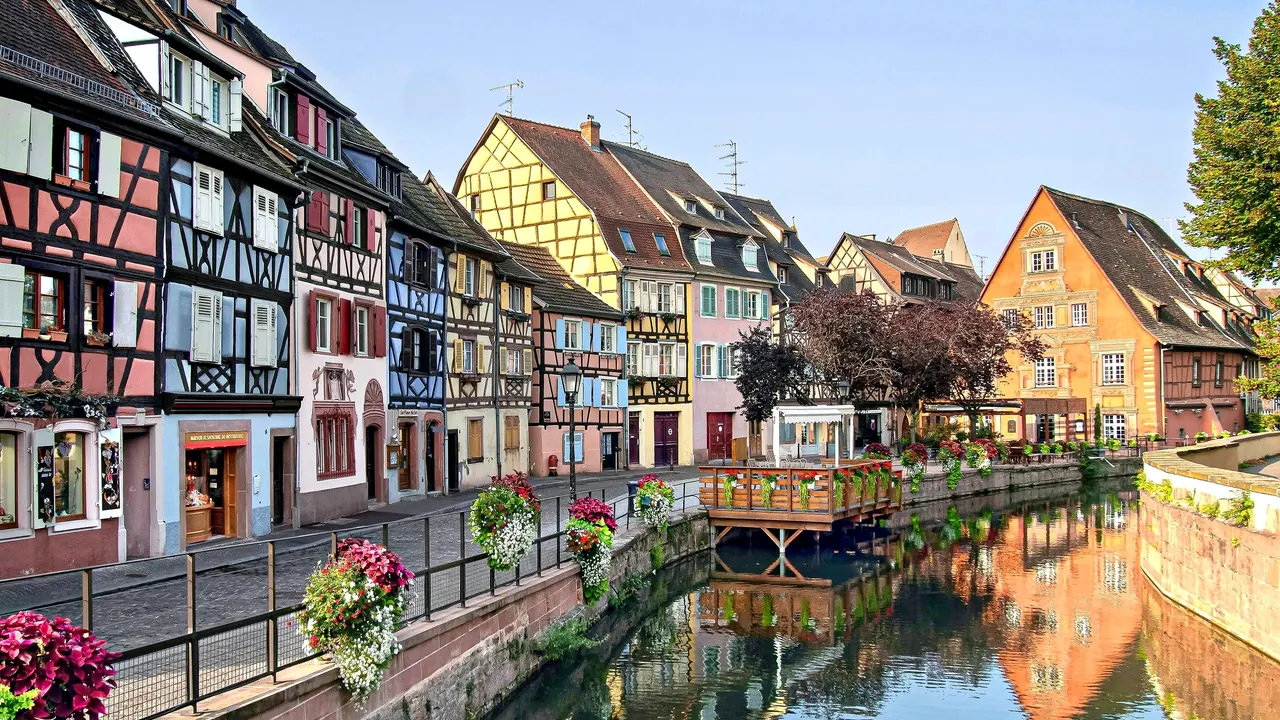
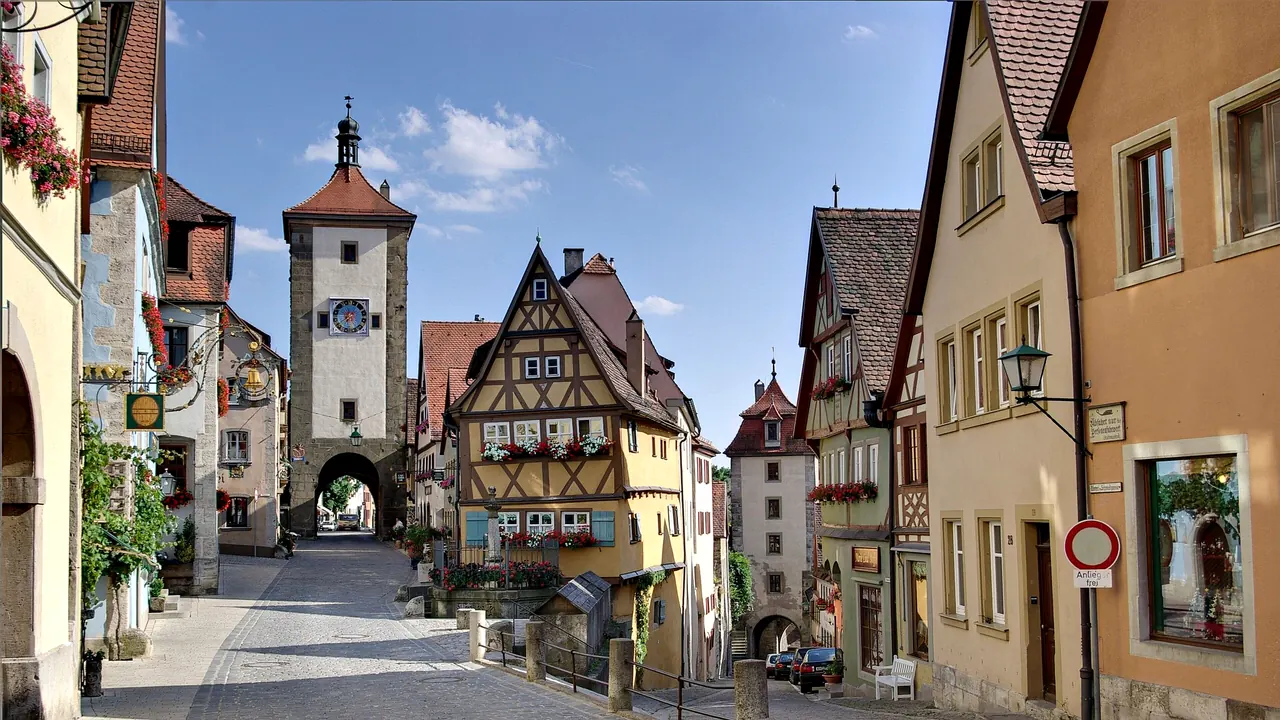
Photos: Colmar by Rolf Kranz, CC BY-SA 4.0, cropped; Rothenburg ob der Tauber by Berthold Werner, Public domain.
Colmar or Rothenburg ob der Tauber?
Our verdict in twelve categories, each scored against the same fixed benchmark cities, and the climate month by month, so you can choose for your trip.
Choose Colmar for
- food and drink
- nature and the outdoors
- families
Colmar suits the traveller who wants a town and a region together. The painted old town and the Isenheim Altarpiece fill a couple of days, and then come Alsace's long food and wine tradition, the vineyard villages, the Vosges ridges and easy trains to Strasbourg and Basel. Couples who like to eat well, walkers, cyclists and families with a car will all find more to do here.
Choose Rothenburg ob der Tauber for
- wellness
- beaches
Rothenburg ob der Tauber is the purer storybook. Its walls are complete and you can walk the top of them, there is almost nothing modern inside, and in the evening the town falls very quiet. Choose it for a short, slow stop on the Romantic Road, a walk with the night watchman and a soak in a Franconian thermal spa, and expect plain inn cooking and little else to do in the evenings.
Scoreboard
Twelve categories on one fixed scale from 0 to 100. The shaded stretch is the gap between the two.
Your match
Pick a travel style or drag the sliders, and both match scores follow your weighting.
Wins on food and drink and nature and the outdoors with your weighting.
Wins on wellness and beaches with your weighting.
What matters to you?
Category by category
What the scores mean for a trip.
Beaches & swimming
Neither town has anything for swimmers. Both lie deep inland, so summer swimming means a public pool or a drive to a lake.
The lakes differ. From Colmar they are small glacial lakes high in the Vosges valleys. From Rothenburg they are the grassy shores of the artificial Franconian lakes such as the Altmühlsee, about an hour away.
Food & drink
Colmar eats far better. Alsace sits between French and German cooking, and the town has panelled winstubs, munster cheese from the valleys above, kougelhopf, a covered market by the Lauch, and wine from slopes that start at the edge of town. There is also some fine dining in town and along the wine route.
Rothenburg's table is narrower: roast pork, Schäufele and bratwurst, with Silvaner in its round Bocksbeutel bottle. Many kitchens around the Marktplatz cook for coach parties, so the better meals are in family guesthouses away from the square. In both towns, avoid the menus on the most photographed streets.
Culture & sights
These two are closely matched, and both are among the most complete old towns in their countries. The difference is in character. Colmar is colourful and open, with painted half-timbered houses, canals and the carved faces of the Maison des Têtes. Rothenburg is enclosed by its walls and towers, and you can walk the covered wall walk above its rooftops.
The art treasures make a neat pair. Colmar has Grünewald's Isenheim Altarpiece at the Unterlinden and Schongauer's Madonna. Rothenburg answers with Riemenschneider's carved Holy Blood Altar and the grimly fascinating Medieval Crime Museum.
Nightlife
Neither is a place for a night out, but Colmar at least has an evening. Wine bars, pubs and brasseries around Petite Venise stay open after dinner, and the summer terraces stay pleasant late. Rothenburg's lanes are mostly silent by eleven, and its signature evening outing is a walking tour with the night watchman. For anything livelier you need Strasbourg from Colmar, or Würzburg and Nuremberg from Rothenburg.
Nature & outdoors
Colmar has the stronger landscape around it. Vineyard paths start within half an hour, and above them the Route des Crêtes runs past the Hohneck and the Grand Ballon, with views to the Black Forest and sometimes the Alps. The Vosges add glacial lakes, summer pastures and some winter skiing.
Rothenburg's outdoors is gentle. Paths lead down from the walls into the Tauber valley with its mills and meadows, there is the family-friendly Tauber valley cycle path, and the rolling Frankenhöhe lies beyond. It is lovely in blossom or autumn colour, but there are no mountains to aim for.
Day trips
Colmar is the better base, mainly because of how close everything is. Eguisheim, Riquewihr and Kaysersberg are only a few kilometres apart. Strasbourg is about half an hour by train, and Basel and Freiburg are about an hour or less, so you get three countries' worth of cities.
Rothenburg's excursions are good but longer. Dinkelsbühl, Nördlingen in its crater, and Würzburg's Residenz each take around an hour by car, and they are often more of the same walled-town character. The rail link involves a branch-line change, so a car matters even more here.
Good for families
Colmar gives children more to do. Flat-bottomed boats glide through Petite Venise, and storks nest on the roofs. Within a short drive are the otter park at Hunawihr, the free-roaming macaques at Kintzheim and Mulhouse's train and car museums, with Europa-Park a longer outing.
Rothenburg wins children over with its ramparts, its tower climb and the night watchman's lantern, and older children are often captivated by the torture devices. Beyond that, there is little aimed at children, and the cobbles are hard work for pushchairs.
Getting around
On foot the two are much alike: both centres can be crossed in minutes and the station is close by. Colmar is flat, while Rothenburg has cobbles and a steep climb back up from the valley.
Rail travel is where they part. Colmar sits on a main line with quick trains to Strasbourg and Mulhouse, while Rothenburg's branch line usually means a change at Steinach. In both, the villages around are best reached by car, and in Colmar's vineyards by bicycle.
Shopping & style
Colmar has the broader shopping, though still regional. You can buy wine straight from producers, Soufflenheim pottery, printed Alsatian linen and foie gras, and browse independent boutiques along the Rue des Marchands.
Rothenburg is narrower and more focused. Its year-round Christmas shops sell glass baubles, nutcrackers and Erzgebirge carvings, and some visitors come specifically for them. Fashion is thin in both towns.
Affordability
Costs are much the same in both, moderate by Western European standards, and in both towns rooms are the expensive part, especially in December. The cheap pleasures differ. In Colmar they are the free or low-cost cellar tastings in the wine villages. In Rothenburg they are inn beer and wine and the modest entry fees at the sights. In both places, sleeping outside the old centre saves a good deal.
Live music & performing arts
Colmar offers a little more. It has an Italian-style municipal theatre with visits from the Opéra national du Rhin, a classical festival in early July and a jazz festival in autumn.
Rothenburg's stage is mostly its own history. The costumed Meistertrunk play retells the town's rescue in the Thirty Years' War, and there are summer open-air productions and organ concerts in St Jakob's. From either town, serious music means a trip to a bigger city.
Wellness & relaxation
Colmar's calm is the sociable, unhurried kind. The rest comes from a slow afternoon at a winstub table, a wander along the canal banks at dusk and an easy day cycling between wine villages, and the only pampering is a hotel spa. It suits couples who relax by eating and drinking well rather than by soaking.
Rothenburg has the stiller quiet. There is barely any traffic inside the walls, and it feels most peaceful before breakfast. What gives it the edge is a proper spa day within reach. At the Franken-Therme the brine pool is salty enough to float in without effort, and Bad Mergentheim has the spa gardens of a long-established resort, so a restful stay can include real thermal bathing that Colmar cannot offer.
When should you go?
Pick your month. The climate figures are measured averages, not a forecast.
Colmar in July
Rothenburg ob der Tauber in July
Daytime high, °C
Rainfall in the month, mm
Where the figures come from
Rothenburg ob der Tauber's sunshine is measured 27 km from the centre, at Feuchtwangen-heilbronn.
Temperature and rainfall are climate normals, averaged over the years shown. Colmar: 1991-2020 normals, Ihringen (21.1 km from centre). Rothenburg ob der Tauber: 1991-2020 normals, Rothenburg ob der Tauber (0.9 km from centre).
Neither town is a beach destination, so the question is when the streets and the countryside are pleasant. Colmar is the warmer and sunnier of the two. Its summers reach about 27°C in August, which is warm for sightseeing but rarely unbearable, and its winters are noticeably drier. May and July are its wettest months, with May bringing about 87mm. September and October are mild and settled, which suits the vineyard walks well.
Rothenburg runs a few degrees cooler all year and is colder in winter, with January highs around 3°C. Its rain is spread more evenly through the months, so its winters are damper than Colmar's. Late spring to early autumn is its comfortable stretch, with July and August near 25°C and long sunny days, and its April is drier than Colmar's. From November to February both towns are cold and grey, and Rothenburg is the bleaker of the two.
Which traveller are you?
For a food and nightlife trip, Colmar is the clear choice. Winstubs serve baeckeoffe and choucroute, the local Riesling and Gewurztraminer are poured everywhere, and a few wine bars stay open late. Rothenburg's evenings come down to a hearty Franconian dinner and an early night.
On a family trip with children, Colmar works better if you have a car. There are boat rides through Petite Venise, then storks, macaques and an eagle show nearby, with Europa-Park within reach. Rothenburg's ramparts and night watchman charm children, but they fill a day or two at most.
On a relaxing and wellness trip, Rothenburg has the edge. After the coach groups leave, the walls and the Tauber valley go very quiet, and real thermal baths at Bad Windsheim and Bad Mergentheim are within driving distance. Colmar offers calm but has no spa culture.
Before you go
| Measure | Colmar | Rothenburg ob der Tauber |
|---|---|---|
| Official language | French | German |
| Currency | Euro (EUR) | Euro (EUR) |
| Sockets | CE230 V, 50 Hz | CF230 V, 50 Hz |
| Driving side | Right | Right |
| Time zone | UTC+1, UTC+2 in summer | UTC+1, UTC+2 in summer |
| Emergency number | 112 | 112 |
| Elevation | 185 m | 430 m |
| Main airport | EuroAirport Basel–Mulhouse–Freiburg (BSL)55 km from centre112 non-stop destinations | Nuremberg Airport (NUE)66 km from centre56 non-stop destinations |
| Public holidays this year | 11 days | 12 days |
By the numbers
| Measure | Colmar | Rothenburg ob der Tauber |
|---|---|---|
| City population | 66,970 | 11,331 |
| People per km² | 1,006 | 272 |
| Museums within 10 km | 9 | 6 |
| UNESCO World Heritage sites within 50 km | 3 | 2 |
Where else could you go?
Every comparison below shares a destination with this one, so you can follow Colmar or Rothenburg ob der Tauber somewhere new.
- Freiburgvs Colmar
- Baselvs Colmar
- Strasbourgvs Colmar
- Nurembergvs Rothenburg ob der Tauber
- Bambergvs Rothenburg ob der Tauber
- Stuttgartvs Rothenburg ob der Tauber