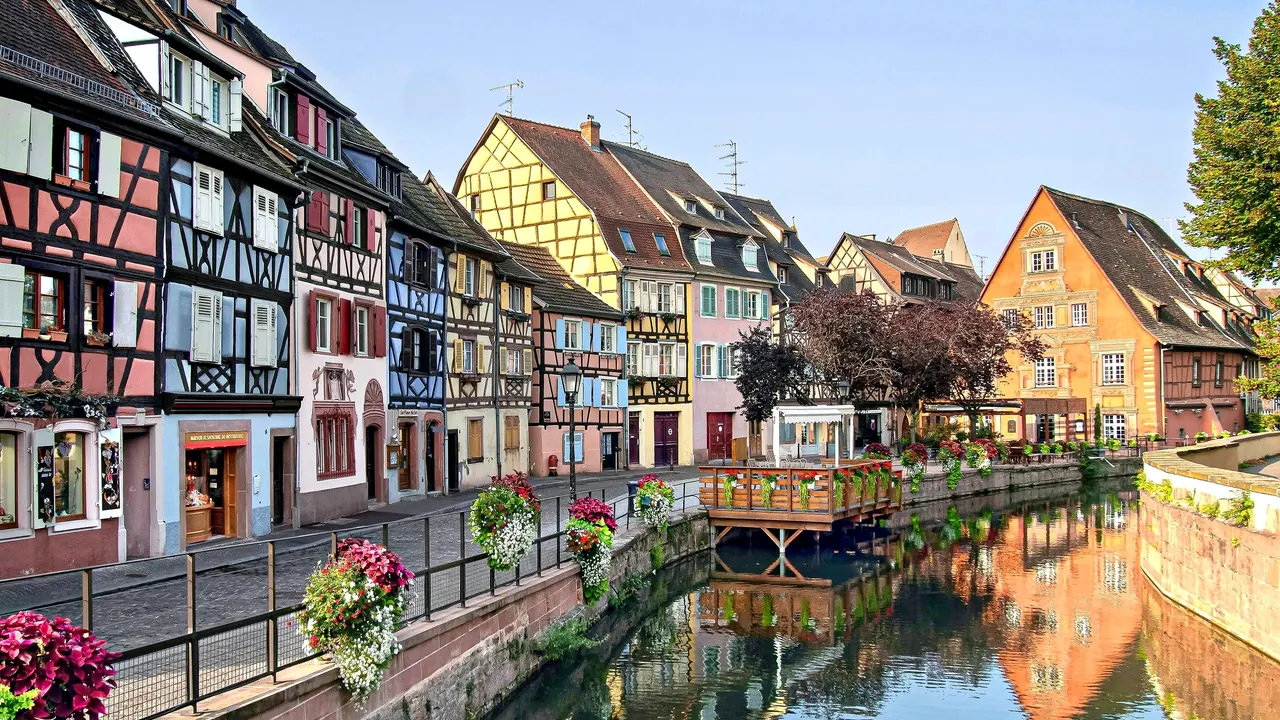
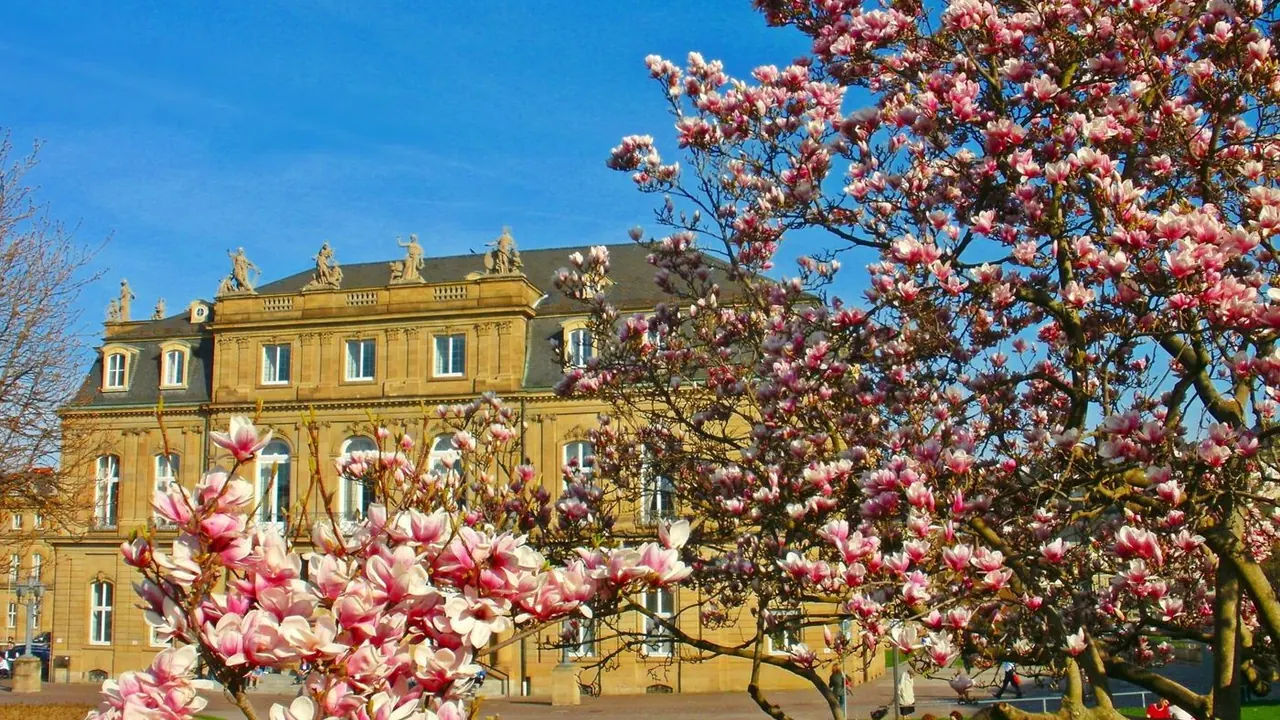
Photos: Colmar by Rolf Kranz, CC BY-SA 4.0, cropped; Stuttgart by Baden de, CC BY 3.0, cropped.
Colmar or Stuttgart?
Our verdict in twelve categories, each scored against the same fixed benchmark cities, and the climate month by month, so you can choose for your trip.
Choose Colmar for
- nature and the outdoors
- prices
- food and drink
Colmar is the better choice for a slow, picturesque trip built around wine, painted half-timbered streets and the countryside. The town itself is small and complete, a single late-medieval whole with the Isenheim Altarpiece at its centre, and beyond it lie the Alsace wine villages, the vineyard paths and the high ridges of the Vosges. It suits couples and walkers who are happy to hire a car or a bike, eat long Alsatian dinners and be in bed early.
Choose Stuttgart for
- live music and the arts
- wellness
- nightlife
Stuttgart rewards travellers who want a proper city with evenings to fill. Its opera, its famous ballet and its concert halls give it a stage life Colmar cannot match, the mineral baths of Bad Cannstatt offer a real soak, and Königstrasse and the Metzingen outlets serve shoppers well. Light rail and S-Bahn reach the car museums, Wilhelma and a long list of day trips without a car, so it works better for anyone who would rather not drive.
Scoreboard
Twelve categories on one fixed scale from 0 to 100. The shaded stretch is the gap between the two.
Your match
Pick a travel style or drag the sliders, and both match scores follow your weighting.
Wins on nature and the outdoors and prices with your weighting.
Wins on live music and the arts and wellness with your weighting.
What matters to you?
Category by category
What the scores mean for a trip.
Beaches & swimming
Neither city has any beach life, so this is not a reason to pick either. The swimming differs a little: in Colmar it means municipal pools or a small lake up in the Vosges valleys, while Stuttgart's outdoor pools, some fed by its mineral springs, are part of everyday summer life in the city.
Food & drink
Both are fine places to eat, and each has a strong regional cuisine paired with its own wine. In Colmar that means Alsace: wood-panelled winstubs serving choucroute, baeckeoffe and tarte flambée, munster cheese from the valleys and Riesling or Gewurztraminer poured everywhere, with free cellar tastings in nearby villages. The catch is a narrow choice beyond regional cooking and tired menus on the prettiest streets.
Stuttgart's Swabian cooking is just as distinctive, with maultaschen, käsespätzle and zwiebelrostbraten, and its vineyards grow inside the city limits. Its seasonal Besen taverns, where growers serve wine and onion tart in their own homes, have no equivalent in Colmar, and a bigger city brings a deeper choice of fine dining.
Culture & sights
These two are about even for sightseeing, but in opposite ways. Colmar is the place for historic townscape: the painted half-timbered houses, Maison Pfister, Petite Venise and the canals read as one intact old town, and the Unterlinden Museum's Isenheim Altarpiece is a masterpiece people travel for.
Stuttgart was heavily bombed, so its old buildings come in pockets around Schlossplatz and the Neues Schloss. It makes up for this with modern design and industry: the Mercedes-Benz and Porsche museums, the Staatsgalerie and the Le Corbusier houses of the Weissenhof Estate. Choose Colmar for atmosphere, Stuttgart for museums of the modern age.
Nightlife
Stuttgart is the only one of the two with a real night out. Theodor-Heuss-Strasse fills with bars and lounges at weekends, clubs in basements and old industrial spaces keep an electronic scene going, and the Bohnenviertel has quieter wine bars.
In Colmar the evening is dinner followed by a glass of wine on a terrace in Petite Venise, and the streets are quiet early. Anyone wanting more from Colmar takes the train to Strasbourg.
Nature & outdoors
Colmar is better placed for the outdoors. Within half an hour you are walking through vineyards, and the valleys of Munster and Kaysersberg climb to the Route des Crêtes, with glacial lakes, summer pastures and views to the Black Forest and sometimes the Alps. There is modest skiing in winter, though a car makes most of it far easier.
Stuttgart's green is closer to hand but gentler: wine trails above the Neckar, the deer forests of the Rotwildpark and Schönbuch, and the limestone escarpments of the Swabian Jura about an hour away. It is good walking and cycling country, just without real mountain scenery.
Day trips
Both are excellent bases, and the difference lies in how you travel. From Colmar the best trips are the wine villages a few kilometres apart, Eguisheim, Riquewihr and Kaysersberg, plus Haut-Koenigsbourg, and these need a car or a bike. Strasbourg, Basel and Freiburg are all within an hour, which gives three countries on one stay.
From Stuttgart almost everything goes by rail: Ludwigsburg's palace and Esslingen by S-Bahn, Tübingen in under an hour and Heidelberg in about forty minutes. Maulbronn, Hohenzollern Castle and Ulm's spire round out a list of towns and monuments rather than villages.
Good for families
Colmar's best days out with children lie in the countryside and mostly need a car, whereas Stuttgart keeps its main attractions inside the city. Colmar itself is flat and easy, with boat rides through Petite Venise and storks nesting on the rooftops. Further out are the stork and otter park at Hunawihr and the free-roaming macaques at Kintzheim, and Europa-Park, one of Europe's biggest theme parks, is about an hour away across the Rhine.
In Stuttgart, Wilhelma's zoo and gardens fill a day, Killesberg park has a narrow-gauge railway and animal enclosures, and even a ride on the rack railway is a treat. The hills are hard work with a pushchair, though, and you have to leave the city for a big theme park.
Getting around
Stuttgart is the easier place to manage without a car. One ticket covers the Stadtbahn, S-Bahn, buses, a rack railway and a funicular, and together they reach the car museums, Wilhelma and the airport, with the Stäffele stairways as shortcuts on foot.
Colmar's centre is small enough to walk in minutes, and trains run quickly to Strasbourg and Mulhouse. Between the wine villages and up into the Vosges, though, buses are thin, so most visitors end up hiring a car or cycling the vineyard roads.
Shopping & style
For shopping, Stuttgart is clearly better. Königstrasse is one of Germany's longest pedestrian streets, Breuninger covers designer fashion, and the Metzingen outlets are half an hour away.
Colmar is a place for regional things to take home: wine bought from the producer, Soufflenheim pottery, kougelhopf moulds, printed table linen and gingerbread from the covered market. Its Christmas markets are its great shopping moment, but fashion is thin.
Affordability
Colmar is a little kinder to the budget, with reasonable set lunches and cheap or free tastings in the villages. Its rooms are the weak point, scarce in summer and expensive in the Christmas market weeks, so staying in a nearby village helps.
Stuttgart runs on business travel, which makes hotels pricey during trade fairs but cheaper at weekends. Tavern meals are generous for the money, while smart restaurants and central hotels are where costs climb.
Live music & performing arts
Here Stuttgart is in a different league. The Staatsoper and the Stuttgart Ballet, one of Europe's most respected companies since John Cranko's time, share the state theatre by the palace gardens, and the Liederhalle adds orchestras and a strong Bach tradition. Big musicals and a jazz club keep things going through the week.
Colmar has a small Italian-style theatre and lively festival weeks, classical in July and jazz in autumn, but outside them serious opera or concerts mean travelling to Strasbourg or Basel.
Wellness & relaxation
Stuttgart has a real bathing culture that Colmar lacks. The springs of Bad Cannstatt and Berg feed the Mineralbad Cannstatt and Mineralbad Leuze, where you can soak in naturally carbonated warm water indoors and out, then move to the saunas.
Colmar's version of relaxation is quieter: unhurried walks through the vines, long lunches and still evenings by the canals once the day visitors leave. For actual spa time, there are only hotel spas.
When should you go?
Pick your month. The climate figures are measured averages, not a forecast.
Colmar in July
Stuttgart in July
Daytime high, °C
Rainfall in the month, mm
Temperature and rainfall are climate normals, averaged over the years shown. Colmar: 1991-2020 normals, Ihringen (21.1 km from centre). Stuttgart: 1991-2020 normals, Stuttgart / Neckartal (2.8 km from centre).
The two share almost the same climate, as you would expect of places on either side of the Upper Rhine. Winters are cold and grey in both, with daytime highs around 6°C from December to January, and summers are warm without being oppressive, peaking at about 26°C to 27°C in July and August. That makes June to September comfortable for walking all day, and there is no month too hot for exploring the streets. Rain is heaviest from May to August in both cities, with Colmar's wettest month in May at 87mm, while Stuttgart's comes in July.
The small differences point Colmar slightly towards late summer and autumn: August is a touch warmer and sunnier there, and September and October are mild for vineyard walks at harvest time. Stuttgart is a little drier and sunnier in April, so spring suits it slightly better. Neither has a beach season, and from November to February both are best treated as indoor cities.
Which traveller are you?
On an outdoors trip, Colmar is the better base. Hire a bike for a day on the flat wine route, then drive up the Munster valley for a ridge walk and a swim in a glacial lake. Stuttgart's walks are gentler and stay among wooded hills.
On a culture and arts trip where the evenings matter as much as the days, Stuttgart wins. Spend the afternoon at the Staatsgalerie, then go to the ballet or the opera. Colmar's painted streets and Grünewald altarpiece fill two fine days, but its evenings have little on stage.
For a relaxing and wellness trip, Stuttgart lets you plan whole days around a soak: a morning in warm, naturally fizzy pools, an hour in the sauna, then an easy vineyard walk. Colmar is restful too, with slow lunches and quiet canals, but it has no baths to go to.
Before you go
| Measure | Colmar | Stuttgart |
|---|---|---|
| Official language | French | German |
| Currency | Euro (EUR) | Euro (EUR) |
| Sockets | CE230 V, 50 Hz | CF230 V, 50 Hz |
| Driving side | Right | Right |
| Time zone | UTC+1, UTC+2 in summer | UTC+1, UTC+2 in summer |
| Emergency number | 112 | 112 |
| Elevation | 185 m | 245 m |
| Main airport | EuroAirport Basel–Mulhouse–Freiburg (BSL)55 km from centre112 non-stop destinations | Stuttgart Airport (STR)10 km from centre124 non-stop destinations |
| Public holidays this year | 11 days | 12 days |
By the numbers
| Measure | Colmar | Stuttgart |
|---|---|---|
| City population | 66,970 | 609,365 |
| People per km² | 1,006 | 2,938 |
| Museums within 10 km | 9 | 42 |
| UNESCO World Heritage sites within 50 km | 3 | 3 |
Where else could you go?
Every comparison below shares a destination with this one, so you can follow Colmar or Stuttgart somewhere new.
- Baselvs Colmar
- Strasbourgvs Colmar
- Baden-Badenvs Stuttgart
- Heidelbergvs Stuttgart
- Baden-Badenvs Colmar
- Strasbourgvs Stuttgart