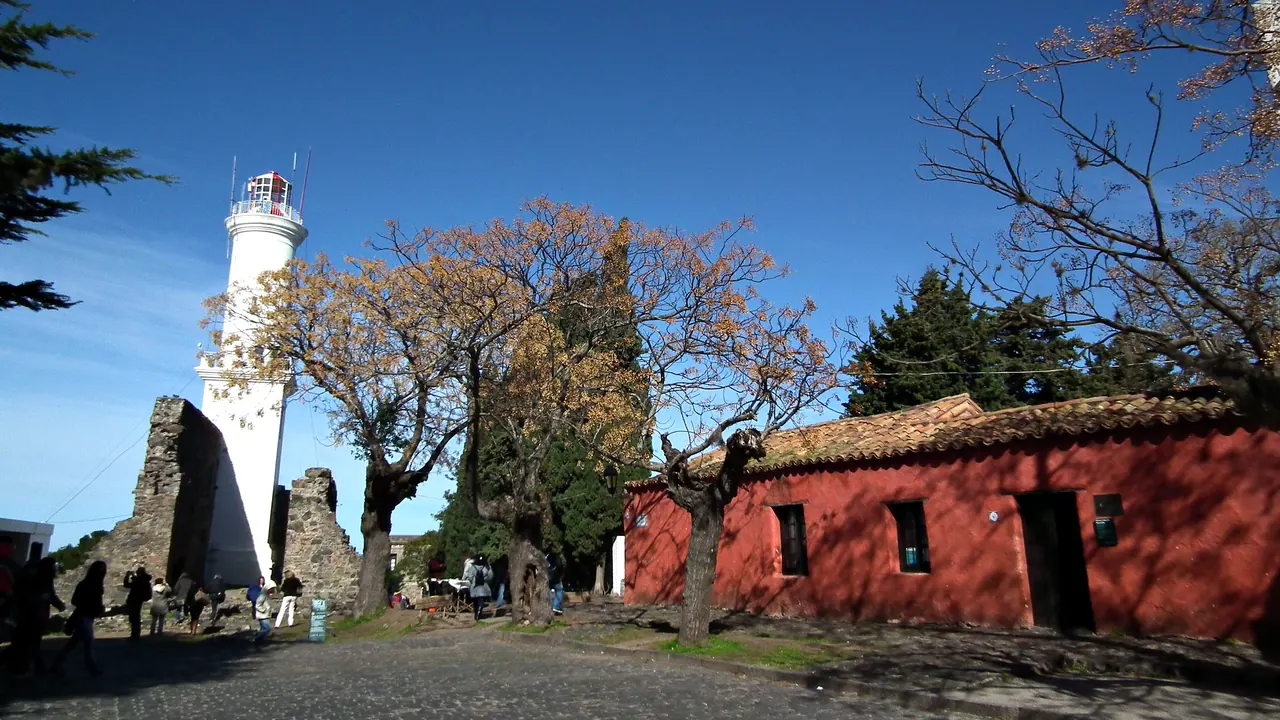
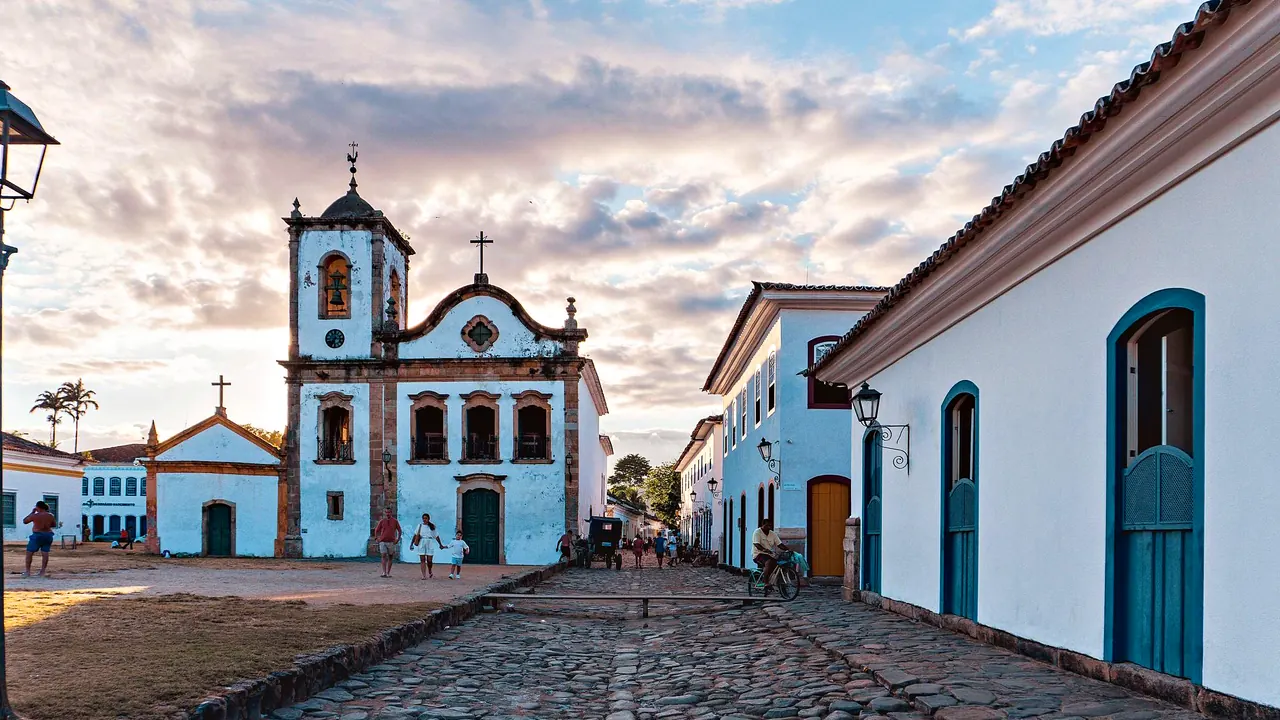
Photos: Colonia del Sacramento by Fulviusbsas, CC BY-SA 3.0, cropped; Paraty by Gabriel Zachi, Pexels License.
Colonia del Sacramento or Paraty?
Our verdict in twelve categories, each scored against the same fixed benchmark cities, and the climate month by month, so you can choose for your trip.
Choose Colonia del Sacramento for
- day trips
- getting around
Colonia del Sacramento is for the traveller who wants a slow, compact old town for a night or two, with wine at dinner, sunsets over the river and Buenos Aires an hour away by ferry for a day in a capital. It is the easier of the two to reach and get around without a car. Expect cobbled lanes and quiet evenings, not beaches or adventure.
Choose Paraty for
- nature and the outdoors
- beaches
- nightlife
Paraty makes more sense when the trip is about the outdoors and the water. Days go on schooners among forested islands, the clear pools at Trindade, and rainforest trails and waterfalls in the Serra da Bocaina. The evenings are livelier, there is more to browse and the money goes further. In return the journeys are longer and the summer rain is heavy.
Scoreboard
Twelve categories on one fixed scale from 0 to 100. The shaded stretch is the gap between the two.
Your match
Pick a travel style or drag the sliders, and both match scores follow your weighting.
Wins on day trips and getting around with your weighting.
Wins on nature and the outdoors and beaches with your weighting.
What matters to you?
Category by category
What the scores mean for a trip.
Beaches & swimming
Colonia's beaches are on the Río de la Plata, a huge estuary, not the sea. The sand is pleasant and the water reaches bathwater warmth in high summer, but it is brown with silt, has no waves and can be closed to swimmers by algae in hot spells. Most people go to these beaches for the sunsets rather than the swim.
Paraty's town beaches are no better, but the bay is a different world. Schooners stop at small forest-backed coves with calm green water, and Trindade, about forty minutes south, adds open-sea beaches and the still, clear pool at Cachadaço. For anyone who plans their days around swimming, Paraty is far ahead.
Food & drink
Both towns have a narrow choice, with plenty of cooking aimed at visitors, but Paraty offers a little more. Its kitchen comes from the sea: grilled fish, shrimp and the banana-tinted azul marinho stew. Some of the candlelit townhouse restaurants are genuinely ambitious, and you can visit cachaça distilleries in the hills.
Colonia sticks to Uruguayan beef from the parrilla, chivitos and dulce de leche. Its strong point is the wine, Tannat and other reds from around Carmelo, best drunk at a courtyard table with the river in view.
Culture & sights
The two are well matched. Both are small UNESCO-listed colonial towns that you take in on foot in an unhurried day. The difference is in the story they tell.
Colonia is a frontier town, fought over by Portugal and Spain from 1680, and its lanes, town gate and walls show that mixed past. A cluster of small museums, the lighthouse view and the Moorish-style bullring at Real de San Carlos give it more individual sights. Paraty is a Brazilian gold port of whitewashed houses with coloured frames, baroque churches led by Santa Rita, and a hilltop fort. Its listing takes in the forest and bay around it, so the setting matters as much as the buildings.
Nightlife
Neither town has clubs, but Paraty has more of an evening. After dinner come caipirinhas in bars with a guitarist, the old town stays busy late on weekends and in season, and Trindade draws a young crowd to its beach parties.
In Colonia, a sunset dinner and a bottle of wine are the whole evening. A few wine bars and pubs stay open, but the town is asleep early, and anyone wanting a real night out takes the ferry to Buenos Aires.
Nature & outdoors
This is where the two differ most. Colonia's landscape is flat: the wide brown river on one side and cattle pasture on the other. The riverside rambla is good for walking or cycling at sunset, and there is little beyond it.
At Paraty the Serra do Mar drops straight into the sea. Rainforest climbs into the Serra da Bocaina national park, with stretches of the cobbled Gold Trail, waterfalls and a natural rock slide. In front, the island-dotted bay is made for kayaking and snorkelling, and Saco do Mamanguá, a fjord-like inlet, has a steep hike up to its viewpoint.
Day trips
Colonia has the better outings, mainly because of one exceptional trip. A fast ferry reaches Buenos Aires in about an hour, with border checks done once at the terminal, so a day in a major capital is easy. Closer to home are the family wineries around Carmelo, the Swiss-settler cheese town of Nueva Helvecia and the British-built core of Conchillas.
Paraty is somewhere to stay put. Trindade is the easy trip, and Cunha's pottery studios and the beach town of Ubatuba are each over an hour away. Ilha Grande needs a night of its own, and Rio and São Paulo are too far for a day.
Good for families
Both work fairly well with children, though neither has a zoo, an aquarium or anything else built for them, and both have old-town paving that defeats pushchairs. The difference is the kind of day.
Colonia is calm and small. Riding golf carts or bikes along the river, paddling in the shallows and climbing the lighthouse fill a short, gentle stay. Paraty gives older children more adventure: boat days with swimming stops, rock pools at Trindade and the waterfall slide. You have to plan around its heat and summer downpours.
Getting around
Colonia is the simpler place to manage. The ferry terminal and bus station are a few minutes' walk from the old town, and the flat riverside road makes it easy to reach the beaches and Real de San Carlos by hired bike, scooter or golf cart. Only the wineries and towns further out need a car or a tour.
Paraty's car-free centre is small, but the big rounded stones make walking slow, and the lowest streets flood at spring tides. Beaches are reached by boat from the quay, and the waterfalls, distilleries and Mamanguá landing need a taxi, a hired car or a tour. Getting there usually means a long bus ride from Rio or São Paulo.
Shopping & style
Paraty is the better place for a browse. Art galleries, linen boutiques and handmade jewellery fill colonial shopfronts, and hand-labelled cachaça, indigenous basketry and painted wooden boats make good things to take home. It works well as an evening stroll.
Colonia's shops are mostly crafts and souvenirs: leather goods, mate gourds with silver bombillas, wool knitwear and a few antique shops. It is the place to buy a mate set, not much more. Neither town has fashion or department stores.
Affordability
Paraty is the cheaper of the two for most visitors from Europe or North America. Shared schooner trips, local buses, beach kiosks and simple fish restaurants keep daily costs moderate, but rooms rise sharply over Carnival, New Year and festival weekends.
Colonia reflects Uruguay's high costs for the region. The old town's boutique hotels and restaurants charge about what a Southern European resort would. The good local wine and the mostly free sights soften the bill, and so does staying a few streets out.
Live music & performing arts
In both towns the music mostly comes with dinner rather than from a stage. In Colonia that means the odd tango or candombe number at a restaurant, and mainly in summer. Its one small venue, inside an old fortification by the water, puts on a play or a concert now and then. For opera or a full tango show, people spend the evening in Buenos Aires.
Paraty has more live music, more often. Samba and bossa nova come out of the old town's dining rooms on most evenings, and the town has a long puppet-theatre tradition with nothing like it in Colonia. Festivals bring concerts and performers into the streets. The famous literary festival is talks rather than shows, though, and between festival dates there is still no regular stage programme.
Wellness & relaxation
The two are much alike here. Neither has a bathing or spa tradition of its own, and both are restful because of their pace rather than their treatments.
Colonia's calm comes in the late afternoon when the day-trippers leave, with siestas, river rides and winery stays with pools in the countryside. Paraty is calmer in the quiet season, when you can stay in a garden pousada with a hammock, go to a yoga studio, or retreat to a forest or bayside hideaway and switch off completely.
When should you go?
Pick your month. The climate figures are measured averages, not a forecast.
Colonia del Sacramento in July
Paraty in July
Daytime high, °C
Rainfall in the month, mm
Where the figures come from
Paraty has no weather station within reach, so its figures come from a gridded climate model rather than a measured record, and read a broad area rather than the city itself.
Temperature and rainfall are climate normals, averaged over the years shown. Colonia del Sacramento: 1991-2020 (sunshine 1961-1990) normals, Colonia (2.4 km from centre). Paraty: 1991-2020 normals, TerraClimate 4 km grid at the town, no weather station within 90 km.
Colonia has four real seasons. December to February is warm and sunny, the best time for its river beaches, with the water at about 25°C in January and February. Winter is cool, with highs around 15°C in June and July. That is fine for walking the old town but not for swimming. Rain is spread fairly evenly through the year, so the warmth matters more than the rain when choosing a month. Spring and autumn are mild and good for cycling and sightseeing.
Paraty is hot all year, and here the rain is what decides. January to March is very wet, with more than 300mm a month and steamy, heavy afternoon downpours. June to September is the driest stretch, down to about 80mm in August, and the heat is easier for walking the old town and the trails. The bay stays warm enough to swim all year, rarely below 21°C. So the two peak in opposite ways: Colonia is best in its hot summer, while Paraty is often at its best in the drier southern winter.
Which traveller are you?
On a beach and sun trip, Paraty is the clear choice. Boats take you to warm, calm coves on forested islands, and Trindade has open-sea beaches and a clear rock pool. Colonia only has silty river beaches on a waveless estuary.
For an outdoors trip, Paraty again wins easily. It has rainforest trails on the old Gold Trail, waterfalls and swimming holes, kayaking among the bay islands and the hike above Saco do Mamanguá. Colonia's flat pasture and riverside rambla are good only for gentle walks and bike rides.
For a short city break, Colonia suits better. The ferry and bus terminals sit beside a tiny, walkable historic quarter that a day covers well, and Buenos Aires is an hour away across the river. Paraty is four or five hours from Rio or São Paulo.
Before you go
| Measure | Colonia del Sacramento | Paraty |
|---|---|---|
| Official language | - | Portuguese |
| Currency | Peso Uruguayo (UYU) | Brazilian Real (BRL) |
| Sockets | CFIL230 V, 50 Hz | CN60 Hz |
| Driving side | Right | Right |
| Time zone | UTC-3 | UTC-3 |
| Emergency number | 911 | Police 190, ambulance 192, fire 193 |
| Elevation | 27 m | 5 m |
| Main airport | Carrasco General Cesáreo L. Berisso International Airport (MVD)171 km from centre15 non-stop destinations | Rio de Janeiro Galeão – Tom Jobim International Airport (GIG)157 km from centre54 non-stop destinations |
| Public holidays this year | 15 days | 14 days |
By the numbers
| Measure | Colonia del Sacramento | Paraty |
|---|---|---|
| City population | 31,720 | 47,668 |
| People per km² | 1,385 | 51 |
| Museums within 10 km | 7 | 2 |
| UNESCO World Heritage sites within 50 km | 2 | 1 |
| Swim season, months above 21 °C | 4 months | 12 months |
Where else could you go?
Every comparison below shares a destination with this one, so you can follow Colonia del Sacramento or Paraty somewhere new.
- Buenos Airesvs Colonia del Sacramento
- Rio de Janeirovs Paraty
- Montevideovs Colonia del Sacramento
- Sao Paulovs Paraty
- Punta del Estevs Colonia del Sacramento
- Buziosvs Paraty